Missing Trees by Beth Bartlett

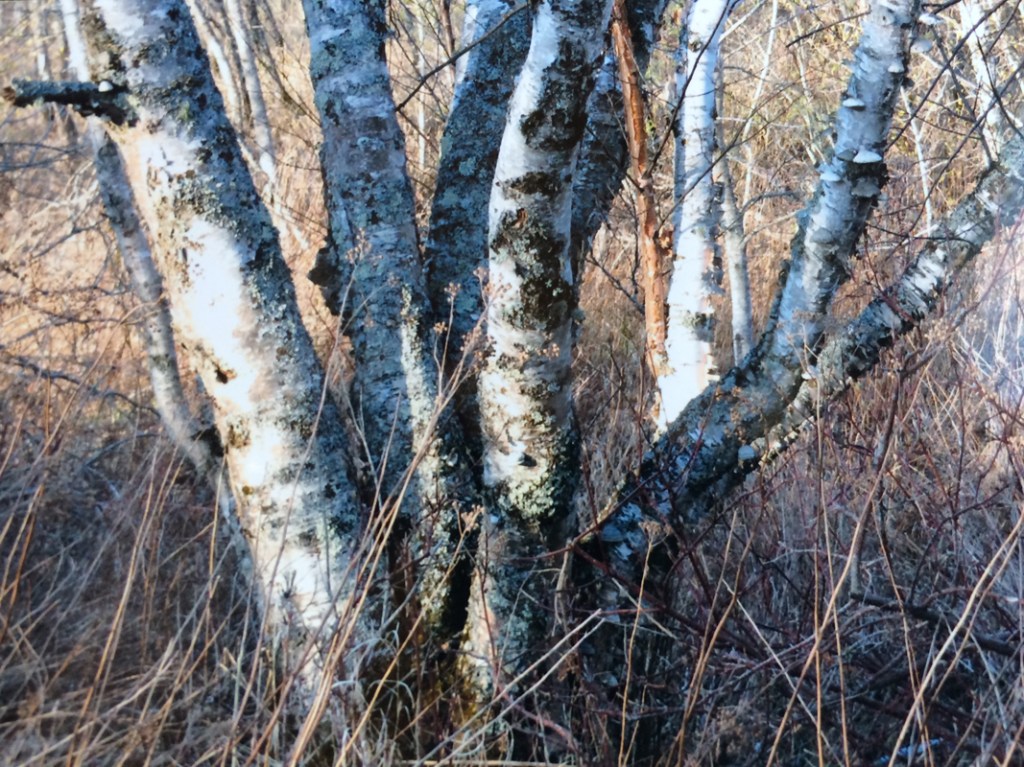
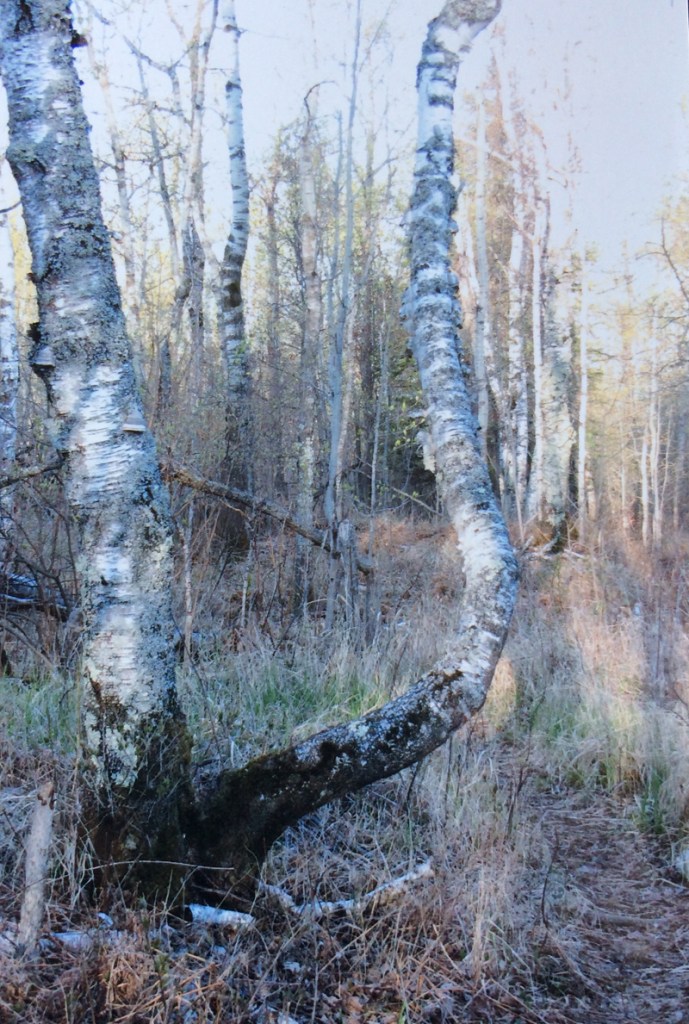
“Tree of Life” photo by author

The gap in the trees is a painful reminder of the one that is missing. This past winter an ice and wind storm late in the season brought down the aspen that had sheltered our deck. Its absence is more than a hole in the canopy – it is a hole in the heart. I miss its friendly presence, its shelter, its shade.  I suspect I never fully appreciated it until now.  It is just the latest in a long line of missing trees – trees lost to disease, insects, climate change.

The paper birch were the first to go. When my dad first bought our family cottage in 1964, paper birch trees arched delicately over the cottage, framing it in white branches against the blue sky.  Another large birch stood as a landmark on the top of the hill, and another by the lake was the centerpiece of the circular bench built around it.  Several more lined the path down to the lake and dotted the hillside.

“Mama” birch, photo by author

When we bought our home in Duluth, paper birches graced the yard on all sides.  In the woods out back I’d befriended several of the birches, naming them according to their distinctive shapes – there was the “Mama” birch with its bulging pregnant belly, the three then four-clump birches that I’d named after our music group – “Wild By Nature,” and the glorious “Tree of Life” – a magnificent clump birch of at least twenty connected trunks that served as a talisman for me during the most difficult days of my illness and for many years after my transplant. 

Continue reading “Missing Trees by Beth Bartlett”

Omen by Sara Wright

I was driving down the road when I noticed a dead owl. Sun glare blinded me, but I stopped to identify the bird.

It has been many years since I picked up dead owls on the road – thirty five years in all. I began this practice of bringing home the bodies of these creatures when I first moved to the mountains. Finding so many dead owls in a brief span of five years was frightening, but someone in me knew that I needed to honor these Harbingers of Night. Yet the last thing I wanted was to be identified or aligned with an owl, so my behavior rose out a body that never lies. Visions of my mother’s love of owls clouded my mind. Within months of this mountain move a Navajo Medicine woman informed me that I had Owl as a Familiar. Horrified, I resisted mightily. Yet despite what seemed like a curse, I was still compelled to sculpt owl pots out of clay for five years. The losses I endured during this time changed the course of my life.

 I taught myself how to dismember owls. I burned owl remains in my woodstove as a symbol of deep respect and out of fear. I always kept feathers and wings in honor of these mysterious night beings not understanding why.

Continue reading “Omen by Sara Wright”

The Littlest Balsam by Sara Wright

Five years ago
I dug a seedling
in protest
ki’s deep green
needles
slender trunk
and roots
yielded
to sweet
spring earth
with prayers.

I believed.

One winter night
I will celebrate
your life
the lives of
thousands
with a
candlelit
spiral
of tiny white lights.

Tonight
white flames
adorn you
old longings
and heartbreak
we share the same
root
stilled by
simple beauty
a single
reflection
of Love.

Continue reading “The Littlest Balsam by Sara Wright”

A Goose Tale by Sara Wright

Coalie and the Goose

It’s the last day of November and small groups Canadian geese are still drifting around on patches of open water. I saw two small groups on North Pond. Although many skeins have flown south along the Atlantic flyway – they can migrate south as far as Mexico and South America -some geese spend the winter along coastal areas in Maine if food resources are available. It’s hard to know whether these groups are migrators from Canada who have stopped over to rest or a few that winter over nearby on the Kennebec or elsewhere along the southern coast of Maine. With warming temperatures Canadian Geese migratory patterns are changing.

Soon after their arrival the female disappears to lay 8 – 10 eggs in her nest that is securely hidden in the reeds while her mate stands watch. When the goslings are born both parents escort them through the water, one parent in front, the other behind. If threatened the male becomes aggressive, a totally appropriate behavior from my point of view. When the little ones are big enough these birds join other families for the rest of the summer and some will probably migrate together. These are such community oriented birds. They make it a habit to get along. Geese are omnivores that will eat almost anything and they mate for life, returning to their designated ‘home’ places to breed year after year. Even before the chicks arrive geese are drawn to some of the 400 million lawns in this country (especially those that are close to water) much to the dismay of some.

Continue reading “A Goose Tale by Sara Wright”

The Return of Little Deer by Sara Wright

“From out of the mountain he comes
Like the Spirit of Light he comes…”
Cherokee Myth

Having just spent almost three hours on Zoom with an interviewer from NPR during which we spoke about the normalcy of interspecies communication for some like me, Little Deer appeared at my window, lifted his head and stared right through me.

I haven’t had a young buck roaming around the house for a while but this kind of conversation between humans who believe we are all part of one fabric brings in the animals.

I recognized him Immediately.

The Cherokee myth states that a mysterious deer materializes from out of the mountain on behalf of the animals in times of trouble. They call him the Justic Maker.

As Justice Maker,  he protects creatures from harm and redresses grave imbalances between humans and the rest of Nature .

 I guess I shouldn’t have been surprised at his return.

Continue reading “The Return of Little Deer by Sara Wright”

The Echo Makers 25 by Sara Wright

Sunrise Crane Day. Nov 1, 2025

When I first heard the ‘trumpeting’ and ‘brrring’ it was less than an hour before dawn, but one aggregation was already on the wing headed west, away from the fields. Because their direction led away from the fields, I feared we would not see the Sandhills at all. It was All Saints Day, a time to give thanks to those creatures and people who have helped us along the way. (Sandhills have been been a beacon of Light in my own life). A bloody red sky turned deep rose as the sun shattered the charcoal outline of distant mountains, turning them carmen red. The wind was fierce as I walked up and down the sides of the open agricultural fields listening intently. Gunshots rang out and I wondered where these might be coming from. In Maine it is illegal to shoot migrating cranes. The sunrise was spectacular. Clouds spun themselves out of ruby, slate, and violet hues. Indescribable.

 Although snow buntings, red winged blackbirds and two harriers were scrying the skies around the fields after dawn I only had eyes for sandhill sightings!

Continue reading “The Echo Makers 25 by Sara Wright”

Lessons in Community at the Lily Pond by Carolyn Lee Boyd

Turtle family on a log
Frog on a lily pad

On a recent tranquil Sunday afternoon I was wandering around a lily pond in a nearby botanical garden, fully immersed in that liminal time between summer’s outbursts of nature’s abundance and the peaceful contentment of fall. The late goldenrod and delicate white wood asters danced a hued duet in the wind among the turtleheads and cardinal flowers, while hydrangeas shifted from white to the vibrancy of their last red passion. The lilies in the pond poked their heads above the water while frogs lay in repose on the pads. They were joined on nearby logs by a family of turtles, parents on one side and two babies on the other, close enough for security but far enough to enjoy some independence. A long dark brown watersnake was curled up unmoving on a boulder. All seemed to be basking in the sun, napping now and then. Around the pond were wanderers like me and human caretakers, silently tending to wildflowers and trees and occasionally stopping to watch if one of the beyond-human inhabitants plopped into the water for a little late afternoon swim. 

watersnake on a rock

Of course, I also knew that the peacefulness of this snapshot moment would not last forever because what do watersnakes eat? Frogs, fish and other beings that live around ponds. And what do frogs and fish eat? Insects, snails, and other beings, and so on up and down the food chain. But even this is part of the wholeness of the pond, as each being fulfills its place in the cycle of birth, life, death, and rebirth so that all of us can, in our own time, enjoy these short times of contentment living on the face of our magnificent planet.

Continue reading “Lessons in Community at the Lily Pond by Carolyn Lee Boyd”

What the Woodpeckers are Trying to Tell Me by Sara Wright

Pileated Woodpecker

Every morning, I awaken to the chirp of woodpeckers. Sapsuckers, downy and hairy woodpeckers are constant visitors climbing up and down the crabapple trees. The chickadees can’t get to the feeder because as soon as one species leaves another arrives.

At first, I enjoyed woodpecker presence and their antics but during the last week I have found the escalating chirps disturbing.  Some days especially around 4 PM a pileated woodpecker joins the other three; this one is drilling a hole in the side of the cabin.

When my pileated friend started drilling on the house, I was forced to acknowledge that undealt with personal issues were being  highlighted by the behavior of these birds, and that someone in me was stuck in denial.

Since my relationship with nature is deeply personal too many sightings of any creature indicate the need to pay closer attention.

Continue reading “What the Woodpeckers are Trying to Tell Me by Sara Wright”

Fire and Ice by Beth Bartlett

As I paddled the lake this morning, I found myself thinking this is what the end of the world looks like.  The sun was rising red through smoke from Canadian wildfires and a smoky haze engulfed the lake to the point I could barely see the not-too-distant opposite shore.  I was paddling by the state forest, where the March ice storm had stripped the tall pines of their upper branches, bent the birches, and uprooted and sent out to sea the largest of the trees.  The camping spot at the spring was inaccessible so covered was it by downed trees and branches. All was bent, broken, and dying and the forest itself appeared to be weeping. Adding to the surreal aspect of this moment was the plethora of motorboats pulling skiers and jet skis bouncing along on what would otherwise be a quiet, calm lake – oblivious to or simply not caring that they were frivolously burning the very fossil fuels that had fueled this environmental crisis and catastrophe.  It was as if I were watching an Octavia Butler dystopia play out with the rich and privileged burning up the last of the fossil fuels with disregard for the earth and disdain for earth’s advocates.

I began going to this lake in northern Michigan when I was two.  Every year my mother would comment on how blue the sky was, how clear the air – such a contrast to northeast Ohio where we lived with its rubber factories, making the sky a hazy gray, even on the sunniest of days. We would marvel at the depth of the blue.  This visit I never once saw a blue sky, nor even across the lake. I have hundreds of photos of the beautiful vista from the hill upon which our cabin sits, simply because of the stunning blues, but this year I took not a one.

Continue reading “Fire and Ice by Beth Bartlett”

Legacy of Carol P. Christ: SACRED RHYTHMS OF THE OLIVE HARVEST

This was originally posted on December 2, 2013

carol-christOlives are being harvested in the fields outside my town these days.  We have been having the first rains of the season.  The roads are wet and muddy, and the trees are partially shrouded in mist.  The fields are spread with black plastic nets, and people are hard at work, the men hitting the trees to make the olives fall, and the women picking up the olives from the nets.  The harvest will continue throughout the winter.

The olive press is busy. Cars and trucks come and go, unloading heavy bags filled with olives.  These days the bags are white, made of sturdy woven plastic. In Crete this fall several of us bought canvas olive bags, hand-woven by women.  These, along with baskets hand-woven by men, were still in use only a few decades ago.

olive harvest in Lesbos early 20th century by Theofilos Hajimichael

A friend who died a few years ago told me that “in the old days” there were no nets. The women and the children had to pick the olives up from the ground, often cutting their hands on thorns and stones.  The nets are a Goddess-send.  Between harvests, the nets are simply folded up and placed in the crotch of the tree. Here no one steals them.

In the fields where I walk some of the trees have enormous trunks. Some of them have two trunks, growing like sisters.  Many of them are 300, some perhaps 500, years old.  A man emerges from a field that has some particularly old trees.  I ask him how old they are. “Older than I am,” he replies. “They were here before I was born.  They will be here after I die.” Continue reading “Legacy of Carol P. Christ: SACRED RHYTHMS OF THE OLIVE HARVEST”