Exploring the F-word in religion at the intersection of scholarship, activism, and community.
Author: Carolyn Lee Boyd
Carolyn Lee Boyd’s essays, short stories, memoirs, reviews, and poetry have been published in a variety of print magazines, internet sites, and book anthologies. Her writing explores goddess-centered spirituality in everyday life and how we can all better live in local and global community. In fact, she is currently writing a book on what ancient and contemporary cultures have to tell us about living in community in the 21st century. She would love for you to visit her at her website, www.goddessinateapot.com, where you can find her writings and music and some of her free e-books to download.
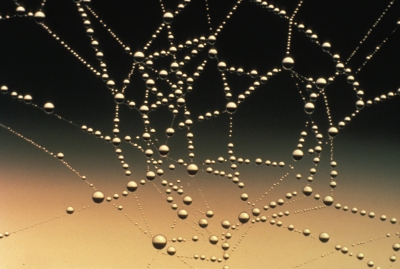
Water drops on spider web, US Fish and Wildlife Service, Public Domain.
According to the Universe, the true nature of reality is relationship. In fact, at the level of quanta, the smallest objects in the cosmos, we don’t even exist outside of our relationships1. How different this is from our common 21st century understanding of ourselves as inherently alone in our bubbles of existence, our societies conceived of as a collection of individuals all wrestling each other for the basics of life. What if we took this truth about quanta to heart on our human level? What if we began to think of ourselves as not primarily alone, but rather as a node in a web of connection, an essential part of a greater, even universal, whole? How might our lives and societies be different? When I experience Goddess myths and traditions and look at some of the societies from which they rose, I seem to catch a glimpse of what this change in perception might be like in our daily lives.
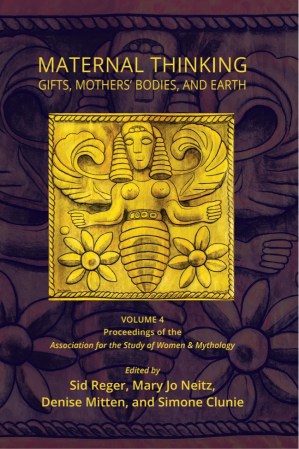
Cover designed by Rebekkah Dreskin ~ http://www.blameitonrebekkah.com Front cover art “Bee Goddess of Rhodes Banner” by Lydia Ruyle. Bee goddess logo by Sid Reger
Maternal Thinking: Gifts, Mothers’ Bodies, and Earth, the fourth book of proceedings of conferences held by the Association for the Study of Women and Mythology (ASWM), is an instructional guide to saving ourselves and our planet. Many pre-historic, and even contemporary cultures, especially Indigenous communities, feature “Maternal Thinking.” Such cultures perceive that societies are successful when they center qualities associated with mothering: care, nurturance, cooperation, and meeting everyone’s basic needs while respecting the Earth and reciprocating nature’s generosity. Some 5000 years ago, Maternal Thinking was superseded in many societies by a perspective valuing instead competition, exploitation, and domination, and we and our planet are now facing the catastrophic consequences.
The fifteen contributors and four editors represent myriad disciplines and life experiences. They are academic researchers in wide-ranging fields, artists, activists, a storyteller, a therapist, scientists, educators, and more. This diversity reflects the expansiveness of the book’s vision, including many layers and facets of “mothering,” and the need for as many voices as possible to be heeded if we are to envision and birth a peaceful, just, equitable, compassionate, and environmentally balanced Earth.
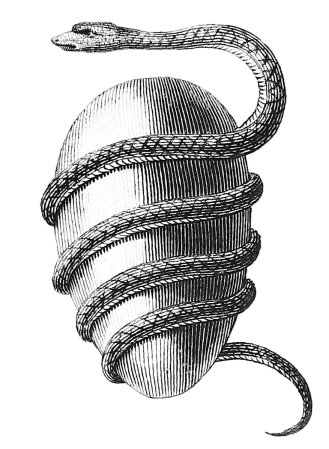
The Cosmic Egg, Orphic egg, James Basire, 1730–1802 (engraver), Public domain
The Greek Eurynome, one of the most ancient Goddesses who emerged before patriarchal times, rose from chaos and began to dance, separating “light from darkness and sea from sky”1 whirling to create a great wind. She faced it, grabbed it and “rolled it into clay like a serpent”2 . She made love with the serpent, “transformed herself into a dove” and “laid the universal egg from which creation hatched”3 Eurynome was a goddess who embraced and created change, bringing the universe into being in the process.
She would have been at home in a 21st century physics lab where scientists are learning that the nature of reality is constant change. According to physicist Carlo Rovelli, “The entire evolution of science would suggest that the best grammar for thinking about the world is that of change, not of permanence. Not of being, but of becoming”4. He further explains, atoms “move freely in space, colliding with one another; they hook onto and push and pull one another. Similar atoms attract one another and join. This is the weave of the world. This is reality. Everything else is nothing but a by-product—random and accidental—of this movement”5. Even our human bodies, which we tend to think of as a single object changing very slowly over the years, are really a maelstrom of molecules, ever-transforming and renewing.
The Mysteries at Eleusis, a nine-day festival in ancient Greece based on the myth of Demeter and Persephone, has fascinated and baffled us for millennia. Here thousands of people from all over Greece and beyond came to understand, in the words of Plutarch, “an undoubted truth our soul is incorruptible and immortal” (277). Producing this festival was the task of the Melissae, the bee priestesses of Demeter, powerful and honored women in a society in which women had few rights, famous in their own time but almost unknown in ours.
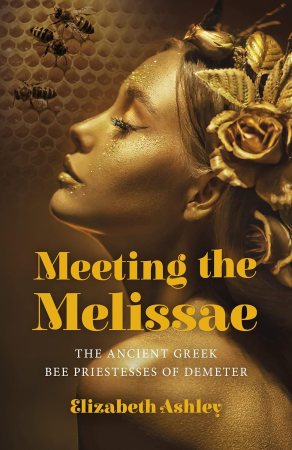
In Meeting the Melissae: The Ancient Greek Bee Priestesses of Demeter, Elizabeth Ashley offers us not only facts about the Melissae and other ancient Greek priestesses gleaned from archaeology, art and literature from the period, and modern academic research but her own glimmerings of their deepest spiritual life. She explores what is known about the priestesses and their everyday lives, the goddesses whose temples they presided over, and bees themselves. An aromatherapy researcher, she began her journey to discovering the secrets of the Melissae when she kept reading references to them in ancient botanicals about the herb lemon balm (Melissa officinalis) but nothing more. (The connection between lemon balm and bee priestesses? Pheromones. That’s all I’m going to say).
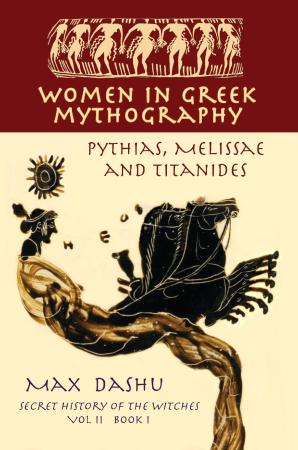
Cover photo: Eos, titanis of Dawn, Black-figure lekythos attributed to the Sappho Painter, Athens, circa 500 bce (Public Domain, courtesy of New York Metropolitan Museum)
Demeter and Persephone, Hera, Athena, Medusa, Artemis are often the first, sometimes only, goddesses modern women experience, and they have profoundly influenced our 21st century attitudes about gender, violence, and more. Yet, as Max Dashu says in her new book, Women in Greek Mythography, Greek history has “served as a template for supremacy, from male domination and Hellenic colonization, to modern Eurocentric ideologies about history” (xi). While most Greek scholarship generally glosses over these malevolent influences and ignores women’s lives, Dashu focuses on “female spheres of power, priestesses, witches, and of course systemic patriarchy” (xi) in order to “map realities of women’s lives, both their spiritual authority and their subjugation; the spaces they carved out, their ceremonies, and the stories they wove into their tapestries” (xi).
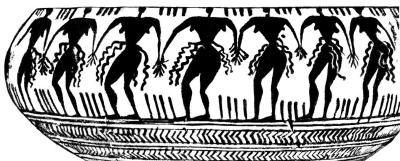
Women in Greek Mythography is not only a fascinating historical story of Greek myth and religion to be read cover-to-cover, but a rich sourcebook full of meticulously documented facts. She draws from scholarly works of history and mythography, as well as analyzing images on vases, friezes, sculpture and more. She has carefully rendered 270 drawings of these images so that readers can judge their meaning themselves. She delves into language, seeking out the origins of words that may indicate where goddesses and myths originated and their relationships to one another. She demonstrates that goddess mythologies often had many variations, sometimes conflicting, with many “countless regional deities that were subsumed under Olympian names, the local origin myths, ceremonies, and customs” (xiv).
Like deeply planted oaks, the women once dwelled together in peace, Their feet covered with nourishing soil and arms outstretched, Branches of flesh to connect with the living air. Like laughing leaves swooping in the sky, The women once jubilantly soared as one Above the skin of the Earth.
As a young child, I dreamt that if I stood very straight, Tensed all my muscles and closed my eyes, I would slowly rise into the air a few inches, Propel myself with my arms wherever I wished to go, Then land again as gently as a rose petal on the wind. But the only time I tried to ascend even a breath’s measure, I failed, landbound, unsure and giftless.
Imagine a world where beauty is revered just for bringing pleasure and joy; where buildings abound in graceful, naturalistic, lively renderings of animals and plants; where the human body is magnificent art; where everyday objects for all are ornamented with complex, graceful imagery. Imagine a world where “beauty” is not a narrowly defined style of attractiveness or an attribute of works created by a small elite, but a revelation of life’s joy created by all, an expression of delight in the Earth, and a bridge to the worlds within us. If we look back across human history, we will find all these expressions of “beauty for beauty’s sake,”
From our earliest millennia, “where you find humans, you will find art,” says pre-historian Jean Clottes (Marchant). People carved zig zags in shells 500,000 years ago (Handwerk). About 164,000 years ago, people left behind in South African caves ochre and pierced shells, perhaps for jewelry (Marchant). Artists created the oldest cave paintings yet found, stunning in their realism and movement, in Spain 65,000 years ago (Handwerk).
While researching my family tree, I discovered the Survey of Scottish Witchcraft of the University of Edinburgh, an amazing database listing those who were accused of witchcraft in Scotland between 1563 and 1736 and what happened to them. I found a woman named Jonnet who had an unusual last name that closely matched one of my ancestors, who happened to come from a small town very close to where my ancestor had been born, and who had several children. Jonnet would have been of the previous generation or maybe two generations earlier than my ancestor. I was not able to trace my ancestor’s line back any farther than her birth, so I wondered if Jonnet had perhaps been the mother or grandmother of my ancestor, or maybe a more distant relative.
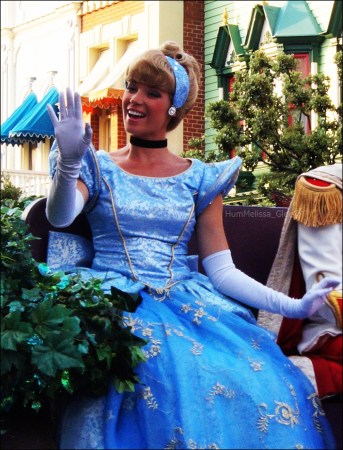
Cinderella-Magic on Parade: By HumMelissa_Glee – Cinderella – Magic On Parade, CC BY 2.0
Cinderella helped make me a pint-sized feminist. Well, of course my strong and rebellious mother and grandmothers were my primary influences, but at age five, Cinderella was definitely up there. I learned in my own little girl way from Disney’s Cinderella that women could forge their own destiny (of sorts), older women can be powerful for good and evil, magic pervades the universe, and whether other women support you is key to success. I completely missed the message about marrying Prince Charming. How did this story get from its origins millennia ago to a little suburban American girl in the 1960s?
Once upon a time, all over the globe, women practiced the inspiring, transformative art of storytelling. In Europe, as their world was overtaken by more patriarchal cultures, they kept alive fairy tales that spoke of their traditional world infused with magical energy and spirit beings and shared with each other new tales of their lives and troubles. In many western cultures from ancient times till very recently, however, storytelling was strictly segregated by gender, with men gathering in taverns or homes to hear epic hero tales while women gathered to sing or tell stories to each other of supernatural beings, local events, and their lives while doing tasks like spinning (hence, “spinning a yarn”) and weaving. Not surprisingly, male folklore scholars have for decades overlooked women storytellers who were also often devalued and denigrated in their own communities. More recently, largely female folklore scholars have brought to light a rich and important tradition of European women storytellers.
The monster and Elizabeth from movie Frankenstein, 1931, Universal Studios, Public Domain
As Mother’s Day beckons, Mary Shelley would like to have a word, or rather a novel’s worth of words. Her novel 200-year-old FrankensteinOr a Modern Prometheus has much to say today about the essential matristic values of nurturing and life-giving, women’s reproductive and other rights, parenthood and child care, and more. The novel’s two centuries of play, film, and book adaptations, most recently Kris Waldherr’s excellent Unnatural Creatures: A Novel of the Frankenstein Women, attest to Frankenstein’s continuing relevance to profound aspects of human experience.
First, let’s look at what might have influenced the writing of Frankenstein. Mary Shelley was the daughter of Mary Wollstonecraft, author of A Vindication of the Rights of Women which in 1792 championed educational and employment opportunities for women. She advocated for women to be treated as full human beings rather than as mere objects of beauty whose inherent “hysteria” made rational thought impossible. Wollstonecraft cited the benefits to society of mothers who can properly educate their children. Wollstonecraft died soon after giving birth to Shelley and was vilified for a previous illegitimate daughter.





 Feminism and Religion