It’s not easy being a full-time female missionary for the Mormon Church by Rachel Hunt

Before I was born, but after I was conceived, my father had a dream. In this dream, he knew that I would be a great missionary. And because of this knowledge, (and because he a. didn’t see me in the dream and was b. Mormon*) he thought I would be a boy.

To my mom’s credit, she reminded my dad, “Girls can be great missionaries too,” and to my dad’s credit, he was not disappointed when I did indeed turn out to be a girl. He also never let go of his impression that I would be a great missionary. Perhaps because of this story, perhaps because of hearing his (and my brothers’) mission stories, I grew up sincerely wanting to serve a mission.

It wasn’t until high school that someone first told me that I shouldn’t go on a mission because I was a girl. The words were spoken by my female leader, with the explanation that men were to go on missions and women were to get married. My best friend and I were upset, because we were adamant that we were going, but we brushed it aside, letting it add flame to our desire.  Continue reading “It’s not easy being a full-time female missionary for the Mormon Church by Rachel Hunt”

Pink Smoke Over the Vatican: A Review by Kate Conmy

Review: Pink Smoke Over the Vatican (2010)

Award-Winning Independent Documentary Film

Directed by Jules Hart

By Kate Conmy, MA.

Membership Coordinator of the Women’s Ordination Conference.

Last weekend I had the honor of joining over eighty Women’s Ordination Conference members and supporters in Claremont, California for a screening of “Pink Smoke Over the Vatican” followed by a distinguished panel discussion.  WOC board member Miriam Todoroff of Pilgrim Place hosted the event, along with Rev. Kathleen Jess, ECC, with local support from Theresa Yugar. “Pink Smoke Over the Vatican” has recently been made available for purchase, but for the past couple of years the film has starred in women’s ordination movement circles, drawing hundreds to cinemas, churches, universities, and homes for a peek at the controversial and moving film.

Fr. Roy Bourgeois has taken the show on the road, touring and speaking throughout the world (from Rhode Island to Rome) on women’s ordination and the important stories in the film. Fr. Roy’s involvement with women’s ordination is well documented, however, notably, “Pink Smoke Over the Vatican” is specifically mentioned in his First Canonical Warning from his Order, the Maryknoll Fathers and Brothers, insisting that his public support and promotion of the movie was a Holy Offense. More than just good press, this is a testament to the power contained within this film. Continue reading “Pink Smoke Over the Vatican: A Review by Kate Conmy”

The Sovereignty of the Soul by Elizabeth Mott

As a teenager, I had very little self-confidence, and I was—and still am—an idealist. My mother, who suffered from diabetes and heart disease, never worked outside the home. She raised four children—one with disabilities—and found a great deal of happiness doing that when we were young. She died at the age of 49, when I was 21. By that point in my life, I had serious questions about my worth as a female member of society. How much of this was due to my family, how much was due to my religion, and how much was due to my middle-class American background? That is hard to answer. But I would probably say that my 21-year-old angst had more to do with witnessing my mother’s health challenges than anything else.

I never pictured my future looking any different than my mother’s and my aunts’, and until the reality began to stare me in the face, I thought I was OK with that. Raised in the Mormon diaspora of the American Mid-West, they all received bachelor’s degrees, married men with advanced degrees, and then settled down into the male-breadwinner model of marriage. Continue reading “The Sovereignty of the Soul by Elizabeth Mott”

Feminist Theologies: Past, Present, and Future

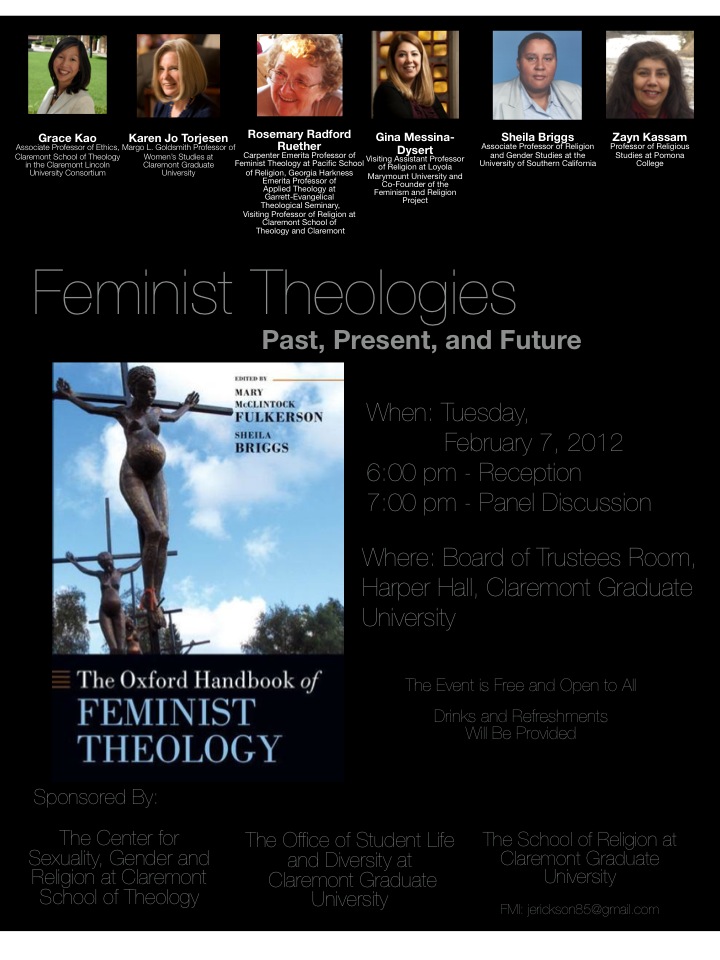
On February 7, 2012, a panel discussion focused on the past, present, and future of feminist theologies took place at Claremont Graduate University to celebrate the release of TheOxford Handbook on Feminist Theology.  The panel was organized by John Erickson, moderated by Grace Kao, and featured Karen Torjesen, Rosemary Radford Ruether, Gina Messina-Dysert, Zayne Kassam, and Sheila Briggs as presenters.  What resulted was a terrific discussion about women, religion, and feminist theologies.  Many were in attendance and participated in the panel; for those who were unable to attend, here is a video of the presentations from that evening.  We look forward to you sharing your thoughts and comments about the past, present, and future of feminist theologies.

Coming Home by Catherine Gorey

I have often heard people speak of times when “life stood still,” where the activity of others continues while yours comes to a sudden halt.

I love the sound of lyrics to the Skylar Grey song “Coming Home.” It has a mantra type melody that allows me to find my center when I am off kilter.

I’m coming home
I’m coming home
Tell the World I’m coming home
Let the rain wash away all the pain of yesterday
I know my kingdom awaits and they’ve forgiven my mistakes
I’m coming home, I’m coming home
Tell the World that I’m coming

It speaks to me often when I am in the midst of interior conflict roused by change, growth, transition, disappointment etc. Each personal encounter causes a shift in my interior landscape which in turn requires me to find my center again. Sometimes the homecoming takes longer, depending on the cause of the axis shifting.

March 15th, 2012 will mark the 3 year anniversary of my mother’s death. A day that caused me much turmoil within and a life event from which I continue to search for my center. I would never have thought that this life event would shake me to the core as it did, causing me to question everything I ever thought to have known about my mother. Continue reading “Coming Home by Catherine Gorey”

England’s “Problem” with Shar’ia by Kristina Benson

A recent occurrence in the recent Islamic legal history of England involves women’s use of Shar’ia law to protect their autonomy, marital security, and property rights. Beginning in September 2008, decisions made by Shari’a councils in Britain became legally binding due to a new application of the 1996 Arbitration Act. Much as Jewish Beth Din courts and Quaker courts, had been doing for over a century, over 84 Shar’ia councils could begin to act as “arbitration tribunals,” making legally binding decisions about issues pertaining to marriage, divorce, inheritance, and custody. Scholars and political observers alike immediately voiced concern that Muslim women would be treated unfairly in these councils, or, alternative, claimed that the continued use of these councils was further evidence of cultural separatism, or an unwillingness to assimilate (See McKinstry). However, Muslim women have actually managed to secure better outcomes from the Shar’ia councils than from English courts; it is thus possible to frame their continued use the Shar’ia councils a rational decision motivated by financial security, as opposed to a disinclination towards assimilation.  In order to understand why this is the case, it is necessary to compare salient aspects of English Family Law and Shar’ia law. Continue reading “England’s “Problem” with Shar’ia by Kristina Benson”

A Feminist “Nutt” Point of View by Shannon Nutt

This is the first blog post I have written, so the concept of being a blogger is a little foreign to me.  But I will just jump in!

I grew up in a religious house that became far more religious after my mother passed away from brain cancer when I was thirteen.  My single father became heavily involved in the Lutheran Church, thinking this was the best way to raise his two daughters.  I was happy to go to church and get the structure that the church provided.  I was also grateful that I went to a church that had a female pastor.  Lacking a mother, it was nice to have a strong female role model who was breaking into the “boys’ club” that was the church.  Having found a postitive, female role model, I was really upset when I heard very conservative members of other churches and my own family say that women have no business speaking or leading people in church.  I was around sixteen when this was happening, and it broke my heart to see women telling other women that they have no right to be heard in the church.  Continue reading “A Feminist “Nutt” Point of View by Shannon Nutt”

Navigating the Academy with an Accent by Amanda Pumphrey

“Where are you from?” I wish I had a dollar for every time someone has asked me that question since moving to California. I would be able to make a substantial payment towards my student loan debt by now. No one knows I’m “different” here in SoCal until I open my mouth. My thick Southern accent happens to be my signifier.

Before I moved to Claremont to begin graduate school, I never considered my accent a problem. Despite the fact that when I moved outside of my hometown to college only two hours away, some of my friends teased me about my accent. Since I grew up in the very southwestern corner of Georgia, I lived right along the Alabama border. Some of my college friends from other regions of Georgia thought I sounded more Alabamian. Still, mostly everyone I went to college with had some form of a Southern accent and that was okay. It was safe. It was normative.  Continue reading “Navigating the Academy with an Accent by Amanda Pumphrey”

Practice What You Preach by Corinna Guerrero

The underlying principle that links a feminist critique to every other critical lens since the rise of feminist discourse is the “hermeneutic of suspicion.” Essentially,  a hermeneutic of suspicion identifies the disconnect between rhetoric and a lived reality. The lived lives of women are different than the pontifications espoused directly and indirectly by the traditionally patriarchal social, political, cultural, religious, and educational structures in which individuals participate.

I like to think that I live my life bucking these structures whenever possible because the roles a woman plays in her own life should: 1) be determined by her; and 2) if she negotiates more “traditional practices” (e.g. marriage, motherhood, etc.) then these practices do not limit her to traditionalist practices (e.g. staying at home, spousal servitude, etc.). Granted, I used the two most generic examples of traditional and traditionalist practices, but the point is still valid. When I go to holidays with my extended family there are very few questions or comments about my PhD program, but many comments about the fact that I do not make a plate of food  for my husband.   Continue reading “Practice What You Preach by Corinna Guerrero”

Goddess Communities in Australia by Patricia Rose

Australia has a very diverse and rapidly expanding number of people for whom the Goddess, however She is understood, is significant. The 2006 census revealed that there were over 30,000 Pagans or followers of other earth-based religious traditions in Australia and, given the way in which religions are classified in the census, this is undoubtedly a serious underestimation. We await the findings of the 2011 census with great interest.

Prior to European settlement in Australia, Aboriginal and Torres Strait Islander peoples followed their own rich spiritual beliefs, which were based on the forces of nature, a reverence for the land and its creatures, and the influence of ancestral spiritual beings. Recently, non-indigenous Australians have become increasingly interested in the indigenous connection to the land and indigenous spirituality.

While it is important not to appropriate indigenous culture, Goddess women and men in Australia are keen to express their spirituality in ways that are relevant to this land and to the Australian culture. We recognize the need to become more attuned to the ways of Australia, to her seasons and her natural cycles, and we can learn from the experiences of indigenous peoples, garnered from millennia of living on and with this land. Continue reading “Goddess Communities in Australia by Patricia Rose”