The Legacy of Carol P. Christ: Patriarchy As An Integral System of Male Dominance Created at the Intersection of the Control of Women, Private Property, and War, Part 3

Part 2 was posted yesterday. You can read it here, or the original in the link below.

carol p. christ 2002 color

Patriarchy is a system of male dominance, rooted in the ethos of war which legitimates violence, sanctified by religious symbols, in which men dominate women through the control of female sexuality, with the intent of passing property to male heirs, and in which men who are heroes of war are told to kill men, and are permitted to rape women, to seize land and treasures, to exploit resources, and to own or otherwise dominate conquered people.

As the discussion of patriarchy* I began last week and the week before shows, patriarchy is not simply the domination of women by men. Patriarchy is an integral system in which men’s control of women’s sexuality, private property, and war (including violence, conquest, rape, and slavery) each play a part. These different elements are so intertwined that it is impossible to separate one as the cause of the others.  Patriarchy is an integral system of interlocking oppressions, enforced through violence, and legitimated by religions.

The model of patriarchy I have proposed argues that the control of female sexuality is fundamental to the patriarchal system.  This explains why there is so much controversy about the “simple matter” of access to birth control and abortion in the US today. It also explains why so much vicious anger is directed at single mothers by politicians and commentators.  Any woman who dares to control her own sexuality is questioning the foundations of the patriarchal system.

Continue reading “The Legacy of Carol P. Christ: Patriarchy As An Integral System of Male Dominance Created at the Intersection of the Control of Women, Private Property, and War, Part 3”

The Legacy of Carol P. Christ: Patriarchy as a System of Male Dominance Created at the Intersection of the Control of Women, Private Property, and War, Part 2

Part 1 was posted yesterday. You can read it here. Or the original in the link below.

carol p. christ 2002 color

Patriarchy is a system of male dominance, rooted in the ethos of war which legitimates violence, sanctified by religious symbols, in which men dominate women through the control of female sexuality, with the intent of passing property to male heirs, and in which men who are heroes of war are told to kill men, and are permitted to rape women, to seize land and treasures, to exploit resources, and to own or otherwise dominate conquered people.*

In last week’s blog, I explained patriarchy as a system in which men dominate women through the control of female sexuality with the intent of passing property to male heirs. How did a system that identifies a man’s essence with his property and the ability to pass it on to sons come about? I suggest that the answer to this question is war and the confiscation of “property” by warriors in war. Patriarchy is rooted in the ethos of war which legitimates violence, and in which men who are heroes of war are told to kill men, and are permitted to rape women, seize land and treasures, to exploit resources, and to own or otherwise dominate conquered people.

My argument is that the origin of “private” property, defined as property owned by a single (male) individual, and as that which defines the “essence” of that individual, is the “spoils” of war, which are divided up by victorious warriors.  The “spoils” of war are the tangible treasures “looted” or taken by the victors from the conquered, such as jewelry and sacred objects.  The “spoils” of war include land “taken” as the result of warfare, along with the right to exploit resources, directly or through taxes and levies. The “spoils” of war also includes the right to “take” the women of the defeated enemy and to confirm ownership of them (and humiliate their fathers or husbands) by raping them.  The “spoils” of war also include the right to “take” these raped women and their young children home to serve as slaves and concubines.

Continue reading “The Legacy of Carol P. Christ: Patriarchy as a System of Male Dominance Created at the Intersection of the Control of Women, Private Property, and War, Part 2”

Legacy of Carol P. Christ: Patriarchy as a System of Male Dominance Created at the Intersection of the Control of Women, Private Property, and War, Part 1

Moderator’s Note: This three part series was originally posted in 2013 near the start-up of FAR. Because of its seminal nature, wee have re-posted it several times since then. This piece not only set FAR off on its ground-breaking direction but Carol also educated many of us about the roots, the patterns and experiences of patriarchy. This knowledge and understanding is so important to understanding where our culture is and what is happening now that we have decided to post it each year starting on the anniversary of Carol’s death, July 14th, 2021 and continuing for the 3 days.

carol p. christ 2002 color

Recently feminist scholar Vicki Noble commented that this is the best definition of patriarchy she has read–but she hadn’t read it earlier. I am reposting it now in the hopes that all of you will share it with your social media so that it will be more widely known.

Patriarchy is often defined as a system of male dominance. This definition does not illuminate, but rather obscures, the complex set of factors that function together in the patriarchal system.  We need more complex definition if we are to understand and challenge the the patriarchal system in all of its aspects.

Patriarchy is a system of male dominance, rooted in the ethos of war which legitimates violence, sanctified by religious symbols, in which men dominate women through the control of female sexuality, with the intent of passing property to male heirs, and in which men who are heroes of war are told to kill men, and are permitted to rape women, to seize land and treasures, to exploit resources, and to own or otherwise dominate conquered people.*

Marx and Engels said that the patriarchal family, private property, and the state arose together. Though their understanding of the societies that preceded “patriarchy” was flawed, their intuition that patriarchy is connected to private property and to domination in the name of the state was correct.  It has long seemed to me that patriarchy cannot be separated from war and the kings who take power in the wake of war.  Many years ago I was stunned by Merlin Stone’s allegation that in matrilineal societies there are no illegitimate children, because all children have mothers. Lately, I have been trying to figure out why the Roman Catholic and other churches and the American Republican party are so strongly opposed to women’s right to control our own bodies and are trying to prevent access to birth control and abortion. In the above definition of patriarchy, I bring all of these lines of thought together in a definition which describes the origins of patriarchy and the interconnections between patriarchy, the control of female sexuality, private property, violence, war, conquest, rape in war, and slavery. 

Continue reading “Legacy of Carol P. Christ: Patriarchy as a System of Male Dominance Created at the Intersection of the Control of Women, Private Property, and War, Part 1”

How We ALL Need the Goddesses Now . . . by Annie Finch

Carol Christ, in her 1978 clarion call “Why Women Need the Goddess,” summarized four powerful, foundational ways that the Sacred Feminine urgently matters for women crawling out from under patriarchy.  Each way helps to heal the psychic damage of our upbringings and surmount the profound losses of our violated herstory.  Christ shows how Goddess belief and worship affirms the legitimacy of our power, the sacredness of our bodies, the honoring of our will—and the centrality of our connections with our foremothers and each other.

All this is still so true. All so important.

AND . . . Christ’s framing of Goddessness as a precious path of women’s transformation is not enough anymore.

Times have changed in the forty years since Christ published her essay.  Today’s world has been fast plummeting into an even more blatantly hellish (no, I don’t want to insult the source of that word, Goddess Hel, guardian of life and death—so I will change the adjective!) into an even more blatantly patriarchal state of affairs.

Continue reading “How We ALL Need the Goddesses Now . . . by Annie Finch”

Our Ecofeminist World.

Every year in my course “Feminism and the Environmental Movements,” we take a part of one class session about halfway through the semester and explore what an ecofeminist world should look like.  I begin by drawing a large circle on the whiteboard, representing the world and as a class we discuss what belongs in the world.  That information goes on the inside of the circle.  What we don’t think belongs within an ecofeminist world, I write on the far corners of the board.  Then there are those topics about which no consensus can be made.  Those I write along the edge of the circle, and we spend considerable class time debating the reasons why those ideas are controversial.  

Continue reading “Our Ecofeminist World.”

PRESSLER’S PROGENY by Esther Nelson

David French, an Opinion Columnist for the New York Times, wrote an enlightening piece (05/14/2026) titled, “I Don’t Think You Can Even Call This Hypocrisy.”  You can read the article here.  

In his essay, French refers to a piece by Robert Downen, an investigative journalist, who wrote about Paul Pressler (d. 2024), an architect of the “so-called resurgence in the Southern Baptist Convention,” the largest Protestant denomination in the USA.  The MAGA movement, filled with loud and often uninformed, conservative Christians, is Pressler’s progeny.

From the early 1990s until 2006, the Southern Baptist Convention (as well as unaffiliated and independent Bible churches) experienced phenomenal growth.  Many fundamentalist evangelicals viewed this growth as God’s blessing on the faithful.  However, as journalist Downen dug around, he found “there was an overwhelming amount of evidence that Pressler was a morally corrupt and abusive man.”  Not only was he a Confederate apologist, he purportedly sexually abused young men and boys and never lost his influence.  Many Baptists believed that “…exposing Pressler’s misdeeds would ‘distort’ his public Christian credibility.”

Continue reading “PRESSLER’S PROGENY by Esther Nelson”

The Legacy of Intergenerational Violence/ Silence, part 1 By Sara Wright

 Patriarchy begins at home.

Author’s Note:  One reason I am sharing this story is that I hope that it will ease another round of suffering. However,  I would dearly like to believe that others might reflect upon the ways they have been impacted by family violence or silence in their own lives, so we don’t get caught by projecting these patriarchal roots outside of us onto the collective while dismissing them in ourselves. That dark  patriarchal seed is present in all of us, and I think that telling our personal stories keeps us attached to the whole with humility – a challenge in this time of monstrous ethical, social, political, ecological breakdown.

  I often have dreams that leave me with  questions, dreams that provoke deep personal reflection, dreams that stay with me as the following one did. At mid-life I had written tributes for two men that mentored me from a distance who brought ‘good fathering’ into the foreground because each encouraged me to believe in myself, to celebrate my original thinking, to trust my intuition and more.

Continue reading “The Legacy of Intergenerational Violence/ Silence, part 1 By Sara Wright”

Maryam Rajavi by Yalda Roshan

My name is Yalda. I am a woman from the Iranian resistance who, for many years, has fought for women’s equality and worked to amplify the voices of Iranian women around the world. Today, I want to share with you the source of inspiration and motivation that has guided my path.

Covering every aspect of Maryam Rajavi’s life and thought in one article is a challenge, so today I will focus only on what has personally influenced me: her perspective on women.

She herself is a woman who has spent decades fighting against two dictatorships—the Shah’s and the misogynistic clerical regime—and believes that women can change the world. A brief overview of her biography: she was born on December 4, 1953, in Tehran and is a metallurgical engineer from Sharif University of Technology in Tehran. From her teenage years, she embarked on the path of struggle, learning from action rather than words.

Continue reading “Maryam Rajavi by Yalda Roshan”

The Epstein Files Prove Just How Right Carol Christ Had Been, part 2 by Janet Maika’i Rudolph

Part 1 was posted March 1st. You can read it here. The definition that Carol refers to as well as a link to her original article can be found there as well. Her words are in italics.

It has long seemed to me that patriarchy cannot be separated from war and the kings who take power in the wake of war.  Many years ago I was stunned by Merlin Stone’s allegation that in matrilineal societies there are no illegitimate children, because all children have mothers. Lately, I have been trying to figure out why the Roman Catholic and other churches and the American Republican party are so strongly opposed to women’s right to control our own bodies and are trying to prevent access to birth control and abortion. In the above definition of patriarchy  . . . I bring all of these lines of thought together in a definition which describes the origins of patriarchy and the interconnections between patriarchy, the control of female sexuality, private property, violence, war, conquest, rape in war, and slavery. 

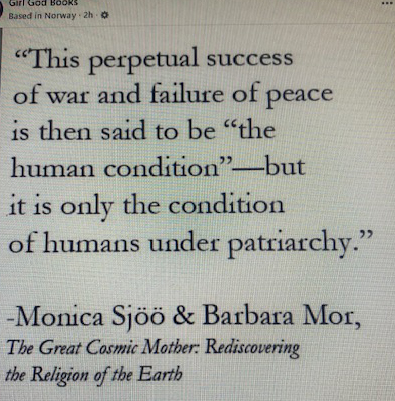
From the Facebook page of GirlGodBooks

Here Carol lays it all out. I, too, have wondered why the Church, why conservative politicians are so obsessed with women’s bodies and reproductive systems. No wonder abortion, in fact all of the healthcare of women is so on the political radar. Taking away the agency of women when they become pregnant is dehumanizing, reduces women to incubators. And that doesn’t even go into the fear of treating women for any health issues when they are pregnant. Take the tragic case of Tierra Walker who died in Texas, pregnant and facing growing health problems. She had a 14year old son and after weeks of severe distress attempted to get an abortion. She was unable to do due to the strict anti-abortion laws in Texas as she went to doctor after doctor. Here is what they told her: “But the doctor, her family said, told her what many other medical providers would say in the weeks that followed: There was no emergency; nothing was wrong with her pregnancy, only her health.” Its as if there was a cabal to diminish the value of women’s lives that even the doctors, who know better, participate in. And that is the templated of patriarchy. True that the doctors are threatened with loss of license and 10 years imprisonment begin. But when they spout the “party” line, they not only risk their patients, they deepen the already ingrained belief that women and our bodies are without worth.

Continue reading “The Epstein Files Prove Just How Right Carol Christ Had Been, part 2 by Janet Maika’i Rudolph”

On Reading by Ivy Helman

I would not say that I was much of a reader growing up.  Doctoral studies and years of education had turned me off of reading as something pleasurable.  Instead, it had become a task, an item on my to-do list, often, a chore.  It was also not that joyful since I have struggled with some form of dyslexia all my life.  

But, now, I would say I am embracing reading.  I have talked on this blog about my love of dystopian books before, but I also enjoy fantasy books, historical fictions, feminist retellings of myths, the occasional thriller, and so on.  In terms of format, I read both paper books and audio books.  The joy of audiobooks is the freedom to read when commuting, cooking, doing laundry, walking the dog, relaxing on the couch, etc.  They have opened up the possibility of enjoying two activities at once sometimes and other times making a difficult activity more bearable. 

Continue reading “On Reading by Ivy Helman”