Why are We Drawn to the Black Madonna? by Judith Shaw

judith Shaw photoOnce the opportunity came my way to spend two weeks with my sister in Paris, I knew I had to visit the Black Madonnas at Chartres.  I had been to Chartres many years ago,  before I knew about the Black Madonnas scattered throughout Europe.  I felt the power of the site at that time, but had little understanding of where that power came from.

History of the Black Madonna 

Isis

The indigenous goddess worship of Europe, was influenced by Phoenician traders who introduced statues of dark skinned African and Middle Eastern goddesses such as Isis, Inanna, and others to the European continent from 1550BC to about 300BCE.  The worship of these goddesses continued  with The Roman invasion of Gaul (France) and other parts of Europe.

Once Christianity took hold in Europe, churches were built on top of sacred pagan sites. But old ways die hard; many of these dark skinned goddesses were incorporated into the newly built Christian churches.  Today there are more than 500 known Black Madonna statues and paintings throughout the world, the majority in France. Continue reading “Why are We Drawn to the Black Madonna? by Judith Shaw”

Art – A Bridge Between the Physical and Spiritual Worlds by Judith Shaw

judith shaw photoBrushing yellow gold on top of deep crimson, I sense the paints coming alive, even as I feel myself moving outside of ego, outside of time, and inside to my deepest source.

At least forty thousand years ago the human family began to make art; drawing, painting, sculpting and playing music. For much of human history, art has served a dual purpose. Some art has been purely decorative, while much art has expressed a spiritual understanding of our physical existence.

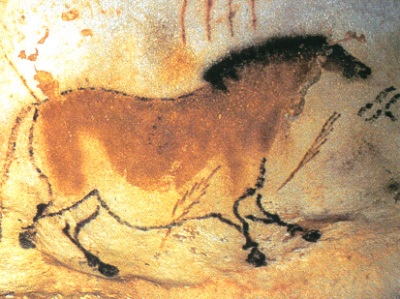
During the Paleolithic period, c.15–18,000 B.C. on the walls of a sacred cave, Lascaux, in southern France, our ancestors created beautiful paintings, often interpreted as a ritual that invoked sympathetic hunting magic. They are a reminder of the bond between the spirit world and the human world. This was a magical time in which humans lived immersed in the connection between the physical and spiritual worlds. Art was a means to both express and facilitate that connection.

Neolithic Goddess Figure

The seasons turned and the art and mythical imagery of the Paleolithic era was transmitted to the Neolithic era in Old Europe. Worship of the Goddess, as giver of all life, continued as did the art which honored Her and our connection to Her. The artists from these ancient days expressed their communal worship through the creation of cult idols and objects, shrines, painted pottery, and religious ceremonialism. The artists, though anonymous, were the hands and eyes of the creator, deepening and transforming the consciousness of their community.

As the human community in the western world developed and grew, art remained firmly grounded in the spiritual. From the megalithic stones of the Celtic era, to the illuminated manuscripts, mosaics and fresco paintings in the churches of the Middle Ages, right up to the work of painters like Van Gogh, Kandinsky, Malevich and Mondrian in the more modern era of late 19th and early 20th century – art expressed our human connection to the divine.

Continue reading “Art – A Bridge Between the Physical and Spiritual Worlds by Judith Shaw”