Why Life Balance is a Feminist Issue by Mary Sharratt

The move to Portugal all but forced me to heal my relationship with time and productivity, to create a life that was sustainable and nurturing.

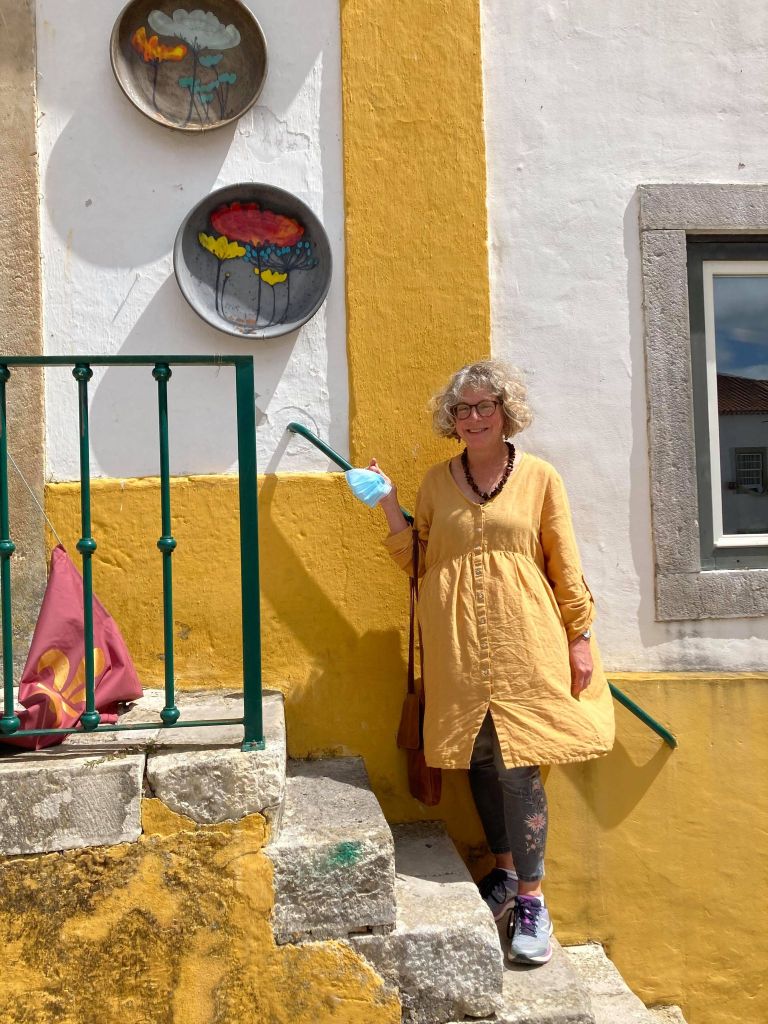
Hanging out in Obidos, the closest town to my village. Photo by Erika Mailman.

One year ago, I published my essay, The Grace of Letting Things End, about my bittersweet experience of leaving England in the wake of Brexit for a new life in Portugal.

One year later, my life in Portugal still feels radically new.

Time passes differently in Portugal. I set my intention, from the outset, to embrace this move as an opportunity to slow down and live a more authentic life.

My day-to-day life has irrevocably changed.

I’ve gone from being a livery yard customer in England, with all the drama and conflict this sometimes entailed, to becoming an independent small holder with two horses on my property to care for all by myself. Practically, this has translated into a lot more work, but also a lot more peace.
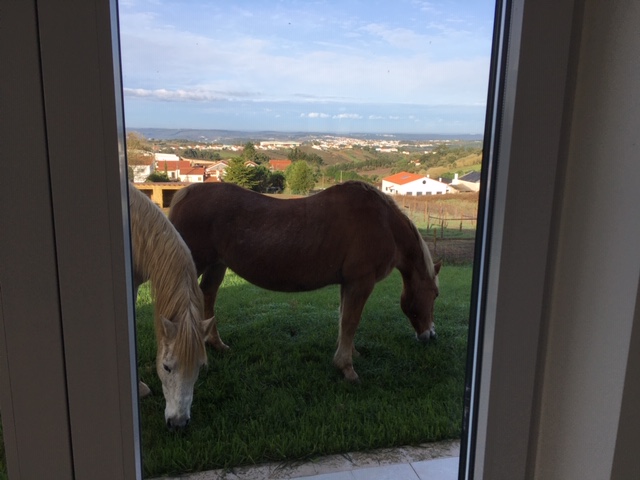
The ponies decided to help with the lawn mowing

I’ve also been devoting considerable time and energy into learning Portuguese. My husband and I have been taking classes once or twice a week for nearly a year now and are making slow but steady progress.

But the most deep-seated change has been to my whole relationship to work and life. In the UK, I led a very productivity-centered life, existing from deadline to deadline with barely any time to breathe in between. I often felt too busy and wrapped up in my projects to meet friends for lunch.

For years I have struggled to heal my dysfunctional relationship with time management, embracing lifehack after lifehack. I’ve all but abandoned social media. I’ve done my utmost to milk every single hour of the day in order to become more productive. This pattern led to disillusionment and epic burn out, something more and more women are facing, particularly those who balance the demands of their careers with childcare and other care-taking duties.

Even writers and artists can fall down the hole of the Cult of Productivity, taking the creative process, which is at its essence slow and organic, and trying to force it into an industrial process with regular, reliable yields that are judged on how well they can be monetized. Even the refuge of spirituality can be compromised if it’s just another task on a never-ending to-do list.

Thus, despite my official intention to slow down, I found myself trying doggedly to replicate my old hectic, tunnel-vision working schedule in Portugal only to discover that it just didn’t work here. I hit a brick wall. Because I couldn’t sustain the same level of busyness AND care for two horses AND learn a challenging new language AND keep my initial intention of slowing down and enjoying the life I moved here to experience.

Something had to give. The move to Portugal all but forced me to heal my relationship with time and productivity, to create a life that was sustainable and nurturing. No lifehack could help me anymore, because I’d already given up television. I don’t even watch Netflix.

We hear a lot about the Slow Living Movement, but actually slowing down involves so much more than decluttering your closet or posting pictures of photogenic hipsters in hammocks on Instagram.

Moving to Portugal forced me to slow down. Because life is slow here. It’s no accident that the Slow Food Movement had its birth in Italy, another slow country in southern Europe. Food is also big in Portugal. In fact, I like to joke that LUNCH is the national religion. No matter how busy or important you think you are, the whole world stops for lunch. Shops close. People pour out of offices and go to restaurants for beautiful, affordable meals. Proper, cooked meals, mind you. Not a sandwich or salad to be inhaled at speed. To say you are too busy to meet your friends for lunch in Portugal would be sacrilege. Even in the height of the pandemic when all the restaurants were closed, people went home for lunch and ate with their families.
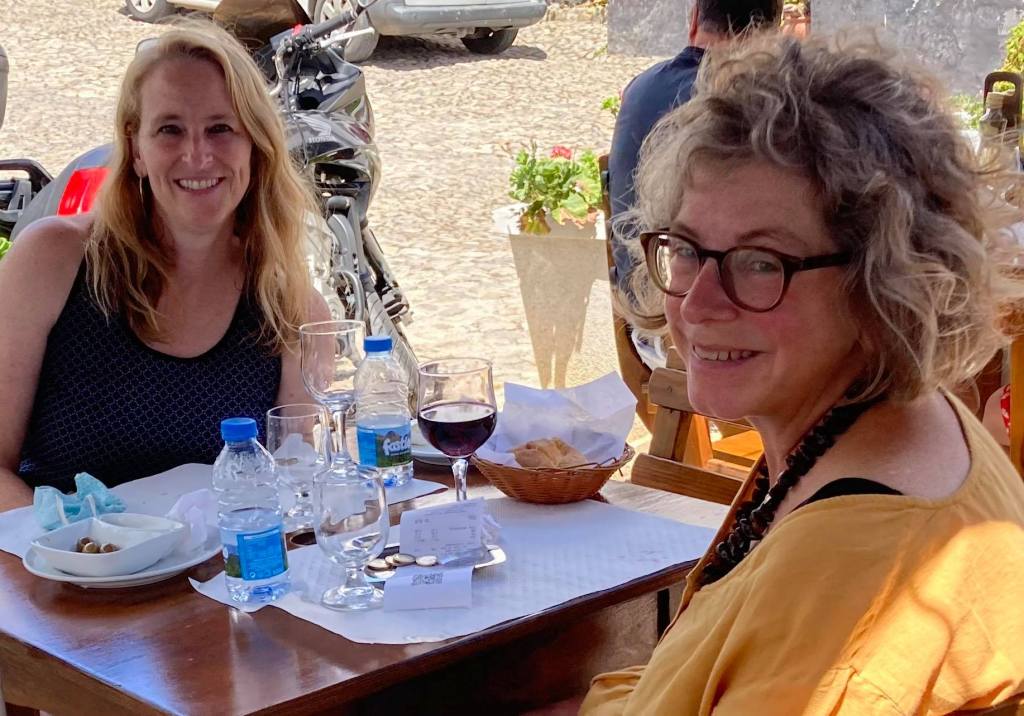
Converting my visiting writer friend Erika Mailman to the religion of LUNCH!

Any culture that prioritizes good food also prioritizes human relationships. My social life here is unlike anything I’ve experienced anywhere in the world. I’ve met wonderful Portuguese people, such as our local Priestess, Luiza Frazao, as well as new friends from the U.S., the U.K., Canada, Columbia, the Netherlands, Israel, Russia, Germany, Spain, Poland, Hong Kong, and Belgium. My husband and I have made so many friends in our village. We can walk to each other’s houses and invite each other for dinner or go on long walks together. The other foreigners who move to Portugal have made the conscious decision to make time for friendship, not just shove it into a twenty minute “let’s meet for coffee” slot. I haven’t had this much fun since I was a student.

Other things are slow here, too. The post office can be painfully slow. My New Yorker subscription has gone AWOL and I’ve resigned myself to reading the digital version. Plumbers and technicians come when they come. Just when you think they’ve forsaken you, they manifest at your door. But then again neighbors I’ve never met before also show up unexpectedly with gifts of apples for the horses. One day an old man pulled his tractor up in front of our house and presented me with two sapling banana trees. 

What I’ve discovered is if I give up any notion of trying to control the clock or manage time, it becomes more expansive. When I’m with my horses or laughing with friends, time disappears and I’m living in an eternal now. The same is true when I’m deep in my writing flow or trying to speak my best Portuguese to thank my neighbor for the banana trees. In a rich and authentic life, there is time for everything.

Life Balance is a feminist issue, because too many women have been brainwashed by the Cult of Productivity for far too long and this has kept too many of us chained to a patriarchal machine that eats us up and spits us out when we’re too broken to go on doing anymore. Let’s rebel and meet our sisters for lunch!
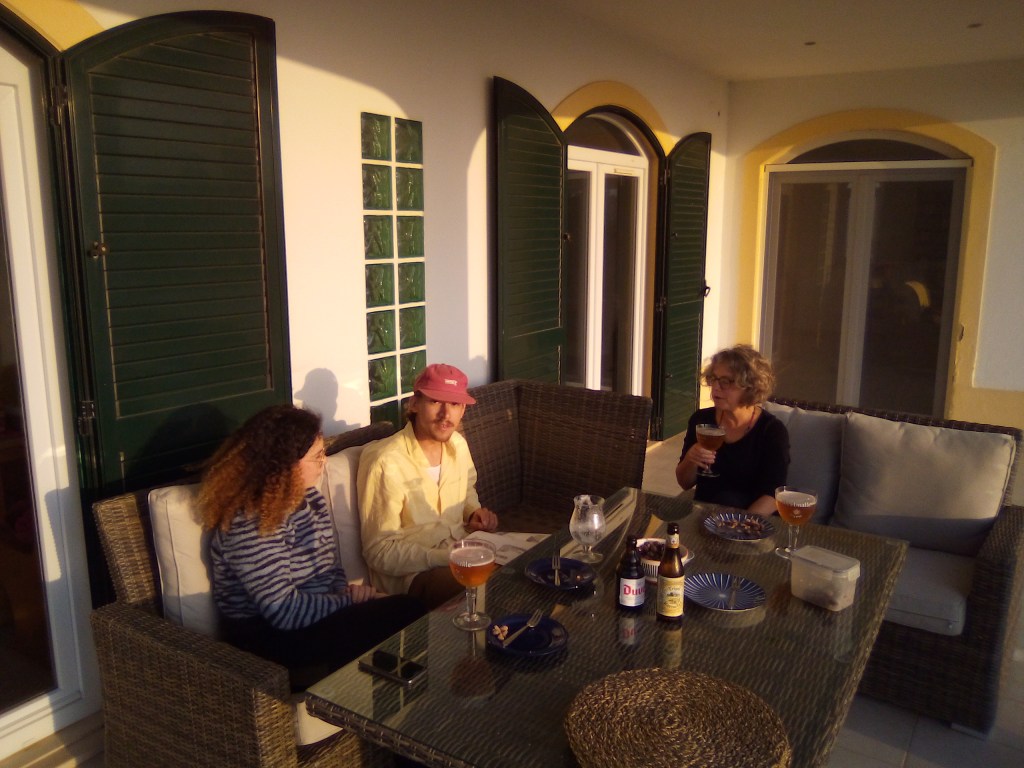
Chilling with friends on a beautiful June evening

Further reading and listening:

Do Nothing by Celeste Headlee: how to work, live a value-driven life, and also have time for friends and hobbies.

Sacred Time by Christine Valters Paintner: how contemplative practice can heal our relationship with time. Highly recommended!

Mary Sharratt is on a mission to write women back into history. Her acclaimed novel Illuminations, drawn from the dramatic life of Hildegard von Bingen, is published by Mariner. Her new novel Revelationsabout the mystical pilgrim Margery Kempe and her friendship with Julian of Norwich, is now available wherever books and ebooks are sold. Visit her website.
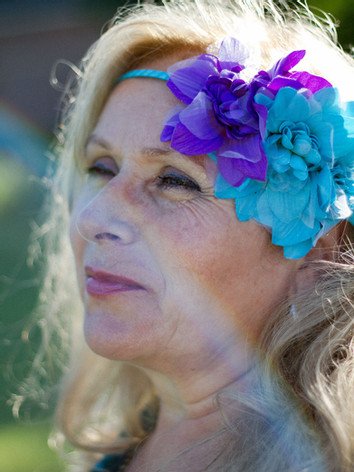
The Goddess in Portugal by Mary Sharratt

Luiza Frazão

Most people know Portugal as a deeply Catholic country with a rich Islamic past and an ancient Sephardic Jewish heritage reaching back to Roman Lusitania. But what about the country’s pre-Roman, pre-Abrahamic Goddess cultures? 

Like many foreigners, I moved to Portugal knowing nothing about Portugal’s Goddess heritage.

Then I met Luiza Frazão, Priestess, author, and independent scholar who studied at the Glastonbury Goddess Temple in England with Kathy Jones. After years of training and steeping herself in the lore of the Celtic Goddesses of the Avalonian Tradition, Luiza returned to her native Portugal to research the rich Goddess lore of her country. Intrigued and eager to learn more about her research, I met up with Luiza in the medieval town of Óbidos.

Continue reading “The Goddess in Portugal by Mary Sharratt”

Plague Year Pilgrims: Let’s Keep Walking

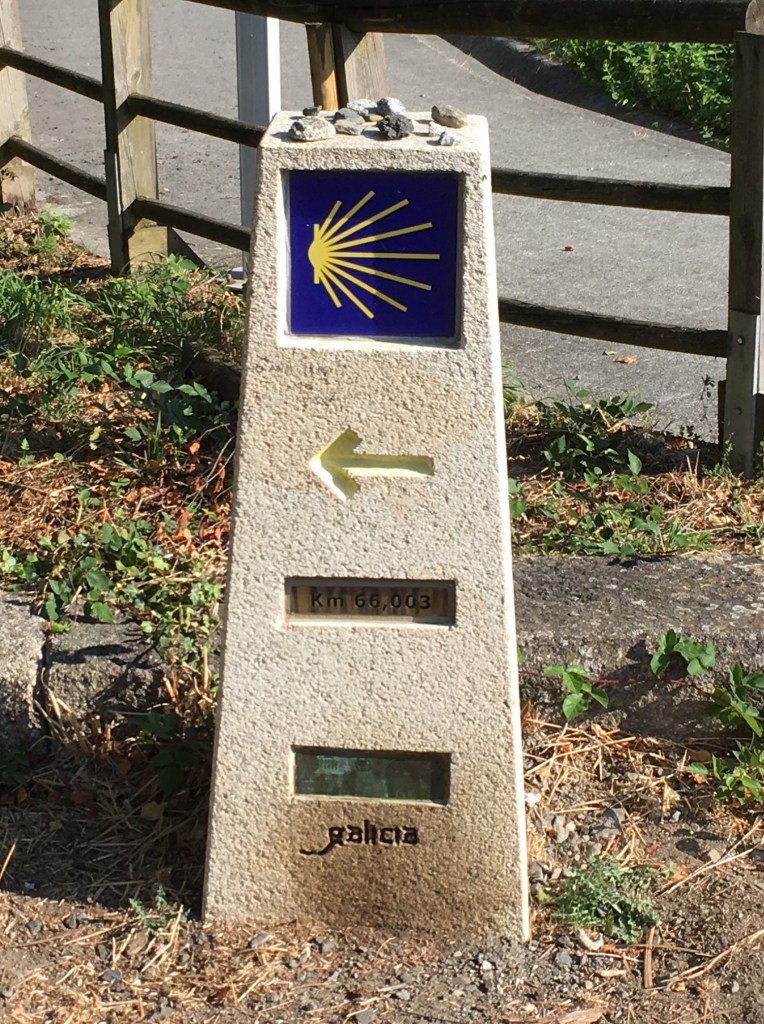
A way marker on the Camino de Santiago de Compostela, Galicia, Spain.

Throughout our long Covid crisis, our daily walk offered precious respite from the tedium of being perpetually housebound and viewing the outer world through electronic screens. Walking brought us exercise and fresh air. It cleared our heads, lifted our mood, and even gave us the rare opportunity to have socially distanced conversations with other humans, face to face.

As we come out of this pandemic year, let’s keep walking. What if we turned our daily walk into a pilgrimage? If we reframed each walk as a daily leg of a journey that will eventually lead us into a post-pandemic future? A pilgrimage in place, as it were.

A pilgrimage is a journey, traditionally taken on foot, to a sacred destination, Mecca, Jerusalem, and Rome being some of the most famous examples.

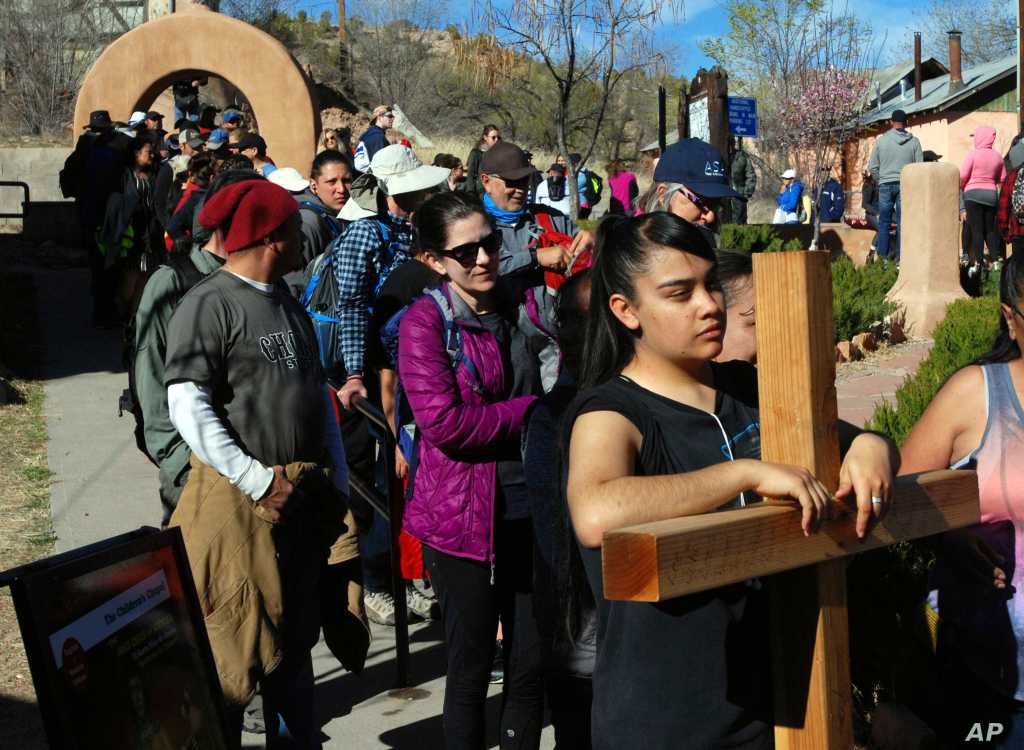
Before Covid, an estimated 300,000 pilgrims walked to the shrine of Chimayó, New Mexico each year in the week before Easter. Some pilgrims even carried heavy homemade crosses to participate in Christ’s journey to Calvary. During my visit to Chimayó some years ago, I witnessed the faithful arriving in the simple adobe church and kneeling before a round pit in the floor to take handfuls of the tierra bendita, the blessed earth, believed to have healing properties.

Jasmin Perez, 17, of Espanola, New Mexico, carries a cross on a pilgrimage to the small adobe church in Chimayo, New Mexico, on Friday, March 30, 2018. (AP Photo/Morgan Lee)

Pilgrims’ eyes perceived the sacred as manifest in what would mundanely be viewed as dirt. To be a pilgrim is to step into a realm of wonder and grace, where anything might happen. The Church itself won’t comment on any purported miracles, yet pilgrims leave abandoned crutches behind in the sanctuary as testimony of their experience.

Perhaps this revelation of the holy in the commonplace means that we can also be pilgrims without even leaving our neighborhood.

You don’t have to be an observant practitioner of any particular faith—not every pilgrim is religious or even spiritual. Some people walk the path to try to figure out what their spirituality even is.

When I walked the Camino, the iconic pilgrimage route to Santiago de Compostela in Galicia, Spain, I encountered people of diverse backgrounds making the pilgrimage for a variety of reasons. Some were taking a break from the stresses of their career to experience a simpler existence—sleeping in hostels and sharing communal meals with strangers. Others were walking to heal trauma and grief. I met grim-faced ex-military guys marching so fast that they wouldn’t deign to respond to other pilgrims’ cheerful greetings of, “Buen Camino!”

Each pilgrim was walking their personal Camino. There is no false reason to go on pilgrimage. Aren’t we all searching for something—some deeper meaning and sense of purpose? In a world so fractured by divisiveness and hatred, sharing the Camino with these vastly different people was an incredible experience of hospitality and spiritual homecoming that I will never forget. The pilgrim’s path is big enough to include us all.

So, what’s the difference between a pilgrimage and a walk? Your intention and your attention, which make all the difference. To have the richest possible experience, we need to be present in our physical bodies, here and now. Not staring at our smart phones or curating our experience on Instagram. Pilgrimage is a time out, a refuge from the news cycle and social media feed.

Pilgrimage doesn’t need to cover a lot of physical distance. It doesn’t even need to be linear. It can be circular. When visiting Nepal, I observed Buddhists circling for hours around the great Boudhanath Stupa in Kathmandu. All the while, they chanted mantras and fingered their mala beads. For one afternoon, I joined them, if only because I was too intimidated to walk elsewhere with the crazy traffic and air pollution. The shrine seemed like the safest and most peaceful place in the city.

Boudhanath Stupa in Kathmandu, Nepal

This kind of Circling the Center can be practiced anywhere and gives a whole new perspective to walking round the block or your local park.

If you feel so inspired, you could even draw a labyrinth in chalk on your driveway and practice the ancient and meditative art of labyrinth walking.

Pilgrimage isn’t about the external destination as much as the journey, the inner process. The ultimate pilgrimage brings us to the shrine of loving presence within our hearts.

There are many ways to be a pilgrim, but there are still some rules to be respected. The most important is practicing open-hearted hospitality for those you meet on your way, maybe stopping to chat with lonely neighbors.

Likewise, we need to be compassionate and welcoming to all the shadowy parts of ourselves that don’t feel the least bit spiritual—all our fear and rage and despair concerning this pandemic.

We come to our pilgrimage as we are and meet ourselves with radical acceptance.

Let us embrace the street where we live as our personal Camino. The sacred is present all around us and, indeed, within us, if we only look through pilgrims’ eyes and pay attention.

Buen Camino!


Mary Sharratt 
is on a mission to write women back into history. Her acclaimed novel 
Illuminations, drawn from the dramatic life of Hildegard von Bingen, is published by Mariner. Her new novel Revelationsabout the mystical pilgrim Margery Kempe and her friendship with Julian of Norwich, is now available wherever books and ebooks are sold. Visit her website.
REVELATIONS: The Mysticism of Julian of Norwich and Margery Kempe

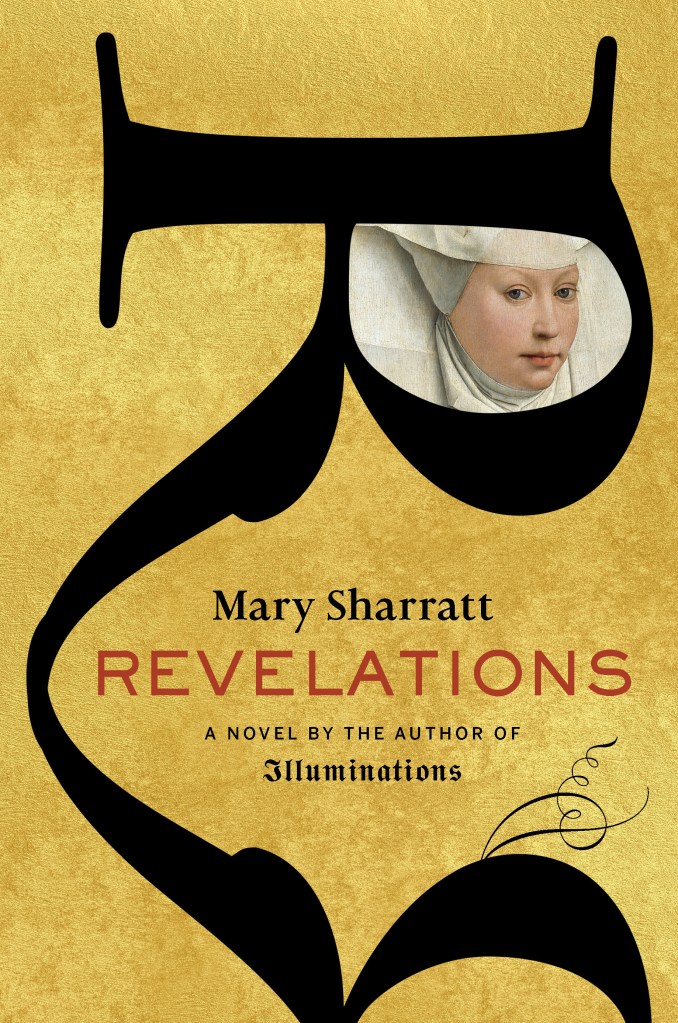
My new novel REVELATIONS is drawn from the lives of two medieval mystics who changed history—Julian of Norwich and Margery Kempe, two very different women whose paths converged and who, I believe, have much to teach us today.

Women’s spiritual experience is a theme that keeps coming up in my novels. Perhaps some of you have read my novel ILLUMINATIONS, about the visionary abbess, composer and polymath, Hildegard von Bingen.

As a spiritual person myself, I’ve always found it frustrating how women have been side-lined and marginalized in every established religion in the world. Yet from time out of mind, mystic and visionary women of all faith traditions have offered radical resistance. They have subverted institutional patriarchal religion from within and found their own direct path to the divine by plunging into the deep mysteries of the soul on a path of inner revelation. Julian of Norwich called God Mother and devoted her life to writing about the Motherhood of God. Similarly, Hildegard of Bingen wrote about her visions of the Feminine Divine. This isn’t a modern feminist interpretation. It’s right there in the original texts.

Like us today, Julian of Norwich and Margery Kempe lived in a time of pandemic and social upheaval, yet both women bore witness to the divine promise that ultimately all shall be well.

Continue reading “REVELATIONS: The Mysticism of Julian of Norwich and Margery Kempe”

The Way of the Mystic

Those of us in the Northern Hemisphere are coming out of a long pandemic winter and entering a new season of waxing light, hope, and growth. Yet these continue to be turbulent times. Even with the progress of the Covid vaccine, none of us truly knows when life will ever return to “normal.”

Like us today, the medieval mystics Julian of Norwich and Margery Kempe, the heroines of my new novel REVELATIONS, which will be published on April 27, lived in a time of pandemic and social upheaval, yet both women bore witness to the divine promise that ultimately all shall be well.

During a near-death experience, Julian received a series of divine visions and spent the next forty years unpacking them in her luminous theology of an unconditionally loving God who is both Mother and Father. Julian offered radical counsel to Margery Kempe, a failed businesswoman and mother of fourteen, who was haunted by her own visceral mystic experience. With Julian’s blessing, Margery walked away from a soul-destroying marriage and became a globe-trotting pilgrim-preacher and rabble rouser. Though these two women might seem like polar opposites—Julian, the enclosed anchoress, and free-roving Margery experiencing her visions in the full stream of worldly life—they complement each other. Together their lives and work form a Via Feminina, a distinctly female path to the divine.

The women mystics have always fascinated me. I identify very powerfully with Hildegard of Bingen, the heroine of my previous novel ILLUMINATIONS, as well as with Margery and Julian as spiritual women facing the roadblock of an institutional, male-dominated religion that side-lined them precisely because they were women. But instead of letting this beat them down, they found within their own hearts a vision of the divine that mirrored their female experience. I believe it’s no mere coincidence that both Hildegard and Julian dared to create a theology of the Feminine Divine, of God the Mother. All three women seized their power and their voice to write about their encounters with the sacred, preserving their revelations to inspire us today.

In our modern world, when many traditional religious institutions are crumbling, we can follow in these women’s footsteps and seek the divine—however we perceive the divine—within the sanctuary of our own hearts. This is the birthright no one can take from us, our eternal refuge. This is the Way of the Mystic.

Learn more about Margery and Julian as I discuss these mystics in a series of free virtual events.

My virtual tour kicks off with a very special Literature Lover’s event, sponsored by Valley Bookseller and Excelsior Bay Books in Minnesota. You can watch the video above. I am in conversation with acclaimed author, Elissa Elliot .

For a deep dive into Julian of Norwich’s spirituality, I am teaming up with Christine Valters Paintner of Abbey of the Arts to offer a Virtual Mini-Retreat on May 13, Julian’s Feast Day. You can learn more and register here.

To stretch body and mind in a creative virtual retreat that combines Yoga, women’s spirituality, and writing women back into history, please join me and Stephanie Renee dos Santos for SHEStories + Saraswati Flow on May 15 – 16.

REVELATIONS may be pre-ordered through any of the links below. As a midlist author, I am profoundly grateful for every single purchase.

PRE-ORDER HARDCOVER & EBOOK: Amazon | Barnes & Noble | Bookshop.org | Indiebound | Hudson | Powell’s | Target |

PRE-ORDER AUDIOBOOK: Amazon / Audible | Kobo

Read an EXCERPT.

Mary Sharratt is on a mission to write women back into history. Her acclaimed novel Illuminations, drawn from the dramatic life of Hildegard von Bingen, is published by Mariner. Her new novel Revelationsabout the globe-trotting mystic and rabble-rouser, Margery Kempe, will be published on April 27. Visit her website.

Embracing Darkness by Mary Sharratt


I have long struggled with winter. I grew in Minnesota where winters were long and brutally cold. I remember hauling myself through hip-deep snowdrifts on my walk to elementary school and that was in the suburbs! The North of England, where I lived for nearly twenty years, has a much milder climate. But being so far north, I was plunged into infernal darkness from Halloween to Candlemas. It started getting dark at 3:30 in the afternoon and by 4:00 it was pitch dark. Remember those horror movies where it’s dark ALL THE TIME?? That’s Lancashire in midwinter. I felt I was trapped inside some brooding gothic novel.  

Now that I’ve moved to the Silver Coast of Portugal, I get a lot more daylight in winter, but also storm winds and torrential rain. My Welsh pony was not impressed and her companion, a Lusitano gelding who came up from Southern Portugal, was so grumpy that he looked like he wanted to jump on the next horse trailer back to the Alentejo!

Yet no matter where I’ve lived geographically, I have always faced the same struggle. I find I just can’t get as much done in winter as I do in the summer. Winter’s short days and long nights seem to drain my energy and drive. While summer is expansive with so many sun-filled hours to fill, in winter everything seems to shrink to the size of a single candleflame. Every year I fought tooth and nail against that contraction. But winter always won.

This winter, curled up by the fireplace on a stormy night, I plunged into Katherine May’s highly recommended book, Wintering: The Power of Rest and Retreat in Difficult Times. In her book, she refers to winter not just as a season in the year, but any fallow or difficult period in our life when we must withdraw, lick our wounds, and replenish ourselves. Our personal winter might be an illness, a relationship break-up, the death of a loved one, a feeling of spiritual dryness, or a time of burnout when we just have to stop and rest.

In Nature, darkness and winter are absolutely necessary for life’s regeneration. May adds that our personal winters, though we would never seek them out, are likewise regenerating and ultimately healing if we can be present with them, as scary and painful as they seem, without seeing them as some personal failure we brought upon ourselves for not being strong enough to resist the natural cycles of death, dissolution, and fallowness.

We live in a culture deep in denial about winter and wintering, where we’re supposed to be “on” all the time, as if we existed in a perpetual summer, full of summer’s buzz, energy, and busy-ness. But if we try to doggedly maintain this level of intense activity during winter when all the elements, as well as our internal rhythms, are telling us to slow down and rest, we get ill, we get burn out, we get depressed.

“Plants and animals don’t fight the winter,” May reminds us. “They don’t pretend it’s not happening and attempt to carry on living the same lives they lived in summer. . . . They adapt.” She adds that once we stop fighting the winter, it can be a most blessed season of reflection and recuperation. In an age when even getting enough sleep and rest feels like a radical act, May teaches us to invite the winter in.

Artwork by Jessica Boehman

May’s book taught me the importance of welcoming the most wintery aspects of my own psyche, all the shadowy stuff I like to repress. Winter is a time of welcoming the shadows. No part of myself needs to be left out in the cold. Anger, doubt, sadness, and uncertainty are not flaws that need to be “fixed.” Just stay present with them in compassionate awareness.

Those of us in the Northern Hemisphere finds ourselves nearly at the threshold of the Spring Equinox. Yet we are still deep in the collective winter of the Covid pandemic, a winter that’s dragged on for over a year. All of us are hitting the pandemic wall. How much more of this can we take? It’s not so easy to rest and regenerate if you’re a mother working remotely while simultaneously trying to homeschool your kids. The pandemic has hit women and girls especially hard, as they carry the brunt of domestic tasks. Girls’ schoolwork is suffering as they take on more and more housework during lockdown. Family violence rates are soaring across the world. In this pandemic winter we meet not only our personal shadows, but the horrors that were lurking in the collective that we can no longer afford to ignore.

If we go through a personal or a collective winter, we need a refuge. A mature spirituality that meets us where we are, that’s robust enough to carry us through the Dark Night of the Soul. Spiritual bypassing and trite tropes like “everything happens for a reason” have no place here. A good litmus test for mature spirituality is to see how spiritual spokespeople from this tradition have responded to the pandemic. Unfortunately, I’ve heard several variations of “God/dess is punishing us for climate change.” While climate change is real and undoubtedly the biggest crisis we face today, I don’t think this punitive imagining of the divine is a helpful or enlightening paradigm for anyone. Life under Covid is hard enough without being told we’re being punished for our sins.

Mature spirituality gives us the courage us look deep into the darkness without flinching. Without seeing it as evil or as punishment but as the deep, compelling, beautiful mystery that surrounds the divine. The fertile darkness. May we all find rest and regeneration here.


Mary Sharratt is on a mission to write women back into history. Her acclaimed novel Illuminations, drawn from the dramatic life of Hildegard von Bingen, is published by Mariner. Her new novel Revelationsabout the globe-trotting mystic and rabble-rouser, Margery Kempe, will be published in April 2021. Visit her website.


The Via Feminina: Revisioning the Heroine’s Journey by Mary Sharratt

Campbell’s Hero’s Journey

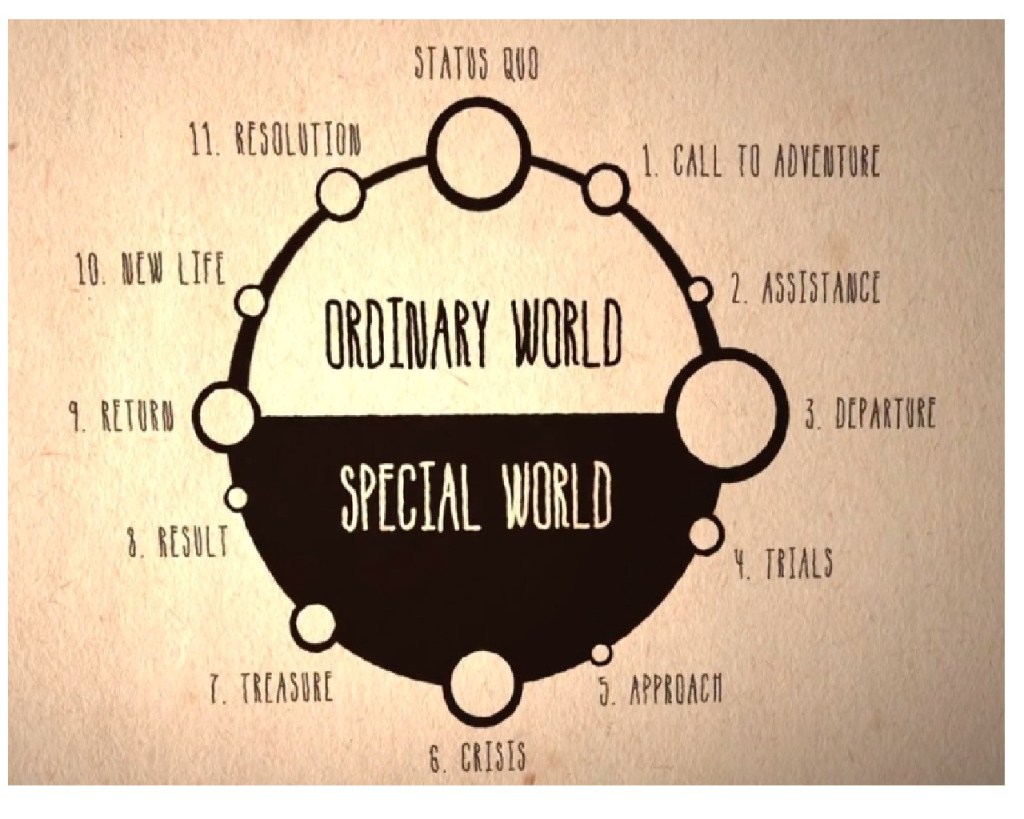
Joseph Campbell’s monomyth, the Hero’s Journey, is outlined in his 1949 book, The Hero with a Thousand Faces. Drawn from his studies of comparative mythology and Jungian psychology, the Hero’s Journey has become a foundation myth of modern culture. The hero, generally young and vigorous, sets off into the unknown to battle antagonistic forces and returns transformed, a hero and guide to his people.

As Campbell writes in The Hero with a Thousand Faces:

A hero ventures forth from the world of common day into a region of supernatural wonder: fabulous forces are there encountered and a decisive victory is won: the hero comes back from this mysterious adventure with the power to bestow boons on his fellow man.

The Hero’s Journey has served as the go-to template for Hollywood screenwriters and bestselling novelists. We see this mythic pattern of the conquering male hero played over and over again in popular culture. Think Luke Skywalker in the original 1977 Star Wars—or any protagonist in a George Lucas or Steven Spielberg movie. Creative writing teachers encourage their students to pattern their story arcs on the Hero’s Journey to give a sense of archetypal depth and resonance. But this technique has been overused to the point of becoming a cliché. A deeply sexist cliché. Continue reading “The Via Feminina: Revisioning the Heroine’s Journey by Mary Sharratt”

The Time of Your Life by Mary Sharratt

Kicking back and enjoying life in the Englischer Garten in Munich, Germany.

Between the ages of 24 and 36, I made my home in Munich, Germany where I taught English to professional adults and began my writing career. My first novel, Summit Avenue, was published in May 2000 when I still lived in Grafing, a market town at the end of the light rail line heading east from Munich.

What I remember most fondly about my Munich years was how much time everyone seemed to have. I had time to teach, write novels, enjoy an active social life, and travel the world from French Polynesia to Namibia. We had eight weeks of paid vacation a year plus numerous public holidays.

During this time, inspired by Julia Cameron’s wildly popular self-help book The Artist’s Way, I took weekly “Artist’s Dates.” I took the train to Munich, got off at the Ostbahnhof, and set off on long aimless walks. Whole short stories would be created in my head during these solo jaunts. I became a flaneur and learned to carry a notebook so I could find a park bench, or, in winter, a table inside a café, to write out the story that unfolded organically during these serene, unrushed afternoons. Continue reading “The Time of Your Life by Mary Sharratt”

Margery Kempe: The Self-Made Mystic

In the 15th century, as now, independent female travelers faced harassment and suspicion.

I’ve always been fascinated with the women mystics, such as 12th century powerfrau and visionary Hildegard von Bingen, the heroine of my 2012 novel, ILLUMINATIONS. Likewise my new novel, REVELATIONS, which will be published in April 2021, is centered on two 15th century English mystics, Margery Kempe and Julian of Norwich. Like Hildegard, they were women of faith facing the roadblock of institutional, male-dominated religion that sidelined them. But instead of letting this beat them down, they found within their own hearts a vision of the divine that mirrored their female experience. I believe it’s no mere coincidence that both Hildegard and Julian dared to create a theology of the Feminine Divine, of God the Mother. All three women seized their power and their voice to write about their encounters with the sacred, preserving their revelations to inspire us today.

While Hildegard and Julian are iconic, Margery Kempe is a more marginal figure–well-known among medievalists but much less known to a general audience. I first encountered Margery in a post-grad course entitled Late Medieval Belief and Superstition. I was blown away by the story of this enterprising woman who survived postnatal depression and a soul-destroying marriage to become an intrepid world traveler and literary pioneer. The Book of Margery Kempe (c. 1436–38) is the first autobiography in the English language.

Margery’s story explodes our every stereotype about medieval women.

She was not just a desperate housewife and mother of fourteen. She rebelled against the straightjacket of an abusive marriage by becoming an entrepreneurial businesswoman. First she ran a brewery, then a grain mill. When both businesses failed and she’d had enough, she left her husband behind and took to the road as a pilgrim, traveling to Jerusalem, Rome, and Santiago de Compostela. This in an age when very few women traveled even in the company of their husbands, Margery blazed her own trail across Europe and the Near East.

Alas, like strong women throughout history, her independence and eccentricities drew suspicion. Before long she found herself on trial for heresy. A guilty verdict would have seen her burned at the stake, yet she kept her spirits high by regaling the Archbishop of York with a parable of a defecating bear and a priest.

Before leaving on her monumental pilgrimage, Margery sought the counsel of her sister mystic, Julian of Norwich. This was an exceedingly vulnerable time in Margery’s life. In leaving her husband and children behind, she had broken all the rules, and she was filled with self-doubt and uncertainty. Julian’s advice to trust her inner calling and not worry too much about what other people thought seemed to have a profound and empowering impact on Margery. While Julian had chosen to wall herself into a cell and live as an anchoress, she gave Margery her blessing to wander the wide world.

Sadly, some historians and theologians try to pit Julian and Margery against each other. Julian is held up as the real saint, the real deal, while Margery is dismissed as a hysterical wanna-be. Because she had the habit of copious weeping when in the throes of mystical experience, many people, both in her time and ours, have refused to take her seriously.

Yet a number of fascinating synchronicities connect Margery and Julian. In so many ways, their stories intertwine and complement each other.

Margery was born in 1373, the same year that thirty-year-old Julian received her “showings”—the divine visions that would inspire her landmark book Revelations of Divine Love, the first book written in English by a woman. Both women lived in Norfolk, in cities less than 45 miles away from each other. Both women were literary pioneers whose lifework was lost to obscurity, only to resurface in the twentieth century.

Immersing myself in Julian’s radical theology of the primacy of divine love was a profound experience. Like Margery, I often found myself moved to tears by the beauty of Julian’s visions, by her absolute assurance that no matter how dire things may seem, all will be well.

But what took me by surprise was how revelatory Margery’s dance with self-doubt was for me. In writing this book and delving into medieval mystical texts, I discovered that our doubts, as painful and wrenching as they are, aren’t a flaw or hindrance. In fact, they lead us deeper into the divine mystery, the vast “Cloud of Unknowing” where God dwells. Only when we set aside our preconceived notions of what we think we believe the divine to be, can we enter this numinous place.

As a mystic, Margery’s especially fascinating to me, because she found her spiritual bliss not in the cloister, but as a laywoman, in the full stream of worldly life with all its wonders and perils. May we all have the power to reinvent ourselves as courageously as Margery did.

Mary Sharratt is on a mission to write women back into history. Her acclaimed novel Illuminations, drawn from the dramatic life of Hildegard von Bingen, is published by Mariner. Her new novel Revelationsabout the globe-trotting mystic and rabble-rouser, Margery Kempe, will be published in April 2021. Visit her website.

The Other Side of the Mountain by Mary Sharratt

The author in the Dolomite Mountains in 2017.

I love my new life in Portugal and I’m so happy and grateful to be here. However, I have encountered one major roadblock–I simply cannot replicate my daily writing routine that I’d relied on in the UK for nearly twenty years. I used to get up and leap right on the page, but now I keep horses on my property and their care and feeding come first, before I even get my human breakfast. And horse care is the last thing I do before sunset. If once I was a morning writer, now I’m a late morning/early afternoon writer. Writing gets sandwiched between horse care. Creative ideas bubble up as I ruminate while picking poo in the early morning. I’ve had to find a new rhythm that fits my new life.

Many of us, particularly many women, are struggling to find their daily rhythm while balancing the demands of remote-working with childcare, home schooling, and elder care as we enter the eleventh month of our global pandemic. This can be depleting, to say the least. To make matters worse, the old boundaries between work, family life, and “leisure” have unravelled and become impossibly blurred. Many of us feel under even greater pressure to be productive during this time.

Experts preach that we need to manage our time, plan every minute of the day by making little boxes for each task in our daily planner. I have tried to do this, but always rebel in the end. It seems a pointless task to try to force the flow of my day into orderly boxes. Instead I try to find what rhythms work for me so it feels organic rather than forced.

Now as a woman in my mid-fifties, I feel I have arrived at the other side of the mountain. I moved to Portugal, in part, to slow down. To be less frantically obsessed about work and career. To take a step back from the whole competitiveness of the writing world that can be soul-destroying and completely antithetical to the creative process. I’m done running myself ragged in some misguided attempt to get ahead. Perhaps I’m losing my “edge.” Perhaps this is what it means to be literally “over the hill.” You’ve come so far on your journey that it’s too late to return to old ways of doing things or old ways of seeing the world–the view is completely different up here.

Due to the radical reset of the pandemic, I think that a lot of people are arriving at this place, regardless of their chronological age. At some point we reach a peak of life experience beyond which there is no going back. We have entered a new landscape, brand new territory where the old maps will not get us anywhere. We have to seek a new direction. We have arrived in the place where we can claim our power, our inner sovereignty, and live our life to the rhythms that work for us.

For me this means abandoning the cult of productivity, the pervasive belief that living to work makes us virtuous. That our worth is determined by our output. This cult is particularly damaging to women who still carry the bulk of childcare and domestic work–the whole second shift of wife work that goes unrecognized, unvalued, and unpaid. I believe the majority of male productivity gurus can only adhere to their monastically rigid schedules because they have an unpaid woman in the background doing all the childcare and mopping up all the mess.

One thing I’ve learned the hard way is that, if we let it, the cult of productivity will completely poison both our creativity and our spirituality.

The cult of productivity diminishes our daily spiritual practice as yet another demanding task on our to-do list, a result-oriented form of competitive striving. “I’m not a serious spiritual seeker unless I get up at 5:00 am to meditate. How else will I be on track to achieve enlightenment?”

Spiritual practice is by its very nature the precise opposite of doing or striving. It’s letting go, surrendering to a state of pure being and receptivity, relaxing into the divine luminosity welling up in our hearts.

As for creativity, international best-selling author Hilary Mantel, one of my great idols, has written one of the best essays on the writing process I have ever read. Writing world-class literature, for her, is not a matter of locking herself in her office for eight hours a day or adhering to a rigid word count but of finding the right rhythm.

“I have to grab a notebook and write before I am properly awake,” she writes. “The day’s writing starts to unroll in my head. It’s fragile and often a matter of rhythm rather than words.”

Mantel stresses the importance of writers trusting themselves, trusting their creative flow, rather than obsessing about productivity. Good writing is not a matter of “persecuting paper with ink or pounding the keys. . . . You can’t measure your productivity day-to-day in any way the world recognizes.”

Then Mantel spills her secret that cuts the productivity gurus down to size:


I feel shy of saying this, because to non-writers it sounds lazy–but if, seven days a week, you can cut out two hours for yourself, when you are undistracted and on-song, you will soon have a book. Unoriginally, I call these “the golden hours.” It doesn’t much matter where I find them, as long as I do. I usually work many more hours. But sometimes I wonder why.


When we step into flow, either creative or spiritual flow, we enter a realm of timelessness, where our calendars and clocks dissolve into oblivion. We lose ourselves in that rich inner world. And it’s not forced. It’s not imposed upon us. The flow carries us. May we all be blessed with golden hours.


Mary Sharratt
is on a mission to write women back into history. Her acclaimed novel
Illuminations, drawn from the dramatic life of Hildegard von Bingen, is published by Mariner. Her new novel Revelations, about the globe-trotting mystic and rabble-rouser, Margery Kempe, will be published in April 2021. Visit her website.