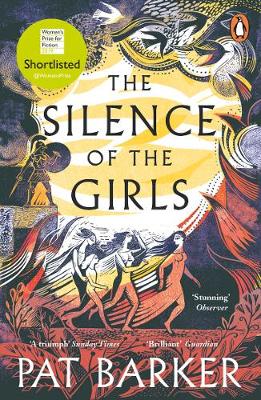
The Silence of the Girls: A Reflection on War by Carol P. Christ

Suppose, suppose just once, once in all these centuries, the slippery gods keep their word and Achilles is granted eternal glory for his early death under the walls of Troy. . .? What will they make of us, the people of those unimaginably distant times? One thing I do know: they won’t want the brutal reality of conquest and slavery. They won’t want to be told about the massacres of men and boys, the enslavement of women and girls. They won’t want to know that we were living in a rape camp. (324)

In The Silence of the Girls Pat Barker retells the story of the siege of Troy from the perspective of Breseis, a captured Trojan princess who became the slave and concubine of Achilles and Agamemnon. She was among the “spoils of war” allotted to the “great heroes” to “honor” their success as killers in war. Breseis does not tell her story of terror in The Iliad, but despite her not speaking, her story and that of the other captured and raped women—many of whom fared much worse that she did–is there is plain sight.

The problem is not that we who have read The Iliad don’t know these women were living in a rape camp. The problem is not that we have read The Iliad do not know that the heroes of the Trojan war were awarded women and loot as a reward for good fighting. Nor is the problem that we do not know that in the times of the Trojan war a man’s “honor” was everything to him and that it was defined by the prizes (women and loot) that he commanded, as well as by the respect of other men his deeds and property inspired.

When I first taught The Iliad in 1972, I was appalled by the women’s story. While my colleagues spoke of the “spear captive” who was the focus of the conflict between Achilles and Agamemnon, I urged them to call her a “rape victim.” Needless to say, I was summarily silenced. “That is not the point of the story,” I was told. “This is a story about men, their glorious deeds, and the honor due to warriors. This story speaks of the origin of culture.” A few guffaws signaling agreement followed. And that was the end of the discussion.

Although I enjoyed reading The Silence of the Girls, it did not provide me with any new insights into the horrors of war or the pervasiveness of rape in war. These were stories I already imagined. Indeed, rape, looting, slavery, and the spoils of war are at the heart of my “A New Definition of Patriarchy.”

The question I ask after reading The Silence of the Girls is how western culture managed to “silence” the women whose stories were there in plain sight for anyone who read The Iliad to see. Breseis was forced to have sex with and wait upon the man who killed her four brothers and her husband and who treated her as a possession not as a person. (283) She learned that when Achilles tired of her, she would probably be offered to his favorite men, and when they had their fill of her, she would be sent to live with the women who were at the mercy of the foot soldiers. “But that’s war,” (284) the Trojan king Priam replied when she asked him to help her escape.

There is more than one “conspiracy of silence” at play here. The conspiracy was compounded when the first person who questioned euphemisms such as “spear captive” was ridiculed and when every man or woman who recognized that rape is an ordinary part of war was told to keep silent about that. It was justified by the phrase “that’s war.”

If The Iliad is the origin of western culture, then western culture originated in a rape camp. Let’s not keep silent about that any longer! We must name the atrocities at the origins of so-called “culture” if we wish to create a more just world. These atrocities did not end with the Trojan war. They continue up to the present day. Ask any woman who has been in the path of invading armies. Ask the soldiers what they did and were permitted to do.

Refuse to accept the aeons-old cover-up: “that’s war.” If that is war, it is time to end war.

Carol P. Christ is an internationally known feminist and ecofeminist writer, activist, and educator who lives in Heraklion, Crete. Carol’s recent book is Goddess and God in the World: Conversations in Embodied Theology. Carol has been leading Goddess Pilgrimage to Crete for over twenty years: join her in Crete. Carol’s photo by Michael Honneger.

Listen to Carol’s a-mazing interview with Mary Hynes on CBC’s Tapestry recorded in conjunction with her keynote address to the Parliament of World’s Religions.

Poem: “Safer at Home in these United States” by Marie Cartier

Content Warning: Child abuse, domestic violence. 

~~~~~~~

Safer at home is what we are told to do in these United States right now,

and the idea is you will not be able

to spread the virus, or catch the virus, if you are home.


I was never safer at home growing up

and sure, people talk about that—safer at home—

but it’s not safe for everyone, especially if you don’t have a home,

and certainly not one you are safe in.


I think of the girl I pass sometimes, walking my dog at night.

She puts herself in a green bag and curls around the meter block to be invisible and sleeps.

She pulls the bag over her head and draws the cord. I was afraid it was a large animal dropped off

until I got closer and saw it was a woman, the top of her head visible beneath the closed bag.

I must understand that she has no home, and she came from one at some time– that was not safe.

Do you remember the little boy? So cute—with a little man’s hat and

a twinkle in his eye, eight years old. His parents beat him repeatedly because he didn’t put his toys away correctly, and because they thought he was gay. He was eight. Continue reading “Poem: “Safer at Home in these United States” by Marie Cartier”

Matriarchal Politics: The Vision of an Egalitarian Society (Part 1) by Heide Goettner-Abendroth

Matriarchies are not just a reversal of patriarchy, with women ruling over men – as the usual misinterpretation would have it. Matriarchies are mother-centered societies: they are based on maternal values: care-taking, nurturing, motherliness, mutual support, peace keeping and building by negotiation, which holds for everybody: for mothers and those who are not mothers, for women and men alike. Matriarchal societies are consciously built upon the maternal values and motherly work, and this is why they are much more realistic than patriarchies. They are, on principle, need-oriented and not power-oriented, they are gender-egalitarian societies, and most of them are fully egalitarian. Their precepts aim to meet everyone’s needs with the greatest benefit. So, in matriarchies, motherhood – which originates as a biological fact – is transformed into a cultural model.

It is becoming increasingly clear that this radically different cultural model of matriarchy will have great significance for the future of women and mothers, and of humankind in general. We can gain much stimulation and insights from them, which – unlike abstract utopias – have been lived over millennia. Continue reading “Matriarchal Politics: The Vision of an Egalitarian Society (Part 1) by Heide Goettner-Abendroth”

I Am a Progressive because of Not in spite of My Feminist Spirituality by Carol P. Christ

Feminist spirituality is often disparaged in academic feminist and progressive communities. Many of the strongest critics are Marxists, but there is a general agreement that religion is the opiate of the people, a false belief system that diverts energy from the difficult work of creating justice in this world. This view is rooted in the habit of thought known as classical dualism in which spirit and nature, spirit and body, and this world and the next are viewed as antithetical. From this, it would seem to follow, feminist spirituality focuses attention on an imagined spiritual world as opposed to the material world in which real people live and interact with each other. Nothing could be farther from the truth.

Feminist spirituality is rooted in a strong critique of classical dualism, which sets mind above body, spirit above nature, and male above female. Feminist Goddess spirituality asserts that the female body has been especially disparaged in traditional theologies rooted in classical dualism. This can be seen in the image of the naked Eve as the source of evil, sin, and temptation. In contrast, Goddess spirituality is inspired by images of the female body of the Goddess as a symbol of the Source of Life. Goddess spirituality understands nature (or the world) to be the body of the Goddess and affirms this world as our true home. This world is understood to be an interconnected web of life shared by humans and other than human beings. Continue reading “I Am a Progressive because of Not in spite of My Feminist Spirituality by Carol P. Christ”

Last Will and Testament by Carol P. Christ

Just over a month ago and shortly before Greece went into Coronavirus lockdown, I signed the contract on my new apartment in Crete (after waiting 6 months for the owner to submit his paperwork). Though I did not realize it until I had been sitting in the notary’s office for several hours, the date of the signing was February 25, my father’s birthday. My father and I had a troubled relationship, due to the fact that he could not accept that I did not “know my place” in a world where women were expected to be submissive to men.

My father and I did not see each other during the last thirteen years of his life. After having received “the silent treatment” for two of the four months when I was teaching in California and living less than a mile away from him and his third wife, I had gradually come to the conclusion that I did not want to put either of us in the position where he could be cruel to me again. When he developed a heart problem a few years before he died, I decided not to visit. Nor did he ask me to do so. Continue reading “Last Will and Testament by Carol P. Christ”

“And a Rich Old White Man Shall Lead Them”? by Carol P. Christ

“And a rich old white man shall lead them.” Is this saying found in the Bible or any other collection of sacred texts that those committed to social justice admire? If not, then why are liberal pundits (and even some of my friends) rushing to declare Michael Bloomberg to be the candidate—and perhaps the only candidate—who can save America from Donald Trump?

When the Democratic Party changed its rules to allow Michael Bloomberg onto the stage after “following its rules” to exclude Kirsten Gillebrand, Kamala Harris, Corey Booker, and Julian Castro, I was appalled. I agree with Bernie Sanders and Elizabeth Warren that it is imperative to get big money out of politics. I supported the small step in that direction enshrined in the debate rules requiring significant numbers of small donors. The decision to rescind this rule in order to place Bloomberg on the debate stage made my blood boil: it confirmed what I already knew—that the Democratic party is not fully committed to cutting its ties to big money.

Bloomberg’s brazen attempt to buy himself the Democratic nomination should be reason enough for progressives to reject him. That Democrats are rushing to support him may say more about their fear of Trump winning again than about any admiration they have for Bloomberg. Joy Reid, for example, opined that Bloomberg would be able to outspend Trump in the election and that unlike other Democratic candidates, he would not be afraid to fight just as dirty as Trump.*

Charles M. Blow took another view. In a New York Times opinion piece, he reminds Democrats of Bloomberg’s notorious “stop-and-frisk” policy when he was mayor of New York City: Continue reading ““And a Rich Old White Man Shall Lead Them”? by Carol P. Christ”

I’m Getting Triggered by the Impeachment Trial and I Bet I’m Not Alone by Janet Maika’i Rudolph

This process is rattling my bones and aching my heart. How often have we seen angry men (and sometimes women) abusing women, abusing the earth, abusing the vulnerable, abusing immigrants, abusing power? And yet the pattern never seems to end. In many cases, they not only get away with it, it is actually celebrated.  

Some have been called to account – think Bill Cosby. But look how hard it is, how many years, how many accusers it takes for justice to be done. We even have two supreme court justices credibly accused of abuse. 

And look at the National Archives’ recent blunder in their exhibit titled “Rightfully Hers.” It was truly no accident that they put up an image of the 2017 Women’s March and blurred out the protest signs. Oh, the irony to blur out women’s voices in an exhibit named Rightfully Hers. Yes, they apologized. But they had to get caught first. 

We are now watching this grand human play with no promise of denouement or a finale to result in healing. 

We all know what happens when untethered abusers are allowed free reign. Although no future is set in stone, I can no longer listen to people talking about how our abuser-in-chief will inevitably be acquitted in the Senate. 

How do we carry on when human justice is denied as it so often is? 

The man who raped me was never caught. My father, who abused me, died before I really understood what abuse was. I never confronted him, nor did he pay any earthly justice price. My mother, who stood silently by, would never speak to me about it. She went to her grave never giving me details of things I knew had happened before I was of an age to remember. I know at least some of the tale from family stories and the scars left on and in my body. “This big secret” was the elephant in our room when it came to our relationship. We were never close. 

I must learn to live without human justice on this earth. My father was very much like Trump except he never had such a big platform. His response to anyone and anything he didn’t like was to sue. He was loud mouthed and judgmental. He would wake people up in the middle of the night to cater to some whim of his. But wow, if he liked you, he lavished you with his riches. And he was rich at one time. But he had made too many enemies and eventually his lawsuits started turning against him. He died from the effects of alcoholism. He was in debt. Near the end of his life he asked me for a loan. I knew I would never get it back. I figured out the price of my guilt (you know for not loving my father enough) and that’s how much I gave him. It wasn’t much. I was right, I never got it back.  

As I’ve written in this blog space before, it reinforces my belief that we each need to find our own healing path, our own pathway through human suffering. And when we come to moments of calm, we need to share our lessons. We need to spread love anyway we can, and we need to fight like hell for those still who can still get justice here on Earth. Everyone has their story of heartbreak whether it be abuse, illness, unimaginable loss, war, extreme poverty, institutional racism, miscarriages of justice, exploitation or any other number of offenses against a person. How can we face it all? How can we experience it all?

As I write this, it is Martin Luther King Day here in the United States. He was a font of wisdom and an exemplar of social action. One of his quotes resonates particularly deeply with me this year. He said, “I have decided to stick with love. Hate is too great a burden to bear.” Yes it is!

I have learned that letting go of pain and replacing it with love is the nature of forgiveness. It is not to forget but to change our own energy around the suffering. And in return for my forgiveness I don’t have to carry the too enormous burden of my history and my family shame. It is the words of MLK Jr that I want to permit to vibrate my bones and heal my heart, not the ugliness of the politics of the moment. And I think that this has global benefits as well. We are more effective when we fight social battles from a place of personal love and health than when we are vibrating the same suffering. 

Now that we have our abuser-in-chief here in the US at least brought up to face public charges, I would gladly substitute to him what I could never get from my father – for him to face true justice. By all accounts it won’t happen. The loudest shouter seems to win, and he is the loudest of all. 

Rumi wrote a poem called “Joy at Sudden Disappointment”

Someone once asked a great sheikh
what sufism was.

“The feeling of joy
when sudden disappointment comes.”

The eagle carries off Muhammed’s boot
and saves him from snakebite.

Don’t grieve for what doesn’t come.
Some things that don’t happen
keep disasters from happening.

If I may be so presumptuous, I wish he had stopped at his second line. What if that sudden disappointment doesn’t prevent disaster but is at the root of it? Can we still find a place of joy? That is the space where we need to truly heal ourselves and our world. I know I will need to find my own ending to this ugly drama in order to survive it. 

In the meantime, I really do hope that both my mother and father are resting in peace.


Janet Rudolph has written three books on the subject of ancient Biblical Teachings.  One Gods: The Mystic Pagan’s Guide to the Bible, When Eve Was a Goddess: A Shamanic Look at the Bible, and the just recently released book, When Moses Was a Shaman. For more information visit her website at /www.mysticpagan.com/

Quaker Ancestor Buys 6 Year-Old Indian Captive by Carol P. Christ

When I wrote about Anne Hutchinson as America’s first feminist theologian a few years ago, I mentioned that I had a Sackett ancestor living in Boston at the time, who might well have been a follower of Hutchinson. That branch of my family tree has since been shown to be false. Recently, while looking into the branch that replaced it, I discovered that in 1637 my 9x great-grandfather William Wodell was required to turn in all of his guns and other weapons because he had been “seduced” and led into “dangerous errors” by a Mr. Wheelwright and Mrs. Hutchinson.

In 1643 William Wodell was charged with “heresy and sedition” in relation to “blasphemous errors.” He was convicted and banned from Boston. He retreated to property he had purchased in Portsmouth, Rhode Island, which had been founded by the Hutchinsons and others fleeing persecution in Boston. Wodell became a respected member of the Quaker community in Portsmouth, holding a number of important public offices before his death some 50 years later.

My happiness at finding an ancestor whose convictions I could admire, was to be short-lived. The next morning, I discovered that in 1677 the respected Quaker William Wodell bought a 6 year-old Indian girl who had been captured in King Phillip’s War. Indian women and children were captured and sold as slaves during both the Pequot War (1636-1638) and King Phillip’s War (1675-1676). Some of those captured were sent to the West Indies, while others were purchased by English colonists. Continue reading “Quaker Ancestor Buys 6 Year-Old Indian Captive by Carol P. Christ”

Old Men Get Away with It: Why? by Carol P. Christ

A few days ago, a friend told me she had just learned that she had a 2x great-aunt who was a beloved and honored single white teacher in the US south in the first half of the twentieth century. The beloved teacher had a school named after her. My friend never heard anything about her distinguished relative while growing up. As a woman without children herself and a teacher, she wished she had. “There are many of us,” she commented.

I offered to do a little research for my friend. Perhaps thinking of my 2x great-aunt who was a single businesswoman, I expected to find that the beloved teacher lived with her mother. What I found was so shocking that it kept me up at night. Continue reading “Old Men Get Away with It: Why? by Carol P. Christ”

A Predator by Sheree La Puma

Feminism and Religion Project Art work designed by Jaysen Waller – http://www.jaysenwaller.com/

“Have I had two roads, I would have chosen their third.”
― Mahmoud DarwishIn the Presence of Absence

Now I tell myself that I’m street smart. I did the Jack Kerouac “On the Road” trip when I was 18, driving cross country in the fall, even sleeping in my car. I’ve volunteered in the projects, been a motivational speaker in correctional camps. I’ve shooed away drug dealers south of Marrakech, been lost in the woods in Michigan, and lived in L.A., N.Y. and London. Despite the occasional bump and an oft damaged psyche, to this day I trust when I shouldn’t. There is some small part of me that longs to see good in everyone…believes there is something redeemable in the worst of men.

The problem is I need to remember that I am not the one with the power to heal the broken. That job belongs to God. My magical thinking has brought me to the edge of a precipice and as my partner of 13 years tells me “I worry about you because there is EVIL out there and you don’t see it.”  I used to scoff at that idea. After all, what does evil look like?  I’d surely recognize it.  But as I look back at past behaviors…picking up hitchhikers on the side of the road at 16, driving homeless drug addicts to recovery, meeting strangers posing as “men of God,” and “writers,” to help them get their careers going, I realize I’m exposing myself to harm on a daily basis.

Continue reading “A Predator by Sheree La Puma”