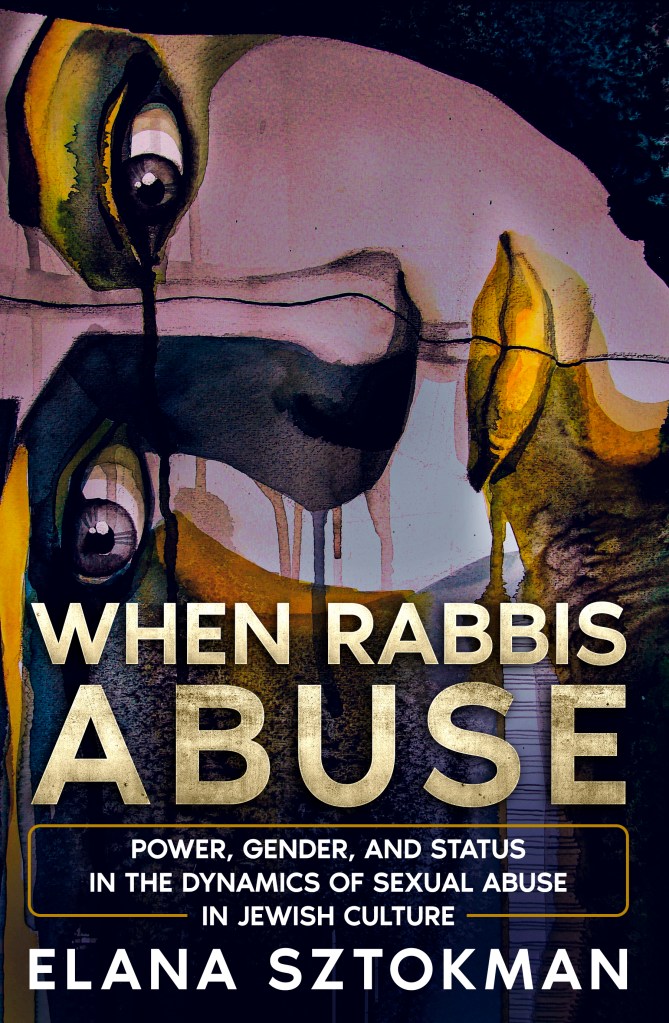
When Rabbis Abuse: Power, Gender, and Status in the Dynamics of Sexual Abuse in Jewish Culture, Part 1 by By Dr. Elana Sztokman

Moderator’s note: This is a book excerpt in 2 parts. Part 2 tomorrow. When Rabbis Abuse will be published on June 14th, information on ordering below.

When I started this research in 2015, I was not expecting rabbis to be the headliners. I was looking at abuse in general in our community. When I began conducting interviews on this topic, I was startled to discover how many of the abusers described by interviewees were rabbis.

Discovering rabbis

Although anthropology does not claim to offer statistical evidence or representative sampling, and although I efforted to maintain listening neutrality and non-judgment, I was nonetheless swept away by hearing so many of these accounts of rabbis who sexually abuse. The title of this book is a result of an incomprehensible number of interviewees in which the abuser was a rabbi. I decided to examine the profile of the rabbi-abuser more carefully to understand what this means for our culture and our community, and to use those insights to analyze other cases of high-profile abuse using those paradigms of power in our culture….

Continue reading “When Rabbis Abuse: Power, Gender, and Status in the Dynamics of Sexual Abuse in Jewish Culture, Part 1 by By Dr. Elana Sztokman”
Crowning the Mother Tree by Sara Wright

Crown the trees

that feed

the bees,

 one more

keystone species.

Crown the trees

 that purify  

 poisoned air,

  ground, water,

create clouds

for rain,

return fish

 to streams…

Crown trees

that shelter birds

as they turn

light to sugar

releasing oxygen

so that we may

breathe

Abundant Greening.

During this month

of her Crowning

let us gather round

The Mother Tree

 to accept communion.

 at gnarled old feet.

Continue reading “Crowning the Mother Tree by Sara Wright”

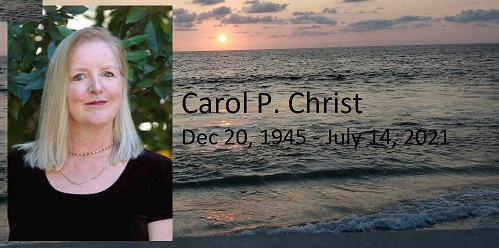
The Legacy of Carol P. Christ: GOD AND WOMAN AT YALE*

This was originally posted on June 25, 2012

As a graduate student, I was told in every way possible that I could not be a woman and a theologian.

When I was studying for my Ph.D. at Yale in theology in the late 1960s and early 1970s, my skirts were short as was the fashion of the day.  The male faculty and students and their wives dressed in ways that would not call attention to themselves or their sexuality.  I was also over 6’ tall.  When I walked into a room, I was consciously and unconsciously perceived as a threat to a world which these men had simply assumed was “theirs.”  Their response was to categorize me as a sexual being (I was once introduced as “our department bunny”) and to erase my mind.  I was to discover that the male graduate students were making bets in the dining hall about “where she will sit today.”  One of my friends frequently fell down and feigned to “worship” me when I passed him in the hallways.  I had never received so much attention from men before and it was flattering.

Continue reading “The Legacy of Carol P. Christ: GOD AND WOMAN AT YALE*”

From the Archives: The Eldest, Truest Olympians

This was originally posted on June 7, 2020

Scene: A comfy lecture hall in the temple on the summit of Mount Olympus. The feminist historians have taken their seats. The eldest Olympians rise to speak. Let us attend to their words.

I am Hera, Queen of All, Daughter of Gaia, Daughter of the Great Mother, whose body is our holy earth, whose bodily fluids are our springs and oceans, whose mind is our precious air and holy fire. I am Mother of the Fates, Sister of Hestia, protector of homes, and sister of Memory, whose daughters are the Muses, sponsors of our culture. I live in contentment with my wife, Zeusina.

Continue reading “From the Archives: The Eldest, Truest Olympians”

From the Archives: Artio, Celtic Goddess of Wild Life, Transformation and Abundance by Judith Shaw

This blog was originally posted August 26, 2015. You can read the original comments here.

Artio, Celtic Goddess of Wild Life, Transformation, and Abundance, is one of the more obscure goddesses in the Celtic pantheon.  She is often shown with baskets of plenty and surrounded by animals.  Artio is frequently depicted as a bear. Her name comes from the old Celtic word for bear, arth(e), which the Romans Latinized to artos.

Artio arrived in western Europe with the Helvetii a Celtic tribe who migrated to Switzerland around 450 BC.  They worshiped Her as the “She-Bear”.

But Her origins could be even older than that.  Some feel that the bear is the oldest European deity as bones and skulls of bears have been found lovingly arranged on niches found in caves across Europe.  In 1840 in Ireland, during the restoration of Armagh Cathedral, ancient, small stone carvings of bears were found.

Continue reading “From the Archives: Artio, Celtic Goddess of Wild Life, Transformation and Abundance by Judith Shaw”

“For I know the plans I have for you:” The coming out story of a queer Catholic raised in the Purity Culture Movement part 2 by Emma Cieslik

You can read part 1 here.

Growing up, I sat through lessons about how my body was inherently evil, that my thoughts and attractions were sinful and unhealthy. I grew up in the age of the Purity Culture Movement, the height of purity culture dated between the 1990s and early 2000s, amid the flush of “modest is hottest” theologies. I grew up surrounded by language codified around victim-blaming, slut-shaming and heteronormativity. I had attended retreats where we were told to pray for our future husbands, where we placed white roses on the altar as an homage to our purity in veneration of the Virgin Mary. I did not wear a purity ring or sign a purity pledge, but the expectations placed on me reinforced the ideas embedded in these objects none the less. I learned over and over to keep my candle unlit until marriage.

I had repressed my sexuality so far that it felt non-existent. I had shamed and punished myself for years whenever I felt any sexual attraction. If I felt ashamed of my attraction to men, my response to my feelings towards women was far worse, avoiding the eyeline of Victoria Secret models and magazine covers. I didn’t know who to talk to about these feelings—I was conditioned that my thoughts about men were sinful but forgivable. Everyone struggles with attraction prior to marriage. But who could I ask or talk to about my attraction to women? I was worried that what I told a priest in confession would somehow make its way back to my parents or friends. Despite their unconditional love, I worried that this would be the line in the sand, a sin so ugly and unnatural that I wouldn’t be welcome back in our Church.

Continue reading ““For I know the plans I have for you:” The coming out story of a queer Catholic raised in the Purity Culture Movement part 2 by Emma Cieslik”

“For I know the plans I have for you:” The coming out story of a queer Catholic raised in the Purity Culture Movement part 1 by Emma Cieslik

It was my last interview for the Muncie LGBTQ+ History Project. I was a senior in college, and I was about to complete my tenth interview focused on the intersections of Christian religion and queer identity. I was slated to conduct an oral history interview with Rachel Replogle, a nonbinary lesbian who runs Indiana’s only queer-affirming wedding videography business. I had expected to explore elements of her work in churches and religious spaces—and I had encountered experiences of trauma, both familial and religious, through the project—but Replogle’s story touched a nerve about my own experiences and made my question the project’s impact on the people conducting it.

Since 2018, the Muncie LGBTQ+ History Project has been collecting the stories of queer people who grew up in and around Muncie. I worked with the project for over a year as a research associate, conducting ten long-form oral history interviews with members of the Muncie LGBTQ+ community about their experiences growing up in Muncie, a small town in East-Central Indiana in the heart of the Rust Belt. Spearheaded by Dr. Emily Johnson [1] the project seeks to uplift and celebrate queer experience in the Midwest. I entered the project with an interest in how queer individuals engage with religious identity, especially in spaces that deny their personhood and/or invalidate their relationships.

Continue reading ““For I know the plans I have for you:” The coming out story of a queer Catholic raised in the Purity Culture Movement part 1 by Emma Cieslik”

I’m Not “Fit” to Judge Another Woman’s “Fit”ness by Liz Cooledge Jenkins

In recent conversations around abortion rights—spurred by a leaked draft of a Supreme Court decision that would overturn Roe v. Wade—everyone has opinions. The financially comfortable, often-white, often-evangelical women in my circles have opinions. And these opinions often involve the lives and choices of materially poor women and women of color.

            In her recent book The Trouble with White Women: A Counterhistory of Feminism, Rutgers University professor Kyla Schuller profiles seven pairs of feminist activists over the last two hundred years. Each pair includes one woman who operated from a framework of white feminism—a framework that, according to Schuller, “consistently…wins more rights and opportunities for white women through further dispossessing the most marginalized.” And each pair includes a woman who embodied intersectional feminism—a feminism that “expose[s] sexism to be a powerful structure of systemic inequality and attempt[s] to untangle its deep threads with other forms of domination, while also building new practices of care, coalition, faith, and solidarity.”[1] This is not just history but a live tension in the present day.

Continue reading “I’m Not “Fit” to Judge Another Woman’s “Fit”ness by Liz Cooledge Jenkins”

May: A Reflection on Time and Trillium by Sara Wright

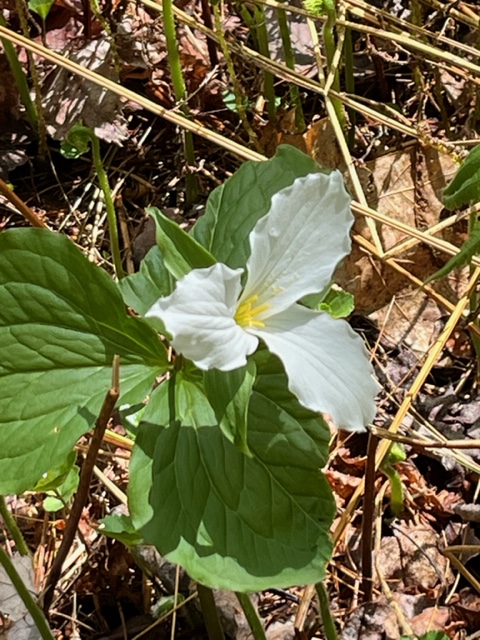
With May coming to a close in a few days, I am feeling nostalgia. This month is both elusive and dramatic – from bare trees to lime green, and now lilacs so heavily laden with blooms that some are bowed as if in prayer.  Wood frogs and peepers bring in the night and the first toads are hopping around my overgrown flower garden; in the forests I surprise them when peering closely at small flowers. Gray tree frogs trill at dusk. Violets of every hue grace the earth outside my door along with robust dandelions, forget – nots, rafts of deep blue ajuga, delicate bells of solomons seal, mayapple umbrellas, false solomon’s seal, wild columbine and golden celandine all nestled in long grasses and moss. No mowing happens here!

On my woodland paths starflowers and Canada mayflowers are now so thick I fear treading on even one, as if one foot could destroy the whole. Down by the brook white trillium bloom on, both painted and purple are setting seed, while bloodroot, arbutus trumpets and delicate anemones have transformed into leafy memory. Ostrich and hay ferns are unfurling, creeping blue phlox and dames rocket are budded or blooming; pink and white lady slippers are beckoning both here and in the woods. June is in the air.

Continue reading “May: A Reflection on Time and Trillium by Sara Wright”

Carol P. Christ’s Legacy: Are Most of Us Abused Children? And is Child Abuse the Root of Evil?

This was originally posted on July 16, 2012

Child abuse does not have to be physical or sexual. The most widespread forms of child abuse are psychological, and therefore harder to see, acknowledge, and eradicate. As abused children, we unconsciously pass on patterns of abuse visited on us to children, and to others we have power over including students, employees, and even friends and lovers.

The recent visit of a friend who is suffering greatly in a “battle” with her own “demons” reminded me of the important work of Alice Miller. My friend’s “demons” take the form of a persistent self-criticism laced with the feeling that “if only” she did or didn’t do certain things, her world would fall into place. My “demons” generally take a different form, telling me that I am helpless and that there is nothing I can do to ease my suffering.

Such “demons” were not implanted in my friend and me by the devil. They took root in interactions with our own parents, who were not themselves any different from most of the parents of their time and place. Recognizing that our parents were not “bad” people should not blind us to the great harm they did to us. However, when abused children speak of their abuse, the statement that their parents did not intend to harm them usually functions to deflect attention away from child abuse that really did occur. What happened to my friend and me was something like this. In many small and perhaps also a few traumatic interactions, we learned that our feelings do not count.  “Don’t talk now, your father is tired.” “Stop making so much noise, your father has a headache.” “Don’t ask your mother for attention, can’t you see that she has more than enough to do with your younger brother.” Harmless in themselves, such messages, when repeated over and over, lead the child to believe that there must be something wrong with the feelings she has.

Continue reading “Carol P. Christ’s Legacy: Are Most of Us Abused Children? And is Child Abuse the Root of Evil?”