From the Archives: Creating Space: Mosques Affirming All Bodies, Minds, and Hearts by Laury Silvers

This was originally posted on December 31, 2013

Silvers, Bio Pic FRBlog

In my first blog for Feminism and Religion, I discussed the cognitive and embodied dissonance that some Muslims experience as a result of historically (not eternally) gendered ritual forms. I ended with a promise to share with readers the ways in which el-Tawhid Juma Circle mosques try to create space to break free of those forms. Our mosques affirm all human beings as spiritually, socially, and ritually equal and try to break down the social hierarchy of ritual and theological leadership by opening up a space for all bodies, minds, and hearts to lead and follow as equals among each other.

Breaking out of cognitive and embodied dissonance requires cognitive and embodied habituation to what Amina Wadud names, “The Tawhidic Principle.”  Meaning, the space must be one in which human beings can embody divine oneness by recognizing that their relationships with each other are on the horizontal plane and refrain from mediating between any other individual and God on the vertical plane.  Wadud has described it as a triangle in which God is at the top with self and other at the two points beneath. Each has an individual relationship with God and a relationship of reciprocitous community with each other. Wadud argues that to mediate between another and God is nothing other than idolatry because the mediator forces another to accept that satisfying his expectations is the same as satisfying God.

Continue reading “From the Archives: Creating Space: Mosques Affirming All Bodies, Minds, and Hearts by Laury Silvers”
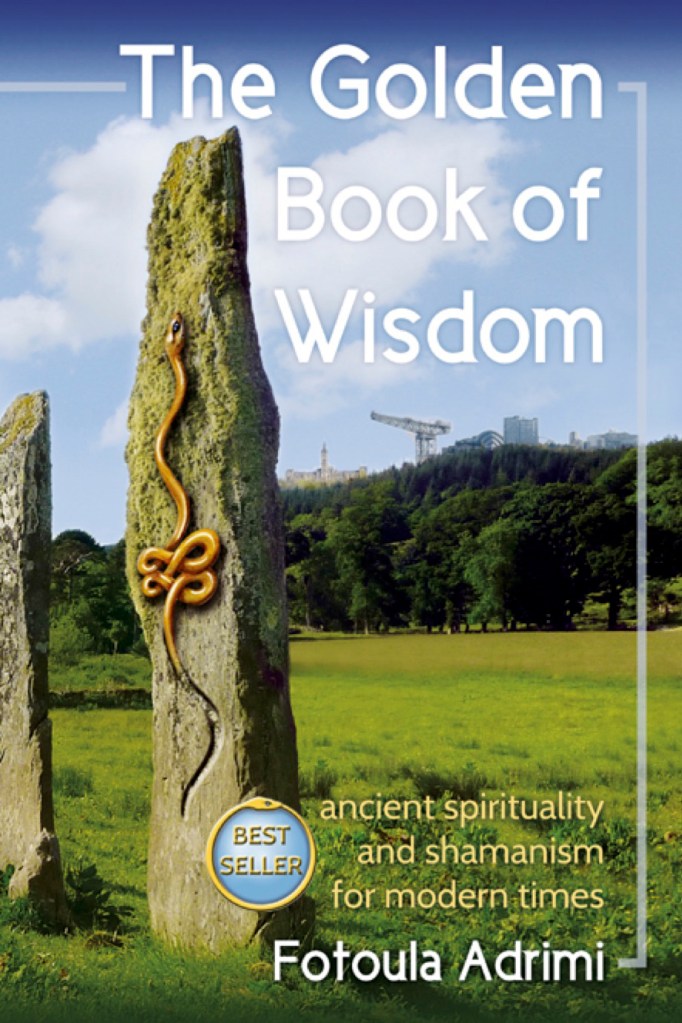
The Golden Book of Wisdom: Ancient Spirituality and Shamanism for Modern Times by Fotoula Adrimi

There comes a moment on the spiritual path, often arriving quietly and unexpectedly, when a woman begins to sense that the life she has been living does not fully belong to her. The roles, expectations, and inherited beliefs that once seemed natural begin to feel like garments that no longer fit. Beneath them, something older and deeper stirs. It is not new knowledge, but an ancient calling.

This call to return to an inner truth has been suppressed in us through centuries of patriarchy, yet it has been carried within us across time. This is a deep exploration that I share throughout The Golden Book of Wisdom – ancient spirituality and shamanism for modern times. In my own journey, this path did not arise as a rejection of the modern world, but as a remembering of something that had always been present. As I share in the book, my early life was marked by intuitive awareness and spiritual connection, which I later suppressed in order to conform to societal expectations. It was only when I returned to spiritual practice through meditation, healing work, and shamanic training, that these gifts reawakened, guiding me back to a path of service and teaching.

At its essence, shamanism is not a belief system but a lived, experiential relationship with spirit, nature, and the unseen worlds. It echoes an ancient role: the healer, the seer, the priestess, the one who walks between the worlds.

In the twenty years I have been practising shamanism professionally, I have come to realise that this movement from disconnection to remembrance, is one that many women recognise. Since 2012 I have been sharing The Priestess of the Moon™ training: a two-year apprenticeship exclusively for women to hold ceremony, rites of passage, and work with the wheel of the year and the moon cycle, reclaiming their inherent mystical power.

Continue reading “The Golden Book of Wisdom: Ancient Spirituality and Shamanism for Modern Times by Fotoula Adrimi”

Embraced by Grace by Margot Van Sluytman

I have Come Full Circle. March 27th is the 48th anniversary of the murder of my father Theodore Van Sluytman in Scarborough, Ontario, Canada. An Easter Monday. My entire life from that time the age of 16 to this time now the age of 64 was, is, and will always be a connection to how word with a capital W and words with a lowercase w, infuse, inspire, and affect my life. I might even say infect my life.

After being contacted by one of my father’s three murderers, almost 30 years after he put the bullet in my father’s heart, we did share healing. All seemed well in the crucible of tying up loose ends as it were. Ten years later, however, he, made choices that were deeply unaligned to that meeting.

When he and I met, it was powerful. It was profound. Terrifying too. And liberating. His choices 10 years after that meeting, though they shattered me for a time, leaving me with feelings of smallness, stupidity, and inadequacy based on the fact that in choosing to meet him major rifts in my family occurred. Few supported my choice to meet him. However, I grew to understand that we are the poetry that we wish to read, to be, and to see in the world. That we are human. I thought about my feelings of smallness, stupidity, and inadequacy. Thought long and hard. Many times. In early dawning days. Sitting in the gloaming. Late into the night.

Continue reading “Embraced by Grace by Margot Van Sluytman”

Confessions: Lunch with Ann by Margot Van Sluytman

This is not Augustine’s confessions. This is not an essay on what love should mean. This is a poetic evocation of recognizing the beauty of friendship, the beauty of companionship. The blessing of breaking bread together and sharing in conversation that is the heart of who and how we are. Who and how we are forever becoming. Even when the Muse abandons us.
     My dear friend, Ann, and I shared a wonderful lunch, talking, tears, supreme laughter, exquisite food. During that conversation, it became clear to me that the poetry of life is love that is situated where kindness and kinship and commitment highlight our meaning, our meaning for being and doing, which is intimately linked, for many of us, with our pens to the page. Fingers to the keyboard. Twinned and intertwined with lushness of choice.
     A choice to have boundaries, whereby though the heart and the flesh can feel moved by what may present itself to be love, stepping back and feeling with the intellect of the heart and the intellect of the mind what is not being said, what is not being expressed warrants keen attention.  A life-changing recognition of the possibility to wash away miasma and mist and pretence. And to stare directly into the depth and clarity that is: Wisdom. She Who Is. Sophia Speaking.

Continue reading “Confessions: Lunch with Ann by Margot Van Sluytman”

Shamanism in the MRI Scanner by Eline Kieft

Medical tests are an inevitable part of modern life. One experience that tends to heighten anxiety is an MRI scan. The claustrophobic tube, the pounding mechanical noise and the requirement to remain perfectly still for extended periods can create intense sensory overload.

At some point I became aware of the similarities with a shamanic journey, and found a way to transform this ordeal into a ritual of connection and support. With mindful presence and inner attunement, you can imagine the tube as a tunnel to the archetypal realms. The rhythmic, mechanical hum replaces the drumbeat. Spirit becomes a companion alongside modern technology.

I hope you’ll never need it, but should you be scheduling an MRI scan, this is an invitation to meet it with a sacred intention. You might connect with a power guide, receive unexpected insights, or simply meditate on a sense of peace while your body is being scanned. Participate, actively, in something that can feel “done to you” and turn it into a soulful inquiry into your inner world while the medical staff do their thing…

Continue reading “Shamanism in the MRI Scanner by Eline Kieft”

Circle of Fire by Sara Wright

Moderator’s Note: This is the final part of Sara’s poem that was posted last week. You can read it here.

Part 1

She burned
 in raging fires
swamped by
merciless floods
crossed mountains
 of grief
so wide so deep
crushed Silence
in her sleep
unknowingly
accompanied
by Owls
and Winter Wren
Marked by Bear’s
sharp Protective
 Claws
 Circles of Fire

Continue reading “Circle of Fire by Sara Wright”

Devi* Has a Sense of Humour by Terry Folks

photo credit: Sonika Agarwal

(*Devi is the feminine principle in Hinduism, the goddess counterpart to Deva, the male aspect.)

I live alone.

I put a small stool on the bathroom floor beside a kitchen chair next to the vanity counter top. My plan was to step on the stool then up on to the chair, then up on to the counter so I could stand and put a hook in the ceiling.

When I finished, I carefully turned around to make my way back down from counter to the chair. As I was stepping down, I felt unstable so I instinctively reached for the towel bar on the wall. The towel bar gave way and I fell directly left side down on to the high back of the chair, bringing the chair down to the floor with me beside the empty stool.

Continue reading “Devi* Has a Sense of Humour by Terry Folks”

Three poems by Rebecca Rogerson

Don’t Take Me to Church

He never let me eat communion because I wasn’t a catholic, but it was okay for me to eat his dick. My tiny palms forced to stroke him, the same dextrous hands that coloured in the lines. 

I knew his God wasn’t my God. I knew she saw everything there was to see and that he wouldn’t reach salvation; no matter how many Hail Marys he said at mass in Ireland.

The Virgin Mary knew what he stole from me, what they steal from all of us.

I couldn’t fall apart on Sundays at noon when he took me to church—before he took me home after he did what he did—to the little Jewish girl who didn’t know she was Jewish.

I couldn’t remember it because I buried it in Survive, until, it was resurrected by nightmares and demons who professed caring and brought me to altars of despair to vomit up all the darkness, and when there was no more left to cleanse or tear out; light ripped in.


No one talks about the embarrassment that goes along with the telling, sharing and surfacing of sexual violence. How it comes up, how it comes back. How we’re always haunted by the deadbeat dead and grabby grandfathers who try to reach from there into here, pretending they are made of heaven.

I fled a friend’s choir concert because perpetrators keep stealing time, moments, sleep, joy, and friendship, in churches and baths. On my flight, I hunted for nature, soil and anything else that felt most alive in the hilly town of Nelson. Pretending I was like everyone else, I hid the panic that strikes broken hearts.

Continue reading “Three poems by Rebecca Rogerson”

Two Poems by Rebecca Rogerson

ROSE WATER

I am the holy place somewhere in the stars of eternity,
 someone’s daughter who seeks reprieve somewhere.

Yetta changed her name to Mary. She tried to erase her past, not as a Jew, well maybe some of that, but more as a Jew molested by her father—a frum[1], “Monster”, his daughters called him.

On my altar sits my tallit alongside a Menorah with seven brass holders. No stars of David—before or after the decimation of Gaza. Can rose water sweeten our hearts? We pour it graciously in our hands, hoping the lost petals heal our guts and brighten our thoughts. She searches hungrily for hope in glass bottles adorned with Farsi, that cost $4.29 each.

Continue reading “Two Poems by Rebecca Rogerson”

Navajo  Mountain Way Chant :  Bear as Healer – He Who Frightens Away Illness, part 2 by Sara Wright

Part 1 was posted last week. You can read it here.

The second sand painting used on the sixth night of the Mountain Way Chant is supposed to be a representation of the bears’ home in the Carrizo Mountains. In the center of this painting is a bowl of water covered with black powder. The edge of the bowl is adorned with sunbeams, and external to it are the four sunbeam rafts, on which the Nature Spirits, the Yei stand. There is a close relationship between the Yei and the bears. In the Mountain Way Chant, Talking God, Water Sprinkler (often pictured as a rainbow) Growling God (bear), and Black God are always present.

Bears and Light are related. In the first painting there is light that surrounds the bear and light is present in the form of sundogs that are positioned in each of the four directions. In the second, sunbeams are present in the center and also in each of the four directions providing places for the Yei to stand. It’s very difficult not to draw the conclusion that the light that we are speaking of is also an inner light, and this is consistent with the qualities of healing, insight, and introspection that the Navajos associate with the bear.

Continue reading “Navajo  Mountain Way Chant :  Bear as Healer – He Who Frightens Away Illness, part 2 by Sara Wright”