Wifehood Redefined: The Twentieth Century Sita by Vibha Shetiya

VibahIn 2003, I picked up a collection of essays on little known Ramayanas. Buried within was a poem by Pathabhi Rama Reddy. Pathabhi, a rebel of Telugu literature, defied not just conventional rules of grammar but also those of popular thinking, best exemplified by his poem, “Sita,” the subject of this post.[1]

Rama’s harsh treatment of Sita in the Ramayana epic when he first doubts her purity, compelling her to undergo a trial-by-fire, and then banishing her despite the fact that she had proved her loyalty to him, has attracted criticism from all quarters – how could the “perfect man” behave so callously towards his own wife who had been Ravana’s helpless victim? The fluidity of the story has ensured a visibility for Sita, no doubt. Continue reading “Wifehood Redefined: The Twentieth Century Sita by Vibha Shetiya”

Was Mother Kalawati a Feminist? (Part 2) by Vibha Shetiya

VibahContinued from Part 1.

After leaving her home and her children in order to take refuge with her guru, in no time, Rukmabai won over hearts. Her guru, Siddharood Swami “with his divine sight” discerned that Rukmabai was no ordinary being. In fact, just before his death, upon realizing that his principle disciple had attained moksha (liberation from the cycle of death and rebirth), he left to her his mission of guiding others to salvation, directing his followers to now address her as Mother Kalawati.

And so it came to be that at the tender age of twenty-one, Rukmabai had a large following herself, and as an intense devotee of Krishna, she almost became synonymous with the god. As many like to point out, she had already internalized the attitude of non-attachment, whether towards individuals, possessions or food or drink; she was already enlightened.

Her disciples were both male and female, although she dedicated herself to the well-being of women. But while directing minds towards god, Kalawati Aai – a high class and high caste woman – also dedicated herself to uplifting the poor and backward Bohari community of Belgaum, Karnataka. It is said that the men used to wile away their time drinking and gambling leaving the womenfolk to run the household. Because of Kalawati Aai’s intervention, some order was brought to their lives; the men stopped drinking, which in turn put an end to the physical abuse they had heaped upon their wives, as well as the neglect their children had faced, who earlier had no choice but to turn to vagrancy. Stability in the homes through prayer and piety – in other words channeling their minds away from vice and towards god – in turn saw not just an economic change but also a change in the lives of these women and children, for the better.

But – and this is interesting – her message to women was not one of directing energy towards god in search of inner peace or salvation, but towards the family, of being a virtuous wife and mother. In fact, she urged women to put aside “just one hour a day of your life to the service of god”; the rest of the time should be aimed towards serving the family. And her advice to women unhappy on account of their domestic life would always be to look deep within themselves to remedy the situation, rather than to blame their husbands. Moreover, at no point should a woman ever neglect her duties towards family on account of her own well-being for that would be tantamount to selfishness. I find this most interesting because she herself broke norms in order to serve a personal calling. Continue reading “Was Mother Kalawati a Feminist? (Part 2) by Vibha Shetiya”

Was Mother Kalawati a Feminist? (Part 1) by Vibha Shetiya

VibahI recently assigned my students an article by Kathleen Erndl – “Is Shakti Empowering for Women? Reflections on Feminism and the Hindu Goddess.”[1] I’m sure, like Erndl, many have been fascinated by this question, especially within the Indian context. Does the presence of an abundance of goddesses necessarily translate to social empowerment for women? The answer is indeed complicated in that one cannot reify all goddess worshippers under one static rubric.

Having said that, however, I would like to posit that generally speaking, it would be fair to say Indian culture is a patriarchal one, and that the presence of a goddess tradition does not translate to independence for women. Firstly, the kind of goddesses worshipped by both men and women, are not necessarily the assertive, independent kind. They are often those such as Lakshmi and Saraswati who are maternal and nurturing, and important in their own right. All too often, however, these virtuous traits have been used to disempower women, to keep them in their “socially assigned places.”

There is evidence from early Hindu literature that the above goddesses may initially have been independent forces, but they soon came to be tamed as consorts of male gods; Lakshmi as Vishnu’s wife, and Saraswati as Brahma’s. Second, fierce and independent goddesses such as Kali and Durga may have a large following, but it is only in certain cases such as in Tantric theology specific to the goddess Shakti, identified with Kali, that ritual practices may do away with gender roles, that both male and female members have equal access to Kali. But the important question would be – outside of the ritual context, how do practitioners of Tantra regard women? In other words, do women have equal social – and not merely equal ritual – status? I am not an expert in Tantric discourse, but judging by various commentaries, I have reason to believe that this does not necessarily translate to gender equality in the social setting.

My quest here, however, is to provide an example of what a community with a strong, female leader may look like. I thought of this example because I have been intrigued with and fascinated by my own family experience regarding the cult of Kalawati Aai or Mother Kalawati (I do not use the term “cult” derogatorily as “a group with a powerful and controlling leader” but in the classical sense of “practices centering on an object of reverence”). My aim is to provide a picture of often conflicting ideals within the Hindu setting, to shed light on how this can play out on the ground. My information on Kalawati Aai – considered a saint by her devotees – comes from hearsay and hagiographical accounts for I never met her; she died almost forty years ago.[2]

Continue reading “Was Mother Kalawati a Feminist? (Part 1) by Vibha Shetiya”

Sita Sings the Blues. Literally. by Vibha Shetiya

VibaOne of the most exciting times of the semester occurs when we watch “Sita Sings the Blues” in class. This film by Nina Paley – one she has made available to the public by withholding copyright – is a wonderful addition to what has come to be known as the Ramayana tradition. Unlike a few decades ago when scholarship focused on only pan-Indian literary Ramayanas, scholars today are beginning to acknowledge that most people get to know of Rama and Sita through folk and oral tales, women’s songs and local and regional tellings.

But the thing about “Sita Sings the Blues” that struck me most was how, in 81 short minutes Paley masterfully reflects the complexity of the tradition; the Ramayana in its various forms has been questioned, adapted, revered and challenged by commentators and devotees alike in the two millennia it has traveled across space and time, from north India to Bali to New York. But what scholarship has elaborated over three decades and endless research, Paley has managed to show in less than two hours.

The Ramayana as my last post explained acts as a blue print for daily living for millions of Hindus worldwide. There are various problematic episodes in the epic, one of the most controversial being Rama’s unceremonious treatment of his own wife, the ever loyal and faithful Sita. Paley like so many others who have joined the debate over Sita’s treatment – one that began in antiquity – gives Sita a voice of her own when she ingeniously has the tragic heroine of the Ramayana singing to Annette Hanshaw’s songs; Hanshaw was an American jazz singer whose success soared in the 1920s and 30s. Throughout the film, her melancholic voice reminds us of the universality of the story, one of a woman scorned by the man she loved. Paley herself could feel Sita’s pain, for amid the various layers of the film, is woven her own experience of love and betrayal. But Paley is present throughout the story in another way – the animation, design and editing is entirely hers. Continue reading “Sita Sings the Blues. Literally. by Vibha Shetiya”

And Then There Was Sita by Vibha Shetiya

VibaWe have been hearing a lot about Kali and Durga lately, manifestations of the great goddess (“Kali Ma,” by Jassy Watson, July 3; “What Would Durga Do?” by Barbara Ardinger, August 2). Nancy Vedder-Shults’ three-part series on Kali (August-October, 2014) too helped shed light on an often misunderstood deity. Both Kali and Durga personify the power or shakti within women, a force that can be empowering and terrifying at once. Kali represents uncontrolled female energy, whereas Durga is portrayed as one in control of her abundant power. These images, especially the one of Kali are double-edged; they can prove problematic for women insofar as – from the male perspective – they confirm the fact that women possess an alarming energy, especially a sexual one, which in turn justifies the need for men to subdue them.

Sita's abduction by Ravana. Artist: Raja Ravi Verma
Sita’s abduction by Ravana. Artist: Raja Ravi Verma

Within this context, I would like to talk about Sita, who, one could argue, is the antithesis of the two. Sita is the gentle wife of Lord Rama, hero of the Ramayana, a two-thousand year old Sanskrit epic. In the Ramayana, Rama, the crown-prince of Ayodhya, is exiled to the forest for fourteen years. His loyal and faithful wife, the princess and goddess Sita, insists on accompanying him to the wilderness. There, the demon king, Ravana kidnaps her leading to a battle between Rama and Ravana. Almost a year and thousands of casualties later, Rama succeeds in slaying Ravana and reclaiming Sita.

But alas, Rama rejects his wife in the presence of the hundreds of onlookers, eagerly awaiting the reunion of the couple, on the grounds that her chastity was suspect; after all, says Rama, surely Ravana couldn’t have resisted her ravishing beauty? If she is to be worthy of Rama, Sita has to undergo a trial by fire to prove that she had indeed remained chaste throughout her captivity. Although she passes with flying colors, Rama eventually gives in to gossip and banishes her to the wilderness a few years later – while she is pregnant with his twins – where she is left to die (she, however, does not). Continue reading “And Then There Was Sita by Vibha Shetiya”

What Would Durga Do? by Barbara Ardinger

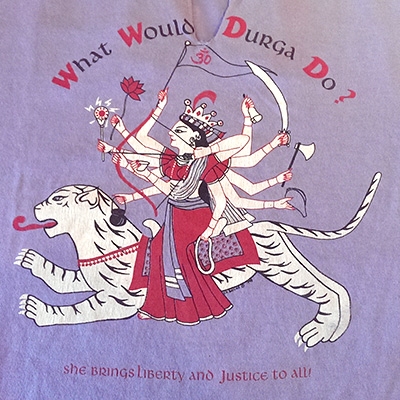
durga1_4inIt’s one of my favorite T-shirts. Every time I wear it, people who know who Durga is comment. So do some people who don’t know who the Hindu goddess is.

 

“What would Durga do?” is of course an echo of the question What would Jesus Do?

I’ve just done a bit of research and learned that this phrase may come from the Middle Ages, that it was famously used in a sermon in about 1891, and that it became very popular among evangelical Christians during the 1990s. What would Jesus do? I think he’d remind us to pay closer attention to the Sermon on the Mount (Matthew 5, 6, 7), especially the Beatitudes and the Golden Rule: “So whatever you wish that others would do to you, do also to them” (Matt.: 7:12). The Golden Rule is of course given in the other major religions, too. WWJD has also been turned into WWBD—“What would Buddha do?” I think the Buddha would tell us to live more mindfully.

But who, you may be asking, is Durga? Why does she have all those arms? Why is she carrying all those weapons? Why is she riding on a tiger? I’ll answer with reference to Patricia Monaghan’s New Book of Goddesses and Heroines (Llewellyn, 1997). While all the Hindu goddesses are ultimately one goddess with the collective name Devi (“goddess”), Monaghan writes, the goddess appears in different forms. “One of the fiercest of Devi’s forms is Durga … [who is] also the eldest.” She appeared during the “primordial war between gods and antigods” and is the “first manifestation of goddess energy” (p. 106). Continue reading “What Would Durga Do? by Barbara Ardinger”

Kali Ma (Part 3 of 3) by Nancy Vedder-Shults

nancymug_3In contrast to the linearity of our time concept in the West, Indians view life as infinite and cyclical.  Although Hindus, like ancient Greeks, believe in four ages of humanity (the so-called yugas), these occur not just once, but repeat cyclically every several million years.  Similarly, the creator god Brahma is said to have a daily cycle which has recurring effects on the existence of the world.  When Brahma awakes the world is created anew, and when he falls asleep it dissolves once again into the primal waters of eternity.  Fortunately for us, Brahma’s day lasts 4,320,000,000 human years.

Holland Cotter, in reflecting on Eastern art, once brought these temporal differences into sharp focus when he contrasted two of the major icons of East and West  — Christ on the cross and the dancing Shiva.  He said, “The Christ figure embodies the Judeo-Christian concept of divine history as a straight, purposeful line from the Fall of Man (sic.) to redemption, but with a tragic human story of self-sacrifice, loss and atonement at its heart.  The dancing Shiva is, by contrast, a dynamic, joyous cyclical image: a poised, uplifted foot and hands form a circle echoing the nimbus of flames surrounding the figure.  The image represents a culture which…views both humans and gods as participants in a cosmic game that periodically grinds to a catastrophic halt only to begin again.”[i]

Like Shiva, Kali has been depicted surrounded by a halo of flames.  But unlike Shiva, her portrait is far from a joyous image.  In one example, a 17th or 18th century North Indian sculpture, Kali is personified as a voracious, old hag squatting on a victim whose entrails she eats.  Slicing open the belly of the anonymous corpse, Kali scoops out its intestines with her bony fingers and gobbles them with her protruding teeth.  The anonymity of the victim brings home to the viewer the fact that ultimately we are all Kali’s prey.  And the flames burning around her head reemphasize this point, for as the aureole of the Dancing Shiva, they are the fires of the final conflagration at the end of each world period.  But in this image we realize that such flames flicker constantly, since time erodes all that has ever existed and Kali swallows all she has ever birthed.[ii] Continue reading “Kali Ma (Part 3 of 3) by Nancy Vedder-Shults”

Ramakrishna Devotion to Kali-Ma (Part 2 of 3) by Nancy Vedder-Shults

nancymug_3Ramakrishna was one of the major poets who popularized Kali’s worship in Bengal, the northeasternmost province of India. Born in the early part of the 19th century, he was a Hindu saint in a tradition known as bhakti, where devotees lovingly surrender their hearts, minds and spirits to their chosen deity in a practice which leads to ecstatic union with the divine. Such devotion is easier for us in the West to imagine when the beloved is the playful Krishna with his sublime flute-playing and sacred lovemaking. But in Ramakrishna’s case, the object of his devotion was the fierce Kali, the wild and uncontrollable aspects of the sacred, to whom he devoted himself as a child would to its mother.
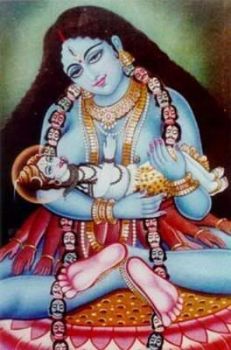
Kali with baby
Kali as the mother of Shiva

In his best-known evocation of the Goddess, Ramakrishna observes her as a graceful young woman sinuously emerging from the waters of the Ganges. As her belly breaks forth from the waves, we realize that she is late in pregnancy, coming to dry land to deliver her child. When she reaches the shore, she gives birth to a beautiful baby whom she fondles affectionately and lifts to her breast, where the child suckles until it is content. Holding her baby once more in her arms, the woman becomes the Kali we are more familiar with, a frightening old hag, gaunt with age and hunger. In her ferocious aspect, Kali then lifts the infant to her mouth, crushes it between her teeth and swallows the baby whole. Without a backward glance, she returns to the waters from which she emerged, disappearing again from view. Continue reading “Ramakrishna Devotion to Kali-Ma (Part 2 of 3) by Nancy Vedder-Shults”

Kali Ma, The Dark Creator and Destroyer by Nancy Vedder-Shults

nancymug_3In contrast to our dualistic thinking here in the West — thinking that separates light from dark, life from death, and chaos from order –there are a number of Eastern philosophies and religions that have retained a more holistic approach to reality. One religion that has done a good job of preserving the awesomeness of its deities by representing them through the full spectrum of life, death and rebirth is the Hindu culture in India. Remarkably, most of the major Hindu gods and goddesses represent divinity as forms of “coincidence of opposites.” In other words, the great deities like Shiva, Vishnu and Devi (the Goddess), simultaneously encompass life and death, good and evil, darkness and light, creation and destruction. For Westerners who live in a society which easily polarizes such distinctions, looking at the living mythology of one of these divine figures might offer us some ideas of how we can create a more unified mythology for ourselves.

It is no surprise to me that in India people acknowledge death as an inevitable part of life, just as they see darkness as half the daily round. When I visited India 35 years ago, I found it to be an overwhelming experience. The streets were filled to overflowing with people, oxcarts, cars with horns blaring, trucks inching along between the pedestrians, camel carts, bicycles and more people, food stalls, markets with vegetables and spices I had never seen before and people on top of people. As a Westerner I found all this lively interaction disconcerting, especially since it was very difficult to find a time and place to be alone. Life — even human life — was abundant to the point of excess. Continue reading “Kali Ma, The Dark Creator and Destroyer by Nancy Vedder-Shults”

Painting Saraswati By Angela Yarber

Saraswati reminds me that the divisions between fields are our construction; that academics can be creative, art can be holy, and preaching can engage the mind. 

I was precariously perched atop a file cabinet tacking a giant cloth to the wall when another staff member entered my office.  “What’s that?” she asked, puzzled, and pointing to the massive cloth now covering my wall.  “Saraswati,” I responded, hopping off the file cabinet, “the Hindu goddess of arts, creativity, and learning.”  She raised her eyebrows.  “Our previous Baptist preacher didn’t have any Hindu goddesses hanging on the wall,” she said with a wry smile.  “I guess I’m not your average Baptist preacher,” I chuckled.

For years I have been searching for Saraswati, claiming her as my patron saint, the one who guides my path as I navigate three seemingly disparate callings: artist, scholar, and preacher.  In Saraswati, these three callings merge.  Naturally, I hang a giant image of her on my office wall and wear a pendant bearing her likeness around my neck.  She reminds me that the divisions between fields are our construction; that academics can be creative, art can be holy, and preaching can engage the mind.  These three seemingly disparate callings do not have to be mutually exclusive.  Saraswati certainly wouldn’t see them this way. Continue reading “Painting Saraswati By Angela Yarber”