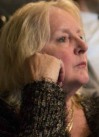
In early December 2016 I visited central Williamsburg in Brooklyn, New York, where my 2x great-grandparents Thomas and Anna Maria Christ and their son George and his family, including my father’s father Irving John, lived for over fifty years. I had compiled a list of all the known addresses of the family in Williamsburg from census and death records. The family lived in a several block square area surrounding Most Holy Trinity Roman Catholic Church on Montrose Street for all that time.
Most of the buildings at the addresses where the family lived had been torn down and replaced with housing projects in the mid-twentieth century. Some of the remaining ones are being torn down today, as this area of Williamsburg is being gentrified. Still, enough of the old buildings remain to give a sense of what the neighborhood was like in the 1800s. Continue reading “Ancestor Connection in Williamsburg, Brooklyn by Carol P. Christ”
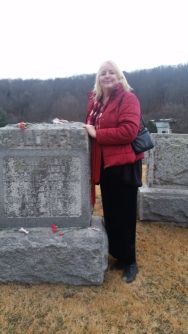
In the past week I visited Cherry Ridge, Honesdale, Wayne, Pennsylvania in the Pokonos, where I was welcomed by my third cousin Marcia Perry Gager whose family never left the place where our ancestors settled. Marcia and I have been corresponding about our family’s history since Ancesty.com connected us about three years ago. During that time, together with another cousin, Debra Ball, we have managed to decipher the complicated history of Henry Iloff, his two wives, and their eighteen children.
My visit to Honesdale began at John’s Evangelical (formerly German) Lutheran Church. Following a last-minute discovery that the baptism, marriage, and funeral records of the church were not in the Wayne County Historical Musem archives as I had been led to believe, I made a call to the “emergency number” of Pastor Richard Mowery the day before our scheduled visit, not knowing how he would respond to this “not-really-emergency” invasion of his personal space. Continue reading “Down on the Farm by Carol P. Christ”
This continues the story I began last week. Catherina is my 2x great-grandmother; Agnes is my 2x great-aunt; Johanetta is my first cousin, 3x removed, and my step-2x great-grandmother; Henry is my 2x great-grandfather. It is true that Henry had eighteen children with two wives. It is also true that Henry and Johanetta married and had a child soon after Catherina’s death. Some of the other details came in waking trance as I allowed the ancestors to tell their stories through me.
Agnes Lattauer Sweitzer: I thought the day Catherina left for America would be the worst day of my life. I did not know I would see Catherina again. I did not know I would outlive my two little sisters and both of my brothers. I did not know what my daughter would do. I read Catherina’s letters from America through my tears. How I wanted to be with her on her wedding day. How I wished she had been with us when we buried our sister Johanetta. My heart nearly burst when Catherina wrote that she longed to take my hand when she gave birth to her first child. My mind contorted itself trying to envision her living in a big city, in a big building, climbing up and down stairs, her feet never touching the earth, her hands never working the soil. What kind of life was that?
Catherina Lattauer Iloff
Catherina Lattauer Iloff: I left home a girl. Because I was not yet engaged, Mother and Agnes never told me about married life. What to expect. What to do. I loved Heinrich, or Henry, as he wanted to be called after he became a citizen of the United States. I was not prepared. Henry was so insistent. I was soon pregnant. First Henry, named for Henry’s father Heinrich, then Elisabeth, named for Mother. I had to care for them on my own. Henry was busy with his work during the days. In the evenings he went to the German beer garden to meet his friends. Growing up with my mother and sisters, I had never been alone. There were other women around, but they were busy with their own lives. Some of them were kind, some of them were not, but nobody cared about me the way Mother and Agnes did. One night Henry came home and told me he had been talking with his friends. There was land available in a place called Cherry Ridge, Pennsylvania, a day’s journey from New York City. He said it was his dream come true. We would build our own house. There was plenty of land to farm—not like back home where there were never enough fields to go around. I held my tongue. I did not tell him that I suspected I was pregnant again.
The Iloff farm house
Agnes Lattauer Sweitzer: Catherina and Henry have been to Cherry Ridge. Catherina says there is land for us there too. I don’t know what my Heinrich will say. Life is difficult for us here, but we have two young daughters, Elisabeth and Johanetta, and the baby, Peter. There is Mother to consider. Well, you could have blown me over with a feather. Heinrich said we should grab the opportunity before it is too late. Mother said she would come with us, because she wants to see Catherina and Rudolph again before she dies. She is an old lady. I wonder how she will manage the journey. But I couldn’t say no. The two of us cannot contain our joy. We will see our beloved Catherina again.
Catherina Lattauer Iloff: My life is complete. Mother and Agnes and the dear little children arrived. Mother immediately took Henry and Elisabeth in her arms. Agnes comforted me about the loss of Baby John. I could finally allow myself to cry, knowing that Mother and Agnes would be there to wipe away my tears.
Agnes Lattauer Sweitzer: Our first years in Cherry Ridge were difficult. There were houses to be built, fields to be plowed, cows to be bought and milked. I had two more children, Henry, who died as a boy, and John. My little sister outdid me. She had nine children in all: Henry, Elisabeth, John who died, John who lived, George, Catherine, Mary, Frank, and Barbara. Giving birth to so many children took its toll on her. After the last one, she was never well. I think she may have been pregnant again several times, but she never spoke about it, not even to me. Finally, she took to her bed.
Catherina Lattauer Iloff: I had nine children. I never told anyone about the babies I lost before I began to show. Mother and Agnes worried that I was having too many children. But what could I do? I loved Henry, and I loved every one of my children. Mother died a few years after she came to Cherry Ridge. She always said she was so happy she had undertaken such a great adventure. She was pleased to know that Agnes and I were settled and happy. I miss her every day. Agnes is always by my side. I was forty-two when Barbara, my last baby was born. I bled a lot. After that, I never carried another child to term. I was never myself again. Agnes is my rock. Johanetta helps with the little ones. Henry is still strong as an ox, busy in the fields or with the cattle. I see that Johanetta hangs on his every word. I dismiss such thoughts from my mind. I do not know how much longer I have.
Agnes Lattauer Sweitzer: Catherina died yesterday. She was only forty-six (I am now fifty-six), and she had not been well for several years. I told her to stay away from Henry, but she was powerless to do so. Sometimes I blame him for her death. I worry about Johanetta now. Wild horses will not keep her away from Henry. I see the way she looks at him, and I see the old goat looking right back at her. She is twenty-six, a full grown woman.
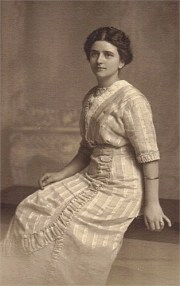
Johanetta displaying her engagement ring
Johanetta Sweitzer: I can’t believe it! Henry asked me to marry him. Mother is furious. Father says he should have whipped me a long time ago. But they can’t say no. I told them I am pregnant with Henry’s child. The older children are shocked that their cousin is marrying their father. The younger ones are thrilled. They have always viewed me as a second mother as well as an aunt. I have been looking after all of them these last years what with Aunt Catherina being so ill. I love those children.
Agnes Lattauer Sweitzer: I had to forgive Johanetta, but I will never forgive Henry. I smile when I see him to keep the peace, but my heart is cold. Peter was her first-born. After that she had Agnes and Emma, who died of some of those diseases children get. I could not help wondering if that was God’s punishment.
Johanetta Sweitzer Iloff: Henry and I were married for twenty years. Except for losing Agnes and Emma, those were the happiest years of my life. In all, we had nine children: first Peter, Agnes, and Emma, and then, Anna, Lawrence, Charles, Robert, Otto, and Phillip. Henry was a good man. He worked hard all of his life to support his family. We lost the second John a few years ago, but there were fourteen living children to mourn Henry’s death. The little ones are still with me, some of the others are scattered to the winds, and quite a few are settled around here, raising families of their own. While he was still strong and able, Henry was elected Commissioner of Wayne County. He served his fellow countrymen proudly for years. I wish Mother had been alive to see that. Maybe then she would have understood what a wonderful man he was.
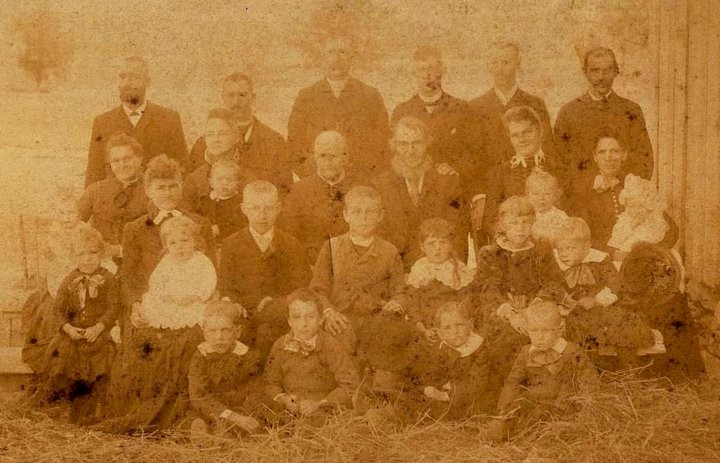
Henry and Johanetta, second row, center right with some of Henry’s children and grandchildren
When I first returned from my ancestor quest in Germany, I fell ill with a bad cold and cough and had little physical energy. For two weeks I lived in the dreamtime, communicating with the ancestors and trying to make sense of the information about their lives I had discovered. After I got better, I had difficulty returning to daily life. The ancestors wanted to speak through me. Their stories, based on facts, come to me in waking trance.
Feeding the ducks
Agnes Lattauer Sweitzer : I was born in Ober-Floerscheim (Hessen Darmstadt) on July 9, 1812. I was the first in a family of five children. Four years after me came Jakob, named after Father, and three years later, Rudolph. It was nice to have brothers, but my dream of a sister came true when Catherina was born a month and a day after my tenth birthday. My mother was busy with Jakob and Rudolph, so I became a second mother to Catherina. I could not nurse her, but I could sing to her and rock her to sleep. I changed her diapers and gave her a bath. It was so wonderful to have a baby to take care of. Three years later little Johanetta was born two days after my thirteenth birthday. Another baby for me and Mother bring up together. I was in heaven. I was both mother and sister to the little girls. When they got older, I took my little sisters to play by the stream, where they giggled and cooed as we fed the ducks and the geese. In the summer, Mother and I brought them with us to the fields where we hoed and planted, weeded and harvested. They tried to pull weeds with their little fingers. It was my job to keep them from pulling up the plants too. Continue reading “A Tale of Two Sisters by Carol P. Christ”
I am Carol Patrice Christ, born in Pasadena, California, daughter of Janet Claire Bergman, born in El Paso, Texas in 1919, daughter of Lena Marie Searing, born in Lyons, Michigan in 1891, daughter of Dora Sophia Bahlke, born in Lyons, Michigan in 1858, daughter of Maria Sophia Catherina Hundt, born in Parum, Mecklenburg in 1827, daughter of Catherina Sophia Elisabeth Schoppenhauer, born in Pogress, Mecklenburg in 1798, daughter of Anna Sophia Seehasse, born in Zulow, Mecklenburg in 1756 in the clan of Tara. I come from a long line of women, known and unknown, stretching back to Africa.
In our ritual on the Goddess Pilgrimage to Crete this May, I will have two new names to add to my mother line. The name Sophia was passed down through the maternal line for at least four generations. I am sorry it was not handed down to my grandmother, my mother, and me.
When I left for Germany a little over a month ago, I knew that Dora Sophia Bahlke was the mother of my grandmother Lena Marie Searing and that Dora Sophia’s parents were Anton Bahlke and Maria Hundt, immigrants from the small towns of Parum and Dummerhutte, in Mecklenburg, Germany. I did not have their parents’ correct names, and I had very little information about their lives in Germany. I have now put some flesh on the bones. Continue reading “An Illegitimate Child in Mecklenburg, 1850 by Carol P. Christ”
In the past month I have been on a spiritual journey seeking my German ancestors. Six of my 2x great-grandparents were born in Germany, which means I am 37 ½ percent German. Growing up, I was subjected to a form of patriarchal family disciple I came to identify as German, but I was told very little, positive or negative, about my German heritage.
Though I had been researching my family tree for five years when I began my trip to Germany, I had no clue about where in Bavaria the Thomas Christ-Anna Maria Hemmerlein branch of my family originated. While making final preparations before the trip, I learned that German church records are no longer kept in individual churches, but are grouped together in church archives. Some areas also have family records in state archives. Contrary to popular belief, the majority of German records were not destroyed in the two World Wars. However, many of the German records are not online. Continue reading “Finding Bavarian Ancestors by Carol P. Christ”
The last few days I have been living in dreamtime with my Swedish ancestors, most especially with my great-great-grandmother Ingrid, about whom I have learned a great deal over the past year. Through a distant cousin Thomas Sievertsson, who has been researching the part of Sweden from which she came, I have discovered details about the kind of life she lived in the old country that few descendants of immigrants are lucky enough to know. Here are a few of them. Continue reading “In Dreamtime with the Ancestors by Carol P. Christ”
I became aware of atDNA (autosomal) tests for ethnicity while watching the PBS American ancestry programs created by Harvard historian Henry Louis Gates. In considering ethnicity, it is important to remember that 99.9% of human DNA is shared. AtDNA testing focuses on the .1% that is not. This type of DNA testing can locate African DNA geographically, and it also can reveal Native American and Jewish ancestry. When the test recently became less expensive, I decided to try it. I was particularly interested to see if my 3x great-grandmother Gertrud Zimmerman might have been Jewish. Continue reading “Ancestor Connection and DNA Testing by Carol P. Christ”
When I decided to become a career woman, I thought I had no role models in my family. My parents (who sometimes considered me the black sheep) would have agreed. Imagine my surprise to find a matriarchal family and three generations of businesswomen women among my Swedish family in Kansas City!
My great-aunt Edith who was a stenographer, secretary, and notary public was a fixture at family gatherings. When I knew her, she was living in California with her two brothers who also were not married. Until their father died, they had lived their whole lives in the family home in Kansas City. I sensed that though my family respected my uncles, they felt sorry for Aunt Edith. It certainly was never suggested to me that instead of getting married and being supported by a husband, I could become a self-supporting working woman like my aunt. Continue reading “Strong Female Role Models among Swedish Immigrant Ancestors in Kansas City by Carol P. Christ”
These days I can’t get my 2x great-grandmother Anna Maria Christ off my mind. She may be the independent female ancestor I have been looking for all these years.
My father’s father was transferred from New York to San Francisco during the depression. When I moved to New York City, I felt powerfully connected to its diverse immigrant culture, but I never thought of trying to figure out where and when my ancestors lived there.
Recently I found my Scottish and Irish 2x great-grandparents, James Inglis, the seaman, and Annie Corliss, mother of 9, living in the tenements on Cherry Street near the port of New York. These were my father’s ancestors on his mother’s side. I felt inspired by a photograph of Annie to take her Irish spirit of triumph over adversity into my soul.
Because it has become fashionable to be interested in things Irish, I began my ancestor research there. In fact, I am more German (3/8) than I am Irish (3/16). As I have delved into my German ancestry, I realized that being German became a cause for shame in both the First and Second World Wars. German language newspapers were banned, Germans were interned, people hated Germans, and many Germans changed their names.


 In early December 2016 I visited central Williamsburg in Brooklyn, New York, where my 2x great-grandparents Thomas and Anna Maria Christ and their son George and his family, including my father’s father Irving John, lived for over fifty years. I had compiled a list of all the known addresses of the family in Williamsburg from census and death records. The family lived in a several block square area surrounding Most Holy Trinity Roman Catholic Church on Montrose Street for all that time.
 In the past week I visited Cherry Ridge, Honesdale, Wayne, Pennsylvania in the Pokonos, where I was welcomed by my third cousin Marcia Perry Gager whose family never left the place where our ancestors settled. Marcia and I have been corresponding about our family’s history since Ancesty.com connected us about three years ago. During that time, together with another cousin, Debra Ball, we have managed to decipher the complicated history of

 Carol P. Christ is author or editor of
  A Serpentine Path: Mysteries of the Goddess

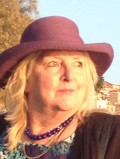 I am Carol Patrice Christ, born in Pasadena, California, daughter of Janet Claire Bergman, born in El Paso, Texas in 1919, daughter of Lena Marie Searing, born in Lyons, Michigan in 1891, daughter of Dora Sophia Bahlke, born in Lyons, Michigan in 1858, daughter of Maria Sophia Catherina Hundt, born in Parum, Mecklenburg in 1827, daughter of Catherina Sophia Elisabeth Schoppenhauer, born in Pogress, Mecklenburg in 1798, daughter of Anna Sophia Seehasse, born in Zulow, Mecklenburg in 1756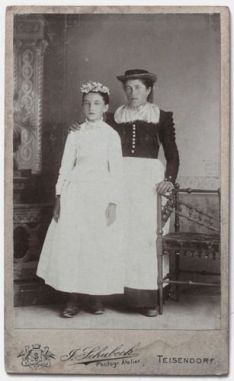
 The last few days I have been living in dreamtime with my Swedish ancestors, most especially with

 Feminism and Religion