
Of Resistance and Risk, Community and Kin: A Thanksgiving Reflection by Beth Bartlett

Ricky DeFoe

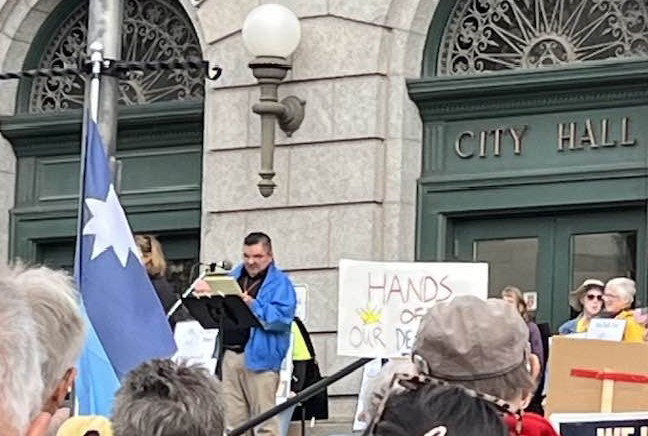
At the No Kings rally on October 18th, Anishinaabe elder Ricky DeFoe affirmed to the gathered crowd that “the natural response to oppression, ignorance, evil, and mystification is wide-awake resistance.” Such resistance, he claimed, calls for an “ethic of risk.”  I was immediately struck by his use of the term, paralleling feminist theologian Susan Welch’s A Feminist Ethic of Risk.[i]Returning home, I picked up my copy and found many of the same points DeFoe had articulated.[ii] Both asserted that an ethic of risk recognizes that “to stop resisting, even when success is unimaginable, is to die,” and by this they meant not only the threat of physical death, but also “the death of the imagination, the death of the ability to care.”[iii]

Continue reading “Of Resistance and Risk, Community and Kin: A Thanksgiving Reflection by Beth Bartlett”
#SHARE THEIR STORIES by Janet Maika’i Rudolph

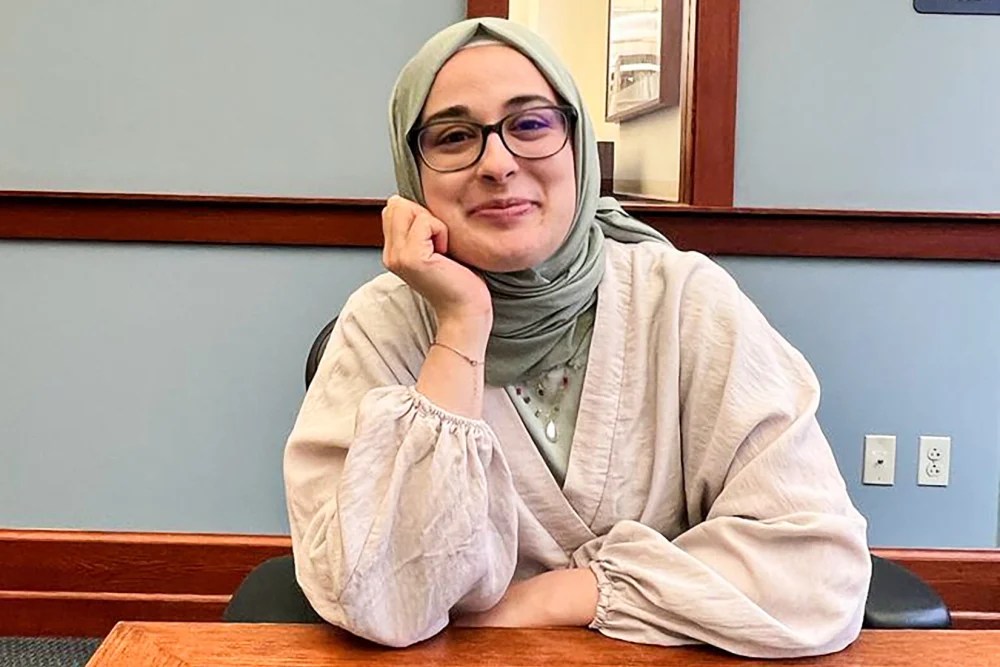
I was walking along the street the other day thinking about the comforts I find at home, my favorite tee-shirt, the three or four books I’m reading at a time, photos of loved ones. Around that time, I heard the news that Rümeysa Öztürk, a Turkish PhD student at Tufts who was whisked off the street by ICE agents in Massachusetts. She disappeared into the system until she showed up in detention in Louisiana. This is the facility that has been called “a black hole” by civil rights groups. So many have been swept off the street, how do we keep track? Ozturk had a valid student visa until the State department revoked it without notice nor telling her. She was on her way to break her Ramadan fast with friends. After her arrest she asked for food, not having eaten for 13 hours. She was given snacks. She still hadn’t eaten a meal by the next day and was feeling faint. She was given more snacks.

I began thinking, who are her friends? What was she going to eat? In fact, what are her favorite foods? In other words, who is she as a person. Her name is foreign, she comes from another country so it might be too easy to dismiss her as one of many. But if we know her story, if we humanize her, her story becomes harder to dismiss. The first step in the authoritarian playbook is to dehumanize people for some feature of who they are. When someone is dehumanized, it is far easier to do hateful things.

The antidote is to know their stories, share their stories, speak their stories.

Continue reading “#SHARE THEIR STORIES by Janet Maika’i Rudolph”

Listening to the Noise: The Connections between Milada Horáková, Anti-Semitism, and the Black Lives Matter Movement by Ivy Helman.

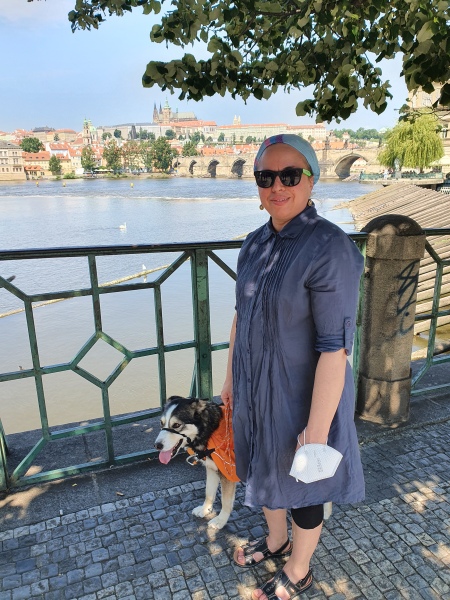
20200627_112934This month more than most, I feel like I have so much to say that I don’t really know where to begin.  It doesn’t help that next door they are remodelling an apartment and, outside my window, there is a crew drilling up the sidewalk and another roofing the house across the street.  The noise and its echoing are overwhelming on Prague’s narrow streets.  

Perhaps the best place to start is with a similarly loud occurrence.  On June 27th, Prague commemorated the 70th anniversary of the execution of Milada Horáková using the city-wide intercom system.  Minute-long excerpts from her trial and execution were broadcast throughout the day.  Horáková, the only woman to be executed during the Communist regime in Czechoslovakia, was a long-time proponent of democracy and  women’s rights.  In the field of women’s rights,  she focused on the status of women and children, spending considerable effort on women in the workplace and reconciling their work with family responsibilities.  She was also an outspoken critic of the Nazi Regime, having spent time as a political prisoner in Terezin.  When the war ended, she joined parliament, but resigned right after the communist take-over.  After continuing to speak out against the Communists,  she was arrested in September of 1949 and charged with attempting to overthrown the government.  She along with 12 others were interrogated and tried.  Four of them, including Horáková were sentenced to death.  She was publicly hanged on the 27th of June 1950.  Eighteen long years later, she was posthumously exonerated, and in 2000, the Czech Republic unveiled a commemorative tombstone for her in the National Cemetery at Vyšehrad Castle.  In 2017, a film was made about her life and legacy. Continue reading “Listening to the Noise: The Connections between Milada Horáková, Anti-Semitism, and the Black Lives Matter Movement by Ivy Helman.”