Are We Talking About the Same Mary? by Dr. Christena Cleveland

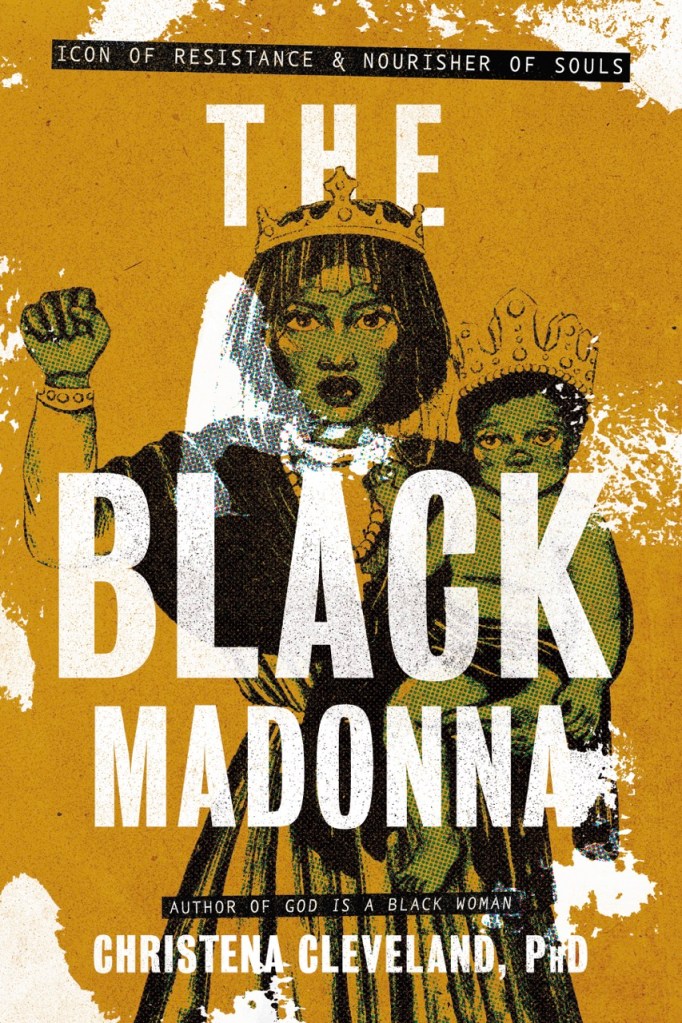
Though we often assume that Christianity was introduced to Africans after colonial enslavement, groundbreaking work by historians such as David Daniels unveils the truth that many African communities practiced a version of Christianity while still living on their ancestral lands Prior to the transatlantic slave trade, the Portuguese established Catholicism in the Kongo, and many Kongolese made magic by integrating the most life-giving aspects of Catholicism with their Indigenous spiritualities. Specifically, many Kongolese Catholics nurtured a deep devotion to the Virgin Mary, elevating her beyond her diminished status as an unassuming and relatively powerless “servant of God” to co-chief of Christ and a goddess in her own right. Despite the patriarchal teachings of the Catholic Church, the Kongolese drew upon an Indigenous cosmology that affirmed the divine power of women and embraced the Virgin Mary as an emboldened Christ figure who possessed all the powers and grace that Jesus and the Father possessed. They implicitly understood what Black Madonna devotee Mirabai Starr would teach over 250 years later: She is “. . . the quintessential Mother, the feminine face of the Holy One, fierce protector and gentle consoler . . . She refuses to be defined as the passive, obedient handmaid of the Father. She is the radical, powerful, engaged Mother of the World.”

Continue reading “Are We Talking About the Same Mary? by Dr. Christena Cleveland”


Slippery tongued Witches by Claire Bullion

It is still Eve the temptress that we must beware in any woman” St Augustine (354-430 CE)

I’ve been annoyed recently by suggestions that the ‘feminization’ of institutions  involves increased deceit and manipulation because of an inherent deviousness to be found in women. Why is the idea of the manipulative woman still so powerful in our culture? When 165 of the 193 countries with UN membership are led by men and the top 10 richest people in the world are all men, why are these manipulative women doing so badly? Are men manipulating women to think they are manipulative? Both  Helen Andrews (2025) and J. Stone (2019) in their essays, which insist that the increase representation of women in institutions is ruining the world, quote the work of Harvard Lecturer Joyce Benenson as evidence of this inherent feminine deviousness that needs to protected against.

Woman, by her nature, is the instrument of the devil. A woman’s voice is the hissing of the serpent” Pope Urban II (c.1035-1099CE)

Continue reading “Slippery tongued Witches by Claire Bullion”

Patriarchy Unbound by Janet Maika’i Rudolph

Some new terms in our language have been after people. Both the terms sadism and masochism were so named according to etymologyonline.

Here is what the site says about sadism: “love of cruelty,” especially as evidence of a subconscious lust that the cruelty satisfies, 1888, from French sadisme, from the name of Count Donatien A.F. de Sade (1740-1815). Not a marquis, though usually now called one, he was notorious for the cruel sexual practices described in his novels.”

And here is what the site says about masochism: “The word masochism originates from the name of Leopold von Sacher-Masoch, an Austrian novelist best known for his 1869 novel Venus in Furs, which explored themes of submissive sexuality and domination.”

I have a new term to add that I would like to add to our vocabulary: Robertism to be named after John Roberts. Here is my definition: love of cruelty, not just cruelty by itself but by spreading cruel acts as widely and far as possible while giving them the authority of legality. Robertism encourages the most base and ugly parts of human behavior, brings them to the surface to be expressed in actions that are given permission through legal cover. 

Continue reading “Patriarchy Unbound by Janet Maika’i Rudolph”

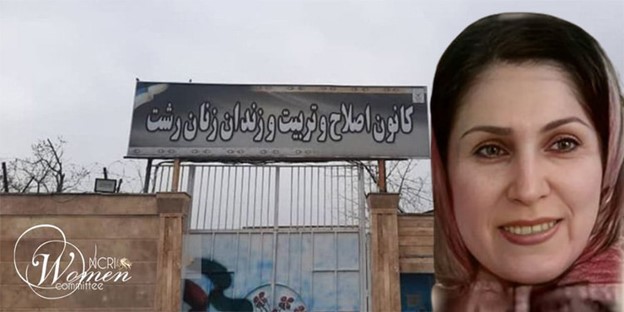
 Zahra Tabari by WNCRI

Women’s National Council of Resistance of Iran (info below)

In a continuation of the escalating crackdown on political dissent in Iran, Zahra Shahbaz Tabari, a 67-year-old political prisoner, was sentenced to death by Branch 1 of the Revolutionary Court of Rasht on October 25, 2025. The regime’s judiciary has accused her of “supporting the People’s Mojahedin Organization of Iran (PMOI).”

Who Is Zahra Tabari?

Zahra Tabari, 68, holds a master’s degree in electrical engineering and is a graduate of Isfahan University of Technology and the University of Borås in Sweden, specializing in Sustainable Energy.

She suffers from chronic health conditions, and the poor conditions in Lakan Prison, combined with shortages of medication, medical care, and constant psychological pressure, have severely deteriorated her physical condition.

She was arrested on April 17, 2025, after security forces raided her home in Rasht without presenting a judicial warrant. During the raid, agents searched the house and confiscated her and her daughter’s electronic devices. For weeks, her family had no information about her whereabouts or health condition. She is currently being held in Lakan Prison in Rasht.

Continue reading ” Zahra Tabari by WNCRI”

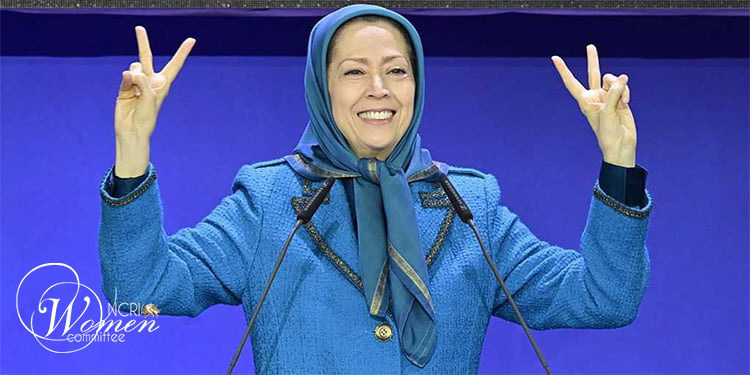
Maryam Rajavi by Yalda Roshan

My name is Yalda. I am a woman from the Iranian resistance who, for many years, has fought for women’s equality and worked to amplify the voices of Iranian women around the world. Today, I want to share with you the source of inspiration and motivation that has guided my path.

Covering every aspect of Maryam Rajavi’s life and thought in one article is a challenge, so today I will focus only on what has personally influenced me: her perspective on women.

She herself is a woman who has spent decades fighting against two dictatorships—the Shah’s and the misogynistic clerical regime—and believes that women can change the world. A brief overview of her biography: she was born on December 4, 1953, in Tehran and is a metallurgical engineer from Sharif University of Technology in Tehran. From her teenage years, she embarked on the path of struggle, learning from action rather than words.

Continue reading “Maryam Rajavi by Yalda Roshan”

A Transgender Man’s Perspective on Purity Culture Got This Cisgender Woman Thinking by Liz Cooledge Jenkins

“Ewww, there’s been a boy in our cabin!” One of my cabinmates squealed. We were at sixth grade camp. Others chimed in quickly: “Gross!”

The evidence? A pair of boys’ cargo shorts, held gingerly between a thumb and forefinger as if they had cooties.

“Ew!” “Weird!” “How’d he get in here?”

The shorts were mine. But I did not admit this.

As a kid, I sometimes wore hand-me-down clothing from my older brother. It made sense. I didn’t have strong opinions about fashion, and the clothes felt just as comfortable and fit just as well as the girl clothes my parents bought for me.

My elementary school classmates didn’t seem to notice or care. But this was sixth grade. This was the first year of middle school. Things were changing, and I hadn’t quite realized the full extent of these changes. Showing up at sixth grade camp with hand-me-down boys’ shorts was taboo.

Continue reading “A Transgender Man’s Perspective on Purity Culture Got This Cisgender Woman Thinking by Liz Cooledge Jenkins”

People Power by Janet Maika’i Rudolph

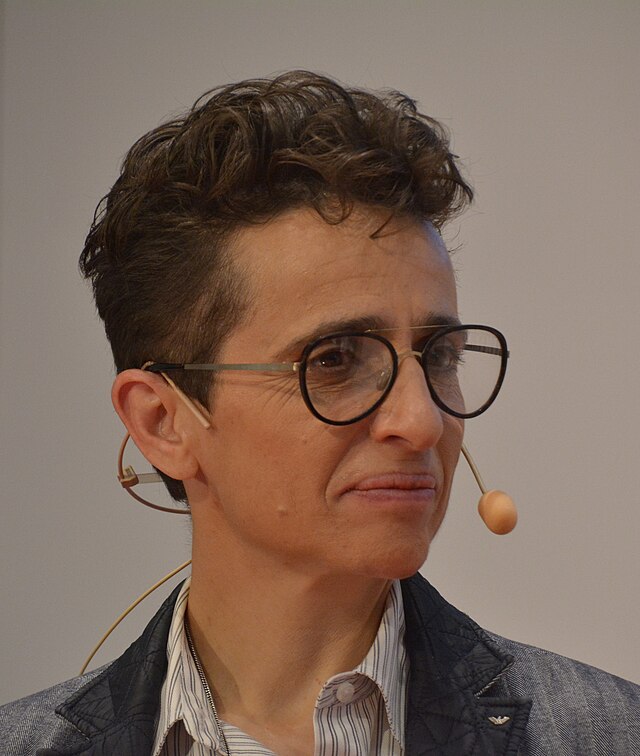
Wikimedia Commons, credit: Bengt Oberger

I am an unapologetic newspaper clipper. Now when my husband and I are involved in a process of cleaning out our long-time home, I am finding numerous clippings going back to the 1990s. Some of them are gems. They are generally painful to read, though because they illuminate the many threads of recent history that have brought us to the point we are at now.  

M. Gessen (once writing under Masha Gessen they/them) is a fairly new columnist at the NY Times. When they write, though, I sit up and take notice. I have saved several of their editorials because Gessen has a unique perspective not only from an intellectual point of view but also personal. They were born in Russia, moved to the US when they were a teen-ager through the U.S. Refugee Resettlement Program. Gessen is trans and in a gay marriage. They had returned to Russia pursuing work in journalism but had to leave when the government began talking about removing children from gay parents. With their partner, they have 3 children.

Continue reading “People Power by Janet Maika’i Rudolph”

Embodiment as Positive Resistance

I nearly cancelled my recent trip to the United States. The political climate felt tense, the global atmosphere uncertain, and travelling across the Atlantic seemed questionable for several reasons.

Friends encouraged me to go anyway, suggesting that meeting people in person would offer a different perspective from the one shaped by media narratives. And of course, it wasn’t headlines I was meeting, but people, in a human reality that persists beneath larger systems. Thankfully, my trust in relational experience outweighed my hesitation, and I returned from my travels with renewed inspiration.

I’m writing this essay because many people I met spoke with an apologetic tone about being American. They expressed disbelief, embarrassment or anger about their conspicuous yellow haired chief. I just want to acknowledge the warmth, generosity, care and humanity I encountered wherever I went.

The entire experience confirmed what I have long sensed in my work with movement, ritual and community: that embodied presence, especially in uncertain times, is such a remedy for heart and soul. What I encountered was meaningful human contact, even in a politically divided country.

Continue reading “Embodiment as Positive Resistance”

The Epstein Files Prove Just How Right Carol Christ Had Been, part 2 by Janet Maika’i Rudolph

Part 1 was posted March 1st. You can read it here. The definition that Carol refers to as well as a link to her original article can be found there as well. Her words are in italics.

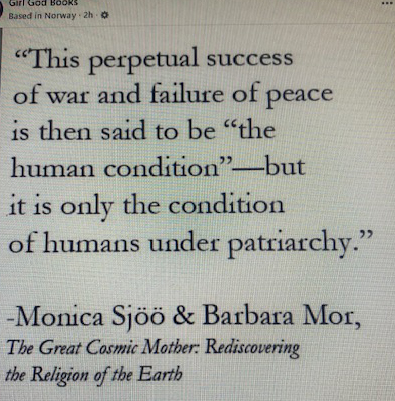
It has long seemed to me that patriarchy cannot be separated from war and the kings who take power in the wake of war.  Many years ago I was stunned by Merlin Stone’s allegation that in matrilineal societies there are no illegitimate children, because all children have mothers. Lately, I have been trying to figure out why the Roman Catholic and other churches and the American Republican party are so strongly opposed to women’s right to control our own bodies and are trying to prevent access to birth control and abortion. In the above definition of patriarchy  . . . I bring all of these lines of thought together in a definition which describes the origins of patriarchy and the interconnections between patriarchy, the control of female sexuality, private property, violence, war, conquest, rape in war, and slavery. 

From the Facebook page of GirlGodBooks

Here Carol lays it all out. I, too, have wondered why the Church, why conservative politicians are so obsessed with women’s bodies and reproductive systems. No wonder abortion, in fact all of the healthcare of women is so on the political radar. Taking away the agency of women when they become pregnant is dehumanizing, reduces women to incubators. And that doesn’t even go into the fear of treating women for any health issues when they are pregnant. Take the tragic case of Tierra Walker who died in Texas, pregnant and facing growing health problems. She had a 14year old son and after weeks of severe distress attempted to get an abortion. She was unable to do due to the strict anti-abortion laws in Texas as she went to doctor after doctor. Here is what they told her: “But the doctor, her family said, told her what many other medical providers would say in the weeks that followed: There was no emergency; nothing was wrong with her pregnancy, only her health.” Its as if there was a cabal to diminish the value of women’s lives that even the doctors, who know better, participate in. And that is the templated of patriarchy. True that the doctors are threatened with loss of license and 10 years imprisonment begin. But when they spout the “party” line, they not only risk their patients, they deepen the already ingrained belief that women and our bodies are without worth.

Continue reading “The Epstein Files Prove Just How Right Carol Christ Had Been, part 2 by Janet Maika’i Rudolph”

Ozymandias and Other Patriarchal Ego-isms by Janet Maika’i Rudolph

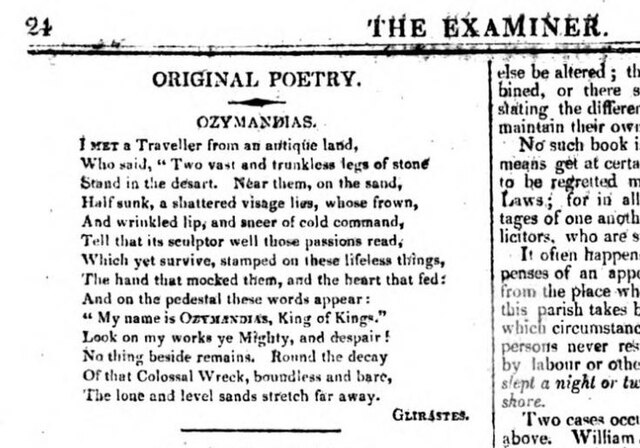
I met a traveller from an antique land
Who said: “Two vast and trunkless legs of stone
Stand in the desert . . . Near them, on the sand,
Half sunk, a shattered visage lies, whose frown,
And wrinkled lip, and sneer of cold command,
Tell that its sculptor well those passions read
Which yet survive, stamped on these lifeless things,
The hand that mocked them, and the heart that fed:
And on the pedestal these words appear:
‘My name is Ozymandias, King of Kings:
Look on my works, ye Mighty, and despair!’
Nothing beside remains. Round the decay
Of that colossal wreck, boundless and bare
The lone and level sands stretch far away.”

Percy Bysshe Shelley 1792 – 1822

There has been discussion of what to name Trump’s ever-expanding ballroom. Some have suggested naming it after Epstein. I would suggest naming it after Ozymandias from Shelley’s poem. 

There is something about building projects that feed to the patriarchal ego.  The Patriarchal ego stands on permanence, largess and if that involves crushing those “below” them, that is just how it is.  Pre-patriarchal pagan systems focus on the cycles of life and are based on an understanding that impermanence is what life is all about. Life works on cyclic movement. The seasons, the moon, the sun, the stars, all is in motion and all presages different aspects of the wheel of life.

Continue reading “Ozymandias and Other Patriarchal Ego-isms by Janet Maika’i Rudolph”