
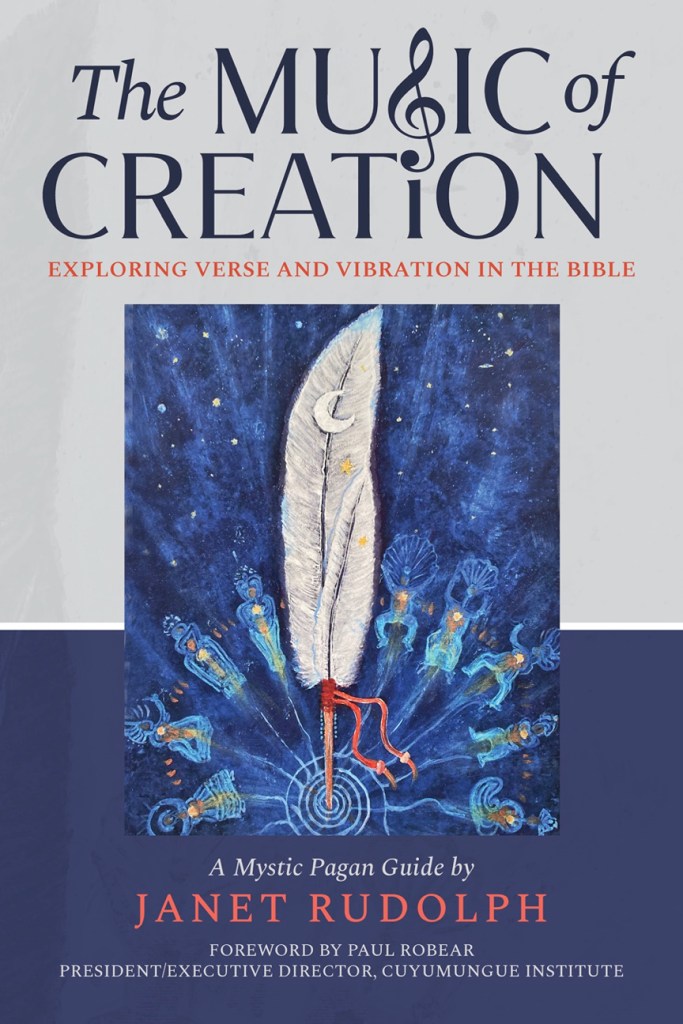
The Music of Creation by Janet Maika’i Rudolph

I am excited to announce my latest book: The Music of Creation: Exploring Verse and Vibration in the Bible. In this book I present pagan translations of the Bible and then lay out spiritual practices based on those verses. The practices make use of “the triple secret” of manifestation which is Mudra (body or hand position), Mantra (chant) and Mandala (image). Each has power on their own. Together they become even more compelling. Below are two excerpts from the book. The first is a template of chanting and the power it can have in our bodies and in our lives. 

Excerpt 1 – Below, I note four different ways to approach chanting. All have merit. They can be combined. In each, I use Hallelujah (in its meaning of praise) as an example.

First: Song, performance, vibration. Hallelujah has been a particular focus of song-writing with beautiful results. The top results which come to my mind are Leonard Cohen and Handel. Hallelujah is a wonderful example of a performance chant and a choral piece. 

Continue reading “The Music of Creation by Janet Maika’i Rudolph”

Dr. Seuss, Multiple Hats, and Advocacy: Reading Broadly By Corinna Guerrero

The ten students in my fall 2011 class at ABSW, Reading OT Biblical Characters, are currently being instructed to read broadly. I tell them to develop their sensibilities as a reader so that they have a greater capacity to serve the needs of their communities. I challenge them with a question like-How do you liberate a biblical character that is not in a biblical story because they/he/she are/is never directly mentioned, given voice, or described? Or,what is the value of investigating the tensions between the story and the discourse exhibited through minor and major biblical characters? I ask them these questions because half of the students are advocating on behalf of a group that is socially, politically, economically, and/or spiritually underserved. The other half is training to develop themselves as scholars and educators of biblical literature. In the class room, regardless of path, everyone is required to be both scholar and servant.

Each student is asked to develop her or his final project with an ideal audience in mind. To whom do you see yourself presenting this semester-long project? The larger question behind that is whom do you serve? Continue reading “Dr. Seuss, Multiple Hats, and Advocacy: Reading Broadly By Corinna Guerrero”