
A Sea Change Towards Women’s Ordination by Mary Ellen Robertson

If I see a flaw in contemporary Mormon feminism, it’s that we haven’t ventured outside our own religious community to partner with other religious feminist activists. Working separately or in ignorance of the work already done by other religious feminists, we’re more likely to spend time reinventing the wheel than building upon the lessons learned.
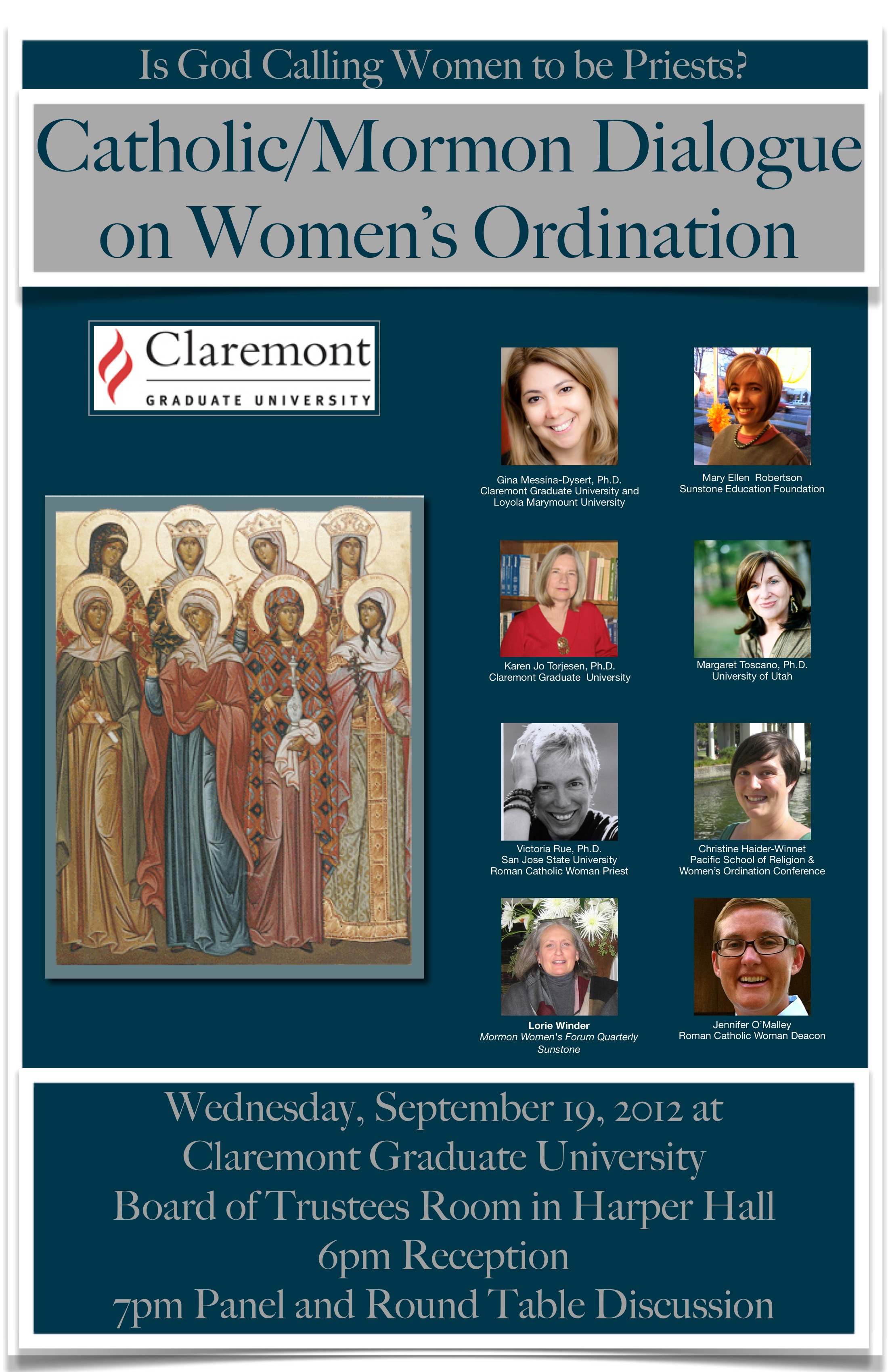

Fortunately, there’s an exciting shift afoot.

Last week, Catholic and Mormon women came together for a dialogue on women’s ordination.
Hosted by Claremont Graduate University, this discussion brought together six women from  patriarchal religions to explore what happens when we call an all-male priesthood into question and examine the theological and cultural assumptions upon which an all-male priesthood rests. Continue reading “A Sea Change Towards Women’s Ordination by Mary Ellen Robertson”

Catholic/Mormon Dialogue on Women’s Ordination

The Catholic/Mormon Dialogue on Women’s Ordination at Claremont Graduate University will take place Wednesday, September 19, 2012.  It is an incredibly relevant topic today and particularly interesting with a Mormon/Catholic presidential ticket before us.

It makes sense to bring Catholics and Mormons together to dialogue about this issue.  Women’s ordination in both Churches is considered a taboo topic and one that if discussed in public can lead to excommunication.  Certainly the women who will stand publicly to address this issue and share their passion and conviction for the need to ordain women are courageous and committed to the recognition of the full humanity of every woman and every man.  Continue reading “Catholic/Mormon Dialogue on Women’s Ordination”

Hijacking the Nuns? by Kate Conmy

When stuck between a vow of obedience and a hard place known as the Vatican, sisterhood may be our only prayer. Since April 18, 2012, the U.S. nuns have been cast into the headlines as the Vatican’s Congregation for the Doctrine of the Faith (CDF) released a harsh assessment of the Leadership Conference of Women Religious (LCWR), an umbrella organization, representing 80% of U.S. sisters.  Accused of “radical feminist themes,” “corporate dissent,” and among other things, not taking an official stance on some hot Catholic issues, nuns have become frontrunners of a revolution.

The groundswell of support and solidarity pouring forth from faithful Catholics and the media has been unprecedented by all standards; when the secular feminist website Jezebel is calling for Sr. Simone Campbell , executive director for the Catholic lobby group, NETWORK, for president, the issue has clearly gone beyond the choir. The movement has taken on the adage “we are all nuns,” expressing a shared sense of oppression by the Catholic Church. If the second largest religious domination in the U.S. (10%) is “former Catholic,” then this shared sense of betrayal by the Vatican may not be new, but it has found new energy in the conflict between Rome and the American nuns. Continue reading “Hijacking the Nuns? by Kate Conmy”

The Vatican’s Spiritual Violence Against Women’s Ordination By Rosemary Radford Ruether

The Vatican has adopted what amounts to a “zero tolerance” policy against those Catholics who actively advocate for women’s ordination, particularly against anyone involved in the movement of Roman Catholic Womenpriests which, for the past three years, has ordained thirty-five women in the United States. This movement began in June, 2002, when seven women were ordained by some Catholic bishops in Austria. Later several of these women were ordained bishops by these same bishops. They, in turn, have ordained more women priests. From this has sprung an increasingly organized movement, which is developing the theological vision of church which they hope to generate and are laying down the formal rubrics for education and preparation for ministry of those aspiring to be ordained in their community.

The Vatican summarily excommunicated the initial seven women ordained in 2002. As more women were ordained it was at first silent and then decreed that anyone being ordained in this movement, as well as those supporting it, were automatically excommunicated. This saved them the trouble of addressing each of these women individually. However, they have escalated their campaign against women’s ordination in the last month in response to Maryknoll priest, Father Roy Bourgeois, who on August 9, 2008 in Lexington, Kentucky, concelebrated the mass where long-time friend, Sevre-Duszynska, was ordained. Father Bourgeois also preached the homily at this ordination mass, where he denounced the Church’s refusal to ordain women as a sin comparable to the sin of racism. “Sexism is a sin” he declared. Continue reading “The Vatican’s Spiritual Violence Against Women’s Ordination By Rosemary Radford Ruether”

This is What a Catholic Looks Like By Kate Conmy

The following is a guest post written by Kate Conmy, MA, Membership Coordinator for the Women’s Ordination Conference.  Kate celebrates spiritual activism, feminism, and human rights.  She currently works as the Membership Coordinator for the Women’s Ordination Conference and lives in Washington, DC.  She can be contacted at Kconmy@womensordination.org.

In my last semester as a Religion student at Mount Holyoke College I sat in my Feminist Theology seminar with only one question for our guest speaker: “Why are you still a Catholic?” A question I rarely dared to ask myself as I spent most of my studies concentrating on Buddhism, traveling abroad to Dharamsala, India, interning with the Buddhist Peace Fellowship in Berkeley, even learning Tibetan; by most observable assessments I had swapped the pew I grew up in for a zafu.  But Mary Hunt reminded me in such a simple and smart way that Catholicism is about community building and justice seeking. She said: “This is what a Catholic looks like. We have a responsibility to speak this language.”

In that moment I realized I had been resisting something that has always belonged to me. Raised in a Jesuit-educated Catholic family in Upstate, New York I felt less confirmed within the church, and more convinced that we were celebrating a god that was too small. One of the great mysteries for me growing up in a church-going family was the personal and religious reconciliation the Catholics I knew negotiated, sometimes weekly to make sense of their faith.  The dissonance between what was practiced during Mass, and what Catholicism meant at the dinner table seemed an exhausting spiritual dance of ambivalence.  It wasn’t until I began to identify as a feminist theologian that my spiritual worlds converged in a moment of satori: ambivalence is a virtue!  The sisters and daughters of Mary Daly gave me permission to re-claim my Catholicism with all of my questions as an extraordinary action of faith.  Ambivalence means courageously engaging the sacred to foster critique, conversation and innovation in the pursuit of knowing God. Just as Carter Heyward writes, “To love God is to un-do evil,” I so strongly believe that God must manifest as an expression of creative justice whereby inclusivity, “right-relation,” and the elimination of discrimination are central on the path toward a higher liberation. I graduated feeling empowered by women, activists, and radicals who claimed their faith and the responsibility to speak a language beyond the binary in order to celebrate the wisdom of all human and divine goodness.  Continue reading “This is What a Catholic Looks Like By Kate Conmy”