

This post is written in conjunction with the Feminist Ethics Course Dialogue project sponsored by Claremont School of Theology in the Claremont Lincoln University Consortium, Claremont Graduate University, and directed by Grace Yia-Hei Kao.
Ruth Marston is a third year Master of Divinity student at the Claremont School of Theology. She is currently seeking Elders Orders in the Pacific Northwest Conference of the United Methodist Church. A lifelong feminist, Ruth hopes to serve churches by helping construct communities of faith that educate, empower and value diversity as a divine gift. She enjoys Science Fiction, dry humor, and has been known to drive twenty miles for a quality cup of coffee.
A fellow student spontaneously invited me into her apartment in for tea. It was at the beginning of our Master of Divinity Degree. We were just discovering the physically and spiritually grueling nature of the three years in front of us, and I think we both sensed that friends would make this journey possible. Continue reading “The Crosshairs of Connotation By Ruth Marston”
Tag: Claremont School of Theology
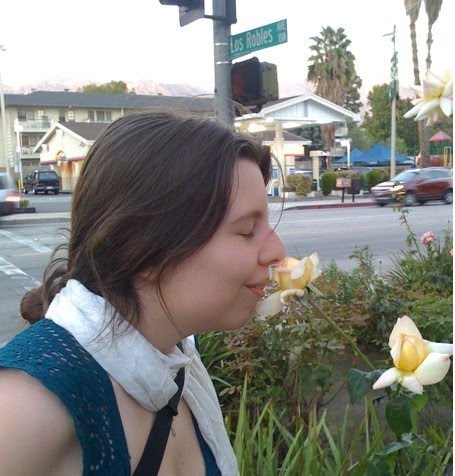
Learning Language By Annie Wells
 This post is written in conjunction with the Feminist Ethics Course Dialogue project sponsored by Claremont School of Theology in the Claremont Lincoln University Consortium, Claremont Graduate University, and directed by Grace Yia-Hei Kao.
Annie Wells is a 3rd year MDiv student at CST. Once a newspaper photographer, she is now studying to become a chaplain. To see her work from the banana plantations in Nicaragua use this link and click on the picture of bananas next to the text entitled “Pesticides.”http://www.anniewellsphotography.com/content.html?page=2
I have been learning to speak Spanish for years. Sometimes Spanish speakers can understand me. Sometimes I don’t come close to saying what I mean to say. Sometimes when I’m trying to speak Spanish I cannot remember one word in Spanish or English. But I remember clearly the woman who inspired me to learn and for her I will keep trying until I die. Continue reading “Learning Language By Annie Wells”
Halloween Matters (Part II): An Immigrant Family, Christian, and Feminist Parenting Perspective by Grace Yia-Hei Kao
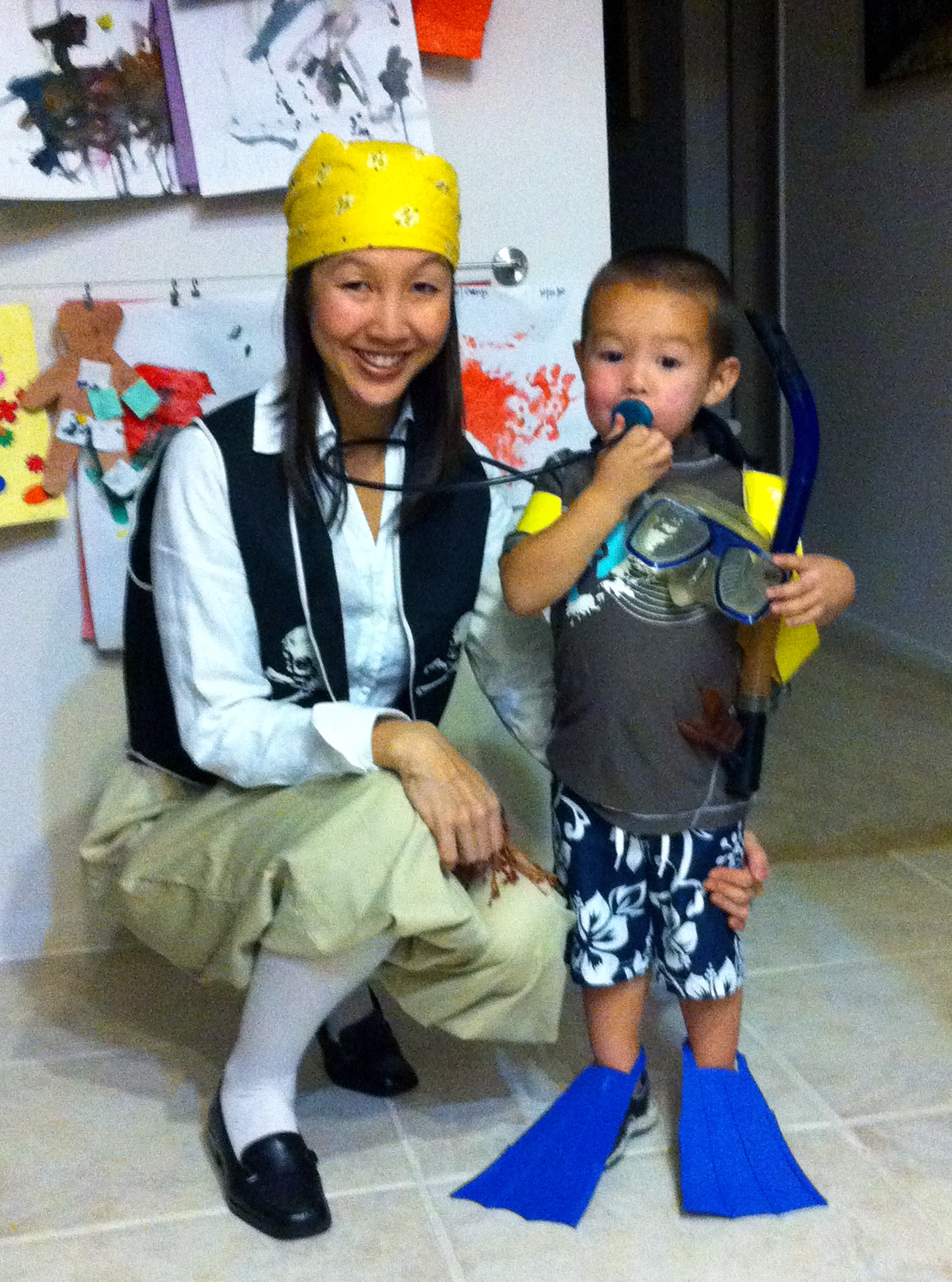
“[W]e have not gone the store-bought, costume-in-a-bag route, even though we recognize that the proliferation of ready-made options is a godsend to time-strapped, dual-career parents.”
This is a second part of a previous post about the shifting personal importance of Halloween. Now that I’m a mother of two young boys, I find that my husband and I are constantly looking for teachable opportunities. The holidays have accordingly become excellent ways for us not only to spend quality time together, but also to impart our values. We manifest our commitments even in something as simple as costume choices, as I explain below.
(1) We do not indulge the Manichean-like stage that our four-year old child is in. As befitting a boy his age, our primo is fascinated by superheroes and has asked on a number of occasions if he could be one for Halloween.
Halloween Matters: An Immigrant Family, Christian, and Feminist Parenting Perspective by Grace Yia-Hei Kao
“I had realized that my parents legitimately had more important things to do than to carve pumpkins or buy costumes. But as a young child, I equated participating in the cultural phenomenon that is Halloween with being an American. I, as a daughter of immigrants, just wanted to fit in and join the fun.”
Mistaken “Miss Representation”: Women in the Media and Necessary Comprehensive Conversations By Jaji Crocker
 This post is written in conjunction with the Feminist Ethics Course Dialogue project sponsored by Claremont School of Theology in the Claremont Lincoln University Consortium, Claremont Graduate University, and directed by Grace Yia-Hei Kao.
Jaji Crocker received her MFA in Creative Writing from Northwestern University, and is now pursuing a dual degree at Claremont Graduate University, studying for her PhD in English and MA in Religion. Her research interests and approach are innately interdisciplinary as she explores the evolution of the ethics buttressing and changing religious philosophies and practices in North America and the Middle East, as well as the evolution of the theological imagination and feminist influences in post WWII American literature. Jaji continues to write fiction and teach creative writing.
Last week, a program graced the Oprah Winfrey Network (OWN) entitled “Miss Representation.” The piece discussed the damaging influence of the media on the psyches and behaviors of girls and women in North America, pointing to the media’s hypersexualized representation of women, emphasizing women’s bodies and clothing rather than their intellect and voice. The message being, a woman’s message – the words she speaks – doesn’t matter; it is trivial and cute and even, sometimes, dangerous. Continue reading “Mistaken “Miss Representation”: Women in the Media and Necessary Comprehensive Conversations By Jaji Crocker”
Finding my Voice through the Vagina Monologues By Anonymous
 This post is written in conjunction with the Feminist Ethics Course Dialogue project sponsored by Claremont School of Theology in the Claremont Lincoln University Consortium, Claremont Graduate University, and directed by Grace Yia-Hei Kao.
“Are you going to the Vagina Monologues try-outs tonight?” my friend asked me last year after class.
“I hadn’t planned on it,” I replied cautiously. Truth be told, the word ‘vagina’ made me uncomfortable. There were yearly productions of the Vagina Monologues at my undergraduate institution, but I never went. I thought it was a time when women gathered and performed monologues they had written, and I thought it demeaning to have these monologues named metonymically. I did not want to be associated with the Monologues: I was in favor of women’s equality, but I did not want to claim my sexuality in so visceral a manner. In my mind, the ‘Vagina’ of Vagina Monologues just referred to the actresses, not the content.
How wrong I was. Continue reading “Finding my Voice through the Vagina Monologues By Anonymous”
Sexual Ethics and Southern Belles By Amanda Pumphrey
 This post is written in conjunction with the Feminist Ethics Course Dialogue project sponsored by Claremont School of Theology in the Claremont Lincoln University Consortium, Claremont Graduate University, and directed by Grace Yia-Hei Kao.
Amanda Pumphrey is a first year Ph.D. student in women’s studies in religion at Claremont Graduate University. She received her MA in religion from Claremont School of Theology and her BA in religious studies from Valdosta State University in Valdosta, Georgia. Amanda enjoys studying Christian sexual ethics and feminist and queer theologies.
It’s 8th grade. I’m in the girls’ bathroom during lunch time and I ask my friend in the stall next to me if she has a tampon that I can use. “Amanda Brookins, I didn’t know you wasn’t a virgin nomore!” screams another friend who is waiting on me. I was confused by her comment, but I later learned that her mother had explained to her that girls could not wear tampons unless they had had sex. Which translated into only married women should be utilizing tampons. This is the context in which I grew up: South Georgia where there is virtually no comprehensive sex education in the public school systems. In this small southern town, I learned about sex through my youth group at a country, Pentecostal church. What I learned was that sex was sinful and it was not something that I should even think about until I was married. Christianity and southern culture go hand in hand within my hometown, so as a born again Christian and a girl I was expected to “save myself for marriage” and my future husband, and to uphold my status as a polite and proper southern belle. The norms were already established: sex is for marriage which is a Christian institution between one man and one woman. Continue reading “Sexual Ethics and Southern Belles By Amanda Pumphrey”
Undermining Our Own Authority by Grace Yia-Hei Kao
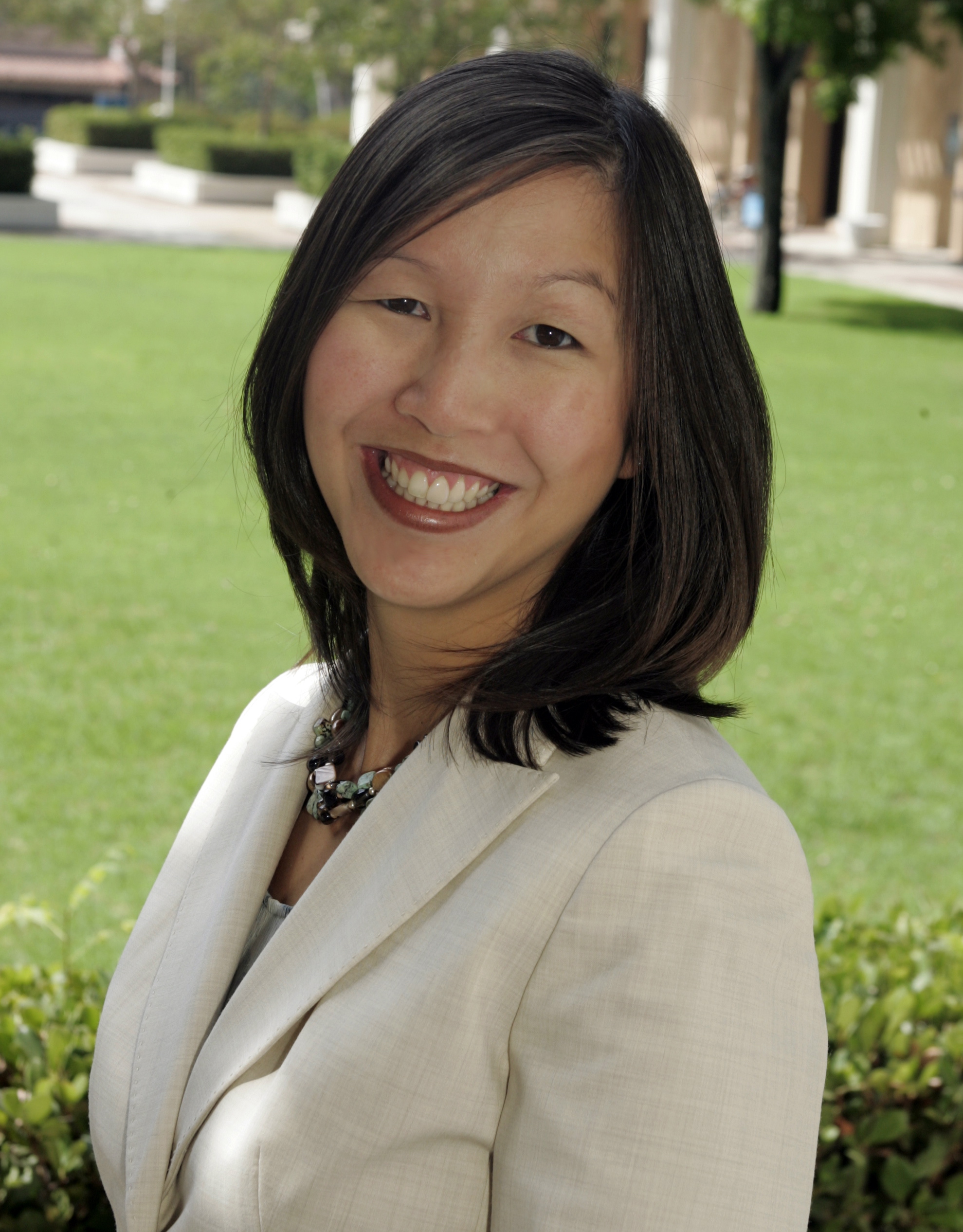 “I’ll be the first to admit that it can be difficult, if not exhausting, for women professionals to discern how to be strong and assertive (and thus be taken seriously) without coming across as arrogant or b*tchy. But there is indeed room for play between over-deference and cockiness, and the ability to code-switch while in formal settings would be a good step in the right direction for many of us.”
Whatever your take is on Madonna’s feminist bona fides, she was definitely on to something in her 2001 hit “What it Feels Like For a Girl.” Madonna sang about the tremendous pressures females of all ages face to conform to gendered norms of physical appearance and demeanor. I want to use her lyrics to discuss some ways I have seen young women in academe subtly undermine their own authority.
Continue reading “Undermining Our Own Authority by Grace Yia-Hei Kao”
Georgia and The Virginity Institute By Katrina Myers
 This post is written in conjunction with the Feminist Ethics Course Dialogue project sponsored by Claremont School of Theology in the Claremont Lincoln University Consortium, Claremont Graduate University, and directed by Grace Yia-Hei Kao.
Katrina Myers is a MA student at Claremont School of Theology and is participating in the Feminist Ethics Course Dialogue project.
During the past two years, I had the opportunity to serve as a Peace Corps volunteer in the country of Georgia, which is located in Eastern Europe. There I worked as a schoolteacher and lived in a tiny, homogenous, Georgian village in the Kakheti region.
I quickly learned the encompassing influence of the Georgian Orthodox Church, which upholds an ideal hierarchy: God, Jesus, Patriarch, Man, Woman. The church champions traditional gender roles; men are to be strong leaders and heads of the community and their households, while women are expected to be virginal, modest, obedient and subservient. In Georgian culture, the influence of the Church and the teachings of Patriarch Ilia II and his predecessors are indisputable. Continue reading “Georgia and The Virginity Institute By Katrina Myers”
Room at the Table: The “Problem” of Men By Lara Helfer
 This post is written in conjunction with the Feminist Ethics Course Dialogue project sponsored by Claremont School of Theology in the Claremont Lincoln University Consortium, Claremont Graduate University, and directed by Grace Yia-Hei Kao.
Lara Helfer is a 3rd year MDiv Student at Claremont School of Theology. She is humbled and excited by the intelligence, passion, and commitment of her classmates and professors, and looks forward their feedback and challenges to her very first blog post.
As an out lesbian for more than 25 years, I have always struggled with the separatist movements associated with radical feminism. For me, affiliating as a ‘woman loving woman’ means just that, I love women. But wait – I love men too! Whom I partner with – and yes, as a lesbian my partner is a woman – is but one aspect of me. Being a lesbian is not all of who I am, by far. I can’t, and do not wish to, imagine my life without men as an integral part of it. Continue reading “Room at the Table: The “Problem” of Men By Lara Helfer”
 Feminism and Religion