

 “[T]he Old European sacred images and symbols were never totally uprooted; these persistent features in human history were too deeply implanted in the psyche. They could have disappeared only with the total extermination of the female population.” Marija Gimbutas, The Language of the Goddess, 318.
August 15 is known to Greek Christians as the date of the Koimisi, “Falling Asleep” or Dormition of the Panagia, She Who Is All Holy. December 25 is a minor holiday in the Orthodox tradition, while Easter and August 15 are major festivals. The mysteries of Easter and August 15 concern the relation of life and death. In Orthodox theology, both Easter and August 15 teach that death is overcome: Jesus dies and is resurrected; Mary falls asleep and is assumed into heaven. These mysteries contain the promise that death is not the final end of human life. Yet this may not be the meaning of the rituals for many of those who participate in them.
In Christus Victor, Gustaf Aulen argued that Eastern (Orthodox) and Western (Catholic and Protestant) traditions understood salvation differently. The Western Church focuses on salvation from sin, while the Eastern Church focuses on transcending death. This contrast is not absolute, as for the Western Church sin is the cause of death and when sin is overcome, immortal life is restored. While Orthodoxy has strong ascetic and monastic traditions, it does not teach ordinary Christians to focus on sexual purity and impurity as Western traditions have done. Nor is there a strong emphasis on transforming collective sin in movements for social justice. Significantly, though Roman Catholics and others consistently refer to the “Virgin Mary,” Orthodox Christians prefer “Panagia,” She Who Is All Holy.
In Greece the ordinary rhythms of life are disrupted at Easter and in August. During lent, many women (and some men) fast, while in August women named Mary and Panagiota–as well as others who wish to honor or petition the Panagia–wear black for two weeks.
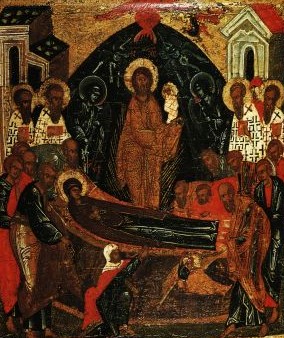 Throughout the first 2 weeks of August, Greek Christians focus on the death of the Panagia. According to theology, her Son appears after her death and “assumes” her into heaven. The Orthodox icon depicts Mary surrounded by the Apostles, while Jesus holds the assumed body of Mary depicted as an infant wrapped in swadling clothes.
When she first saw this icon, my friend Naomi Goldenberg commented that it is an example of the widespread attempt on the part of men to appropriate the power to give birth. The icon reverses the symbolism of the nativity where the baby wrapped in swadling clothes is held in the hands of his mother. Christian baptism described as re-birth through the Father, Son, and Holy Spirit is another version of “male birth.” Continue reading “Hidden Meanings in the Rituals of the Assumption by Carol P. Christ”


 Feminism and Religion