Though represented by its detractors as an incursion of paganism into
Christianity, and presented as an integrally and intrinsically Christian phenomenon by its supporters, the truth about the Re-Imagining Conference and movement is that it was a product of a wider feminist awakening. The critique of patriarchal religions that emerged in the academy and in churches and synagogues in the late 1960s and early 1970s was part of the emerging feminist uprising. The feminist movement placed a question mark over all patriarchal texts and traditions, secular and religious, and as such was beholden to none.
In the spring of 1971, Roman Catholic Christian Mary Daly published “After the Death of God the Father” in the liberal Catholic magazine Commonweal. She asserted that the God whose death was touted in the “Death of God” movement was an idol fashioned in the image of male power and authority. She called for “the becoming of new symbols” to express the new becoming of women. In the summer of 1971, a group of nuns from Alverno College convened the first Conference of Women Theologians. Besides sparking dialogue about the role of women in religions, the conference endorsed my call to form a women’s group at the fall meetings of the American Academy of Religion, up until then a gathering of several thousand male scholars of religion, with only a handful of women scholars in attendance. At winter solstice, Z Budapest launched the Susan B. Anthony Coven #1 in Los Angeles publishing a Manifesto calling on women to return to the ancient religion of the Goddess.
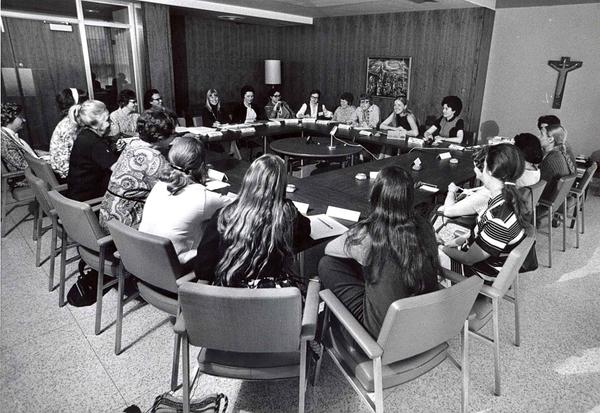
Carol Christ at the Conference of Women Theologians
Today I am publishing an early work on female language for God that I wrote with Emma Trout at the first Conference of Women Theologians in 1971. Highly contested at the conference, this essay is a foreshadowing of my subsequent work on the need for female imagery for divinity.
Rereading this essay more than four decades later, I am gratified to see that though we began our essay with the image of God giving birth (which I still view as an important image), Emma and I were aware of the danger that female imagery for God could reinforce “a false sexual polarity.” We insisted then that female imagery for God must not repeat sex role stereotypes, but rather must shatter them.
I am surprised that we also mentioned the need for a new non-static or process metaphysic, a theme I did pursue until I wrote Rebirth of the Goddessand then She Who Changesseveral decades later.
While the references in the essay are dated, the issues it raises are not. Though many mainline Christian and Jewish communities have adopted inclusive language, active experimentation with female language for God is relegated to the fringes of these groups. And while Goddess feminists resist gender stereotypes, some New Age teachers and Neo-Pagan groups perpetuate the idea that the Divine Feminine is receptive, loving, and giving, while the Divine Masculine is active, assertive, and aggressive.
Conference of Women Theologians 1971
ALTERNATIVE IMAGES OF GOD: COMMUNAL THEOLOGY BY CAROL CHRIST AND EMMA TROUT
How much better for theology to conceive of God the Creator as pregnant with the world, giving birth to it and nourishing it, than of God the divine Watchmaker who set the machine ticking millions of years ago. — Penelope Washbourne Chen in “Rediscovering the Feminine in God” The Tower alumni magazine
Even though we know that God Himself is not really a male, we have made use of no other images in talking about Him. As Mary Daly has pointed out, images have a way of perpetuating themselves even though we conceptually know better. (“After the Death of God the Father”) The image of God as a male authority figure serves to legitimize the structures of subordination (oppression) of women to (by) men. The problem is to conceive God in such a way that God’s masculinity does not function as a legitimation system for the oppression of women.
The imaging of God as male has two aspects: 1) the poverty of our language, and 2) the impoverishing of our vision of God by exclusive use of characteristics which our culture has attributed to and limited to the male in conceptualizing and imaging God. In the first of these two aspects we find images of God as Father, King, Lord; our language has no pronoun which is able to embrace and/or transcend both sexes. Our language forces us to think of God as male; we need words like “she-he,” “father-mother,” “daughter-son,” “brother-sister.” Regarding the second aspect: in the Western tradition, particularly the Christian theological tradition our ideas and images have been impoverished by almost exclusive use of “male” characteristics in conceptualizing and imaging God.
For example, initiative, transcendence, authority, primacy, leadership, control and order have all been conceived in static, self-sufficient, abstractly rational terms, in correspondence with masculine stereotypes. An alternative image of God suggested by Penelope Washbourne Chen, imaging God as pregnant, giving birth to, and nurturing the world, presents us with a more dynamic way of conceiving God. Philosophically, this image of God would find expression in the neo-classical metaphysics or process view of reality of Whitehead and Hartshorne, rather than the static ontology of the Greek tradition.
. . .
Let us now turn to the alternatives. Underlying the problem of choosing among the alternative conceptions/images of God is the problem of the evaluation of sexual differences. If, for example, one believes sexual differences are a fundamental polarity in human experience, she will find it appropriate to see this polarity reflected in the deity. If, on the other hand, one does not see sexual differences as a fundamental polarity, she will be wary of correcting a false male image/concept of God by introducing a “female” element which may serve to further legitimize a false sexual polarity.
If one is open to the possibility that sexual differences may not be fundamental, the real question is how to shatter the idol of a male deity without either 1) substituting a reverse idol of a female deity, or 2) legitimizing a false sexual polarity.
Photos of Carol speaking at the Conference of Women Theologians and of the Conference Participants from the Alverno College archives. Thanks to Sarah Shutkin for providing a copy of the essay from the Alverno College Library Archives.
Our mother Sophia, we are women in your image:
With the hot blood of our wombs we give form to new life.
With the courage of our convictions we pour out our life blood for justice.
Sophia-God, Creator-God
let your milk and honey pour out,
showering us with your nourishment.
From my reflections on the Re-Imagining Conference presented at Hamline University on Novemeber 1, 2018:
One reason the creative re-imagining of God as female has not taken hold in churches and synagogues is fear of paganism and the Goddess. The creators of the Re-Imagining Sophia ritual took great care to guard against this charge by connecting it to Bible and tradition. Commenting on the reasons for the backlash against the Re-Imaging Conference, Sylvia Thorson-Smith stated:
One was the liturgical use of the biblical image of Sophia – but blown up as evidence of Goddess worship. Second was the milk and honey ritual – an ancient part of early Christianity, but attacked as a pagan substitute for communion.
Though represented by its detractors as an incursion of paganism into Christianity, and presented as an integrally and intrinsically Christian phenomenon by its supporters, the truth about the Re-Imagining Conference and movement is that it was a product of a wider feminist awakening. The critique of patriarchal religions that emerged in the academy and in churches and synagogues in the late 1960s and early 1970s was part of the emerging feminist uprising. The feminist movement placed a question mark over all patriarchal texts and traditions, secular and religious, and as such was beholden to none.
In the spring of 1971, Roman Catholic Christian Mary Daly published “After the Death of God the Father” in the liberal Catholic magazine Commonweal. She asserted that the God whose death was touted in the “Death of God” movement was an idol fashioned in the image of male power and authority. She called for “the becoming of new symbols” to express the new becoming of women. In the summer of 1971, a group of nuns from Alverno College convened the first Conference of Women Theologians. Besides sparking dialogue about the role of women in religions, the conference endorsed my call to form a women’s group at the fall meetings of the American Academy of Religion, up until then a gathering of several thousand male scholars of religion, with only a handful of women scholars in attendance. At winter solstice, Z Budapest launched the Susan B. Anthony Coven #1 in Los Angeles publishing a Manifesto calling on women to return to the ancient religion of the Goddess. Continue reading “Sophia, Goddess, and Feminist Spirituality: Imagining the Future by Carol P. Christ”
Carol Christ at the Conference of Women Theologians
Today I am publishing an early work on female language for God that I wrote with Emma Trout at the first Conference of Women Theologians in 1971. Highly contested at the conference, this essay is a foreshadowing of my subsequent work on the need for female imagery for divinity.
Rereading this essay more than four decades later, I am gratified to see that though we began our essay with the image of God giving birth (which I still view as an important image), Emma and I were aware of the danger that female imagery for God could reinforce “a false sexual polarity.” We insisted then that female imagery for God must not repeat sex role stereotypes, but rather must shatter them. Continue reading “ALTERNATIVE IMAGES OF GOD BY CAROL CHRIST AND EMMA TROUT”
In my previous post, I shared some of the ways in which I’ve been wrestling with gendered imagery for God, the first person of the Christian Trinity often referred to as God the Father. In this entry, I’d like to reflect on ways I am reconsidering the gender of the Christ.
It is only recently, after reading Melinda Bielas’ post “Waiting for Jesus… I mean, Superman” (December 17, 2013), that I began to question male language for the Christ. I got into an interesting conversation with Grace Kao in January about it. My thoughts on this topic are still unformed and more theologically “speculative” than I usually share on this site, but I’d love to hear what you think. I think it is important for Christian feminists to consider the doctrines of the faith and assess where they support the co-humanity of women and when they degrade it. Continue reading “Gendered Imagery of God (Part 2) by Elise M. Edwards”
I have been doing a lot of thinking about gendered imagery and language for God over the past few months. Honestly, a lot of this reflection was provoked by hostile comments I got from my college students at the end of the fall semester because I require gender-neutral language for God and gender-inclusive language when referring to people. The policy in my syllabus is this:
For academic discourse, spoken and written, students are expected to use gender-inclusive language for human beings, and gender-neutral language for God. (e.g. “God” instead of “He;” “God’s” instead of “His;” etc.) This is to prepare students to communicate to the world beyond the Christian university setting. I want to equip you to succeed in graduate school, in the corporate world, and in public communication, all settings in which gender inclusive language for is increasingly expected.
I provide links to websites that discuss the issue, and we talk about it more when we discuss 20th century feminist issues in my course on the Christian Heritage and when we discuss prejudice and sexism in my ethics class. Some students have thanked me for the policy. But many students are perplexed by it, and I’m perplexed by their confusion. It shocks my system when I hear people refer to “man” for all people; I first became aware of the issue when I was in 2nd or 3rd grade and the Girl Scouts changed their pledge because it referred to “mankind.” That was over 30 years ago!
While I’m confused as to why replacing “man” with “people” is such a difficult task, I am more empathetic to the reorientation required to replace “He” with “God.” (And I also acknowledge that the term “God” is not completely genderless either.) I recognize that for many of my students, I might be the first one to challenge their gendered conceptions of God. So I am empathetic, but insistent.
The way discussions about the “gender” of God and Savior are often dismissed as irrelevant, unimportant, silly, or the remote concern of “those feminists” bothers me. Traditional Christian theology asserts that God is a different kind of being than humans are. Therefore, God (the first person of the Trinity) and the Holy Spirit do not have a sex or gender, as sex is a characteristic associated with physical creature-ness and gender is (to simplify) a social construction related to sex. The second person of the Trinity, Jesus, is thought to be male. In the Incarnation, the eternal God became human while also divine, and therefore has a sex and gender in the person of Jesus. But the Trinity as a whole is without sex and has characteristics that we would associate with femininity, masculinity, and genders in between. According to this logic, references to the maleness of God should only be understood metaphoricall,y not literally, and therefore replacing that language with genderless/sexless language should not be inherently problematic.
I’m not saying that the use of any language in reference to God is appropriate or acceptable within the bounds of traditional theology. We (traditionals and non-traditionals alike) should be concerned with how we refer to God, because as Sallie McFague and others remind us, these metaphors/models of God have consequences in the world beyond language. Maleness becomes deified or closer to godliness than femaleness, maleness becomes the model for the priesthood, maleness is the true form of authority, etc. I believe that many of the concerns about feminine imagery for God are based in this same concern: that by associating God with one sex or gender, we claim God’s preference for that sex or gender. In a patriarchal system, this correlation between God and the feminine simply will not do. Feminists who assert feminine qualities of God are merely making projections of themselves, critics claim.
How we conceptualize the being we worship matters. It matters to me, at least. While I acknowledge that there is a danger of simply projecting an image of myself as a deity that I worship, I also think there is great harm in loving and worshiping the divine imaged as those who are at times hostile to me, and historically have been so to my ancestors and kin. So although I know and have good relationships with older, white males, I see no reason why I should image and worship God “the Father” who looks like an old white man. How would that benefit my spiritual practice?
Thank you Carol Christ, for asking me to state my views about this in the comments to my last post. I look forward to more discussions with you and the members of this community. When I read your work years ago, I was convinced about the validity and rightness of affirming feminine forms of divinity. Although the Christian (patriarchal) tradition does not have much room for Goddess language, I am comfortable with it, at least for the first and third persons of the Trinity. In my next post, I’ll talk more about the ways I am considering the gender of the Christ.
Elise M. Edwards, PhD is a Lecturer in Christian Ethics at Baylor University and a graduate of Claremont Graduate University. She is also a registered architect in the State of Florida. Her interdisciplinary work examines issues of civic engagement and how beliefs and commitments are expressed publicly. As a black feminist, she primarily focuses on cultural expressions by, for, and about women and marginalized communities. Follow her on twitter, google+ or academia.edu.




 From the 1993 Re-Imagining Conference:
 Though represented by its detractors as an incursion of paganism into Christianity, and presented as an integrally and intrinsically Christian phenomenon by its supporters, the truth about the Re-Imagining Conference and movement is that it was a product of a wider feminist awakening. The critique of patriarchal religions that emerged in the academy and in churches and synagogues in the late 1960s and early 1970s was part of the emerging feminist uprising. The feminist movement placed a question mark over all patriarchal texts and traditions, secular and religious, and as such was beholden to none.

 Feminism and Religion