Hajar: of the desert by amina wadud

Amina Wadud 2 I am Muslim, by choice, practice and vocation

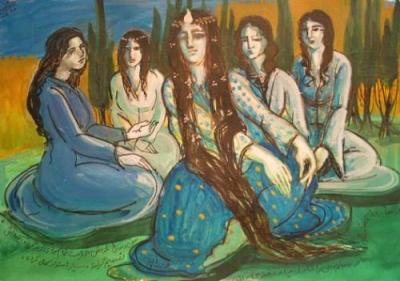
This week the Islamic pilgrimage or Hajj was completed.  For those not gathering on the dusty plains of the desert in Arabia, we have the celebration of the Feast of the Sacrifice, commemorating the exchange of a lamb for the blood of the son of Abraham.  This story is coated with patriarchy, and so it is with some fascination that Hajar (biblical Hagar) configures so significantly in the Islamic telling of it.

According to the same patriarchal twist, it is Abraham’s first son that is pivotal to the story’s continuation and the salvation of a people, yet to be born.  That his first son, Ishmael, was born of a slave woman—some say of African origins—is not without extreme symbolism for African-American women, mostly Christian.  That she is the mother of the tribes of Arabs is also not without some extreme genealogy along with that symbolism. But that she a single female head of household, whose sojourn in the desert still, has a central ritual re-enactment in the Hajj, that I turn to here. Continue reading “Hajar: of the desert by amina wadud”

Letter to Allah by Jameelah X. Medina

Would we eat without the pangs of hunger? Would we drink without feeling thirst? Would we sleep without feeling fatigue or drowsiness? Would we cry without feeling sorrow? These are some questions I’ve asked myself when I wonder why so many people tend to find God, religion, or spirituality in times of great dis-ease and despair. Suddenly, I felt inspired to write a letter to God thanking Her for all that She is and for all that I am. In labyrinthical terms, this is my letter to the God in me that resides within me in God.

Letter to Allah Continue reading “Letter to Allah by Jameelah X. Medina”

When Some People Say “Religion” They Mean “My” Religion by amina wadud

Amina Wadud 2 I am Muslim, by choice, practice and vocation

I came to live in India after having already lived in other parts of Asia. Naively, I anticipated that the best of my Asian living experiences would be manifest in India and this centered on a dynamic encounter with diverse religious communities. I have thus been disappointed that the ideals of diversity have given way to exceptionalism and exclusivity.

For example, members of one religion are not encouraged to or interested in visiting the sacred spaces of other religions. In fact, in most cases, they are prohibited. To be sensitive to these constraints I do not visit any sacred place, no matter how much I have wanted, unless I am given permission as a Muslim. (Coincidentally, I am also prohibited as a woman from entering some of the sacred Muslim spaces!)

As a (retired) professor of religious studies I would like to think I can be a respectful observer. Nevertheless, I have little ability to internalize the notion of taboo. That is, I cannot understand that any space constructed by human beings would be defiled by the entry of another human being. My history of social and political advocacy against all forms of oppression just cannot find a space to accept this notion that one person is irredeemably taboo. Continue reading “When Some People Say “Religion” They Mean “My” Religion by amina wadud”

Forgiveness (is a two-way street) by amina wadud

Amina Wadud 2 I am Muslim, by choice, practice and vocation

I don’t know why this came to me as the discussion I want to have in blog form today, but here you go–

Imam al-Ghazzali (d. 1111) said that Allah (God) only stops forgiving when the believer stops asking for forgiveness.  This is the crux of the Islamic view of divine forgiveness.  Start with the fact that we have NO FALL story, because despite mis-conduct in the Garden, Adam and Eve ASKED for and were granted forgiveness.  Thus, they leave without the mark of some eternal “original sin.”  They live as we all do, here on earth, not as some punishment but because that is where they were intended to live in the first place.  The creation story in Islam describes human creation as per a primordial conversation between the Creator and the unseen creatures known as angels, when God says, “Indeed, I will create ON THE EARTH a khalifah (moral agent, vice-regent of God).”

Thus, the relationship between divine forgiveness and human sin or error is fixed in a dialectic where sin and error might be part and parcel of the human being but likewise forgiveness is part and parcel of the Divine Creator.  In fact, the language used is telling.  Taubah, which is also translated as forgiveness, means “returning to the original place/station.”  Our original place is at one with the Creator, and we are in that station in harmony with all of creation ~ a sort of cosmic bliss.  When we err, we fall away from our true nature and the nature of the entire universe so must return to realign ourselves with this cosmic harmony… and everything will be alright. Continue reading “Forgiveness (is a two-way street) by amina wadud”

Why I Try to Stay Away From the Media by amina wadud

Amina Wadud 2 I am Muslim, by choice, practice and vocation

Recently a controversy broke out surrounding a University talk I was to give in Tamil Nadhu, here in India.  That visit was to include a workshop and several meetings, including one with the all women Jamaat or STEP – the first of its kind in the context of the male dominated personal status law scenario in India).

This is how the events unfolded:  Before I came to India last year, I began communications with various Non-Government Organizations on gender and justice in Islam and with academics or others related to the study of Islam.  At that time an invitation to visit Madras University was extended to me. It took the better part of the year to get the details sorted out.  Meanwhile, I traveled throughout India, spoke at about a dozen Universities and several community organizations (including mosques), and started a book club discussing reformist Islam with interested persons in Kerala. Continue reading “Why I Try to Stay Away From the Media by amina wadud”

Tug-of-Warring over the Female Body (Part 2 of 2) by Jameelah X. Medina

Cover up! No, get naked!

Haraam [Sin]; cover yourself! Be free; show some skin!

AstaghfirAllah [seeking forgiveness from God]; aren’t you ashamed?! Damn, aren’t you hot in that?!

The Muslim woman’s body feels like a battleground with essentialized feminism on one side (covered in Part I) and patriarchy on the other. Both sides have Muslim women on their team, but both sides also harm and silence them. This second part deals with “Team Haraaminator.”

The Haraaminators are kind of like “Daddy Longlegs” or “Momma Longreaches” who hold their wives, daughters, sisters, and even extended sisters in faith close to the chest with their long-legged grips. They come in the male and female variety. They believe that all women should be covered and wearing at least a headscarf. They speak with authority about the headscarf and how important it is for a woman in her pursuit of piety, virtue, modesty, chastity, and heaven. Some allow questioning the headscarf while others take it as a decree from Allah that should never be interrogated. Many use the Qur’an and ahadith (prophetic sayings and doings) to arrive at their opinions while other haraaminators just go by what their shaykh, imam, father, mother, friend or others have told them is the Islamic ruling on the headscarf. Continue reading “Tug-of-Warring over the Female Body (Part 2 of 2) by Jameelah X. Medina”

To Blog or Not to Blog? Is That Even a Question..? by amina wadud

Amina Wadud 2 I am Muslim, by choice, practice and vocationI just want to introduce myself to this blogging forum Feminism and Religion. I will join and then try to keep some kind of pace, so before I jump right in on this that or the other personal and or political topic of interest or inspiration, let me locate myself in blog-relative terms.

The first time I ever participated in a public forum blog was also related to women and religion, but with the word “spirituality” in its title.  For me, there is no divide: to discuss religion I must discuss feminism, and to discuss feminism, I must discuss spirituality.  You will see how these are interwoven, contested and re-woven as the time goes by for me here: blog-wise.

I am Muslim, by choice, practice and vocation. Meaning, I accepted Islam as my way of life, after a loving relationship as a daughter of a Methodist Minister. I was not yet 21.  Now I am 60. The years in between have allowed me to both intra-face within my religion of choice but also to inter-face with religions worldwide and across a wide spectrum of commitments by the followers. Currently, I live in India (about which you will undoubtedly hear a great deal).  Continue reading “To Blog or Not to Blog? Is That Even a Question..? by amina wadud”

They Don’t Know Me by Jameelah X. Medina

A spoken word piece… 

They think I’m uneducated, relegated to the sidelines of life, desecrated and infected mind with cultish, hocus pocish, dogma of misogyny; my worth based solely on my progeny!?…

They think I’m silent, ruled by a tyrant, never speakin’ unless spoken to, hiding scars and contusions too?! Continue reading “They Don’t Know Me by Jameelah X. Medina”

Tug-of-Warring over the Female Body (Part 1 of 2) by Jameelah X. Medina

Cover up! No, get naked!

Haraam [Sin]; cover yourself! Be free; show some skin!

AstaghfirAllah [seeking forgiveness from God]; aren’t you ashamed?! Damn, aren’t you hot in that?!

The Muslim woman’s body feels like a battleground, especially during times like last month (April) with the whole FEMEN “topless jihad” controversy sparked by the Tunisian woman who protested the female body as a source a familial honor. On one side is essentialized feminism and patriarchy on the other end with both sides pulling hard. Both sides have Muslim women on their team, but both sides also harm them. Let’s start with “Team Femesential.”

Questioning the headscarf and certain covering practices is mostly a healthy endeavor in which many Muslim girls and women engage before and after deciding (if they do) to wear a headscarf. However, questioning the headscarf can also be an oppressive and even dismissive strategy that is disrespectful to Muslim women and to all women in general. Continue reading “Tug-of-Warring over the Female Body (Part 1 of 2) by Jameelah X. Medina”

Taking Back the Caliphate: The Role of Muslim Women as Agents of Social Justice by Vanessa Rivera de la Fuente

Vanessa Rivera de la Fuente. Muslim Women as Caliphs.Whenever we talk of Muslim women, two dominant discourses reach our ears. The first is about women of the past who may serve as role models, such as Aisha, Fatima, and Khadija (ra). This perspective, which I call the historical approach, presents an ideal woman with qualities we should strive to develop, values that make life possible with more comfort and a deepening of our imam (faith). These values include wisdom, loyalty, courage, justice, perseverance, faith, independence, and generosity.

The second discourse is based on stereotypes and presents Muslim women as passive and without initiative. I call this the objectification approach, which says that Muslim women are oppressed and sees us as objects without voice or power, subject to the tyranny of the hijab (headscarf), and in need of someone to save us from the bondage of religion and from men, who, incidentally, are all terrorists. Continue reading “Taking Back the Caliphate: The Role of Muslim Women as Agents of Social Justice by Vanessa Rivera de la Fuente”