
The Erotic as Power, Notes on Audre Lorde by Janet Maika’i Rudolph

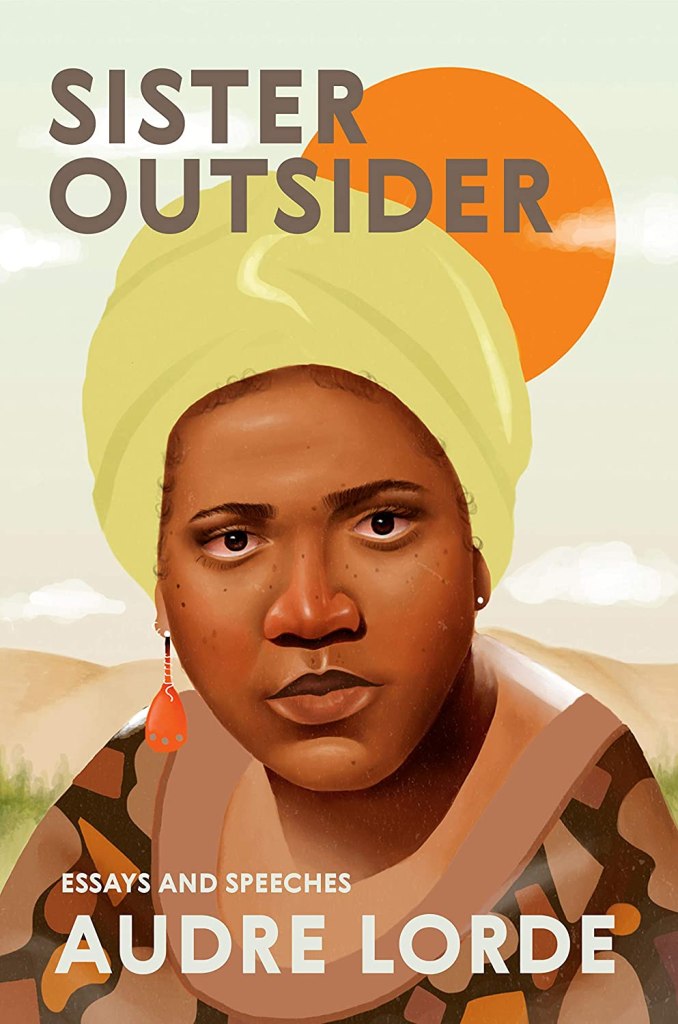
I’ve long kept a tract of Audre Lorde’s seminal piece The Uses of the Erotic near my computer. “The Erotic as Power” is her subtitle. If you haven’t read it, please do.  It is in her book Sister Outsider. And you can find it as a stand-alone here. It was written in 1978.

Lorde points out how the erotic is the opposite of pornography, in fact pornography is ultimately a denial of the erotic because it emphasizes sensation without feeling. “The erotic is a resource within each of us that lies in a deeply female and spiritual plane . . .” She goes on to note how it is through our bodies that we recognize and access this power. But she goes on, “We have been taught to suspect this resource, vilified, abused and devalued within Western society.”  In the hands of patriarchy this amazing and important resource often lies out of reach because it has become a source of shame and a sense of inferiority for women.[1]

I would add to the definition of patriarchy that one of its main goals is to damp down, even destroy, the erotic. We have seen this play out over thousands of years of history. Women are often viewed as either saints or sinners. Saints are denuded of this deep earthy power and sinners are those who flaunt it, or at least in the eyes of patriarchy.

Continue reading “The Erotic as Power, Notes on Audre Lorde by Janet Maika’i Rudolph”

The Pleasure of Education and New Beginnings

BUT GOD/DESS—it is also enjoyable, passionate, and fun. Learning and teaching is fun; and I love having fun with my students. Even when the topics are hard and when the lessons hurt, it is the pleasure of relatedness to them, to text, to new understanding that facilitates the process. And without that pleasure, the work is unsustainable.

In graduate school, I fell in love with the book Teaching to Transgress by bell hooks. My memory of what I specifically loved about that book has blurred over time, particularly as I read more and more of her work. But what remains is a sense of how challenging and how real the writing was—how inclusive of whole experiences and truths, comfortable and uncomfortable.

hooks doesn’t shy away from the pain or pleasure of education, indicating how learning and those we learn from can induce passion: Audre Lorde’s erotic, which is so hard to distinguish from the sexual because, as Lorde explains, we are taught to limit our sense of the erotic to the sexual or pornographic.

Continue reading “The Pleasure of Education and New Beginnings”

Legacy of Carol P. Christ: Remembering Audre Lorde and “The Uses Of The Erotic”

This was originally posted on March 18, 2013

Moderator’s Note: Carol’s original essay had links to the essay which are no longer active. The essay can be found in Sister Outsider.

I was  given a copy of Audre Lorde’s essay “The Uses of the Erotic” in my first year of teaching at San Jose State by a young white lesbian M.A. student named Terry.  It was 1978.  I was in my early 30s.  This essay came into my life and the lives of my students, friends, and colleagues at “the right time.”  It became a kind of “sacred text” that authorized us to continue to explore the feelings of our bodies and to take them seriously.

The second wave of the women’s movement was about to enter its second decade. We had already been through years of consciousness raising groups.  There we learned to “hear each other to speech” about feelings we had learned to suppress because we had been told they were not acceptable for us as women to have or to express.  Those early days of the women’s movement were one big “coming out” movement.  We were bringing our feelings and ourselves out of the closet.

Continue reading “Legacy of Carol P. Christ: Remembering Audre Lorde and “The Uses Of The Erotic””

Remembering Audre Lorde and “The Uses Of The Erotic” by Carol P. Christ

carol p. christ 2002 colorI was  given a copy of Audre Lorde’s essay “The Uses of the Erotic” in my first year of teaching at San Jose State by a young white lesbian M.A. student named Terry.  It was 1978.  I was in my early 30s.  This essay came into my life and the lives of my students, friends, and colleagues at “the right time.”  It became a kind of “sacred text” that authorized us to continue to explore the feelings of our bodies and to take them seriously.

The second wave of the women’s movement was about to enter its second decade. We had already been through years of consciousness raising groups.  There we learned to “hear each other to speech” about feelings we had learned to suppress because we had been told they were not acceptable for us as women to have or to express.  Those early days of the women’s movement were one big “coming out” movement.  We were bringing our feelings and ourselves out of the closet.

Many of us had been exploring various forms of body and feeling based therapies broadly called “humanistic” that encouraged the open acknowledgment and expression of feelings.  It was also the time when large numbers of women were beginning to “come out” as lesbian.  Some of these were women who had theretofore not “known” or even had any idea that they were lesbian. The song by Lavender Jane Loves Women with the refrain “any woman can be a lesbian” was well-known in feminist circles.  Women who did not stay lesbian explored their sexuality with other women. Women who did not do that were naming and recognizing the importance of female friendship and its life-saving and life-transforming part in their lives—an act that was in itself transgressive.

Audre Lorde told us that all of this was not only good–it was sacred. “The erotic is a resource exists in each of us on a deeply female and spiritual plane.”  Continue reading “Remembering Audre Lorde and “The Uses Of The Erotic” by Carol P. Christ”