
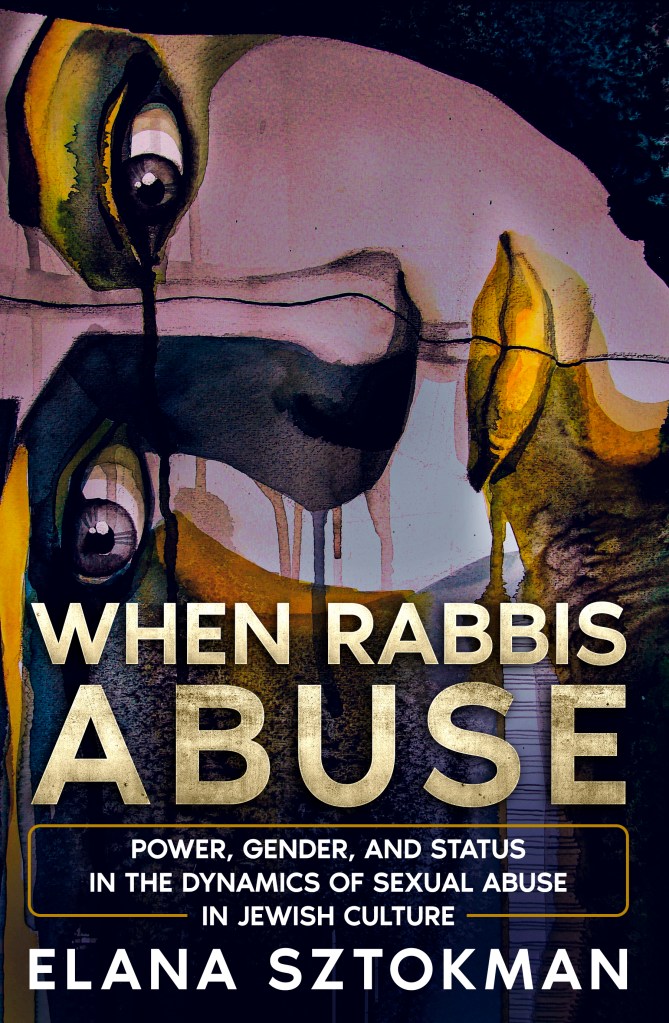
When Rabbis Abuse: Power, Gender, and Status in the Dynamics of Sexual Abuse in Jewish Culture, Part 2 by Dr. Elana Sztokman

Moderator’s note: This is a book excerpt in 2 parts. Part 1 was posted yesterday. When Rabbis Abuse will be published on June 14th, information on ordering below.

Grooming tactics: Targeting the victim
Although there are many ways to target a victim, there is a particular type of grooming that is available to rabbinic figures and other clergy, which comes in the form of pastoral care. Many stories involve glaring examples of this—funeral, bat mitzvah class, depression, or other moments of emotional vulnerability. Often the rabbi-abuser will target people who are going through a divorce—or even worse, recovering from sexual abuse. …

Brenda, for example, says that the rabbi targeted her when she was at a very stressful time in her life and having what she described as “emotional issues”:

I was making my son’s bar mitzvah, and it was a lot of work. I was having some emotional issues because I’m more observant than my family and most of my family is pretty secular and it’s always challenging to get my family to be engaged, and I was feeling stressed and hurt because a lot of my relatives had decided not to come.

Continue reading “When Rabbis Abuse: Power, Gender, and Status in the Dynamics of Sexual Abuse in Jewish Culture, Part 2 by Dr. Elana Sztokman”

When Rabbis Abuse: Power, Gender, and Status in the Dynamics of Sexual Abuse in Jewish Culture, Part 1 by By Dr. Elana Sztokman

Moderator’s note: This is a book excerpt in 2 parts. Part 2 tomorrow. When Rabbis Abuse will be published on June 14th, information on ordering below.

When I started this research in 2015, I was not expecting rabbis to be the headliners. I was looking at abuse in general in our community. When I began conducting interviews on this topic, I was startled to discover how many of the abusers described by interviewees were rabbis.

Discovering rabbis

Although anthropology does not claim to offer statistical evidence or representative sampling, and although I efforted to maintain listening neutrality and non-judgment, I was nonetheless swept away by hearing so many of these accounts of rabbis who sexually abuse. The title of this book is a result of an incomprehensible number of interviewees in which the abuser was a rabbi. I decided to examine the profile of the rabbi-abuser more carefully to understand what this means for our culture and our community, and to use those insights to analyze other cases of high-profile abuse using those paradigms of power in our culture….

Continue reading “When Rabbis Abuse: Power, Gender, and Status in the Dynamics of Sexual Abuse in Jewish Culture, Part 1 by By Dr. Elana Sztokman”

A Feminist Retelling of Cain and Abel by Trelawney Grenfell-Muir

Eve and Adam had many children. Two of them, the sisters Cain and Abel, were best friends. When they grew up, Cain became a farmer, and Abel became a shepherd. In their community, people shared what they had with each other. They shared this way in order to help the community be strong, and to practice gratitude. They shared with each other in sacred, holy ceremonies, in which they put their communal offerings onto an altar for Sister God/ess, to be blessed. One day, both Cain and Abel brought an offering to their community. Cain brought some food she had grown, and Abel brought a sheep. The community gathered for the ceremony. They prayed prayers of gratitude and blessing, and thanked the Earth for its abundance. They each laid hands on the sheep and thanked her for her life, blessed her spirit that it might journey peacefully and joyfully to reunite with Sister God/ess, and praised her for giving her body to feed the community.  Then they killed the sheep, as quickly and carefully as they could, and set the meat in the sacred fire to cook. Abel was glad that she could help her community be fed and healthy with the sheep she had given.

Continue reading “A Feminist Retelling of Cain and Abel by Trelawney Grenfell-Muir”

What If…She’s Stronger than She Knows…by Molly Remer

“When I dare to be powerful–to use my strength in the service of my vision–then it becomes less and less important whether I am afraid.”

Audre Lorde

“The purpose of life is not to maintain personal comfort; it’s to grow the soul.”

–Christina Baldwin

When teaching childbirth classes, I would speak to my clients about shifting the common fear-based “what if” cultural dialog of birth to “positive” anticipation rather than fears, encouraging them to ask themselves questions like: “what if I give birth and it is one of the most powerful, thrilling moments of my life?” While I stand by this practice, I also think about the what ifs that crawl out of our dark places and lodge in our hearts. The what ifs that snake around the edges of our consciousness in the early hours of the morning. The what ifs we try to push down, down, down and away. The what ifs that stalk us. The what ifs so very awful that we fear in giving voice to them, we might give life to them as well.

We may feel guilty, ashamed, negative, and apologetic about our deepest “what ifs.” We worry that if we speak of them, they might come true. We worry that in voicing them, we might make ourselves, our families, our communities, our work, or philosophies, our faiths, or whatever look bad. We want to be positive. We want to be blissfully empowered, confident, and courageous. And, guess what? We are. Sometimes that courage comes from looking the “what ifs” right in the eye. Sometimes it comes from living through them. My most powerful gift from my pregnancy with my daughter, my pregnancy-after-loss baby, was to watch myself feel the fear and do it anyway. I was brave. And, it changed me to learn that.

What if we can learn more from our shadows than we ever thought possible? There is power in thinking what if I can’t do this and then discovering that you CAN.

Continue reading “What If…She’s Stronger than She Knows…by Molly Remer”

Women Standing as Sacred Witness to One Another By Stacia Guzzo

The following is a guest post written by Stacia Guzzo.  She received her MA in Theological Studies from Loyola Marymount University and is currently working toward a MDiv through Fuller Theological Seminary. She is also in the midst of completing certification in Childbirth Education and periodically serves women in her community as a labor doula. She has taught on the elementary and high school levels, led retreats, and spoken at regional congresses through the Los Angeles Roman Catholic Archdiocese. She lives with her husband, son, two dogs, two cats, seven chickens, and five beehives on a small homestead in Tehachapi, California.

“Hands!” The young woman gasped as the next contraction swelled. I quickly put the wet washcloth I had been using to dab her face back in the small bowl of water beside me and grabbed her hands. She squeezed them, moaning low. Her husband stood behind her in the birthing tub, pressing on her hips. Two midwives stood in the background, their encouragement silent and strong. The dim light of dawn was beginning to shine through the window of their home. In another room, the couple’s two-year-old son slept. Continue reading “Women Standing as Sacred Witness to One Another By Stacia Guzzo”