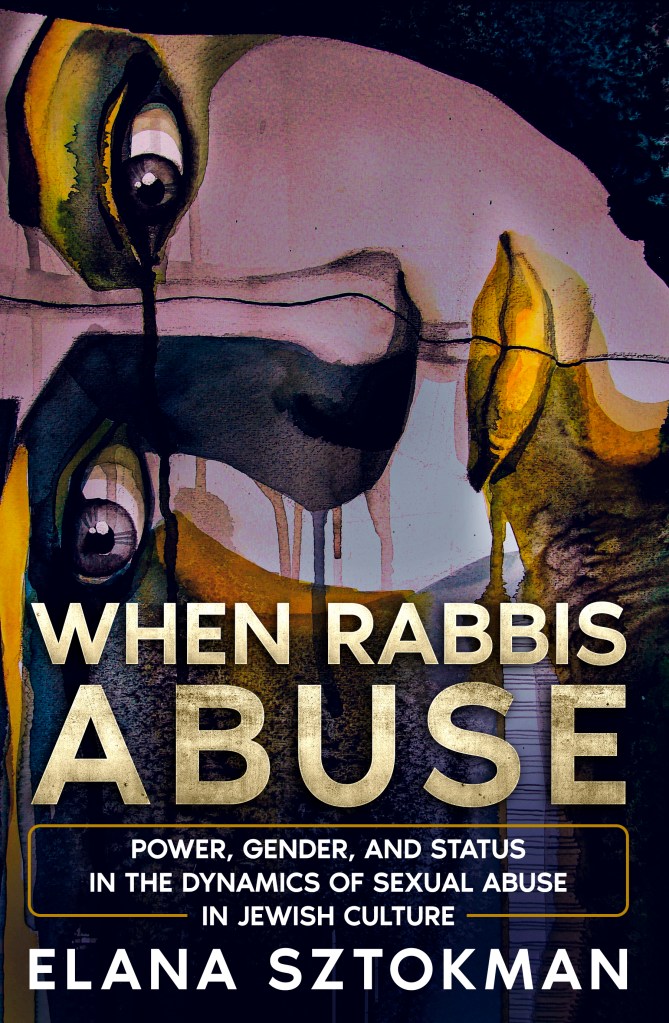
When Rabbis Abuse: Power, Gender, and Status in the Dynamics of Sexual Abuse in Jewish Culture, Part 2 by Dr. Elana Sztokman

Moderator’s note: This is a book excerpt in 2 parts. Part 1 was posted yesterday. When Rabbis Abuse will be published on June 14th, information on ordering below.

Grooming tactics: Targeting the victim
Although there are many ways to target a victim, there is a particular type of grooming that is available to rabbinic figures and other clergy, which comes in the form of pastoral care. Many stories involve glaring examples of this—funeral, bat mitzvah class, depression, or other moments of emotional vulnerability. Often the rabbi-abuser will target people who are going through a divorce—or even worse, recovering from sexual abuse. …

Brenda, for example, says that the rabbi targeted her when she was at a very stressful time in her life and having what she described as “emotional issues”:

I was making my son’s bar mitzvah, and it was a lot of work. I was having some emotional issues because I’m more observant than my family and most of my family is pretty secular and it’s always challenging to get my family to be engaged, and I was feeling stressed and hurt because a lot of my relatives had decided not to come.

Continue reading “When Rabbis Abuse: Power, Gender, and Status in the Dynamics of Sexual Abuse in Jewish Culture, Part 2 by Dr. Elana Sztokman”
When Rabbis Abuse: Power, Gender, and Status in the Dynamics of Sexual Abuse in Jewish Culture, Part 1 by By Dr. Elana Sztokman

Moderator’s note: This is a book excerpt in 2 parts. Part 2 tomorrow. When Rabbis Abuse will be published on June 14th, information on ordering below.

When I started this research in 2015, I was not expecting rabbis to be the headliners. I was looking at abuse in general in our community. When I began conducting interviews on this topic, I was startled to discover how many of the abusers described by interviewees were rabbis.

Discovering rabbis

Although anthropology does not claim to offer statistical evidence or representative sampling, and although I efforted to maintain listening neutrality and non-judgment, I was nonetheless swept away by hearing so many of these accounts of rabbis who sexually abuse. The title of this book is a result of an incomprehensible number of interviewees in which the abuser was a rabbi. I decided to examine the profile of the rabbi-abuser more carefully to understand what this means for our culture and our community, and to use those insights to analyze other cases of high-profile abuse using those paradigms of power in our culture….

Continue reading “When Rabbis Abuse: Power, Gender, and Status in the Dynamics of Sexual Abuse in Jewish Culture, Part 1 by By Dr. Elana Sztokman”

“For I know the plans I have for you:” The coming out story of a queer Catholic raised in the Purity Culture Movement part 2 by Emma Cieslik

You can read part 1 here.

Growing up, I sat through lessons about how my body was inherently evil, that my thoughts and attractions were sinful and unhealthy. I grew up in the age of the Purity Culture Movement, the height of purity culture dated between the 1990s and early 2000s, amid the flush of “modest is hottest” theologies. I grew up surrounded by language codified around victim-blaming, slut-shaming and heteronormativity. I had attended retreats where we were told to pray for our future husbands, where we placed white roses on the altar as an homage to our purity in veneration of the Virgin Mary. I did not wear a purity ring or sign a purity pledge, but the expectations placed on me reinforced the ideas embedded in these objects none the less. I learned over and over to keep my candle unlit until marriage.

I had repressed my sexuality so far that it felt non-existent. I had shamed and punished myself for years whenever I felt any sexual attraction. If I felt ashamed of my attraction to men, my response to my feelings towards women was far worse, avoiding the eyeline of Victoria Secret models and magazine covers. I didn’t know who to talk to about these feelings—I was conditioned that my thoughts about men were sinful but forgivable. Everyone struggles with attraction prior to marriage. But who could I ask or talk to about my attraction to women? I was worried that what I told a priest in confession would somehow make its way back to my parents or friends. Despite their unconditional love, I worried that this would be the line in the sand, a sin so ugly and unnatural that I wouldn’t be welcome back in our Church.

Continue reading ““For I know the plans I have for you:” The coming out story of a queer Catholic raised in the Purity Culture Movement part 2 by Emma Cieslik”

“For I know the plans I have for you:” The coming out story of a queer Catholic raised in the Purity Culture Movement part 1 by Emma Cieslik

It was my last interview for the Muncie LGBTQ+ History Project. I was a senior in college, and I was about to complete my tenth interview focused on the intersections of Christian religion and queer identity. I was slated to conduct an oral history interview with Rachel Replogle, a nonbinary lesbian who runs Indiana’s only queer-affirming wedding videography business. I had expected to explore elements of her work in churches and religious spaces—and I had encountered experiences of trauma, both familial and religious, through the project—but Replogle’s story touched a nerve about my own experiences and made my question the project’s impact on the people conducting it.

Since 2018, the Muncie LGBTQ+ History Project has been collecting the stories of queer people who grew up in and around Muncie. I worked with the project for over a year as a research associate, conducting ten long-form oral history interviews with members of the Muncie LGBTQ+ community about their experiences growing up in Muncie, a small town in East-Central Indiana in the heart of the Rust Belt. Spearheaded by Dr. Emily Johnson [1] the project seeks to uplift and celebrate queer experience in the Midwest. I entered the project with an interest in how queer individuals engage with religious identity, especially in spaces that deny their personhood and/or invalidate their relationships.

Continue reading ““For I know the plans I have for you:” The coming out story of a queer Catholic raised in the Purity Culture Movement part 1 by Emma Cieslik”

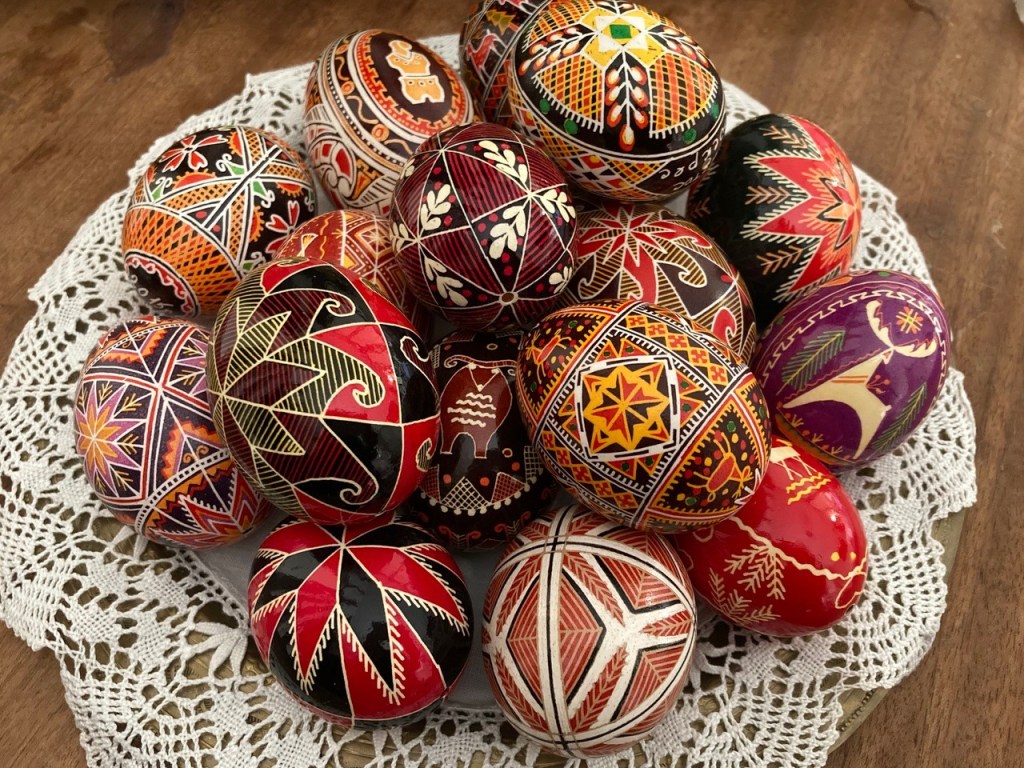
Symbols of Hope – Event in Support of Ukrainian Refugees by Mary Condren

Despite the many assertions, made since the Second World War, that never again could we see war on European soil, the past several months have proved otherwise. Ukrainian refugees have arrived all over Europe, mostly women and children, or elderly male relatives. They arrive with only the clothes on their backs, exhausted, traumatised, stressed over the possible fate of those they have had to leave behind.

Laura Shannon Pysanky Eggs

As a neutral country, Ireland does not offer military assistance.  However, thirty thousand refugees have been welcomed, in houses, sports clubs, hotels, bed and breakfasts, and when they first arrive, until more suitable accommodation can be found, they are offered campsites.

Where do we begin to address, let alone heal, such brokenness? What kind of language would we speak from our common humanity? English, Irish or Ukrainian?  Or maybe we have other languages: the language of symbols, songs, poems and stories?

Continue reading “Symbols of Hope – Event in Support of Ukrainian Refugees by Mary Condren”

Women’s Autonomy and Well-Being v. the Patriarchy by Elizabeth Ann Bartlett

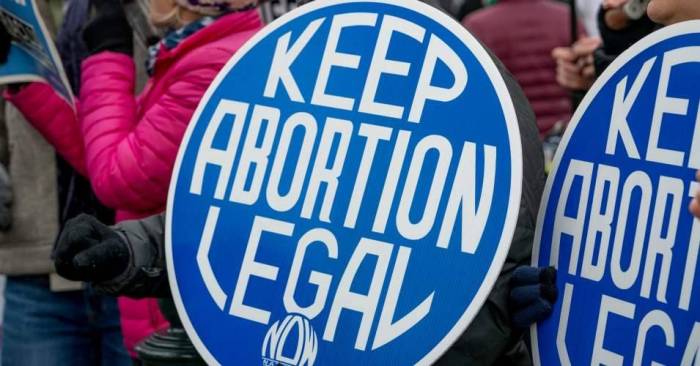
A recently leaked draft of the US Supreme Court’s opinion on Dobbs v. Jackson Women’s Health Organization suggests that the court is ready to overturn Roe v. Wade. Most people know the legal consequence of Roe, but few know the grounds for the decision. The focus was on the “important and legitimate interest” the state has in preserving and protecting the health of the pregnant woman. Defining “health” broadly, Justice Blackmun wrote:

            The detriment that the State would impose upon the pregnant woman by denying this choice altogether is apparent. Specific and direct harm medically diagnosable even in early pregnancy may be involved. Maternity, or additional offspring, may force upon the woman a distressful life and future. Psychological harm may be imminent. Mental and physical health may be taxed by child care. There is also the distress, for all concerned, associated with the unwanted child, and there is the problem of bringing a child into a family already unable, psychologically and otherwise, to care for it. In other cases, . . . the additional difficulties and continuing stigma of unwed motherhood may be involved. (410 U.S. 113, 1973) 

Psychological, physical, familial, social, present and future health of the woman are all to be taken into consideration. I would add to this the spiritual well-being of the woman, for this is a deeply personal spiritual decision as well.

Continue reading “Women’s Autonomy and Well-Being v. the Patriarchy by Elizabeth Ann Bartlett”

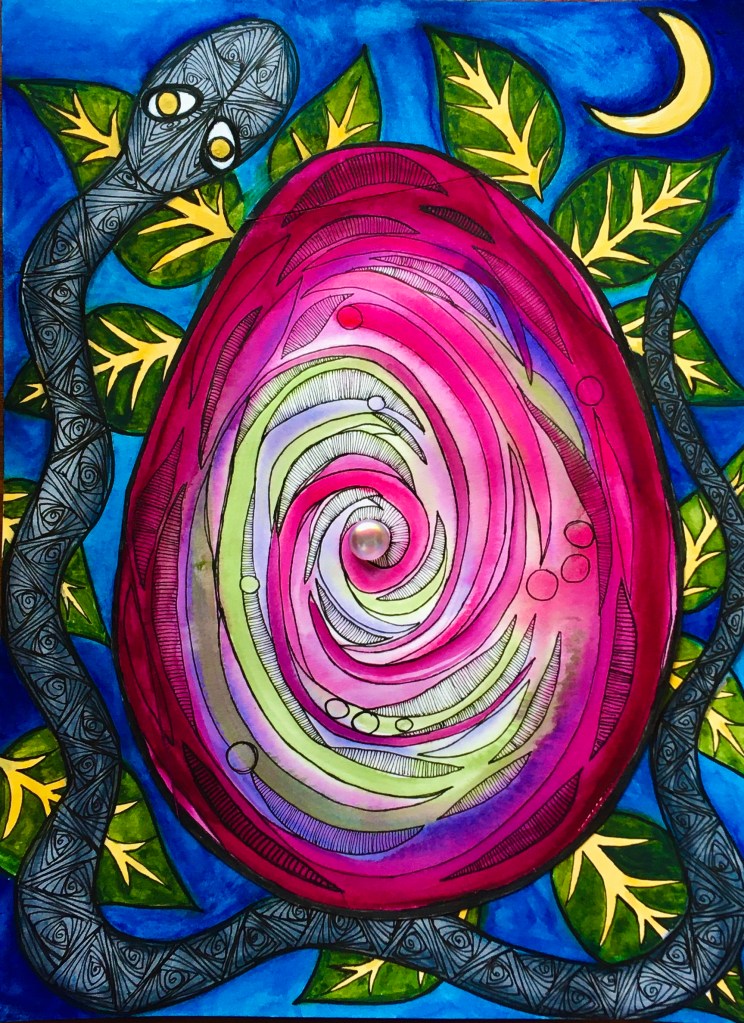
The Egg by Annelinde Metzner

Art by Deb Pollard Materials: Watercolor, markers, and vintage pearl button on paper.

In 1989 I was 37 years old. My body’s sacred work, centered around eggs, hormones and fertility, strongly governed my everyday existence.  I’m sure that influence is strong for all women of that age, mothers or not, body conscious or not.   I was directing a large women’s choir in Asheville, Womansong, composing and arranging for the women’s voices, as well as leading ritual-like rehearsals in a seated circle on the floor (pretty sure I can’t do that any more!) where I would often read my latest poems.

     Now I know that the egg of our own existence was carried in our mother’s wombs while in our grandmother’s bodies. I can see how my imagination in 1989 would go further and further afield, to women’s relations with all the egg-bearers, flora and fauna, of our amazing Earth. Quite a family we are!

Continue reading “The Egg by Annelinde Metzner”

Finding Andraste in the Norfolk Landscape by Claire Bullion

Goddess Andraste is the embodied spirit of all of nature in Norfolk, England. We know She must have been a Goddess of Sovereignty to the Iceni tribe because Queen Boudica called on her to protect the people and their lands when they were invaded and brutalised by the Romans in 60AD.

Boudica may have been a Priestess of Andraste, possibly as Queen she was an earthly embodiment of the Goddess, or at least chosen as leader by Andraste. Able to perform ritual, she was probably trained as a Druid.

Continue reading “Finding Andraste in the Norfolk Landscape by Claire Bullion”

INTERBEING by Elizabeth Ann Bartlett

“Every life bears in some way on every other.”

                                                                                -Susan Griffin, A Chorus of Stones

This line from Susan Griffin’s profound investigation into the ways our lives are interwoven through war has been echoing in my mind frequently in recent days, as we find our hearts breaking and outraged by a distant war. In the depths of our compassion, we ache with the suffering of families huddling together in bomb shelters, a birthing woman and her baby dying on a stretcher after a maternity hospital is bombed, the poignant strains of a Chopin etude played by a woman on her piano – the only thing to survive her bombed out home.

This truth of Griffin’s words echoes throughout ancient wisdom traditions — in the indigenous recognition that all our relations — animals, plants, water, earth, stone — are kin; in the African concept of Ubuntu — “I am because we are;” in the Buddhist precept of interdependent co-arising, which Buddhist monk Thich Nhat Hanh called simply “interbeing.” As he described it:

Continue reading “INTERBEING by Elizabeth Ann Bartlett”

white femininity: whitemalegod’s secret weapon By Christena Cleveland, PhD

For the first several weeks of my walking pilgrimage, I debated whether to visit the famous Black Madonna of Orcival. It wasn’t the walking distance that deterred me; She lived in a gorgeous Romanesque cathedral nestled in a charming medieval mountain town only fifteen miles away. Rather, I was hesitant to visit Her because I knew that, after a thousand years of being Black, She had undergone a mid-twentieth-century “renovation and restoration” process that whitened Her skin. I knew from photos that Her once gorgeous melanated skin was now a ghastly beige-ish pink. The incredible Black Madonna of Orcival now appears to be a white woman.

Continue reading “white femininity: whitemalegod’s secret weapon By Christena Cleveland, PhD”