Book Review: FLORENCE IN ECSTASY by Jessie Chaffee

FlorenceInEcstasy3DBook


Jessie Chaffee‘s Florence in Ecstasy is the most luminous debut novel I have read in a very long time. Imagine, if you will, a darker and more literary version of Elizabeth Gilbert’s popular spiritual seeker’s memoir, Eat Pray Love. This is not to diminish Gilbert’s memoir, which I loved, but Chaffee offers a much deeper dive into the dark night of a woman’s soul.

Hannah, a young American from Boston, goes to Florence, Italy to heal herself after her professional and personal life back home has disintegrated due to her anorexia. Surely, in life-loving Italy, where every meal is a celebration, Hannah can heal her disturbed relationship with food and her own body. Similarly, Eat Pray Love, with its luscious descriptions of Italian cuisine and Gilbert’s rejection of dieting in favor of buying a bigger pair of jeans, deals with body image issues and is often recommended reading for women and girls recovering from eating disorders.

But Chaffee’s novel, unlike Gilbert’s memoir, is no easy-going, feel-good read. Continue reading “Book Review: FLORENCE IN ECSTASY by Jessie Chaffee”

The Motherhood of God by Mary Sharratt

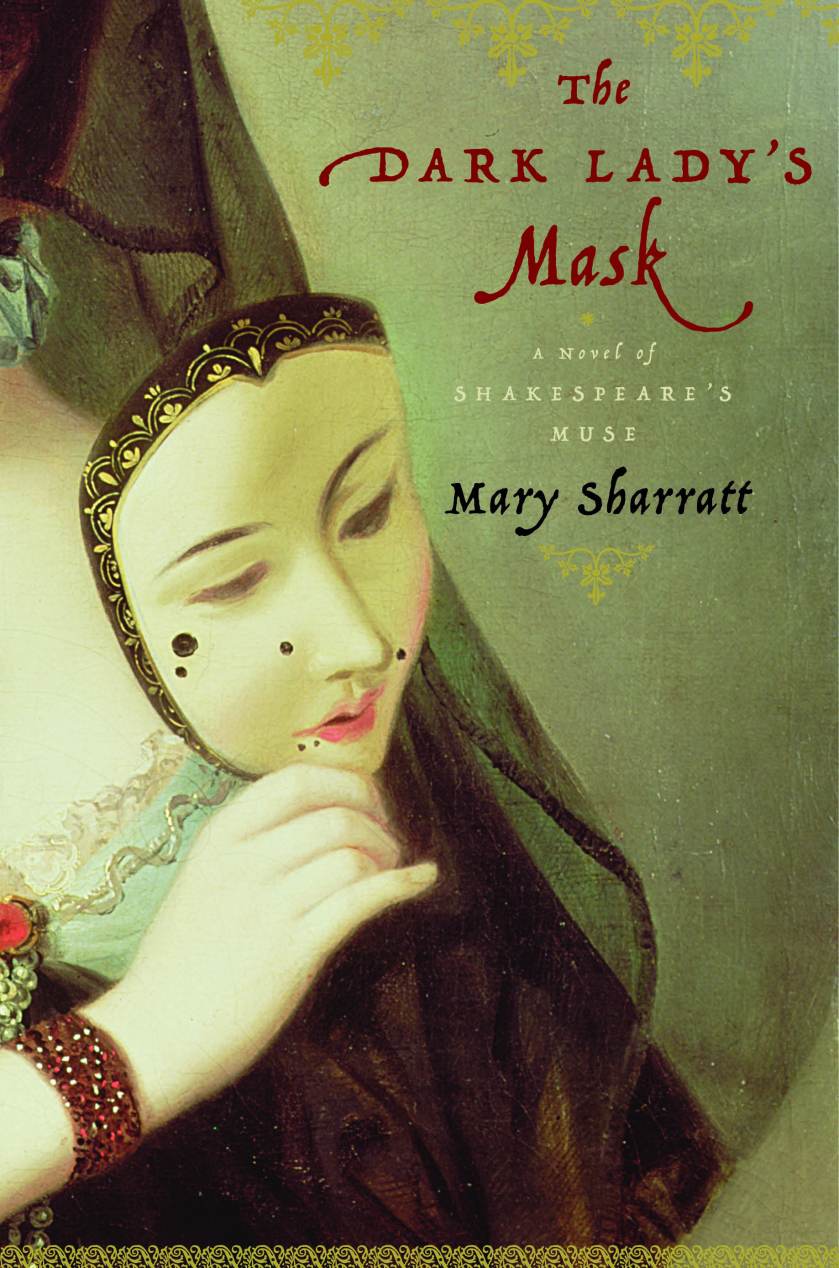
Doing a recent talk on pioneering woman writers, I like to do the Before Jane Austen test with my audience. Who can name a single woman writer in the English language before Jane Austen? Alas, because woman have been written out of history to such a large extent, most people come up blank. Then we talk about pioneering Renaissance authors, such as Aemilia Bassano Lanier, the subject of my recent novel, THE DARK LADY’S MASK, or her mentor, Anne Locke, the first person of either sex to write a sonnet sequence in the English language.
But my next question takes us even further back into history. Who was the first woman to write a book in English?

The answer is Julian of Norwich, who wrote Revelations of Divine Love. Continue reading “The Motherhood of God by Mary Sharratt”

Shakespeare’s Sister Revisited: A Circle of Female Lineage by Mary Sharratt

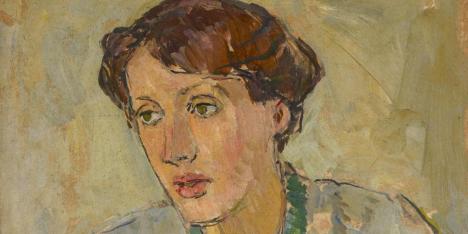
Vanessa Bell’s painting of her sister, Virginia Woolf

What do groundbreaking 17th century poet, Aemilia Bassano Lanier, and 20th century feminist icon, Virginia Woolf, have in common? A lot actually.

In her 1929 essay, “A Room of One’s Own,” Woolf imagines the tragedy of Shakespeare’s brilliant sister, Judith, barred from the grammar school because of her sex and forced to hide her writing from her family. To escape a forced marriage to a man she hates, she runs away to London to seek her fortune in the theatre, only to end up pregnant, abandoned, and destitute. Out of despair, she kills herself. Continue reading “Shakespeare’s Sister Revisited: A Circle of Female Lineage by Mary Sharratt”

Straight from the Horse’s Mouth: Celebrating Epona by Mary Sharratt


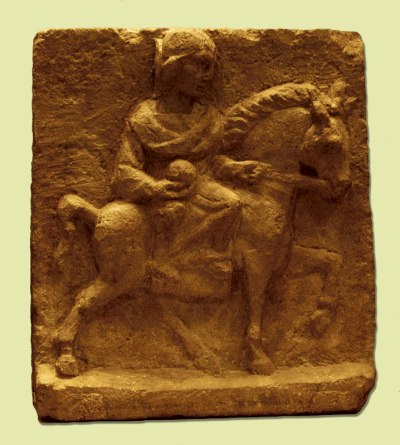
epona-of-kastel

The following is a guest post by Mary Sharratt’s Welsh mare, Miss Boo aka Queen Boudicca


The ancient Romans and Gauls knew something that many modern day humans have forgotten. Mares are divine.

The worship of Epona was popular throughout the Roman Empire. Epona was a Gaulish deity whose name means “divine mare” or “she who is like a mare.” Epona was the the only Celtic divinity to receive her own official feast day in the Roman Calendar: Eponalia, December 18, was celebrated on the second day of Saturnalia, the Roman midwinter celebration (December 17 to December 23). But as far as we horses are concerned, every day is Epona’s Day! Go out and hug a horse right now!

The patron deity of horses, ponies, donkeys, and mules, Epona also protected those who looked after equines or worked with them. Thus she was beloved of the Roman cavalry. Epona’s worship stretched from Roman Britain, across Gaul and Germania to Spain, Rome, and Eastern Europe. Not only did she have a temple in Rome and her own holiday, but there were shrines to her in almost every stable. Her altars were adorned with fresh roses. Horses and donkeys were adorned with roses for her processions.

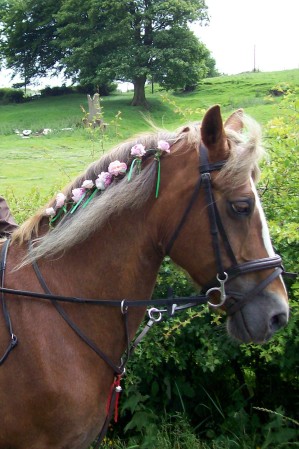
Some modern humans are inspired by these ancient traditions. At midsummer, my human ties roses in my beautiful mane when we ride out together.

midsummer-boo-4

In her iconography, Epona is often depicted as a majestic woman riding side saddle, always travelling from left to right. In the image at the top of the page, “Epona from Kastel,” she is riding and carrying a round fruit or loaf. Epona is associated with abundance, fertility, and sovereignty.

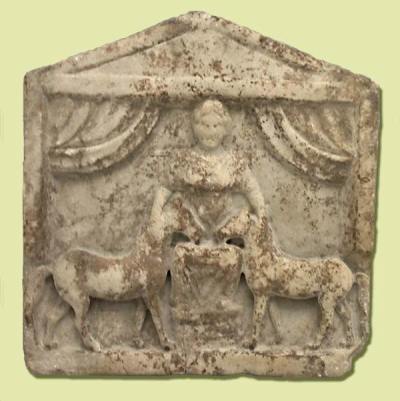
A votive image from Budapest shows Epona as a great sovereign lady seated between two horses who feed from her lap.

epona-of-budapest

In the Middle Ages, Epona’s archetype lived on in literary figures such as Rhiannon in the Mabinogian.

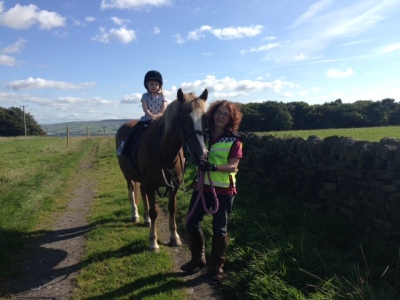
Epona was a nurturing mother figure, a giver of abundance and plenty. But what does this mean for us today? Anyone who has spent any time around us horses knows that we are capable of great empathy. Any person who is sad or depressed should spend some time just quietly grooming horses and being with them, and the healing will unfold. When my human is upset, I know right away and I’m especially gentle with her and give her lots of tender snuffles. I also love children and am extra careful around them. Here’s a picture of me with one of my little human friends.

boo-saffron


People have reported great success using horses to treat autistic children and adults. Even people suffering from eating disorders can heal if they spend time with equines. Horses have huge hearts. Especially mares! We’re hard-wired to nurture.

Heartland Girls’ Ranch in Minnesota offers equine therapy to help heal sex-trafficked girls. Each girl is matched with a horse that she cares for and this partnership helps build back her sense of trust and self-worth.

The Romans celebrated Eponalia by giving every horse, donkey, and mule a day of rest. Modern humans who keep horses can observe this by giving their horses a day off and by offering them apples, which are sacred to Epona. Humans can also honour Epona by donating to equine charities, to Heartland Ranch, or your local horse rescue centre.

What would human civilization look like had there not been a millennia-long partnership between humans and equines? Have a heart for the horses who have carried their humans so far and so faithfully.

Links: Epona.net

Epona’s Day: The Gifts of Midwinter by Caitlin Matthews

Heartland Girls’ Ranch

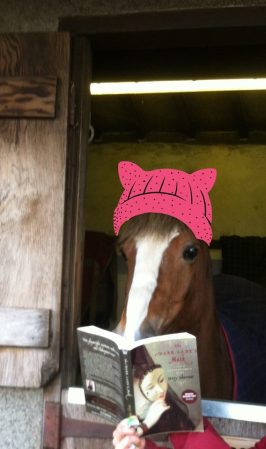
Miss Boo aka Queen Boudicca is a Welsh mare who lives in the Pendle region of Lancashire. A hereditary Welsh trad witch in the most archetypal sense of the word, Miss Boo lives in deep communion with the Earth and is a keeper of ancestral wisdom. Miss Boo is a committed feminist, and she and her herd preserve an ancient matriarchal social structure unchanged since the dawn of their species. Don’t mess with chestnut mares! She is the proud owner of the author, Mary Sharratt. All royalties from Mary’s book sales will go to keeping Miss Boo in the style to which she has become accustomed. Visit her human’s website.

boo-pussy-hat

The Power of Silence by Mary Sharratt

winter-stillness

In darkest midwinter, in the hectic rush of the holiday season and its often anticlimactic aftermath, I find myself craving silence and solitude. I’m in hibernation mode and want to curl up in a cave like a bear and sleep. But our modern culture is all about doingness rather than beingness. About action. And noise. Lots of noise. First the giddy celebrations and consumerist frenzy of the December holidays and then the rigorous Puritanical expectations of New Year’s resolutions. Leaping into a better, more virtuous, and hard-working self with both feet.

But are we going against nature in our mad pursuit of busyness and self improvement in this dark ebb of the year? Why not lie fallow and bask in a day or two of silence, or whatever retreat from the maddening world we can manage? After all, January is a traditional detox month, and silent meditation is the ultimate mental and spiritual detox technique.

Over the holidays, while traveling in the Azores with my husband, I went on a two week social media, internet, and news fast in an attempt to recover from my post US election trauma. Once I returned home, I embraced my silent meditation practice and allowed myself to rest in retreat mode until January 6, the traditional Twelfth Day of Christmas, when Yuletide ends. Continue reading “The Power of Silence by Mary Sharratt”

Mother Demdike, Ancestor of My Heart, Part 1 by Mary Sharratt


beltaine-pendle-view

Pendle Hill, seen from the back of my house, in May.

mary sharrattThe Soul of Gaia is the numinous earth beneath my feet, her soil cradling the bones and the stories of the ancestors who have died into the land and become part of the ever-living spirit of the place.

An expat writer, my home is everywhere and nowhere. A wanderer, I have lived in many different places, from Minnesota, my birthplace, with its rustling marshes haunted by the cries of redwing blackbirds, to Bavaria with its dark forests and dazzling meadows and pure streams where otter still live. But I don’t know if any place has touched me as deeply as Lancashire, England, my home for the past fifteen years. Continue reading “Mother Demdike, Ancestor of My Heart, Part 1 by Mary Sharratt”

Calling on the Muse: A Meditation for Creative Spirits by Mary Sharratt

mary sharrattThe world at large might view artists and writers as free spirits rocking la vie bohème, but creative people know that it’s much more complicated than that, especially if we’re striving to earn even a modest living from our work. As a writer, I often fall into the trap of measuring my success or failure on factors completely beyond my control, such as the ups and downs of a fickle book buying market.
I know that I’ve often wrestled with the feeling that I’ll never be enough. Never be big enough, never be a bestseller. Sometimes it’s hard not to succumb to a flailing sense of helplessness—why are any of us doing all this? Worst of all is my fear of creative dryness—that my inspiration will turn to dust and I’ll never write—let alone publish—another book.

woman_writing

Continue reading “Calling on the Muse: A Meditation for Creative Spirits by Mary Sharratt”

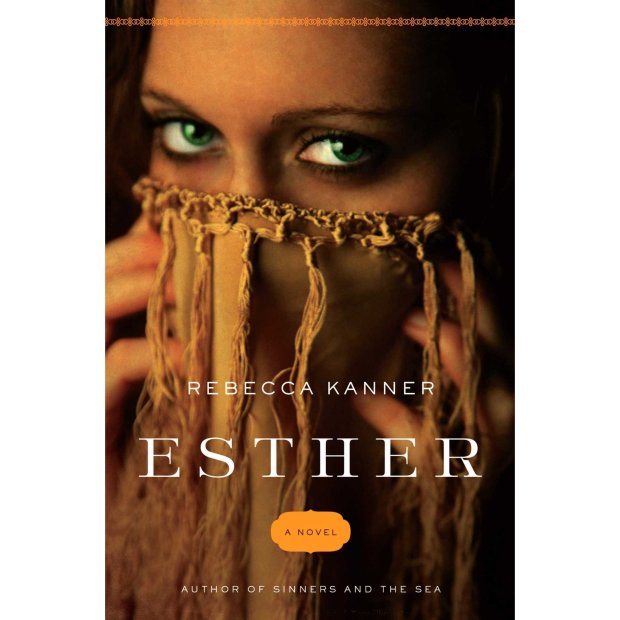
Book Review by Mary Sharratt: ESTHER by Rebecca Kanner

esther


We have been lost to each other for so long. My name means nothing to you. My memory is dust. This is not your fault or mine. The chain connecting mother to daughter was broken and the word passed into the keeping of men, who had no way of knowing. That is why I became a footnote, my story a brief detour between the well-known history of my father and the celebrated chronicle of my brother.

-Anita Diamant, The Red Tent

To a large extent, women have been written out of history. Their lives and deeds have become lost to us. To uncover the buried histories of women, we must act as detectives, studying the clues left from ages lost.

At its best, historical fiction can write women back into history and challenge our misconceptions about women in the past. Anita Diamant’s novel, The Red Tent, became such an iconic classic because she turned our stereotyped image of women in the Old Testament on its head by allowing the biblical Dinah to tell her own story in her own voice. Continue reading “Book Review by Mary Sharratt: ESTHER by Rebecca Kanner”

American Renaissance Festivals and the Yearning for Merry England

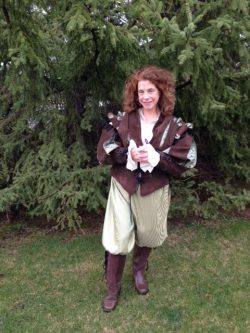
mary costume arden forest
Mary sporting Elizabethan attire during her recent book tour for The Dark Lady’s Mask.

When I was a student in the 1980s, I spent my late summer weekends in another realm. Donning a green gown I had sewn myself, I became a Renaissance woman, or a low-budget facsimile thereof, my cheap, silver-plated goblet hanging from my belt to save me from the indignity of drinking from a paper cup.

For three summers from 1983 to 1985, I was a performer at the Minnesota Renaissance Festival, in those days a much more low-key and grassroots affair than it is today. My character was a historically inaccurate hybrid between a village minstrel and a faery queen out of A Midsummer Night’s Dream.  (I was trying very hard to channel Stevie Nicks.) I even spoke in a fake British accent, largely informed by Monty Python.

For the most part, I was unpaid, although I did earn minimum wage the summer I worked in the information booth. This involved giving directions and handing out site maps. The most exciting part was when some unsuspecting person asked the way to the restroom. Continue reading “American Renaissance Festivals and the Yearning for Merry England”

Rewriting Religion: the radical poetry of Aemilia Bassano Lanier by Mary Sharratt

Sharratt_DarkLady-hi


Aemilia Bassano Lanier (also spelled Lanyer) is the heroine of my new novel The Dark Lady’s Mask.  Born in 1569, she was the highly educated daughter of an Italian court musician—a man thought to have been a Marrano, a secret Jew living under the guise of a Christian convert. She may have also been the mysterious, musical Dark Lady of Shakespeare’s sonnets, although most academic scholars dispute this. What we do know for a fact and what really matters is that she was the first woman in England to pursue a career as a published poet.

In Italy women such as Isabella Andreini published plays and poetry on a wide variety of secular subjects, but in England Lanier effectively had only one option—to write devotional Protestant verse. Her English literary predecessors, Anne Locke and Mary Sidney, wrote poetic meditations on the Psalms.

But Lanier turned this tradition of women’s religious poetry on its head. Published in 1611, her Salve Deus Rex Judaeorum (Hail God, King of the Jews) is a radical, ground-breaking tour de force, a searing vindication of the rights of women—and of herself as a woman writer.

In this epic narrative poem, Lanier describes the passion of Christ from the viewpoint of the women in the Gospels. In comparing the sufferings of women in male-dominated culture to the sufferings of Christ, she upholds women as Christ’s true imitators.

Most significantly Salve Deus is dedicated and addressed exclusively to women, and is prefaced by nine praise poems dedicated to the royal and aristocratic women whose patronage Lanier sought. She also included a dedication in praise of all women.

Having thus established her female audience, Lanier attacks the theological roots of male domination, namely the blame attached to Eve—and by extension all women—for humanity’s fall from grace. In “Eve’s Apology in Defence of Women,” Lanier argues that the original sin was actually Adam’s for accepting the forbidden fruit. For he, unlike Eve, was fully aware of the consequences. Out of selfishness and desire for power, Adam let Eve take the fall.


If Eve did err, it was for knowledge sake,

The fruit being fair persuaded him to fall:

No subtle serpent’s falsehood did betray him,

If he would eat it, who had the power to stay him?


Not Eve, whose fault was only too much love.


Lanier contends that male culpability in crucifying Christ far exceeds Eve’s tragic misunderstanding. Therefore there is no moral or divine cause to justify women’s subjugation. Here Lanier explicitly champions women’s rights and freedoms:


Let us have our Liberty again,

And challenge to yourselves no Sovereignty,

You came not into the world without our pain,

Make that a bar against your cruelty;

Your fault being greater, why should you disdain

Our being your equals, free from tyranny?

If one weak woman simply did offend,

This sin of yours hath no excuse, nor end.  


Lanier’s poetry lays claim to women’s God-given call to rise up against male arrogance, just as the strong women of the Old Testament rose up against their oppressors. While wooing her highborn female patrons, Lanier uses the scriptures to assert a sense of social egalitarianism that foreshadows the Levellers and the Quaker religious movement that emerged a few decades after her poetry’s publication. “God makes both even, the cottage with the throne,” Lanier writes in her dedicatory poem to her former pupil, Lady Anne Clifford. (Clifford was herself a feminist firebrand who fought long and hard to regain her properties after her father disinherited her because of her sex. Anne Clifford was an ancestor of Vita Sackville West and the historical inspiration for Virginia Woolf’s novel, Orlando.)

Lanier’s book ends with “A Description of Cookham,” an elegiac ode to the country house where she lived for a time with Anne Clifford and her mother Margaret, who was Lanier’s greatest patron. Cookham was the blessed refuge where Lanier received both her spiritual epiphany and the confirmation of her vocation as a poet.


Farewell (sweet Cookham) where I first obtained

Grace from the Grace where perfect Grace remained,

And where the Muses gave their full consent,

I should have the power the virtuous to content.


Salve Deus Rex Judaeorum is a corpus of poetry celebrating female and divine goodness, penned by a poet who found her own sense of salvation in a community of women who supported her and believed in her.


Mary Sharratt’s book Illuminations: A Novel of Hildegard von Bingen, won the 2013 Nautilus Gold Award, Better Books for a Better World. Her forthcoming novel, The Dark Lady’s Maskwill be published by Houghton Mifflin Harcourt in April 2016. Visit Mary’s website.