

 In medieval Europe, religious devotion provided an alternate narrative for women’s lives in a male-dominated culture. Defiant women who stood up for themselves in the face of rape, incest, and murder were hailed as virgin martyrs. Religious vocations, such as becoming a nun or a beguine, provided a viable and esteemed alternative to forced marriage.
Even women who were married with children could escape their domestic entanglements and conjugal duties by taking an oath of celibacy as 15th century English mystic Margery Kempe did, leaving behind her husband and 14 children to go on pilgrimage to Santiago de Compostela, Rome, and Jerusalem. Her Book of Margery Kempe, the tale of her travels, reads like a kind of late medieval Eat, Pray, Love and is the first autobiography written in the English language.
Though it might seem surprising to us today, women of the European Middle Ages possessed more rights and freedoms than their descendants in the Renaissance, Early Modern, and Victorian ages. Women worked as craftspeople and artisans and were members of the guilds, alongside men. Monarchs such as Eleanor of Aquitaine were global power brokers while religious leaders such as Hildegard von Bingen devoted their lives to intellectual and artistic pursuits, composing music and writing weighty philosophical and theological books that are still being discussed today.
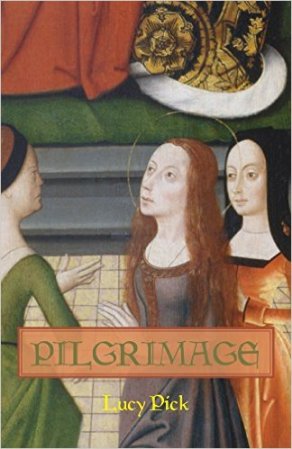 The cover of academic historian Lucy Pick’s novel Pilgrimage shows details from a painted altarpiece dedicated to Saint Godeleva. A victim of forced marriage who was strangled by order of her husband, this legendary saint was a patron of abused wives. Lucy Pick’s novel concerns the saint’s daughter, the blind Gebirga of Gistel in Flanders. What would it be like to be the daughter of a martyred saint whose miracles cured everyone except you?
Considered unmarriageable due to her blindness, Gebirga rejects life as a nun in an abbey dedicated to her sainted mother. Instead, in a bid for freedom, she embarks on a pilgrimage to Santiago de Compostela in faraway Iberia, an epic journey for that time. She serves as the companion to a highly strung teenage noblewoman and is charged with delivering the girl to the Spanish king she is contracted to marry. During their travels, Gebirga must use all her intelligence and resourcefulness to protect herself and her young charge from the considerable dangers and political intrigues they face on their way. Though they encounter hardship and heartbreak, this is a pilgrimage of miracles, healing, and redemption.
Lucy Pick, the Director of Undergraduate Studies and Senior Lecturer at the University of Chicago’s Divinity School, has infused her novel with impeccable research into the lives of medieval women. This novel is a medievalist’s delight and fans of the late Margaret Frazer will devour this book.
Mary Sharratt’s book Illuminations: A Novel of Hildegard von Bingen, won the 2013 Nautilus Gold Award, Better Books for a Better World. Her forthcoming novel, The Dark Lady’s Mask: A Novel of Shakespeare’s Muse, tells the tale of the groundbreaking Renaissance women poet Aemilia Bassano Lanier and will be published by Houghton Mifflin Harcourt in April 2016. Visit Mary’s website.

 Mormon feminists experience what most
 My first post for FAR appeared on
  When Merlin Stone’s book,
 Feminism and Religion