How quickly the wheel of the year turns. Once again we have reached the dark and cold of the Winter Solstice, which occured on December 21st this year. Winter Solstice is an astronomical moment – the exact moment when our hemisphere tilts as far away from the sun as possible. But for the ten days after, the increase in daylight each day is only a few seconds So I think of this time as the Winter Solstice Season.
Literally, you did not count on my astuteness. Or in other words, you underestimated my intelligence. It is the perpetual trick of arrogance that white supremacy and classism plays on racially and ethnically minoritized people and the joke/yoke these people carry. It is the most frequent microaggression I experience in academia in the supposed –– disque–– compliment of “you are so articulate!”
Source: Yahoo News
El Chapulín Colorado (The Red Grasshopper) is a Mexican comedic superhero character created by artist Roberto Gómez Bolaños, better known as Chespirito (little Shakespeare), in the 1970s. Whenever Chapulín untangles a mess, whether on purpose or by chance, he says “¡No contaban con mi astucia!” The movie Blue Beetle, which pays homage to this beloved character across Latin America and Latinx people is ––entre otras cosas–– exactly that, astute! Puerto Rican director, Angel Manuel Soto, and Mexican writer, Gareth Dunnet-Alcocer, take the DC comic book story of Jaime Reyes’s Blue Beetle (2006) and transform it into a film that, more than responds to a Latino superhero gap, it takes representation, impact, and issues of capitalism seriously. The truck, the heart-shaped shield, the tools, and the crickets playing in the background of the outdoor scenes ––to name a few–– are an extension of the characters’ parallelisms and the possibilities of what it means to have higher numbers of representation in mass media-produced films with integrity and astucia. ¡Awiwi!
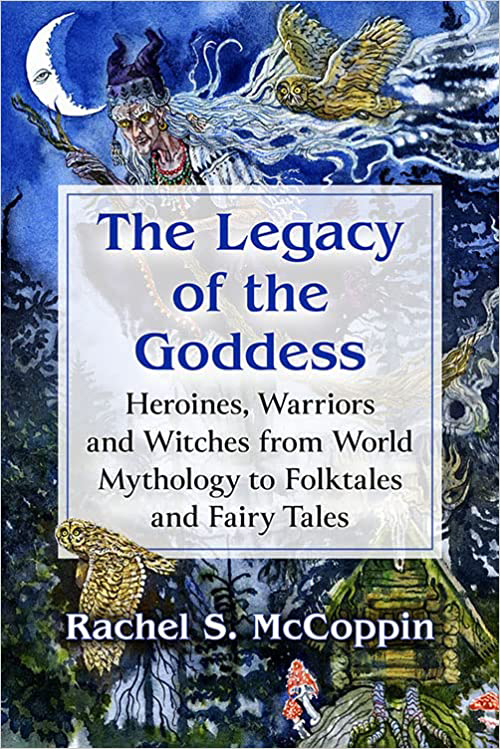
Chapter 4, “Monstrous Females and Ghost Women,” “traces the many female characters within folktales and fairy tales who appear as monstrous, materializing in the forms of giantesses, succubi, mermaids, rusalki, etc. Just as in many ancient myths, even though these monstrous women appear in folktales and fairy tales as hindrances to the quest of the hero, they ultimately serve to educate male heroes about the true meaning of their quest, which again often aligns with concepts associated with mythic goddesses. The many ghost women who appear in folktales and fairy tales around the world are also discussed in this chapter, as they often serve as agents to teach male heroes about how they, particularly as females, have been wronged by males or by patriarchal systems, and thus have been thwarted from completing their own heroic quests” (McCoppin, p. 9).
Though most myths around the world display male heroes partaking on heroic quests, and seldom focus on heroines who participate in their own heroic journeys, this is not at all the case with folktales and fairy tales, as hundreds of folktales and fairy tales portray strong, independent female heroines who indeed partake on their own heroic quests. Therefore, the second half of Legacy of the Goddess focuses on the formidable heroines found in many folktales and fairy tales from around the globe.
Cinderella-Magic on Parade: By HumMelissa_Glee – Cinderella – Magic On Parade, CC BY 2.0
Cinderella helped make me a pint-sized feminist. Well, of course my strong and rebellious mother and grandmothers were my primary influences, but at age five, Cinderella was definitely up there. I learned in my own little girl way from Disney’s Cinderella that women could forge their own destiny (of sorts), older women can be powerful for good and evil, magic pervades the universe, and whether other women support you is key to success. I completely missed the message about marrying Prince Charming. How did this story get from its origins millennia ago to a little suburban American girl in the 1960s?
Once upon a time, all over the globe, women practiced the inspiring, transformative art of storytelling. In Europe, as their world was overtaken by more patriarchal cultures, they kept alive fairy tales that spoke of their traditional world infused with magical energy and spirit beings and shared with each other new tales of their lives and troubles. In many western cultures from ancient times till very recently, however, storytelling was strictly segregated by gender, with men gathering in taverns or homes to hear epic hero tales while women gathered to sing or tell stories to each other of supernatural beings, local events, and their lives while doing tasks like spinning (hence, “spinning a yarn”) and weaving. Not surprisingly, male folklore scholars have for decades overlooked women storytellers who were also often devalued and denigrated in their own communities. More recently, largely female folklore scholars have brought to light a rich and important tradition of European women storytellers.
On a trip to Ireland several years ago, I was fortunate to have been able to see the Sheela-na-gigs in the National Museum of Dublin. Two of these Sheelas including the one removed from the Seir Kieran Church of County Offaly, pictured below, are currently on display. They stand at the doorway of a room dedicated to items from the medieval period and easily missed. As there was little interest in them and they are not in cases, I was able to silently commune without interruption.
Throughout these years that I have focused on animals and their spiritual meanings – often in ways that relate to goddesses – I’ve heard from many people about their own encounters with animals. It seemed that for me animals mainly showed up in images and words. But now different animals have been showing up in my life while out in nature.
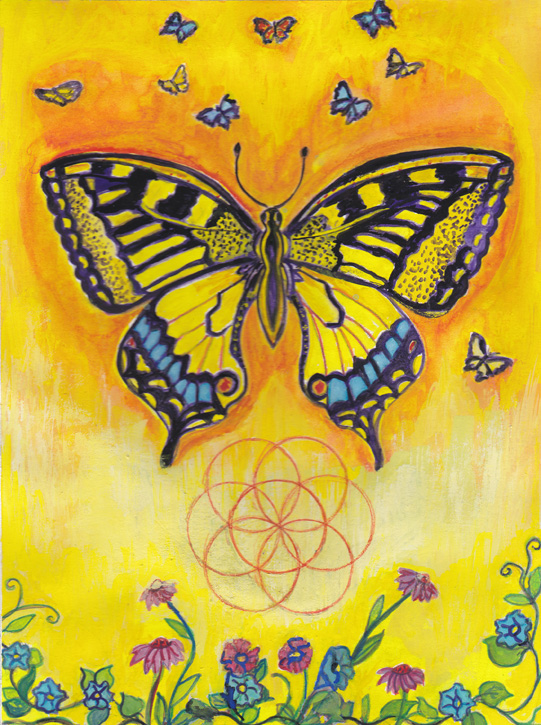
This past summer I was visited by Butterfly. A large Yellow Swallowtail graced my yard for several days on several occasions – a positive sign of ongoing transformation. In September a big colorful swallowtail caterpillar was chomping away at a parsley plant in my herb garden. Not long after a Black Swallowtail appeared with more Butterfly messages of joy and transformation.
Butterfly – Soul Transformation by Judith Shaw
Recently I lost that positive feeling of joy and the promise given by transformation – feeling instead a sense of stagnation, of not having achieved my goals and wondering what I needed, to create change and revitalization. With no answer in sight, I activated my go-to cure for the blues – a bike ride in the Bosque – Albuquerque’s cottonwood forest growing along the Rio Grande.
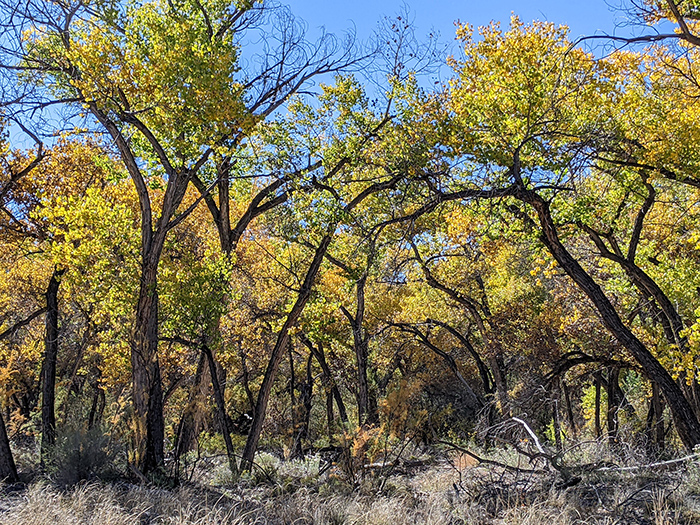
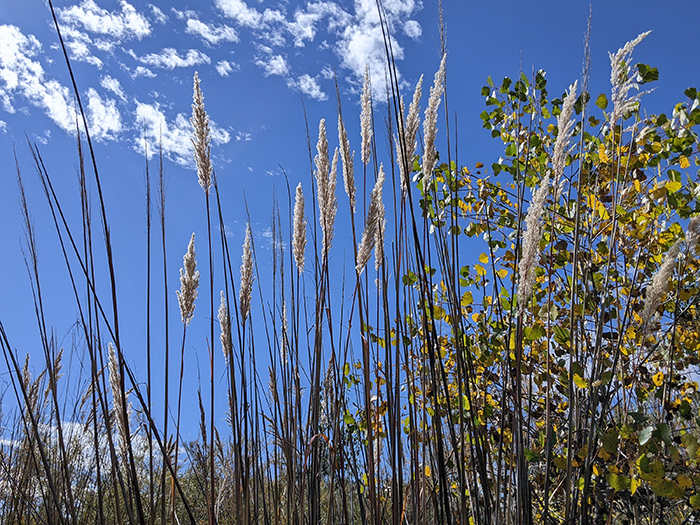
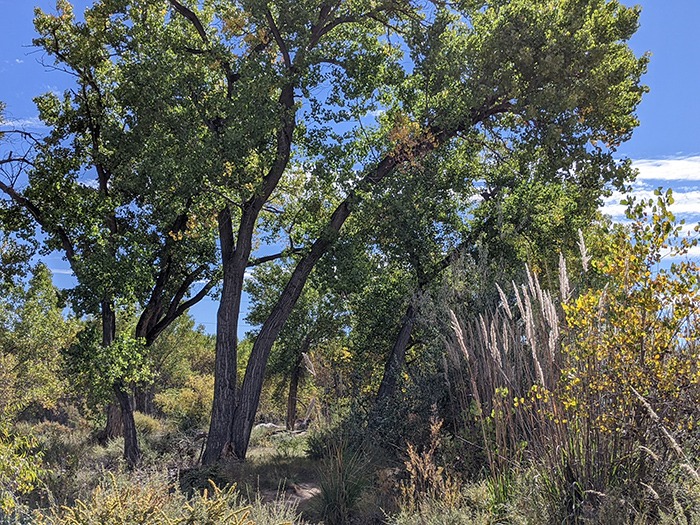
It was a glorious autumn day in the cottonwoods – hues of green turning, turning turning into orange, yellow, gold – sun-white grass heads shimmering in the sun, framed by a deep turquoise blue sky.
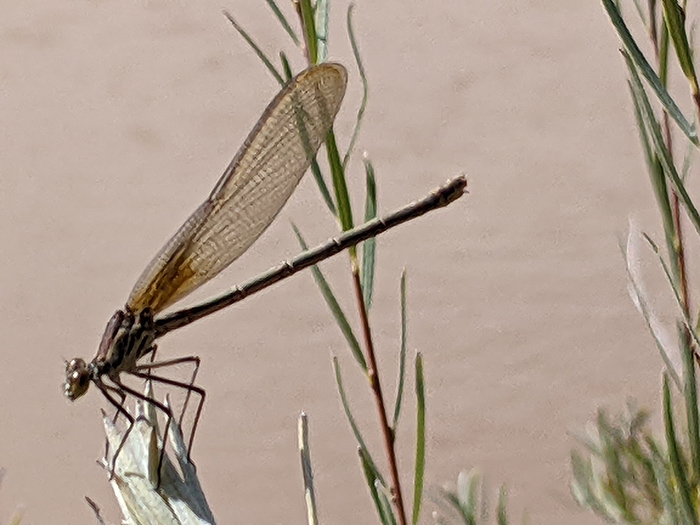
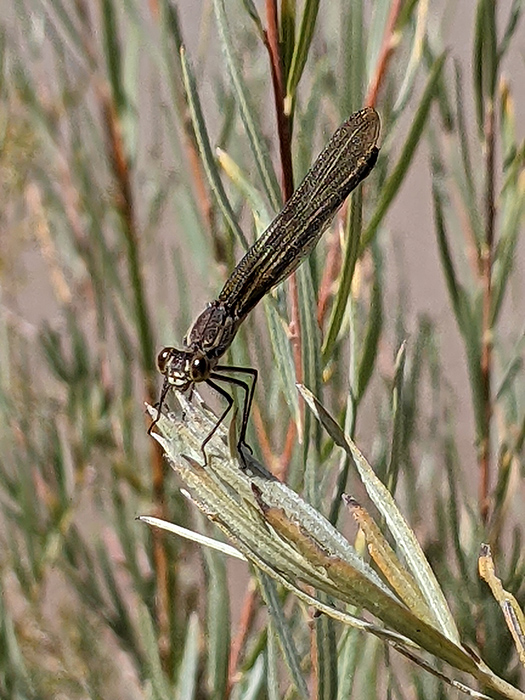
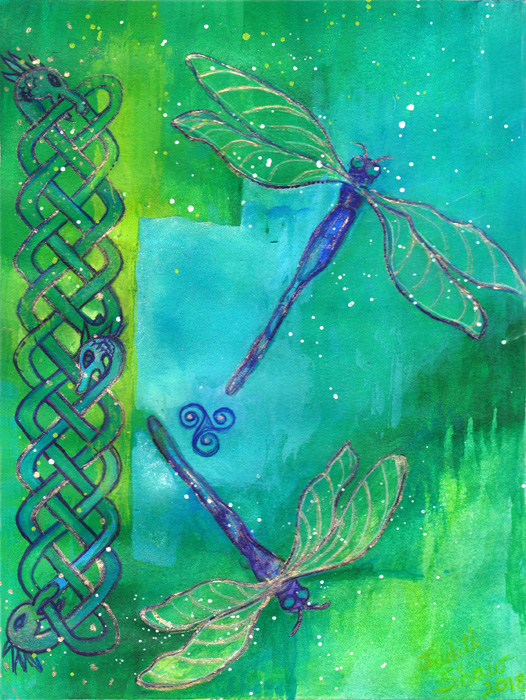
Stopping by the river, Dragonfly lit on a stalk of grass, swaying over the water. It remained. I photographed it – moved in closer. It remained. Breathe… wait…. look…. It remained. Suddenly Dragonfly darted – up, down – left, right – circled round – quickly, quickly and then returned to the stalk. It remained. Same sequence repeated ending on the stalk.
Still it remained. I spoke with Dragonfly while gazing at its huge eyes. Eyes that lead to true sight. “Dragonfly,” I said “Show me the way to a positive transformation, give me a sign. With your true sight lead me to an answer, a resolution to my dilemma.”
I repeated these words several times as Dragonfly remained – a few times flitting about – yet always returning. Dragonfly was still perched on its stalk when I finally moved on.
Returning to the cool shadows under the trees, I trekked along. Arriving at a spot where the trees opened up to the banks of the river was a downed tree – a good spot for a river view.
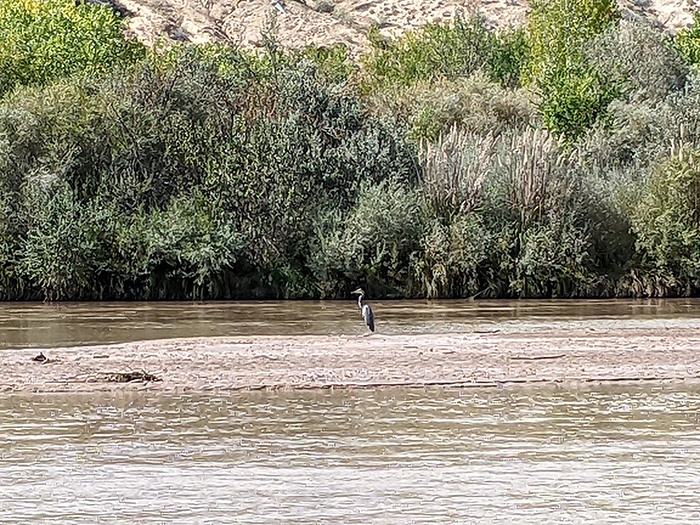
Shortly I noticed a lone bird, standing tall on a small island in the far side of the river It stood and it stood – same position – same spot. It was tall like a crane – many are arriving now. But no, something was different – it wasn’t a crane. It was grayer with fringe-edged feathers around its neck. With the help of my phone camera I discovered it was a Great Blue Heron. I was amazed!
“Ah ha!” I thought. “So this is my sign. Blue Heron has the wisdom I need now”
Not yet having investigated Great Blue Heron I had to wait until I got home to my computer and the wealth of information on the internet. What I discovered was not what I was hoping for.
As I had been struggling with what I needed to instigate the changes wanted, all I could focus on was who to connect with, what action to take, what project to start…. But Great Blue Heron delivered a completely different message.
Blue Heron brings messages of solitude, of standing still and waiting patiently for what you need to come to you. This is how Blue Heron hunts. Blue Heron encourages calm while watching for opportunities to arrive. Blue Heron says that only after calmly waiting, will opportunity arrive – which you must catch quickly or it will disappear.
Dragonfly, embodiment of transformation and true sight, led me to Blue Heron who then informed me that my usual way of doing and fixing and forging ahead would not work. Blue Heron called me to stop, to remain in my solitude and to wait. Now I can only trust that with patience and quiet meditation I will be able to flow with all of the forces active at this time and the path to the realization of my goals will become clear.
A week later, while on a bike-riding break from working on editing the stories for the Animal Wisdom deck, Coyote popped up in my path a mere 25 feet away before hightailing it across the way. I suppose I should expect the unexpected in this time of calm waiting.
I hope you too can find meaningful messages from the animals that appear in your life – messages that help rediscover the wisdom of our ancestors and support the reemergence of the feminine principle in your life.
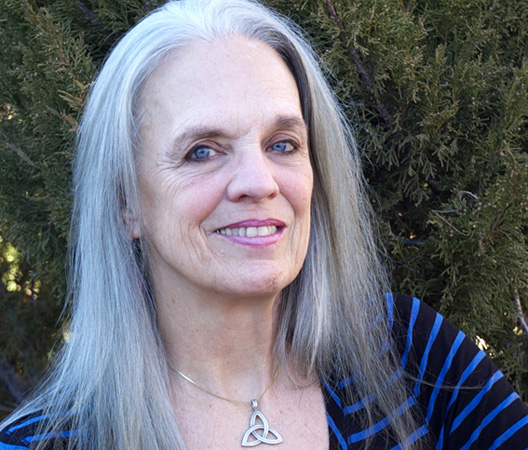
Judith Shaw, a graduate of the San Francisco Art Institute, has been interested in myth, culture and mystical studies all her life. Not long after graduating from SFAI, while living in Greece, Judith began exploring the Goddess in her art. She continues to be inspired by the Goddess in all of Her manifestations. Originally from New Orleans, Judith makes her home in New Mexico, The Land of Enchantment.
Judith is currently in the pre-press stage for her new oracle deck – Animal Wisdom. To learn about a soon-to-come, pre-order special, sign up to receive her newsletter on her website.
The Celtic Goddess Oracle Deck is still available. Order your deck from Judith’s website – click here. Experience the wisdom of the Celtic Goddesses!
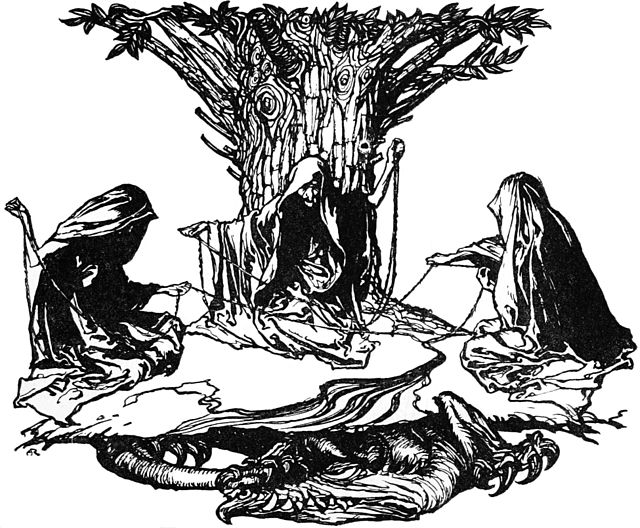
In 2020, I began writing my biography because some weird things were happening in my life including some which were time-bending. To help make sense of it, I wrote up “conversations” with the mythical characters of Persephone, Inanna and the Norns of the Norse. Throughout my bio, I speak to the Norns as an out loud meditation on the nature of time, fate and energy.
The three Norn sisters are Urd, Verdandi and Skuld. Their names come from Old Norse which is not a spoken language. The actual translation of their names is open to speculation. In general, here are their common meanings.
Urd – past
Verdandi – happening or present
Skuld – future or debt.
By mythological tradition, they show up at a child’s birth and then weave their “fateful” decisions about that child’s life into a tapestry. They are considered more powerful and fearsome than the gods because even the gods are ruled by the hands of fate (or Norns in this case). They were also treated as oracles where kings and warriors went to consult them much as was done in Delphi Greece.[1]
On the recent Goddess Pilgrimage to Crete, I visited the Historical Museum in Heraklion where I saw a beautiful embroidered silk panel of a mermaid identified only as having come from Koustogerako, a village in western Crete. As it is unlikely that a man in a Cretan village would have been talented in embroidery, in this case “Anonymous” most definitely “was a woman.”
In this thread painting a mermaid surrounded by fish is holding the anchor of a ship in one hand and a fish in the other. In Greece the mermaid is the protectress of sailors. In a well-known legend, a mermaid said to be the sister of Alexander the Great, emerges from the sea in front of a ship during a storm and asks: “Is Alexander the Great still living?” If the sailors answer, “Yes, he lives and reigns,” the ship is saved.
Let’s go back 100 years today and watch a silent movie. As you may know, most silent films had orchestral accompaniment. While you’re reading this, therefore, you can be the orchestra. Hum along as you read. Selections from Wagner (like the Ring Cycle) would probably be best unless you want to dive deep into irony, in which case you can hum selections from Gilbert and Sullivan.
The film begins. It’s a dark and stormy night. The ocean is crashing against a narrow beach overlooked by steep cliffs. There is a deep, dark forest nearby. Out of the forest comes a small figure bearing a large burden upon its back. As the figure comes forward, we see a curly-haired young girl wearing ragged clothing.
Intertitle: O me, O my. I seem to be carrying the burdens of the world upon my back. I am so weary!







 Feminism and Religion