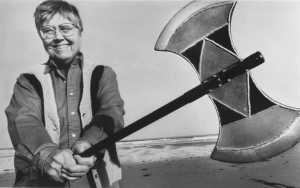
Mary Daly: My Springboard Into Critical Feminist Thought By Katie Driscoll

This post is written in conjunction with the Feminist Ethics Course Dialogue project sponsored by Claremont School of Theology in the Claremont Lincoln University Consortium,  Claremont Graduate University, and directed by Grace Yia-Hei Kao.

Katie Driscoll is pursuing an MA in the Applied Women’s Studies Program at Claremont Graduate University and is participating in the Feminist Ethics Course Dialogue project.

Mary Daly, a professor of theology at Boston College, is known as a radical feminist, one who is widely understood to have epitomized the stereotypical “man-hating femi-nazi.”  Daly earned the latter title as the result of a dispute with Boston College concerning her supposed refusal to grant male students admittance into her classes.  This dispute ultimately resulted in Daly’s retirement from Boston College in 1999.  Somehow, Daly remained a presence on campus, attending panels and other events for years to follow.  I had the privilege of meeting her twice while attending BC between 2002 and 2006.  I cannot claim that she was particularly warm or personable.  She was actually quite cold and demanding.  While I was never close to Mary Daly, I feel that I owe her my deepest gratitude for her role in my Self-discovery. I would like to take this opportunity to reflect upon her influence in my life and, utilizing the insights of some of Daly’s former colleagues and students, to set the record straight regarding her alleged refusal to allow men into her classes. Continue reading “Mary Daly: My Springboard Into Critical Feminist Thought By Katie Driscoll”

Using the Bible to Promote and Impose Terror on Women By Michele Stopera Freyhauf

Terrorism is a worldwide issue, not specific to one religion. While we attribute the atrocities of 9/11 to Islamic extremists, Christianity has a long history of imposing terror, especially on women. Phyllis Trible’s book Texts of Terror describes texts in the Old Testament that causes harm to women, i.e. abuse, betrayal, torture, rape/gang rape, and mutilation (See Genesis 16212 Samuel 13:1-22, Judges 11:29-4019:1-30). Texts such as these are used to validate violence against women, because of the fundamental view that the text is divinely revealed or God’s own words.

This phenomenon is not specific to the Old Testament.  Writings in the New Testament are used to put women in their place, define their role in church, family, and society.  The remedy for disobedience allows for violence to be committed against the offender.  The most damning of these texts are derived from the Pastoral Epistles (1 Timothy2 Timothy, and Titus).  Here, women’s place and role in society is defined.  Women should be silent, submissive, and subservient to men.  Women are to be veiled, dress modestly without adornment, no gold or pearls.  Finally women are not permitted to teach and have no authority over men (See 1 Timothy 2:9-15). Continue reading “Using the Bible to Promote and Impose Terror on Women By Michele Stopera Freyhauf”

Be-ing in the Church By Xochitl Alvizo

Sometimes it is difficult to make sense of the peculiar paths our religious lives take, much more so to make sense of one another’s paths which can be so different from our own.

I was raised in a Mexican American family and grew up in Los Angeles, California(my parents say I was “made in Mexico, assembled in the U.S.”). And I grew up going to Spanish-speaking Catholic mass. I have often said that the God I know in Spanish is so different from the God I came to know in English when I began to roam Protestant circles in undergrad. Growing up, the Spanish speaking God I knew was  as assumed and as basic as the air that kept us alive: always available and always with us in the good, the bad, and the ugly. God was a constant without which we could not exist.  But in undergrad, my Protestant friends seemed to have a completely different understanding of God than the one I had grown up with. Theirs was a God that required obedience, a God of very specific expectations, and a jealous God at that! It was a very confusing time for me and my engagement with Christianity wavered.

Then in graduate school, eight years after undergrad, something happened that revolutionized my life – I discovered radical feminists! As ironic as this might seem, radical feminists provided me with a way to make sense of Christianity. They gave me a language and the tools to both critique and engage Christianity and the church. I have often said that if it wasn’t for Mary Daly, I wouldn’t be able to call myself a Christian(!). Continue reading “Be-ing in the Church By Xochitl Alvizo”

Mary Daly: Radical Elemental Feminist and Sinner By Gina Messina-Dysert

While some argue that Mary Daly was too radical, I have been greatly influenced by her contributions to the field of feminism and religion.  I can still remember the first time I read a piece of her work.  It was during my undergraduate career at Cleveland State University in a course entitled “Women and Religion.”  I was immediately impacted and wanted to know more about this bold, strong and courageous woman, and although I had already considered myself a feminist, it was in that moment I recognized the existence of patriarchy in religion.  Shortly thereafter I applied to a graduate program in religious studies and became better acquainted with Daly’s work and the intersection of feminism and religion.

While I must admit that I am troubled by some of Daly’s claims and disagree with some of her contentions, I have also been significantly influenced by her foundational work in feminist theology, her demand for women’s liberation and Spinning of new tales and new ideas.  Daly called for women to have the courage to be, to experience a new fall out of patriarchal systems and into a new being that allows women to discover their capabilities, the dynamic power women possess within themselves.

According to Mary E. Hunt, co-founder and co-director of the Women’s Alliance for Theology, Ethics and Ritual (WATER), “Her contributions to feminist theology, philosophy, and theory were many, unique, and if I may say so, world-changing. She created intellectual space; she set the bar high. Even those who disagreed with her are in her debt for the challenges she offered…She always advised women to throw our lives as far as they would go. I can say without fear of exaggeration that she lived that way herself.”[1]

While I never had the opportunity to meet Mary Daly, I have no doubt been inspired by her brilliance, courage, wit, and spirit.  My feminist and theological views have been shaped through her influence. I have been able to spiral into freedom and rename and reclaim my own experiences; I have found my own creative power.  Thank you for having the courage to sin big Mary Daly.

“There are and will be those who think I have gone overboard. Let them rest assured that this assessment is correct, probably beyond their wildest imagination, and that I will continue to do so.” – Mary Daly