
From the Archives: Censored Angel: Anthony Comstock’s Nemesis. A Novel by Joan Koster

This was originally posted on October 10, 2024.

Moderator’s Note: With the Trump administration getting closer and closer to re-establishing the Comstock Laws in their efforts to stop all abortions in the United States, we felt it important to repost this story. It is about Ida Craddock, her life and her efforts to stand against Anthony Comstock. Joan Koster wrote a powerful book about her. This post today is also a prelude to tomorrow’s post which will discuss a new movie Sex Radical that will be premiering this month about Ida Craddock’s life.

“I would lay down my life for the cause of sex reform, but I don’t want to be swept away. A useless sacrifice.” Ida C. Craddock, Letter to Edward Bond Foote, June 6, 1898
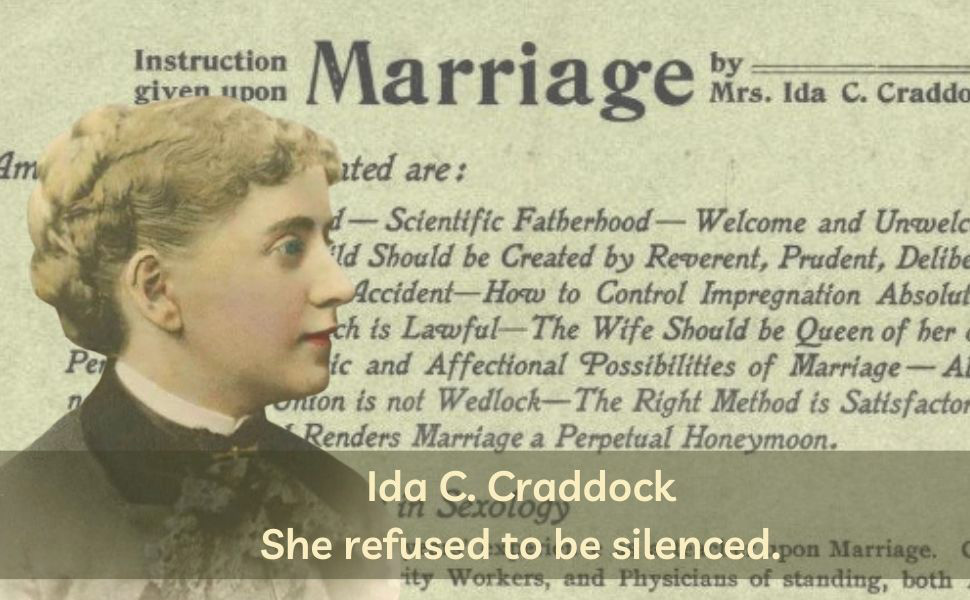
In 1882, Ida C. Craddock applied to the all-male undergraduate school of University of Pennsylvania. With the highest results on the entrance tests, the faculty voted to admit her. But her admission was rejected by the Board of Trustees, who said the university was not suitably prepared for a female. (U of P only became co-ed in 1974)

With her aspirations blocked, Ida left home determined to leave her mark on women’s lives by studying and writing about Female Sex Worship in early cultures. At the time, little information was available to women about sexual relations. To do her research, Ida resorted to having male friends take books forbidden to females, such as the Karma Sutra, out of the library for her.

An unmarried woman, she turned to spirituality and the practice of yoga, a newly introduced practice to the American public at the time, as a way to learn about sex. In her journals, she describes her interaction with angels from the borderlands, and in particular, her sexual experiences with Soph, her angel husband through what was likely tantric sex.

Continue reading “From the Archives: Censored Angel: Anthony Comstock’s Nemesis. A Novel by Joan Koster”
Censored Angel: Anthony Comstock’s Nemesis. A Novel by Joan Koster

“I would lay down my life for the cause of sex reform, but I don’t want to be swept away. A useless sacrifice.” Ida C. Craddock, Letter to Edward Bond Foote, June 6, 1898

In 1882, Ida C. Craddock applied to the all-male undergraduate school of University of Pennsylvania. With the highest results on the entrance tests, the faculty voted to admit her. But her admission was rejected by the Board of Trustees, who said the university was not suitably prepared for a female. (U of P only became co-ed in 1974)

With her aspirations blocked, Ida left home determined to leave her mark on women’s lives by studying and writing about Female Sex Worship in early cultures. At the time, little information was available to women about sexual relations. To do her research, Ida resorted to having male friends take books forbidden to females, such as the Karma Sutra, out of the library for her.

An unmarried woman, she turned to spirituality and the practice of yoga, a newly introduced practice to the American public at the time, as a way to learn about sex. In her journals, she describes her interaction with angels from the borderlands, and in particular, her sexual experiences with Soph, her angel husband through what was likely tantric sex.

Continue reading “Censored Angel: Anthony Comstock’s Nemesis. A Novel by Joan Koster”

Unsung Heroines: Mary Moody Emerson, Foremother of Transcendentalism by Carolyn Lee Boyd

Transcendentalism is a philosophical, literary, and spiritual movement begun in 19th century America whose founders centered being guided by your own inner voice, the immanence of divinity in all beings, the sacredness of nature, and the importance of social reform, among other aspects. Its influence is still felt today in the environmental movement, civil rights, literature, spirituality celebrating nature, and more. Ralph Waldo Emerson, Henry David Thoreau, Margaret Fuller and others are often considered to be its originators, but before them all was Mary Moody Emerson.

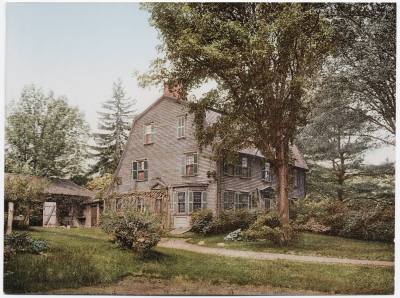
The Old Manse, Concord, Massachusetts, where Mary Moody Emerson was born and lived periodically, as did various minister ancestors and Ralph Waldo Emerson.

Mary Moody Emerson was born in 1774 in Concord, Massachusetts into a family of ministers and philosophers, including her nephew, Ralph Waldo Emerson. Her literary legacy includes a few published pieces, but is primarily the mountain of letters and journals which she called her “Almanacks.” She circulated these among friends and family, including many transcendentalists, especially Ralph Waldo Emerson. They featured many revolutionary ideas that made their way into his books and lectures, in particular, especially foreshadowing his book Nature, which launched transcendentalism. She also held influential conversations with Henry David Thoreau as he was writing Walden and with many other prominent thinkers over decades. Ralph Waldo Emerson praised her “Genius always new, subtle, frolicsome, musical, unpredictable” (Cole, 262). Almost entirely self-educated through books given or lent by family, friends, and local libraries, her sagacity was the well-spring of a movement that has been instrumental in making her world and ours. 

Continue reading “Unsung Heroines: Mary Moody Emerson, Foremother of Transcendentalism by Carolyn Lee Boyd”

Legacy of Carol P. Christ:“Ursula Niebuhr, Ursula Niebuhr”: Unacknowledged Co-author of Great Works of Theology?

This was originally posted on August 26, 2019. It fits in with our new project of Unsung Heroines.

A few days ago while watching the movie The Wife, I kept hearing the words “Ursula Niebuhr, Ursula Niebuhr,” in my mind. I knew the reason was Ursula’s unacknowledged collaboration on the work of Reinhold Niebuhr, which I discovered while writing an earlier blog on uncredited co-authors.

I had not been particularly interested in seeing The Wife because I assumed it was the familiar story of the woman who gives up her career interests when she marries. Want to become a rabbi? Marry one. Want to become an artist? Live with him and become his muse. This is a very old story, and for me, not a very interesting one.

Continue reading “Legacy of Carol P. Christ:“Ursula Niebuhr, Ursula Niebuhr”: Unacknowledged Co-author of Great Works of Theology?”

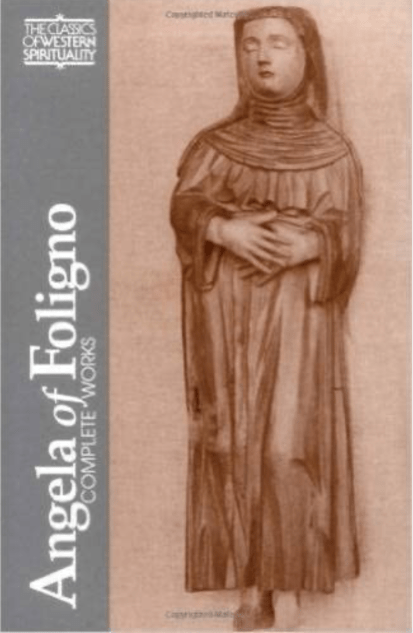
Unsung Heroines: Self-Worth takes Time: The Transformation of Angela di Foligno by Elisabeth Schilling

Angela di Foligno was a 13th century Umbrian Franciscan mystic who began her initiation on the spiritual path when she was almost 40. She was officially declared as saint in October of 2013. Her works were dictated to a relative who was scribe and a Franciscan brother in the church, and so we unfortunately do not have access to the complete depth and intimacies of her ecstatic visions and commentary (both she and her scribe discuss how he was writing in such haste and fear from admonishment from his religious brothers that it is a “short and defective version” of her experience). Nevertheless, as readers, there is still so much for us to gain in terms of inspiration and commiseration.

In “The First Twenty Steps of the Blessed Angela in the Way of Penance and Spiritual Perfection,” the Franciscan saint details the arduous journey of mastering both fear and love, a requirement to evolving in our human consciousness to realize our divine spark and transform shame. I want to discuss three aspects of this journey that relate specifically, as I see it, to the challenges set forth by many women: love for the body, love for one’s relational boundaries, and love for one’s time and space. Most cultures fail to honor women in all of their desires and powers, and so we must learn to honor ourselves and each other. Angela, as we shall see, was fiercely willing to honor herself.

Continue reading “Unsung Heroines: Self-Worth takes Time: The Transformation of Angela di Foligno by Elisabeth Schilling”

Unsung Heroines: Pamela Coleman Smith by Mary Gelfand

If you’ve ever had a Tarot reading or played with reading cards yourself, you’re probably familiar with the work of Pamela Coleman Smith, illustrator of the great-grandmother of all contemporary Tarot decks—The Rider Waite Smith Deck. First published in 1909, the illustrations in most contemporary decks are direct descendants of Smith’s work. Yet most people who engage with Tarot are unaware of Smith’s significant contribution to the world of Tarot. In my eyes, Pamela Coleman Smith is an Unsung Heroine.  

Continue reading “Unsung Heroines: Pamela Coleman Smith by Mary Gelfand”