Healing What Ails Us and Coming Together: Politics and Other Forbidden Subjects by Caryn MacGrandle

I met my best friend growing up in Third Grade.  I moved around the country after high school, but regardless, her and I have managed to stay in touch.  I spoke with her last weekend and asked about her parents.  Even though its been years since I’ve seen them, I remember them as if it were yesterday. Going out to their cabin at Lake Texoma. Seeing them around the house. 

You see Kim and I were tight.  We saw each other pretty much daily for years.  In some ways it was a much more innocent time.  I remember summers leaving the house in the morning and not going back until sunset, muddy and barefoot.  Crawdads and horse models.  Playgrounds and baseball games.  

But in some ways, it was a much less innocent time. We dabbled in quite a lot that we should not have as the term helicopter parent was unheard of.  Our skies were wide open.  The good and the bad. The large majority of us were latch key kids, and we raised ourselves.  No apps to tell our parents where we were or check in. We went as the wind blew us.

Continue reading “Healing What Ails Us and Coming Together: Politics and Other Forbidden Subjects by Caryn MacGrandle”

Priestesses of the Shtetl? The Jewish Women Spiritual Leaders of Eastern  Europe by Annabel Gottfried Cohen

‘Four thousand years ago, in the ancient Near East, women were poets, drummers, scholars, dancers, healers, prophets and keepers of sacred space.’ In The Hebrew Priestess (2015), Rabbi Jill Hammer argues that as the Israelite cult became more centralised, leadership roles were restricted to men and women’s spiritual leadership was gradually repressed. Yet, as Hammer and co-author Taya Shere demonstrate, ‘the remnants of the priestesshood remain for those who seek them out.’ Combining a close reading of biblical and rabbinic texts, alongside other contemporary sources and archaeological evidence, Hammer has identified thirteen models or netivot of feminine Jewish leadership, which she argues persisted, albeit in altered and marginalised forms, into the medieval, early modern and even modern periods. My own research supports these conclusions, suggesting that Hammer’s netivot framework provides a useful lens by which to better understand Jewish women’s traditions that, in a patriarchal culture, have often been marginalised.

Continue reading “Priestesses of the Shtetl? The Jewish Women Spiritual Leaders of Eastern  Europe by Annabel Gottfried Cohen”

Ritual Theatre for What Ails You by Caryn MacGrandle

Tanishka the Moon Woman at the Edinburgh Fringe Festival in August in Scotland

The power of the Eleusinian Mysteries: “so powerful that ‘people in Greco-Roman civilization came to Eleusis to be initiated every fall for almost 1300 years.”  The greatest “mystery” about the Mysteries is that they were secret; only the initiates knew what had happened there.”*

Yesterday, I spoke with Tanishka Moon Woman.  I have known Tanishka’s work since I began the divine feminine app a decade ago.  It was wildly popular.  I believe she had about 400,000 in her facebook group.  Tanishka has 27 years of writing books, hosting and teaching Red Tents amongst other online and in person offerings.  She travels extensively between Australia, Bali and the UK. 

Continue reading “Ritual Theatre for What Ails You by Caryn MacGrandle”

Thirst for Knowledge, Thirst for Rain: Women’s Seeds and Symbols in Southern Morocco by Laura Shannon

Last week, once again, I had the good fortune to bring a small group of dancing friends to southern Morocco. As always, our travels there unfolded in a blessed and beautiful way, rich in experiences of ancient Berber/Amazigh culture and encounters with local women.

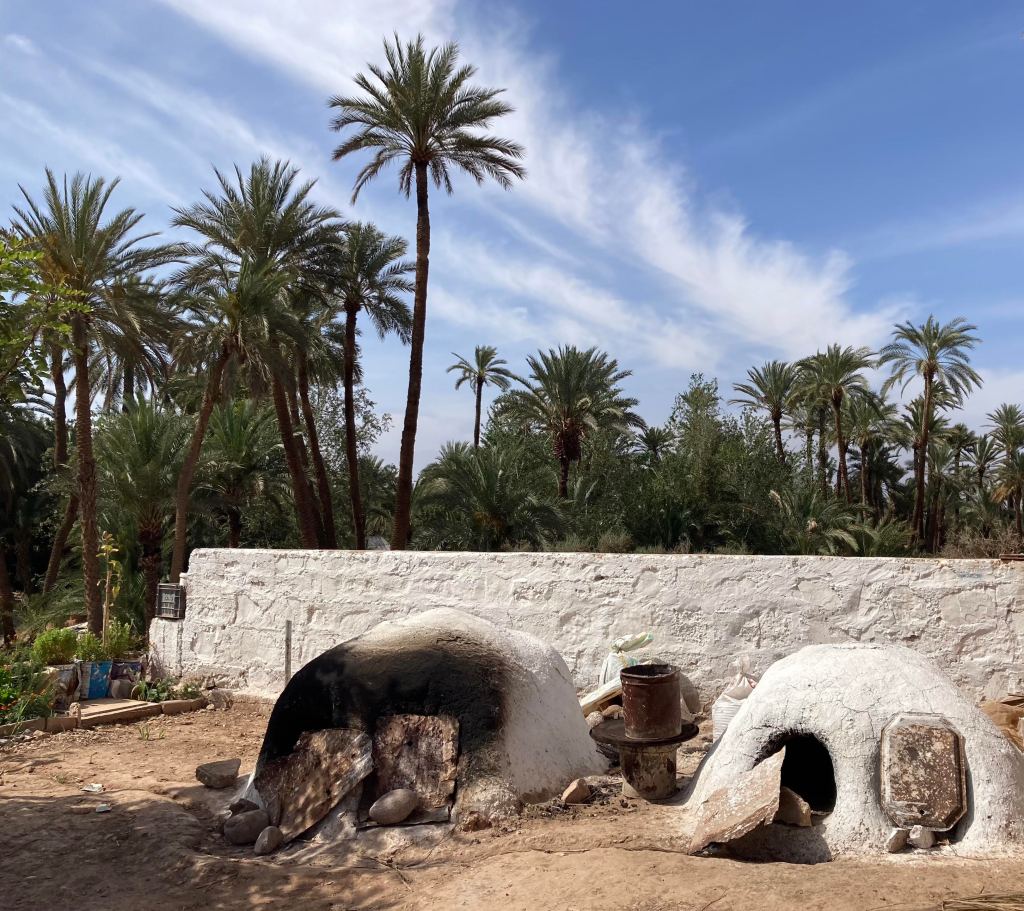
At Tioute oasis in the foothills of the Anti-Atlas mountains, we bought unleavened flatbread baked in rounded clay ovens. 

Bread ovens at Tioute oasis, southern Morocco. Photo: Laura Shannon
Continue reading “Thirst for Knowledge, Thirst for Rain: Women’s Seeds and Symbols in Southern Morocco by Laura Shannon”

The Policing of Muslim Women’s Speech: Invited, then Silenced on a Women’s History Month Panel by Dr. Hadia Mubarak  

Moderator’s Note: This is part 1 of a 2 part series. A version of this article first appeared in The Charlotte Post on March 25

In her paradigm-shifting book, Why I am No Longer a Feminist: A Feminist Manifesto, Jessa Crispin reminds us that having token “female representation” does not solve the problem of systemic oppression or marginalization.  I was recently reminded of this truth when a female co-panelist attempted to silence me twice, when I shared my perspective on women’s challenges in Gaza.

On March 20, I joined an all-female interfaith panel for an elite retirement community center in Charlotte, NC in honor of Women’s History Month. As three female panelists, we were invited to represent our respective faiths, Judaism, Islam, and Christianity. After we each responded to the scripted questions posed to us, community members began to ask us questions. One man stood up and said, “I have visited Jordan, Egypt, and Israel. Will it be safe to travel to Israel again given the current situation?”

Continue reading “The Policing of Muslim Women’s Speech: Invited, then Silenced on a Women’s History Month Panel by Dr. Hadia Mubarak  “

The Painful Problem and How the Divine Feminine is the Answer by Caryn MacGrandle

Two young kids and an Airline Pilot husband who got caught in the 911 lay-offs, a first divorce, struggling, a second marriage and struggling again.  Moving around the country with no ties and not knowing many people. I remember after my first marriage having to move to a less expensive neighborhood, I had the thought “Match.com? I don’t need a Match.com, I need a Friend.com!”

Only “Friend.Com” doesn’t work.  It is awkward to go out to lunch “Do you want to be my friend?”

And so I remained isolated and struggling alone.

I drank daily in order to quell my anxiety and fall asleep.

Continue reading “The Painful Problem and How the Divine Feminine is the Answer by Caryn MacGrandle”

Archives from the FAR Founders: We are Worth the Time it Takes to Create a Practice by Xochitl Alvizo

Incarnation, Goddess spirituality, Xochitl Alvizo, god became fleshThis was originally posted on September 10, 2014. It seems relevant to me these days as I continue to develop practices for my groundedness, community, and well-being. 

Recently, in response to the excellent conversation following Nancy Vedder-Shults’ post on the goddess Kali, Carol Christ commented to Nancy, “I too love our conversations, wish there was more in depth talk on our blog [FAR], maybe there will be.” Carol’s comment* struck a deep chord within me. One of the main objectives that the FAR co-founders had in creating Feminism and Religion was that it be a place where we could and would engage with one another across a diversity of feminist issues and the broad range of feminist passions and work – where we could discuss, critique, and build upon on each other’s efforts.

So two things came to mind as I reflected on Carol’s comment. The first was my personal lament that I have not been as actively participating in the discussions that follow the FAR blog posts as I did when we first started Feminism and Religion. FAR has such rich and valuable material – it really does provide a great opportunity for conversation and dialogue – and sadly I have been a passive participant as of late. I read and learn from the discussions, but I have not been joining in. I lament that. FAR is definitely a place where I could engage with others in deep conversations, but how actively am I actually doing this? Continue reading “Archives from the FAR Founders: We are Worth the Time it Takes to Create a Practice by Xochitl Alvizo”

Memorializing Grief and Trauma by Stephanie Arel

On Monday, March 18th, I joined a webinar developed by Dr. John Seitz and Sonia de Silva Monteiro at Fordham University. The panel included myself, Dr. Layla Karst, Assistant Professor of Theological Studies from Loyola Marymount, and Dr. Alana Harris, Reader in Modern British Social, Cultural and Gender History at King’s College London. All offered valuable insights to the topic: “Memorializing Clergy Sexual Abuse: An Interdisciplinary Conversation about the Ethics, Means, and Meanings of Sex Abuse Memorials.” The panel represented one of a series you can follow here.

My presentation featured some things I learned from researching my last book Bearing Witness: The Wounds of Trauma at Memorial Museums. The text focuses on memorial museums, illuminating methods of memorializing human suffering, suffering that penetrates workers’ personal lives. In fact, people preserving painful memories and histories often labor (physically and emotionally) from a place of personal wounding. From nine sites across the globe, 82 interviews revealed that 35% of the people engaged in memorializing mass trauma in a museum setting are survivors of the event they commemorate; 35% are family members of those who suffered or died; and the remaining signify community members, who are not impacted directly by the event or events commemorated but care deeply about those who were.

Continue reading “Memorializing Grief and Trauma by Stephanie Arel”

On Friendship: Part Two by Beth Bartlett

In Part One I began the examination of nine requisites of friendship. The first three are love, reciprocity, and honesty and trust. In Part Two, I continue the examination of the final six: world-traveling, commitment, reconciliation, loyalty, fun and play, and graciousness.

4) World-traveling. Maria Lugones’s prescription for truly knowing and loving another is to travel with them to those places where they are most at home, playful, and at ease.  This may mean knowing them in their homes, meeting their families, or literally traveling to their countries, knowing them in what may be cultures and languages different from our own. This has been especially important for me as I’ve sought friendship with those whose identities are different from mine – the lesbian community in the ‘80s, the indigenous community. It has been a vital part of my friendships to travel and be with friends, and create friendships, in those places where they thrive, find meaning, and are most fully themselves.

Continue reading “On Friendship: Part Two by Beth Bartlett”

On Friendship: Part One by Beth Bartlett

I’ve been fortunate in my life to have friends, to be a friend, though I’ve also had periods of drought without the nourishing stream of friendship in my life. The nature of my friendships have changed over time – with friends in childhood being primarily playmates, in adolescence – friends traveling in packs – gangs of girls; in grad school, mostly my colleagues.  And then I discovered feminism.

 I bonded with people with whom I shared a passion, a cause, and the work to bring our vision into being.  We gathered in consciousness-raising groups where, in Nelle Morton’s phrase, we heard each other into speech.  We helped each other discover ourselves by sharing our truths out loud – without criticism, argument, interruption, advice – simply being heard.  The self-discovery in sharing the truths we had not even been willing to tell ourselves was powerful.  Most importantly for me was the feminist theorists I was reading – Adrienne Rich, Audre Lorde, Susan Griffin – who challenged me to be my authentic self, honest, open, no longer hiding behind the façade of being someone I thought others wanted me to be – myself.[i]  

Continue reading “On Friendship: Part One by Beth Bartlett”