

This post is written in conjunction with the Feminist Ethics Course Dialogue project sponsored by Claremont School of Theology in the Claremont Lincoln University Consortium, Claremont Graduate University, and directed by Grace Yia-Hei Kao.
Ruth Marston is a third year Master of Divinity student at the Claremont School of Theology. She is currently seeking Elders Orders in the Pacific Northwest Conference of the United Methodist Church. A lifelong feminist, Ruth hopes to serve churches by helping construct communities of faith that educate, empower and value diversity as a divine gift. She enjoys Science Fiction, dry humor, and has been known to drive twenty miles for a quality cup of coffee.
A fellow student spontaneously invited me into her apartment in for tea. It was at the beginning of our Master of Divinity Degree. We were just discovering the physically and spiritually grueling nature of the three years in front of us, and I think we both sensed that friends would make this journey possible. Continue reading “The Crosshairs of Connotation By Ruth Marston”
Should Our Children and Grandchildren Live Better Than Us? And Whatever Happened to Our Dreams? By Carol P. Christ
 Carol P. Christ is a founding mother in the study of women and religion, feminist theology, women’s spirituality, and the Goddess movement. She teaches in the Women’s Spirituality program at CIIS and through Ariadne Institute offers Goddess Pilgrimages to Crete. Her books include She Who Changes and Rebirth of the Goddess and the widely used anthologies Womanspirit Rising and Weaving the Visions.
Last Sunday on Meet the Press Tom Brokaw spoke about the breakdown of what he felt had been a common consensus about American life. He said that Americans are questioning the American dream which tells us that “our children and grandchildren will live better than us.” He found it disturbing that people now feel their children will not be better off than they were. The poor no longer see a way out of poverty and the middle class fear that their children will be unemployed for long periods in their lives, burdened with college debt, and unable to afford mortgages and college educations for their children. I have heard this idea expressed many times in the recent economic crisis, including by progressive journalist Adrianna Huffington.
What Brokaw and others do not mention is that a few generations ago, this American dream was the hope that one’s children would not live in poverty. Now, for the middle class if this dream means anything, it means having a bigger house, more cars, $2000 suits, botox and plastic surgery, expensive vacations, weddings costing tens of thousands of dollars, store-bought Halloween costumes, and so many Christmas presents that children step on their new toys to get to the tree for more packages. What Brokaw and others did not address is whether the desire for your children to have “more” than you had, once your family is out of poverty is a valid, good, or sustainable desire to have. Of course we should all hope that our children and children’s children will find employment and not live in poverty, but an endless upward spiral cannot be sustained and there is no evidence that it makes anyone any happier. Continue reading “Should Our Children and Grandchildren Live Better Than Us? And Whatever Happened to Our Dreams? By Carol P. Christ”
Confronting Sexual Harassment Ten Years Later: Speaking Out, Empowerment, and Refusing to Accept Defeat By Gina Messina-Dysert
 Much of my research and activism thus far has centered on rape culture*, sexual violence, and spiritual wounding. This being said, I have given little consideration, and have shared even less, of my own experience of sexual harassment perpetrated by a professor at the end of my undergraduate career. Although I had called myself an advocate for women who had been victimized by various forms of violence, sexual included, I was unable to advocate for myself when confronted with my experience. What’s more, although I have called for a speaking out of one’s experience of sexual violence in order to challenge the rape culture and begin the healing process, I have not been able to do this myself.
My professor sexually harassed me during my final semester of college in the very last course I needed to graduate. The first time he approached me he asked me to stay after class. Initially I was nervous thinking I had done something wrong; however I was surprised when he began to ask me personal questions. I was engaged at the time and Dr. X commented how lucky my now husband was. He then reached out, hugged me, and stroked my hair. I didn’t move, I was scared and wondered what was happening. After a few moments, I forced myself out of his arms and with my head down, unable to look him in the eye, I said I had to leave and darted out the door. My initial reaction was to downplay his inappropriate behavior and I convinced myself that I must have misinterpreted the situation. Continue reading “Confronting Sexual Harassment Ten Years Later: Speaking Out, Empowerment, and Refusing to Accept Defeat By Gina Messina-Dysert”
Between the Newness of Life and the Slipping of Moments By Christie Havey Smith
The following is a guest post written by Christie Havey Smith, M.A., a Spiritual Director and a mother of three. She teaches spiritual writing workshops in the community and through Loyola Marymount University’s extension program. She has been a Youth Minister for St. Monica’s parish community and a volunteer at WriteGirl in Los Angeles, an organization dedicated to empowering teen girls through creative writing.
I come from a long line of amazing women. I had two great aunts with impassioned spirits. In neither case did that passion find its way into marriage, but instead found romance in literature and in travels; they married poetry, theology and their gardens. They gave birth to ideas and lavished love upon their sister and her children.
Their sister is my grandmother. She was widowed when her three children were still small, and she rose above every kind of challenge a needy mother can face. She is now ninety-five years old. Her sisters and friends have passed away, and she is the last of the greats of her generation. She is the Elizabeth Taylor of her community; when she dies it will be the end of an era. And it will leave quite a hole in our family. Continue reading “Between the Newness of Life and the Slipping of Moments By Christie Havey Smith”
On being an imperfect feminist: releasing definitions built in shame By Sara Frykenberg
 A few weeks ago, a very interesting and in some places, tense discussion arose from John Erickson’s post, “Hands Off,” some of which related to the difference between what it means to be a liberal feminist and what it means to identify as radical. Since then, I have been thinking a lot about what the identification “feminist” means to me, what it means to be an ally and how I am defining these categories. Rather, I mean to say, against what kind of a standard am I applying this definition.
I think I have asked myself these questions many times in my life, in different ways, but perhaps most significantly I asked myself “am I a feminist?” when I started graduate school. I was sitting in a classroom, set up like a circle, and all the women and two men in my… I think, “Gender and Education,” class were introducing themselves. “Hello, I am so and so, and I have been a feminist for X number of years and I do this, etc.” “Hello, I am so and so, and I am a feminist ally and I do such and such, etc.”—as I remember, some classmates identified more as allies. When it came time for me to introduce myself, I said, “Hello, my name is Sara, and I am not sure if I am a feminist or not. I thought I was, but I don’t know now.” Continue reading “On being an imperfect feminist: releasing definitions built in shame By Sara Frykenberg”
The Egyptian Revolution: Women, Islam And Social Change By Karen Torjesen
 The following is a guest post written by Karen Torjesen, Ph.D., Margo L. Goldsmith Professor of Women’s Studies in Religion at Claremont Graduate University where she has helped establish graduate programs in Women’s Studies in Religion and Applied Women’s Studies. For ten years she served as Dean of the School of Religion, partnering with religious communities to create programs in comparative religion. She has published extensively on women, gender and sexuality within Christianity.
Originally posted at Huffington Post: http://www.huffingtonpost.com/karen-torjesen/the-egyptian-revolution-women-islam-social-change_b_978190.html
Traffic inches through the narrow streets. Sidewalks are peppered with chairs, men in gallabiyas (tunic-like garment reaching the ankles) chatting, drinking tea or smoking the hookah. Women in hijabs threading the traffic, children in tow. Shops bustle; vendors call. Normal life — but there is something in the air. What is it I wondered. What is going on in Egypt?
It is profound and it is complex, but a conversation at the Cheops pyramid with a young student worked as a single snapshot. His first question after, “Where are you from?” was, “What do Americans think of us now, after the revolution?” How can I describe his effect — it was something new. A tone? A manner? He asked with eagerness; he asked with pride, there was a confidence in his voice. He explained, straining for the English vocabulary that the regime had controlled how Egyptians thought about themselves. “When we woke up in the morning, we thought only of taking care of food and family. Now we think about ourselves differently.” Johnny West named this difference in his Journey through the Arab Spring. It became the title of his book, “Karama,” dignity. Continue reading “The Egyptian Revolution: Women, Islam And Social Change By Karen Torjesen”
Learning Language By Annie Wells
 This post is written in conjunction with the Feminist Ethics Course Dialogue project sponsored by Claremont School of Theology in the Claremont Lincoln University Consortium, Claremont Graduate University, and directed by Grace Yia-Hei Kao.
Annie Wells is a 3rd year MDiv student at CST. Once a newspaper photographer, she is now studying to become a chaplain. To see her work from the banana plantations in Nicaragua use this link and click on the picture of bananas next to the text entitled “Pesticides.”http://www.anniewellsphotography.com/content.html?page=2
I have been learning to speak Spanish for years. Sometimes Spanish speakers can understand me. Sometimes I don’t come close to saying what I mean to say. Sometimes when I’m trying to speak Spanish I cannot remember one word in Spanish or English. But I remember clearly the woman who inspired me to learn and for her I will keep trying until I die. Continue reading “Learning Language By Annie Wells”
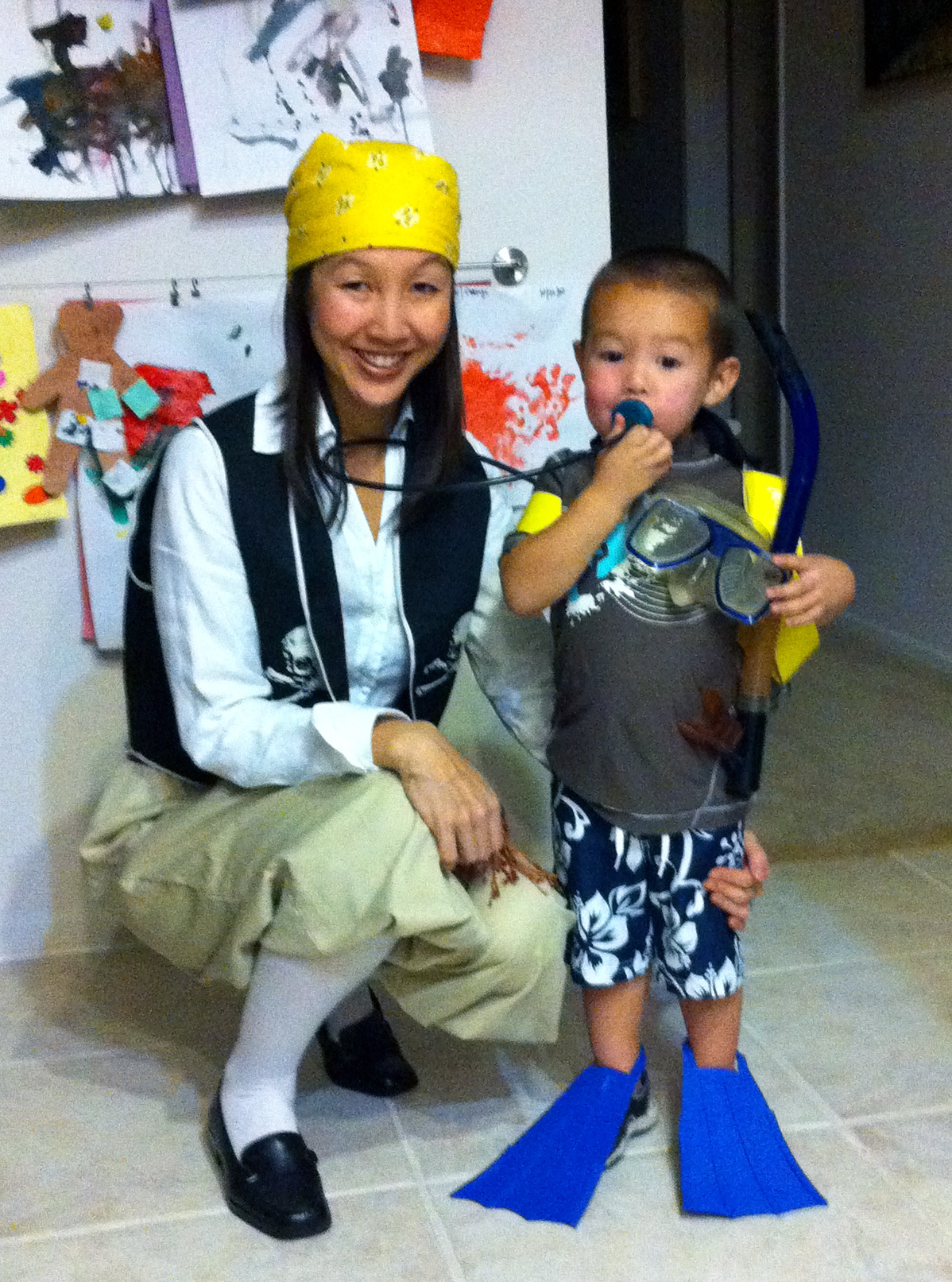
Halloween Matters (Part II): An Immigrant Family, Christian, and Feminist Parenting Perspective by Grace Yia-Hei Kao
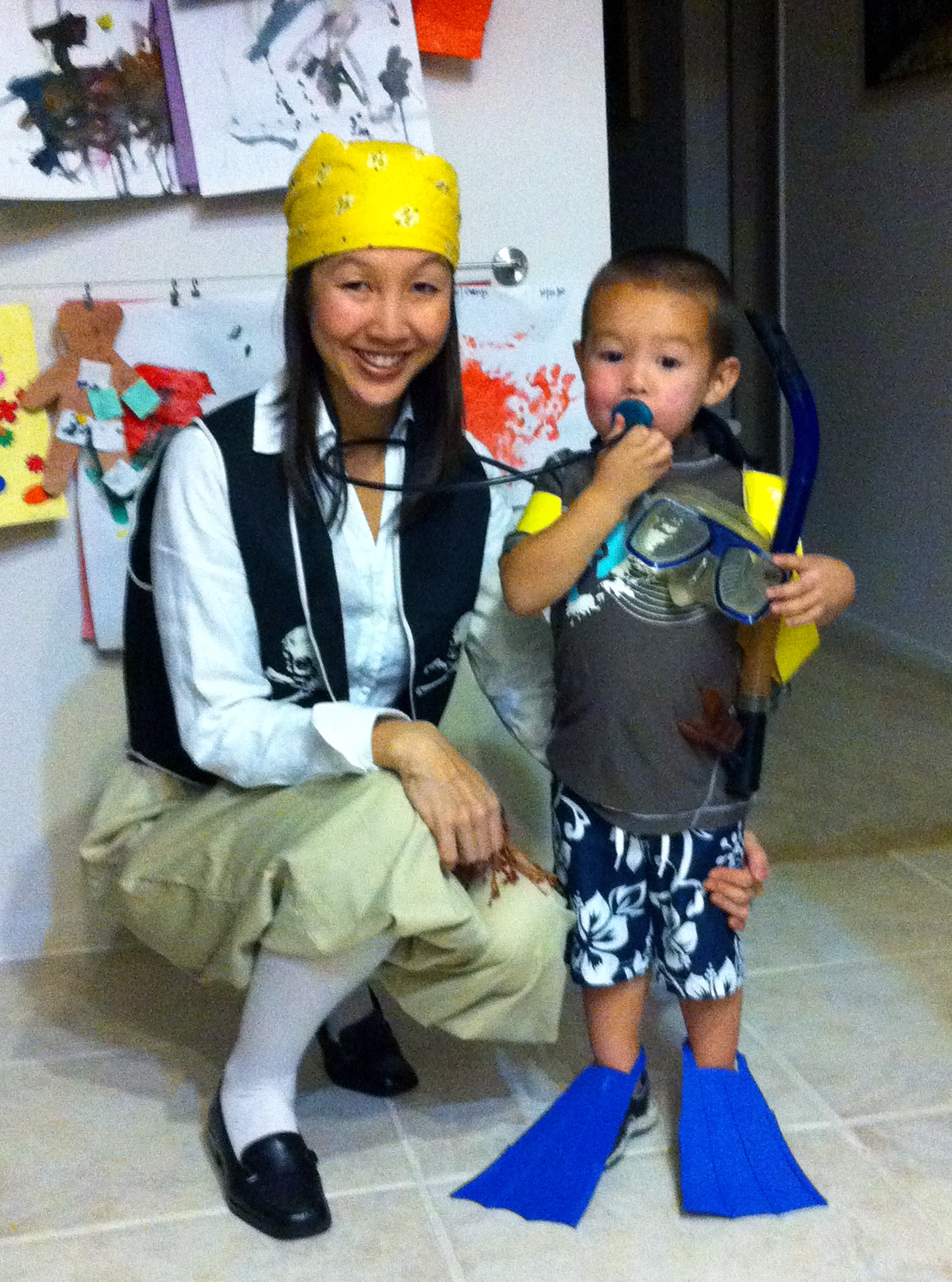
“[W]e have not gone the store-bought, costume-in-a-bag route, even though we recognize that the proliferation of ready-made options is a godsend to time-strapped, dual-career parents.”
This is a second part of a previous post about the shifting personal importance of Halloween. Now that I’m a mother of two young boys, I find that my husband and I are constantly looking for teachable opportunities. The holidays have accordingly become excellent ways for us not only to spend quality time together, but also to impart our values. We manifest our commitments even in something as simple as costume choices, as I explain below.
(1) We do not indulge the Manichean-like stage that our four-year old child is in. As befitting a boy his age, our primo is fascinated by superheroes and has asked on a number of occasions if he could be one for Halloween.
Halloween Matters: An Immigrant Family, Christian, and Feminist Parenting Perspective by Grace Yia-Hei Kao
“I had realized that my parents legitimately had more important things to do than to carve pumpkins or buy costumes. But as a young child, I equated participating in the cultural phenomenon that is Halloween with being an American. I, as a daughter of immigrants, just wanted to fit in and join the fun.”
Sacrament By Monica A. Coleman
 The following is a guest post written by Monica A. Coleman, Ph.D., scholar and activist committed to connecting faith and social justice. An ordained elder in the African Methodist Episcopal Church, Coleman has earned degrees at Harvard University, Vanderbilt University and Claremont Graduate University. Coleman is currently Associate Professor of Constructive Theology and African American Religions and Co-Director of the Center for Process Studies at Claremont School of Theology in southern California. She is also Associate Professor of Religion at Claremont Graduate University.
This article was originally posted on the Beautiful Mind Blog. Be sure to check in there and follow Monica’s journey.
“You have to believe in it. It won’t work if you don’t have some faith that it will work.”
These are the words my friend said to me years ago when I realized I could no longer manage my depressive condition without medication. Friend to friend, depressive to depressive, minister to minister . . . he told me to have faith.
I knew how to have faith in God. We prayed and preached about that for a living. I was not used to having faith in a pill. Continue reading “Sacrament By Monica A. Coleman”
 Feminism and Religion