This post was originally published on Jan. 21st, 2013
Over the past year I have written several blogs on ancestor connection. In this blog I will share what I have learned about how to find ancestors.
I recommend the popular television series Who Do You Think You Are? which has US, UK, and Australian, and other versions, and the PBS series hosted by Henry Louis Gates, African American Lives and Finding Your Roots. While you might think, as I did, that genealogical research is about finding the names and birthplaces of ancestors, these programs set the genealogical quest in the great flow of history.
Records show that I have ancestors who immigrated to the United States from Ireland, Scotland, Prussia, and Germany in the early 1850s. Historical research tells me that more than a million people left Ireland and Scotland in the 1850s due to the “potato famine,”* which affected the rest of Europe as well. History explains why ancestors emigrated.
In the middle of the night in waking sleep, I asked my great-great grandmother Annie Corliss to tell me the story of how she met and married James Inglis. This story came through me in a place I have come to call the Dreamtime. The Aboriginal term feels right. As I understand it, this is not a place where the dead speak to the living but rather a space where boundaries blur as the ancestors speak in us.
During my ancestor research, I have seen the word “tenement”—with the implication of poverty, filth, and disease–handwritten onto more than one death certificate. Last month, I visited the Lower East Side where my Irish 2x great-grandmother Annie Corliss lived in the tenements near the docks with her husband the Scottish seaman James Inglis and their nine children.
Though the tenements where they lived in the vicinity of Cherry Street a block from the East River have been torn down to build public housing, my newly discovered third cousin Hattie Murphy still lives in the area. She arranged for me to visit the “Irish Outsiders” house in the Tenement Museum on nearby Orchard Street in order to gain an understanding the conditions of life in the tenements in the middle of the nineteenth century.
The other night I hosted a First Moon Circle for my fourteen year old daughter. I have been hosting Circles almost a decade, but outside of having them on the ‘periphery’, walking through the sunroom where I host, talking and laughing with all of us after Circle as we eat, occasionally a short ‘sit-down’ in Circle, but nothing where they are included beginning to end.
Because my attitude up until now has been that Circles are work and so are they. Why mix the two?
But I find myself at new juncture: when you become very strong on who you are, feedback becomes so less relevant. And I have learned how to hold the rim of the Circle allowing it to flow and sway with minimum effort on my part.
Nowadays I find myself ‘receiving’ from Circles no matter who else is sitting in them and what they are contributing.
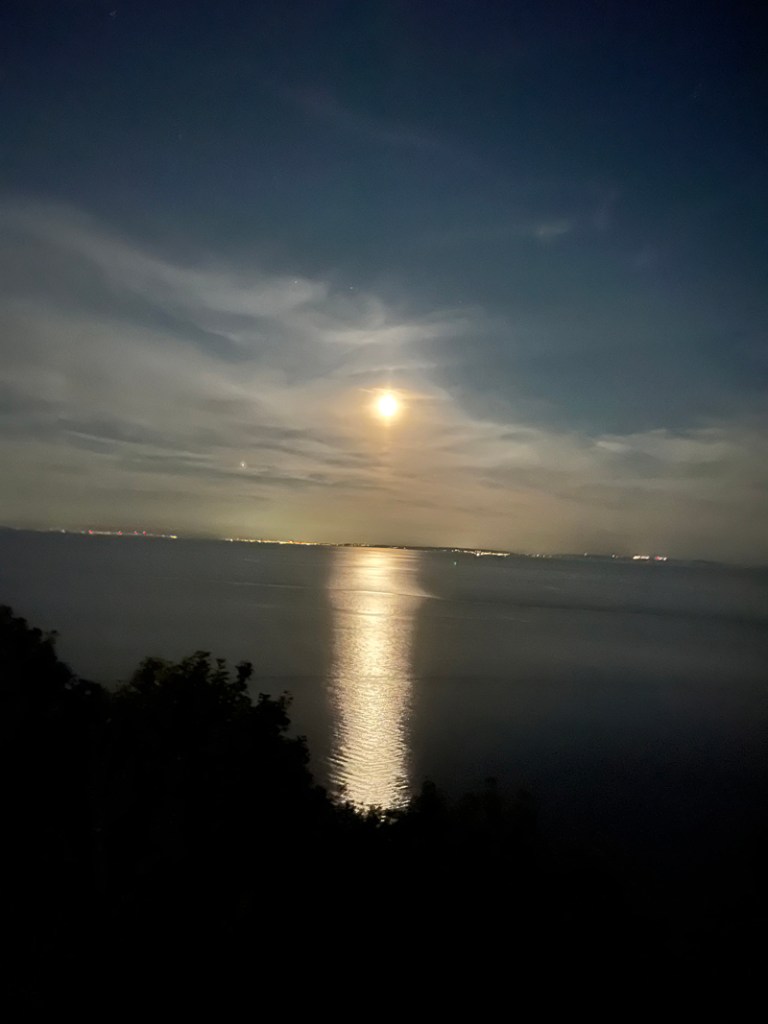
This year, the full moon on 30th August, which was a Super Moon, is also called Blue Moon – the name given to a second full moon occurring in the same month. I stayed up meditating and reflecting, because the rising of this moon flooded both my front room and my awareness with a light of great beauty. Beginning gold, she changed into a robe of silver, and eventually pearl white, with a crown of pastel shades, in her vault of luminous blue flecked with white feathered clouds. The full moon is always an inspiration, a Goddess who lights up the psyche, revealing hidden shadows to be faced, firing intuition, or illuminating the soul with her timeless wisdom. She has become my good friend over the years, and in my life as an elder human being, she offers me inspiration, visions of creative wisdom and possibility on those gold and silver paths stretching between the shores of Wales and The County of Somerset in England.
When I began researching years ago, I knew the names of my grandparents and what country in Europe their ancestors were from, but not much more. I have now traced most of my ancestors back to the Old Country, some to the 1600s. But there remained four ancestors with unknown places of origin among my sixteen 2x great-grandparents. A week or so ago, I decided to go back to the online resources, focusing on James Inglis, the Scottish seaman, and his Irish wife, Anne Corliss. This time I was more experienced, and I was determined to find the records.
Several sources confirmed that James’ parents were James and Isabella. Unfortunately, more than one James Inglis was born about 1838 to parents with these names. I had already ruled these Jameses out, because they were living in Scotland during the 1861 census, while my ancestor was by that time married and living in New York City. Scottish birth, marriage, and death records are incomplete before 1855 when civil registration was required; neither the marriage of James’ parents, nor his birth record were online. Continue reading “Finding Missing Pieces of My Ancestral Story: Scotland and Ireland by Carol P. Christ”
Last week, In the Room of Undressing where women strip themselves to the bone, my great-great-grandmothers on my father’s side spoke in me. I had been afraid they would judge me for not being a wife and mother like they were, but they did not.
The story continues with my great-great-grandmothers on my mother’s side.
Ingrid Mattsdottor, born 1829, Överhogdal, Jämtlands Län, Sweden, died 1918, Kansas City, Missouri, proprietor of a boarding house, mother of five daughters:
I was the oldest of eight children. Our father died when I was eleven. At sixteen I was sent to work as a servant in a village far from home. I stayed for six years. After that, I worked for two years on a farm in our village. I was twenty-nine, and wondering if I would be an old maid, when Olof and I married. Our five daughters came quickly. I knew a lot more about work and children he did, so I took charge. When the crops failed all over Sweden for two years running, I said enough was enough. As soon as our last daughter was born, I sold the farm, and we left for America.
Iowa was worse than Sweden. Our little Carin died the first year. Olof gave Ingrid to a wealthy Swedish couple without so much as a word to me. He kept talking about going back to Sweden. One day he took the money I set aside and bought his ticket.
By the time he came back for us, Anna, Sarah, Belle, and I had moved to Kansas City. I was running a boarding house. I told Olof that we had no intention of going back to Sweden with him. When Anna married, instead of moving out, she brought her husband and his children to live with us. Belle became quite the business woman and took over my role as provider. Sarah and her family were always close by.
I worked as hard as any man and Belle did too. “Far better off on our own,” we would often say. We are proud to have another strong woman in our family. I am sorry you didn’t get to meet Belle. You would have liked her.
Over the past year or so I have been reciting my mother line, seven generations back, as a mantra of gratitude that helps me sleep at night. Sometimes I also name my sixteen great-great-grandparents, though I often fall asleep before finishing.
I have gained courage from the strength of their lives, but I never wondered what my eight great-great grandmothers would think of me. My life feels so different from theirs. Perhaps I feared they would judge me and my life.
This weekend, while re-reading Woman and Nature, I followed the narrator through a Passage to the Room of Dressing:
Where the women are not close. Where the women keep themselves at a distance. . . . where the women tell each other that they are happy. . . . The room where the daughter denies she is anything like her mother. (156)
In the middle of the night in waking sleep, I asked my great-great grandmother Annie Corliss to tell me the story of how she met and married James Inglis. This story came through me in a place I have come to call the Dreamtime. The Aboriginal term feels right. As I understand it, this is not a place where the dead speak to the living but rather a space where boundaries blur as the ancestors speak in us.
Annie Corliss’s Story: As It Might Have Been
My mother decided to come to America after my father died. My brother Hudson was 7 and my brother Hugh was a baby. I was 13. Mother had a little money, and she said we would have a better life in America. We left Ireland on a boat that took us to Liverpool. There we boarded the big ship Continent that took us to America. The trip took about 6 weeks. While we were at sea, first Hudson, and then Hugh died. Their bodies were wrapped in the blankets that had covered them in the filthy cabins on the ship. The priest said a few words of blessing, and they were dumped into the cold angry sea. Every day, another body was thrown overboard, sometimes two. So much grief, so many tears in the night. After Hudson died, Mother wouldn’t let go of Hugh, so afraid was she of losing him. After he died, she would not stop crying. I kept telling her she still had me. She didn’t care anymore. “America is cursed,” she kept repeating. (1) Continue reading “As It Might Have Been: Ancestor Stories in the Dreamtime by Carol P. Christ”
During my ancestor research, I have seen the word “tenement”—with the implication of poverty, filth, and disease–handwritten onto more than one death certificate. Last month, I visited the Lower East Side where my Irish 2x great-grandmother Annie Corliss lived in the tenements near the docks with her husband the Scottish seaman James Inglis and their nine children.
Though the tenements where they lived in the vicinity of Cherry Street a block from the East River have been torn down to build public housing, my newly discovered third cousin Hattie Murphy still lives in the area. She arranged for me to visit the “Irish Outsiders” house in the Tenement Museum on nearby Orchard Street in order to gain an understanding the conditions of life in the tenements in the middle of the nineteenth century.
Tenement housing, which was a euphemism for apartment living in crowded and impoverished conditions, was often built on 25 x 100 foot lots that had been intended for single family homes. These several story buildings with four windows on the front of each floor were divided into small three-room apartments eight to a floor, each with one window facing the street or the back alley.
Buildings like this may look charming from the outside, until you imagine living your whole life in a small apartment set behind only one of these windows.
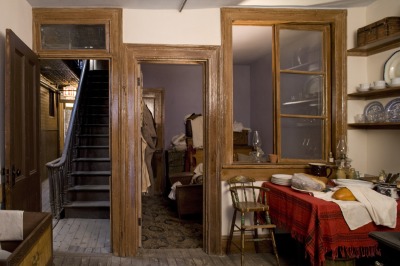
In the apartment we visited, the window was in the sitting room in the front, the bedroom was in the back, and the kitchen was in the center. The kitchen included a coal stove that was the only heating for the house. Laundry hung above the stove, and, as our guide explained, dirty diapers with only “number one” were simply pinned up to dry. Coal dust hung in the air and fell upon everything. Even in the summer when the windows were open, fresh air rarely reached to the kitchen, let alone to the bedroom in the back. Our guide remarked that the smells of cooking, coal, babies, and unwashed bodies would have been overpowering. Despite their poverty, the women purchased pretty dishes, often chipped, at second hand stores, and proudly displayed them.
This photo shows the communal staircase, the open door of the apartment, kitchen and bedroom. The window inside the apartment was added to improve air circulation due to health regulations. Blue Willow pattern dishes on display upper left.
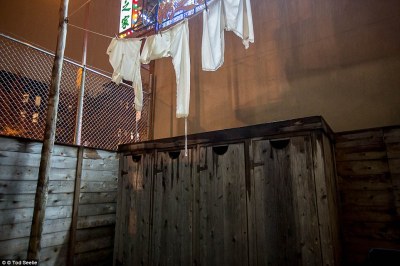
Our visit began in the back “garden” where there were four toilets for twenty-two families. I shuddered to imagine trying to clean them or to run down to use them in the middle of the night. There was a pump for fresh water. The guide handed around a bucket filled with pebbles to give us an idea of the weight the housewives and their children had to lug up flights of stairs numerous times each day. No wonder baths were infrequent. I remember an older Greek friend telling me how they used to wash with a cloth from the waist up one day and from the waist down the next. Annie’s family may not even have managed that.
Outdoor toilets in the back “garden” serving twenty-two families.
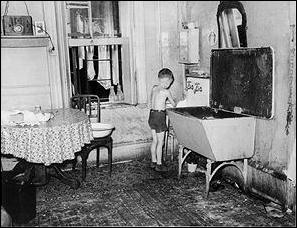
Our tour included a description of a sick and dying baby and a funeral with the baby’s body laid out in the sitting room. My 2x great-grandmother gave birth to nine children of whom, unusually, the first eight lived to adulthood. Annie must have understood that hygiene is heath. Her days would have been spent fighting to keep her house and her children as clean as she could.
Boy washing in tenement kitchen. The sink doubled as a work space.
The bedroom in the apartment we visited had a small double bed pushed up against two walls, with just enough room to walk past it to get to a small closet and a few trunks crammed in the space against the back wall. When James the seaman was home, this would have been the marital bed, but when he was gone, the younger children slept with their mother, while the older ones wrapped themselves in sheets and blankets near the stove or in the sitting room.
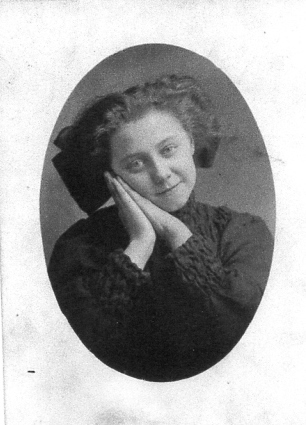
Annie, at the time of her marriage
Anne, age 20, and James “Ingles,” mariner, age 25, husband and wife, living in the area of the docks, appear on the 1855 New York State census. In fact, Annie was perhaps 15, while James was 17. I suspected this was an unusually young age to marry, and research proved me right. The average age for Irish marriages at the time was 20 for the bride and 25 for the groom. Annie would have had every reason to lie about her age for reasons of propriety.
Documents I have only recently found show that Ann “Carless,” age 13 arrived in New York with her mother Mary on January 16, 1854. Her two younger brothers, one 7 and the other an infant, died on the ship. As I could not find Ann’s mother Mary after that, I assume she died soon after arriving, leaving her young daughter on her own.
Annie lived her whole life in America in tenements in the the unsavory area near the docks—filled with bars, drunken sailors, prostitution, and crime. She died at the age of forty-five of a stroke, leaving her husband and eight children. Because of her, I am here.



 When I began researching years ago, I knew the names of my grandparents and what country in Europe their ancestors were from, but not much more. I have now traced most of my ancestors back to the Old Country, some to the 1600s. But there remained four ancestors with unknown places of origin among my sixteen 2x great-grandparents. A week or so ago, I decided to go back to the online resources, focusing on James Inglis, the Scottish seaman, and his Irish wife, Anne Corliss. This time I was more experienced, and I was determined to find the records.
 In the middle of the night in waking sleep, I asked my great-great grandmother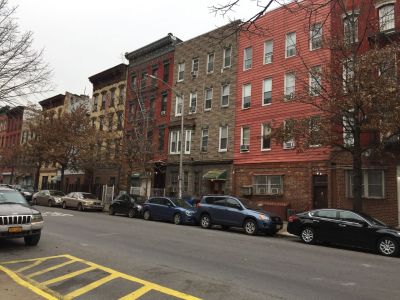
 Feminism and Religion