
Legacy of Carol P. Christ: MATRIARCHY: DARING TO USE THE “M” WORD

carol-christ

This post was originally published on Feb. 17th, 2014.

For me the word “matriarchy” expresses the certainty that “another world” can exist—a world not based in domination and hierarchy or violence and war. 

The word “matriarchy” makes people’s hair stand on end as they imagine the mirror-image of patriarchy: societies in which women dominate men, beat men, rape men, hold men as slaves, and demand obedience from men.  Some who do not protest very loudly or at all against patriarchy are horrified by the very idea of matriarchy. To be fair, most feminists have also been schooled not to use the “m” word.

Early in my academic career, I read “The Myth of Matriarchy” by Joan Bamberger and learned that the idea of matriarchy gone wrong has been used by men to justify patriarchy. From other academics I learned that in matrilineal societies, uncles have a great deal of power—so therefore there never was a matriarchy.  I was also aware that Jungian and other proponents of a “matriarchal stage” in the development of culture have argued that matriarchy had to be succeeded by patriarchy in order for societies to evolve to a “higher” stage. Unlike many of my colleagues I stubbornly held onto the belief that there must have been “a better way” prior to patriarchy. Continue reading “Legacy of Carol P. Christ: MATRIARCHY: DARING TO USE THE “M” WORD”

Legacy of Carol P. Christ: What Is Patriotism?

This was originally posted on July 8, 2013.

July 4, American Independence Day, has come and gone. Perhaps now is as good a time as any to reflect on patriotism. What is it? What does it mean from a feminist perspective?  What is the relationship between patriotism and militarism?  Can one be a patriot and oppose war?  Can one be a patriot and deny that “America is the greatest country in the world,” the foundation of  the doctrine of American exceptionalism?

In a recent blog, Caroline Kline called attention to the use of patriarchal God language in the patriotic hymns her child was asked to sing in the 1st grade.  She wondered if this God language could be changed to female positive or gender neutral.  Her post prompted me to ask if changing pronouns would be enough and to revisit the question of patriotism and nationalism.

Continue reading “Legacy of Carol P. Christ: What Is Patriotism?”

It’s Time to Thank Stacey Abrams Again by Carol P. Christ

The insurrection in the Capitol on January 6 has dominated the news ever since. Coverage of the Democrats’ victories in the two Senate runoffs in Georgia has been virtually nil. Now that it seems that at least as long as the National Guard is deployed to defend the national and state capitols, the insurrectionists have been stopped, it is time to thank Raphael Warnock and Jon Ossoff–and most of all to Stacey Abrams–for returning control of the Senate to the Democrats.
As is well-known to most readers of FAR, Stacey Abrams narrowly lost the election for Governor of Georgia in 2018 due to voter suppression.

Voter suppression of voters of color and young voters is a scourge our country faces in states across the nation.  Georgia’s 2018 elections shone a bright light on the issue with elections that were rife with mismanagement, irregularities, unbelievably long lines and more, exposing both recent and also decades-long actions and inactions by the state to thwart the right to vote. 

In response to widespread nation-wide efforts of Republican dominated states to suppress the vote, Stacey Abrams founded Fair Fight. Continue reading “It’s Time to Thank Stacey Abrams Again by Carol P. Christ”

Altars Everywhere, Part 2 by Carol P. Christ

This is a continuation of an earlier blog in which I discuss home altars as a way to bring beliefs about women’s spiritual power into the body and daily life.

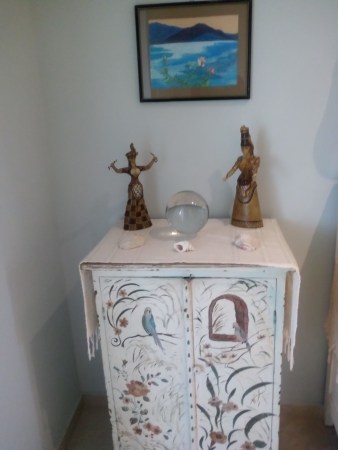
In my bedroom, images of the Snake Goddesses of Knossos sit on a cabinet painted by a Greek woman with images of birds and flowers. Between them is a crystal ball, while before them are three shells, the smaller of which was given to me by a Maori woman from New Zealand. Above them is an image of the sea in Molivos, Lesbos, painted by my friend Judith Shaw in the year we were both living in the village.

Continue reading “Altars Everywhere, Part 2 by Carol P. Christ”

Dear Cousin: Can We Talk about Structural Racism? by Carol P. Christ

,A few years ago, I visited the family farm founded by ancestors from Germany in the Pokonos with a newly discovered cousin. The woman I met was delightful: warm and friendly and very much connected to family still living in the area. Her mother had vivid memories of the farm. In contrast, my great-grandmother left home to marry in Brooklyn. My father had fond memories of visiting the farm as a child, but lost touch with the relatives there when his family moved to California in the 1930s.

My cousin was working as a department manager at Walmart. She seemed smart as a button, so I asked her why she had not gone to college. She said that though she had the grades no one encouraged her to do so. Her response made me wonder if I would have gone to college if my part of the family had remained close to the family farm. I was stunned by the roles chance and the choices of others play in our lives. Though I had more education than my cousin, I was not sure that mine was a happier life. I envied the family ties that shaped and defined her days.

About two weeks ago my cousin wrote on facebook:

I have often wondered about why Whites are racists, and no other race is. Someone finally said it. How many are actually paying attention to this? Continue reading “Dear Cousin: Can We Talk about Structural Racism? by Carol P. Christ”

The Lost Is Found by Carol P. Christ

Since I wrote “Claiming the Power to Choose to Our Lovers” and “Choosing to End Love” in the spring, my beloved and I came back together and parted again, not once, but twice.  At the end of the summer, believing our separation to be final, I decided to drop a miniature copy of the Minoan bee pendant, symbol of my desire to “let go of a beautiful dream,” into a crevice in the Skoteino Cave while on the Goddess Pilgrimage to Crete.

I don’t believe in divine intervention, but something happened to stop me. The day before the ritual, the pendant disappeared. It was not in my jewelry case, not in my handbag, not anywhere in my suitcase or my hotel room: it was nowhere to be found. That same day I received a gift of a large jar of honey from a local shopkeeper. In the end, I dropped a sugar-coated almond into the crevice and poured every bit of the honey onto the altar of the cave, asking for transformation and love. Continue reading “The Lost Is Found by Carol P. Christ”

JUSTICE AND PREJUDICE IN THE “PROPHETIC TRADITION” by Carol P. Christ

carol christBesides being advocates of social justice, the prophets of Israel were advocates of “exclusive monotheism,” exclusively “male monotheism,” “religious othering,” and “religious prejudice.” 

Many progressive Jews and Christians find inspiration in prophets because of their insistence that their God cares about the poor and “the widow at the gate.” For progressive Christians, Jesus stands in the prophetic tradition, and the core of his message is “concern for the poor.” For progressive Jews the prophetic tradition is the root of their concern for human rights.

Those who locate their spirituality and concern for social justice in the prophets can point proudly to Martin Luther King and the many priests, ministers, and rabbis, as well as ordinary Christians and Jews who marched with him as exemplars of the prophetic tradition.

But the prophetic tradition also has a nasty underside. Continue reading “JUSTICE AND PREJUDICE IN THE “PROPHETIC TRADITION” by Carol P. Christ”

MATRIARCHY: DARING TO USE THE “M” WORD by Carol P. Christ

carol-christFor me the word “matriarchy” expresses the certainty that “another world” can exist—a world not based in domination and hierarchy or violence and war. 

The word “matriarchy” makes people’s hair stand on end as they imagine the mirror-image of patriarchy: societies in which women dominate men, beat men, rape men, hold men as slaves, and demand obedience from men.  Some who do not protest very loudly or at all against patriarchy are horrified by the very idea of matriarchy. To be fair, most feminists have also been schooled not to use the “m” word.

Early in my academic career, I read “The Myth of Matriarchy” by Joan Bamberger and learned that the idea of matriarchy gone wrong has been used by men to justify patriarchy. From other academics I learned that in matrilineal societies, uncles have a great deal of power—so therefore there never was a matriarchy.  I was also aware that Jungian and other proponents of a “matriarchal stage” in the development of culture have argued that matriarchy had to be succeeded by patriarchy in order for societies to evolve to a “higher” stage. Unlike many of my colleagues I stubbornly held onto the belief that there must have been “a better way” prior to patriarchy. Continue reading “MATRIARCHY: DARING TO USE THE “M” WORD by Carol P. Christ”