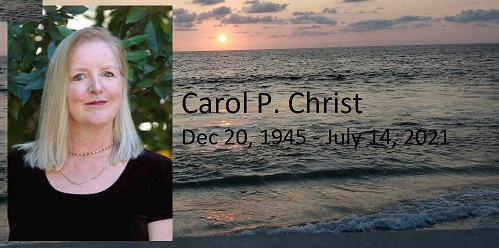
Legacy of Carol P. Christ: What Was Your Childhood Religious Tradition And Do You Still Follow It?

This post was originally published on Nov. 26th, 2012

Recently, in an interview with the Women’s Living History Project of Claremont Graduate University, I was asked: What religious tradition did you identify with as a child and how did it impact your childhood? and: Is your tradition the same today that you had when growing up?

I was surprised that the interview questions didn’t ask anything about feminism, experiencing exclusion in patriarchal religions, or belief.  My religious and political convictions, which are intertwined, have alienated me from family members.  Therefore, I was suspicious of questions that seemed to have been formulated by someone for whom religion and family go together, and for whom believing or not believing (!) did not seem to be an important issue.

After expressing criticism of the questions, I agreed to work with them.  My answer to the first question was that I did not have a single religious tradition as a child. I had four.  Continue reading “Legacy of Carol P. Christ: What Was Your Childhood Religious Tradition And Do You Still Follow It?”

Legacy of Carol P. Christ: Of Human Life*

This post was originally published on July 2nd, 2012like many of Carol’s other posts, it is eerily poignant for today.

Watching the last episode of the Australian series Brides of Christ in which Catherine leaves the sisterhood of the convent because of her disagreement with Humanae Vitae brought me right back to the Yale Roman Catholic chapel and the folk mass I attended regularly.  In 1968 just after the publication of Humanae Vitae, priest and co-graduate student Bob Imbelli preached a sermon on the doctrine of conscience, arguing that though it was incumbent on Catholics to think carefully about the papal encyclical on birth control, it was also the responsibility of every Catholic to follow her or his conscience on the matter.  In the episode, Sister Catherine encourages a Roman Catholic mother of six who has already self-induced more than one abortion to take the pill, but the woman decides she cannot go against the church’s teachings.  Catherine allows an editorial against Humanae Vitae to be published in the school newspaper even though she knows it will probably lead to the expulsion of one of her favorite students.

Continue reading “Legacy of Carol P. Christ: Of Human Life*”

Legacy of Carol P. Christ: Of Human Life*

This was originally posted on December 30, 2011

Watching the last episode of the Australian series Brides of Christ in which Catherine leaves the sisterhood of the convent because of her disagreement with Humanae Vitae brought me right back to the Yale Roman Catholic chapel and the folk mass I attended regularly.  In 1968 just after the publication of Humanae Vitae, priest and co-graduate student Bob Imbelli preached a sermon on the doctrine of conscience, arguing that though it was incumbent on Catholics to think carefully about the papal encyclical on birth control, it was also the responsibility of every Catholic to follow her or his conscience on the matter.  In the episode, Sister Catherine encourages a Roman Catholic mother of six who has already self-induced more than one abortion to take the pill, but the woman decides she cannot go against the church’s teachings.  Catherine allows an editorial against Humanae Vitae to be published in the school newspaper even though she knows it will probably lead to the expulsion of one of her favorite students.

Continue reading “Legacy of Carol P. Christ: Of Human Life*”

Open Letter to the Pope and all the King’s Men by Natalie Weaver

Dear Sirs,

It breaks me down.  My anger, my revulsion, my powerlessness.   I have been searching for the way since I was a child old enough to remember my mind.  For a time, I thought Jesus was a white guy knocking on my door after having seen a religious pamphlet placed under our windshield wiper.  I’m not sure he has blond hair anymore, but I still feel him knocking.  I have been in love with him for as long as I have been a self, so much so that I baptized myself as a little girl.

Somewhere along the way, I figured my little, lonely way wasn’t good enough, and I wanted a church home.  I finished a doctoral dissertation trying to find some place I could hang my hat.  I picked the Roman Catholic Church, despite what I knew of it and what I had to defend about its patriarchy and history to family and friends.  I loved the conversation, the so-called “Catholic Intellectual Tradition.”  I always felt myself to be a covert, a conversa, a definitive outsider, and someone not to be trusted entirely as a cradle Catholic might be trusted, yet I tried to be family. I’ve been bringing up my kids in the Church, volunteering, working in Catholic education, paying the boys’ tuition.  I do work-arounds, making excuses for the exclusion of women, defying the Church’s stance on sexuality with a critical repertoire of cross-disciplinary scholarship.  Lord, I even had to help my Seventh-Day Adventist mom with a hostile annulment process that was dropped on her unsuspecting by a horrendously insensitive marriage tribunal.  It wounded us all. Yet, here I have sat, until this.

Continue reading “Open Letter to the Pope and all the King’s Men by Natalie Weaver”

Confession by Darlena Cunha

Darlena family portraitGood afternoon, Fr. John. I’m here for confession. No, I’d like the curtain back, please. I want you to see my face. I really need to talk to you, get my bearings. But this confession will not be solely about my sins, for, unfortunately, I am not sure I will ever change my ways.

Does that exclude me? Is Catholicism a club? Should my twin daughters, five years old, be subjected to scorn and pity that their mother is a sinner? That they were born in sin? They don’t look like sin, to me. They are light, and love, and happiness. They have shaped me, taught me, brought me into the woman I was meant to be. Is it wrong of me to want to do the same for them? Is it better to turn me out and lose two potentially pure beings who will make their own choices in their religion and could be devout Catholics, or put up with me in the hopes that my children will be more worthy?

I’m here because I like you, you know. I like Catholicism. It’s in my blood, my heritage, my family. And where I’m from, everyone belongs.

I was baptized, received communion, was confirmed, attended youth group. I went to an all-girls Catholic college my freshman year. Full-ride because I’m fairly smart, and I work hard. That’s where I lost Him, you see. I don’t know how, or why, but one early fall day when the leaves were crisp and bright but not yet falling, I looked up at the chapel on campus, and He was gone. Or He seemed gone. Continue reading “Confession by Darlena Cunha”

Beyond Hemlines: What a Pope Can Teach Us About Modesty by Deborah Farmer Kris

DeborahPhotoPope Francis’ obvious decency appeals to me as a human.  His discourse and homilies appeal to me as a Christian.

But his humble actions appeal to me as a Mormon woman who is weary of witnessing, over and over, how we culturally misuse the term “modesty” and reduce it to base rules governing the attire of (primarily) teenage girls.

Pope Francis gives me hope for the future of our modesty discourse because in five months, he has somehow managed to make humility and  modesty cool again.

First, let’s look at modesty as discussed in the Catholic Catechism:

  • Modesty protects the intimate center of the person. It guides how one looks at others (author note: not how others look at you) and behaves toward them in conformity with the dignity of persons and their solidarity. Modesty inspires a way of life which makes it possible to resist the allurements of fashion and the pressures of prevailing ideologies. Teaching modesty to children and adolescents means awakening in them respect for the human person. Continue reading “Beyond Hemlines: What a Pope Can Teach Us About Modesty by Deborah Farmer Kris”

BREAKING NEWS: Pope Resigns

pope-1-1216The world is stunned this morning as news breaks that Pope Benedict XVI has announced that he will resign his position due to lack of strength to carry out his role; he stated: “to the extent that I have had to recognize my incapacity to adequately fulfill the ministry entrusted to me”.

“For this reason, and well aware of the seriousness of this act, with full freedom I declare that I renounce the ministry of Bishop of Rome, Successor of Saint Peter.” Continue reading “BREAKING NEWS: Pope Resigns”

What Was Your Childhood Religious Tradition And Do You Still Follow It? by Carol P. Christ

Recently, in an interview with the Women’s Living History Project of Claremont Graduate University, I was asked: What religious tradition did you identify with as a child and how did it impact your childhood? and: Is your tradition the same today that you had when growing up?

I was surprised that the interview questions didn’t ask anything about feminism, experiencing exclusion in patriarchal religions, or belief.  My religious and political convictions, which are intertwined, have alienated me from family members.  Therefore, I was suspicious of questions that seemed to have been formulated by someone for whom religion and family go together, and for whom believing or not believing (!) did not seem to be an important issue.

After expressing criticism of the questions, I agreed to work with them.  My answer to the first question was that I did not have a single religious tradition as a child. I had four.  Continue reading “What Was Your Childhood Religious Tradition And Do You Still Follow It? by Carol P. Christ”

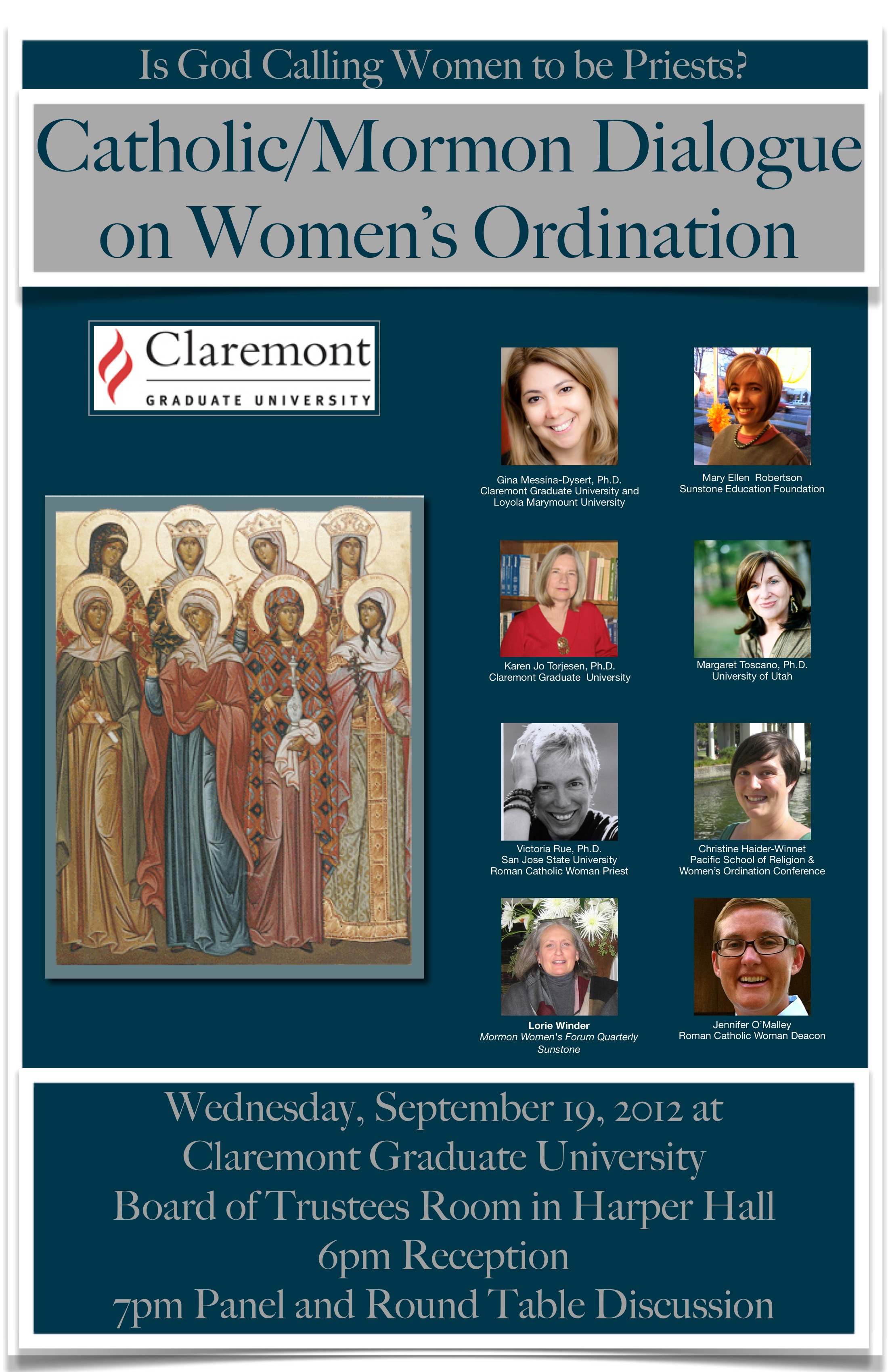
Catholic/Mormon Dialogue on Women’s Ordination

The Catholic/Mormon Dialogue on Women’s Ordination at Claremont Graduate University will take place Wednesday, September 19, 2012.  It is an incredibly relevant topic today and particularly interesting with a Mormon/Catholic presidential ticket before us.

It makes sense to bring Catholics and Mormons together to dialogue about this issue.  Women’s ordination in both Churches is considered a taboo topic and one that if discussed in public can lead to excommunication.  Certainly the women who will stand publicly to address this issue and share their passion and conviction for the need to ordain women are courageous and committed to the recognition of the full humanity of every woman and every man.  Continue reading “Catholic/Mormon Dialogue on Women’s Ordination”