Sea Glass by Elanur Williams

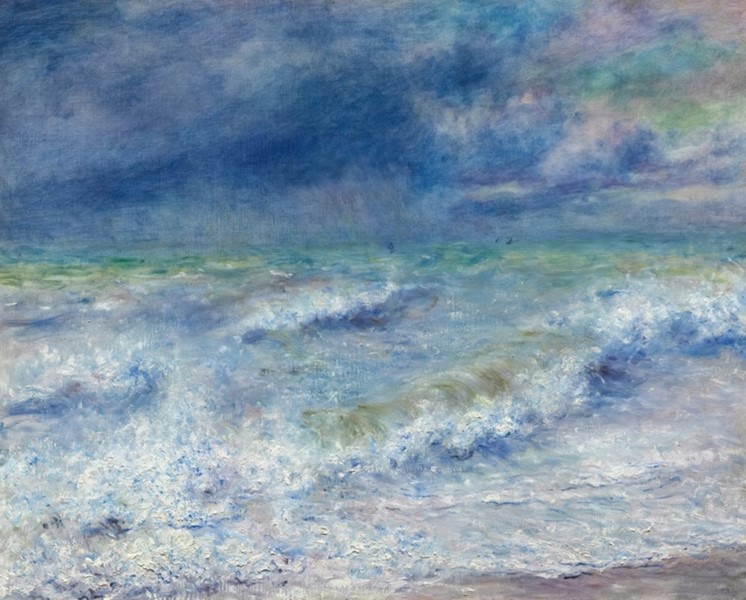
Image Credit: Seascape, 1879, Pierre-Auguste Renoir (available on public domain).

I am drawn to the sea not for its grandeur, but for what it returns: small, broken things that once had sharpness. As a child, I remember walking along the shore searching for glimmers, glass fragments dulled into misty greens, smoky ambers, pale blues. I wanted to gather the pieces of what had once been whole and what had once been contained. I collected the way a child collects secrets, each piece a contradiction. Maybe I thought I could make something from these fragments; after all, I was the kind of child who looked for meanings and signs in everything. It is in part what drew me to literature and writing.

There is a piece of sea glass I remember more than the others: an opalescent shard, a piece of moon. That piece became a metaphor for the self I hadn’t yet become. Like those fragments, I too had sharp edges once. Pain teaches that: the need to defend, to protect oneself from further breakage, carves us into angular shapes. I learned early how to brace for fracture, and there was a comfort I found in control, a fierce desire for wholeness that was often mistaken for strength. But there is a brittleness to that kind of armor, and eventually, it begins to break. It took years of undoing for my edges to soften.

Continue reading “Sea Glass by Elanur Williams”
Legacy of Carol P. Christ: Touching Roots: An Incredible Lightness Of Being

This was originally posted on Jan. 7, 2o13

A few days ago, a German-speaking friend spoke with an Eiloff relative of mine who lives in St. Nikolaus, Saarland.  My relative remembered hearing the story that Heinrich Eiloff, my 2x great-grandfather, emigrated to the United States in the mid-1800s.  Since we connected, I am experiencing an incredible lightness of being.

This is the first time my two years of genealogical research have led to a “Kunta Kinte” moment, a connection with a relative in “the old country.”  I have been unable to trace most of my ancestors back to the places of their birth. 

My relative in St. Nikolaus was perplexed by a call from Greece from a woman claiming to represent his American relative. But when she explained that I only want to find my roots and perhaps visit relatives in St. Nikolaus, he said, “that would be very nice.”  He promised to speak with other living relatives and said we should call in a month or two and he would tell us what he found.

Continue reading “Legacy of Carol P. Christ: Touching Roots: An Incredible Lightness Of Being”

Legacy of Carol P. Christ: I am Beginning to Understand

This was originally posted on Feb. 13, 2012

Elizabeth Kelly Inglis died in 1927 at age 62 from complications of a stroke. Secondary causes were malnutrition and exhaustion.

When I was a child, my father, though he was very close to his own parents and sister, spoke very little about his ancestors. I knew that both of his parents lost their fathers when they were small children. I was told that the Christs were German and the Inglises were Scottish and Irish. My grandmother Mary Inglis Christ was as Irish as the day is long. She prayed to the blessed Virgin and took me to church with her in the early mornings where she lit candles and whispered the rosary while fingering faceted lavender beads. She voted for Kennedy because he was Irish and Catholic—to the horror of my father and his father who had no use for the Democrats. My grandmother sometimes cried when she showed us photographs of her family, especially when she pointed to her sister Veronica, called Very. I sensed that my grandmother felt sad to have left her family in New York when she moved with her husband and children to California during the depression, but I was too young to understand fully. As far as I know, I never met any of the relatives from her side of the family, even when I moved to “back east.”

Continue reading “Legacy of Carol P. Christ: I am Beginning to Understand”

If You Remove the Yoke: the Hidden Home in Life’s Pilgrimage by Tallessyn Zawn Grenfell-Lee

(Note: This post briefly references genocide and brothels.)

Every year we can, we go visit my amazing Korean parents in law, Halmeoni and Harabeoji (‘Grandmother’ and ‘Grandfather’). Now in their 80s, they consistently embody the kind of radical trust that I’m trying to build. Their lives tell like a movie script, one dramatic, heartbreaking story after another, interwoven with incredible courage, faithfulness, and generosity. Hunger and genocide, robbery and abandonment, occupation and persecution – and, unexpected, powerful sources of support and inspiration.

Against all odds, their journeys brought them together; then across the world to Germany, a haven to raise their children and minister to lonely Korean workers, far from kin and homeland. Then, uprooted again to chilly Alberta, to learn yet another language and culture, ecosystem and way.

Continue reading “If You Remove the Yoke: the Hidden Home in Life’s Pilgrimage by Tallessyn Zawn Grenfell-Lee”

Children of German Immigrant Farmers in Cherry Ridge: American Stories by Carol P. Christ

In my genealogy research, I traced my father’s grandmother, Catherine, to her roots on the Iloff farm in Cherry Ridge, Honesdale, Pennsylvania, about two hours north of New York City. Catherine’s parents were Henry Iloff, who emigrated in 1841 from St. Nicholas, Saarland, and Catherina Lattauer who emigrated in 1845 or 1846 from Ober-Floerscheim, Hesse-Darmstadt. They were married February 2, 1846 at St. Matthew’s Church in “Little Germany” on the Lower East Side of Manhattan.
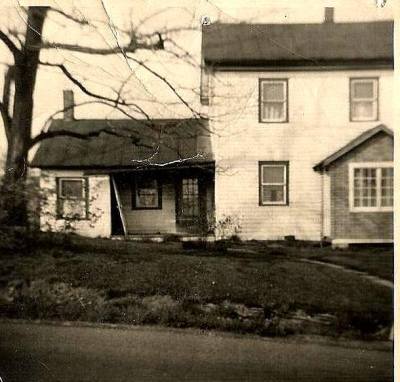

Iloff farmhouse

In 1850, Henry and Catherina purchased land in Cherry Ridge, Honesdale, where they built the farm that remained in the family for a hundred years. In 1851 Catherina’s sister Agnes Lattauer Schweizer emigrated with her family from Ober-Floerscheim to Cherry Ridge. The Schweizer farm also remained in the family for a hundred years.

I had been told about the family Henry Iloff had with two wives who were somehow related: nine children with his first wife and nine with his second over a forty year period–fourteen of whom were living at the time of his death in 1889. I was shocked to learn that when his first wife died in 1869, Henry married his wife’s sister’s daughter Johanna Schweizer–who was half his age and his children’s cousin. I suspect that the marriage was considered scandalous in a conservative farming community, and that it did not sit well with the children of the first marriage, four of whom left the local area. Nonetheless, Henry Iloff was elected to the prestigious position of Wayne County Commissioner a decade later. Continue reading “Children of German Immigrant Farmers in Cherry Ridge: American Stories by Carol P. Christ”

Forest Heritage by Molly

editMollyNov 083

Trees

To my lips
a prayer comes
thank you,
I see.

When we decided to buy some land on which to build our home, one of the deciding factors was the wonderful big rocks on the hillside behind where we imagined building our house. Over the years, we would go out and walk through the woods and stand on the rocks, and I often said that I wanted to create a sacred space down there to visit regularly. As I realized later, there was no need to “create” the sacred space, it was already there.

Following two miscarriages, I would often go to the woods to sit on a chair-shaped rock and connect with nature and my body. During my subsequent pregnancy with my daughter, I would return to this place to sit and connect with my baby and prepare for her birth. After she was born, I brought her to these rocks and these woods to “introduce” her to the planet. At some point at the end of 2010, I suddenly “heard” the words priestess rocks when I was standing out on these large flat stones that look out over the horizon. It felt like their name, I suddenly knew it. So, in July of 2012 when I became ordained as a priestess, the priestess rocks felt like the absolutely perfect place to bear witness to my ceremony of ordination. They called me. They named me priestess first. Continue reading “Forest Heritage by Molly”

Touching Roots: An Incredible Lightness Of Being by Carol P. Christ

carol p. christ 2002 colorA few days ago, a German-speaking friend spoke with an Eiloff relative of mine who lives in St. Nikolaus, Saarland.  My relative remembered hearing the story that Heinrich Eiloff, my 2x great-grandfather, emigrated to the United States in the mid-1800s.  Since we connected, I am experiencing an incredible lightness of being.

This is the first time my two years of genealogical research have led to a “Kunta Kinte” moment, a connection with a relative in “the old country.”  I have been unable to trace most of my ancestors back to the places of their birth. 

My relative in St. Nikolaus was perplexed by a call from Greece from a woman claiming to represent his American relative. But when she explained that I only want to find my roots and perhaps visit relatives in St. Nikolaus, he said, “that would be very nice.”  He promised to speak with other living relatives and said we should call in a month or two and he would tell us what he found.

According to my research, my 2x great-grandfather Heinrich Eiloff was born in 1820 in St. Nikolas, Saarland, in Prussia (now in Germany).

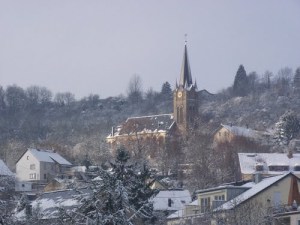
st nikolaus saarland

Continue reading “Touching Roots: An Incredible Lightness Of Being by Carol P. Christ”

I am Beginning to Understand by Carol P. Christ

Elizabeth Kelly Inglis died in 1927 at age 62 from complications of a stroke. Secondary causes were malnutrition and exhaustion.

When I was a child, my father, though he was very close to his own parents and sister, spoke very little about his ancestors. I knew that both of his parents lost their fathers when they were small children. I was told that the Christs were German and the Inglises were Scottish and Irish. My grandmother Mary Inglis Christ was as Irish as the day is long. She prayed to the blessed Virgin and took me to church with her in the early mornings where she lit candles and whispered the rosary while fingering faceted lavender beads. She voted for Kennedy because he was Irish and Catholic—to the horror of my father and his father who had no use for the Democrats. My grandmother sometimes cried when she showed us photographs of her family, especially when she pointed to her sister Veronica, called Very. I sensed that my grandmother felt sad to have left her family in New York when she moved with her husband and children to California during the depression, but I was too young to understand fully. As far as I know, I never met any of the relatives from her side of the family, even when I moved to “back east.” Continue reading “I am Beginning to Understand by Carol P. Christ”