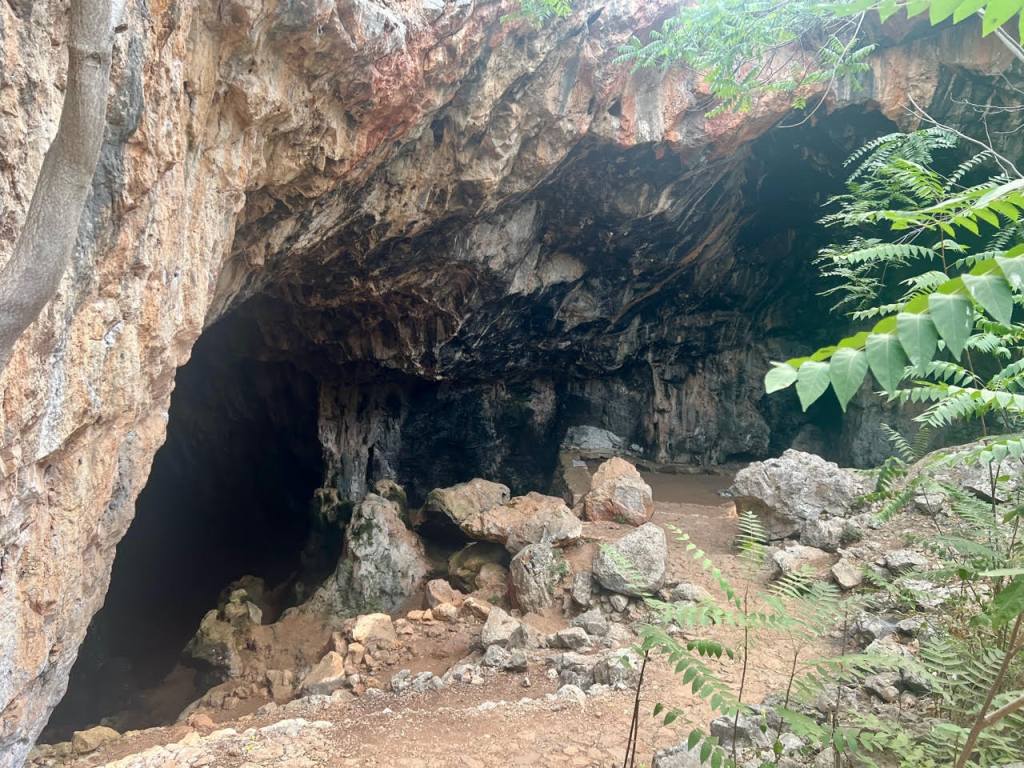
A Cave Story by Arianne MacBean

A few years ago, I took a pilgrimage to Crete with the hope of meeting the Great Goddess. I was yearning from something undeniable, proof that would allow me to be a card-carrying believer. Although our group was led to powerful ancient sites where we enacted sincere rituals and dances, each time I failed to feel greeted by Her universal power.

Except once. And I almost missed it.

The great cavern, Skotino (Photo by Helen Marie Traglia)

One day, a small but determined group of women took it upon us to co-lead a ritual at Skotino cave, an ancient site used for sacred purposes from the Bronze Age through the Roman era. The collaborative approach to facilitating a ritual was new to us, so we all felt especially ignited and giddy. Before we descended into the depths of the cave, I sang, (something I NEVER do). I had been provided lyrics, but I made up my own melody, which my fellow initiates sang back to me, as a call and response.

Continue reading “A Cave Story by Arianne MacBean”

Ancient Her-Story by Annelinde Metzner

Lately I’ve been rereading and refreshing myself with important books of the Great Goddess.  Three books at a time! I would switch off, chapter by chapter, among  When God Was a Woman by Merlin Stone, When the Drummers Were Women by Layne Redmond, and one that had remained overlooked on my shelf, Sanctuaries of the Goddess, The Sacred Landscapes and Objects, by Peg Streep (1994.)  I’ve been immersed in the knowledge of 30,000 years of honoring and worship of women’s bodies and the Great Goddess. When I got to Chapter 7 of Peg Streep’s well-researched book, “The Goddess at the Peak: Crete,” I was blown away with the evidence we still have, in art, architecture, religion and culture, of a highly advanced society, full of life and joy, where women were central to all life. With my mind, my heart, my intuition and my sense of past lives, I’ve attempted to place myself there, before any influence of patriarchy.

Continue reading “Ancient Her-Story by Annelinde Metzner”

From the Archives: Where Did the Gods Come From? by Barbara Ardinger

This was originally posted on June 10, 2012

A man in the group leaned forward and asked, “But how did the Goddess get overcome?” So I told him. Young “warrior heroes” came galloping out of the Russian steppes and the Caucasus Mountains, including Afghanistan, which no one (not even Alexander the so-called Great) has ever conquered. The boys were carrying their thunder-solar-sky gods with them.

Continue reading “From the Archives: Where Did the Gods Come From? by Barbara Ardinger”

Carol P. Christ’s Legacy: Great Goddess, Mother Goddess, Creatrix, Source of Life

This post was originally posted on February 5, 2018

The symbol of the Goddess is as old as human history. The most ancient images of the Goddesses from the Paleolithic era are neither pregnant nor holding a child. In Neolithic Old Europe the Goddess was most commonly linked with birds or snakes and only rarely portrayed as mother. Yet we tend to equate the Goddess with the Mother Goddess. I suspect that images of the Virgin Mary with Jesus on her lap and prayers to God as Father have fused in our minds, leading us to think that the Goddess must be a Mother Goddess and primarily a Mother.

In a recent blog, Christy Croft reminded us that in our culture, women’s experiences of mothering and motherhood are not always positive:

[The mother] doesn’t always appear in our stories in simple or easy ways. Some of us mother children we did not or could not grow in our bodies; some of us birth babies who are now mothered by others. Some of us are not mothers at all. Some of us had mothers who could not love us unconditionally, or did not have mothers in our lives, or had mothers who brought us more pain and humiliation than comfort, from whose effects we are still recovering, are still healing.

Continue reading “Carol P. Christ’s Legacy: Great Goddess, Mother Goddess, Creatrix, Source of Life”

Great Goddess, Mother Goddess, Creatrix, Source of Life by Carol P. Christ

The symbol of the Goddess is as old as human history. The most ancient images of the Goddesses from the Paleolithic era are neither pregnant nor holding a child. In Neolithic Old Europe the Goddess was most commonly linked with birds or snakes and only rarely portrayed as mother. Yet we tend to equate the Goddess with the Mother Goddess. I suspect that images of the Virgin Mary with Jesus on her lap and prayers to God as Father have fused in our minds, leading us to think that the Goddess must be a Mother Goddess and primarily a Mother.

In a recent blog, Christy Croft reminded us that in our culture, women’s experiences of mothering and motherhood are not always positive:

[The mother] doesn’t always appear in our stories in simple or easy ways. Some of us mother children we did not or could not grow in our bodies; some of us birth babies who are now mothered by others. Some of us are not mothers at all. Some of us had mothers who could not love us unconditionally, or did not have mothers in our lives, or had mothers who brought us more pain and humiliation than comfort, from whose effects we are still recovering, are still healing.

Women who have had negative or painful experiences of motherhood or mothering may find the symbol of the Mother Goddess off-putting. Continue reading “Great Goddess, Mother Goddess, Creatrix, Source of Life by Carol P. Christ”

Where Did the Gods Come From? by Barbara Ardinger

A man in the group leaned forward and asked, “But how did the Goddess get overcome?” So I told him. Young “warrior heroes” came galloping out of the Russian steppes and the Caucasus Mountains, including Afghanistan, which no one (not even Alexander the so-called Great) has ever conquered. The boys were carrying their thunder-solar-sky gods with them.

I attended a book club at a beautiful metaphysical bookstore a few weeks ago where we discussed the conquest of matrilineal civilizations by the patriarchy. A man in the group leaned forward and asked, “But how did the Goddess get overcome?” So I told him. As my friend Miriam Robbins Dexter writes in her essay in The Rule of Mars, young “warrior heroes” came galloping out of the Russian steppes and the Caucasus Mountains, including Afghanistan, which no one (not even Alexander the so-called Great) has ever conquered. The boys were carrying their thunder-solar-sky gods with them. Those gods included Jehovah, Zeus, Jupiter, and Ares. (Allah arrived later.) Some of these young “heroes” were outlaws “who live[d] at the edge of society and are connected in legend and myth to wolves, dogs, or other animals.”[1] Dexter does not use the term “biker gangs,” but that’s what they were. Testosterone-crazed invaders out to have a good time. They ran over every goddess and temple in their path, and to make themselves seem more legitimate, they “married” former Great Goddesses (like Hera) to their thunder gods (Zeus). Their gods are famous for hurling lightning bolts, enticing their generals to invade peaceful, Goddess-worshipping lands (like Canaan), and populating their new turf via rape, which is how the innumerable sons of Zeus were conceived. More recently, during the last two or three millennia, one of those gods has inspired his prophets and preachers to roar about sin and hell and idol-worship and punishment. The new gods and their carriers thus planted the seeds of warfare in society and its literature. I describe one such invasion in the prologue of Secret Lives, where after a horrific vision that causes her the blind herself, the shaman sends her people out into the world to escape the coming hooligans on their horses and become the secretive, dark “little people” of Europe. Continue reading “Where Did the Gods Come From? by Barbara Ardinger”