The Grandfathers, part 1 by Sara Wright

Moderator’s Note: Sara wrote this in 2019. This is its first publication and has grown all the more pertinent now.
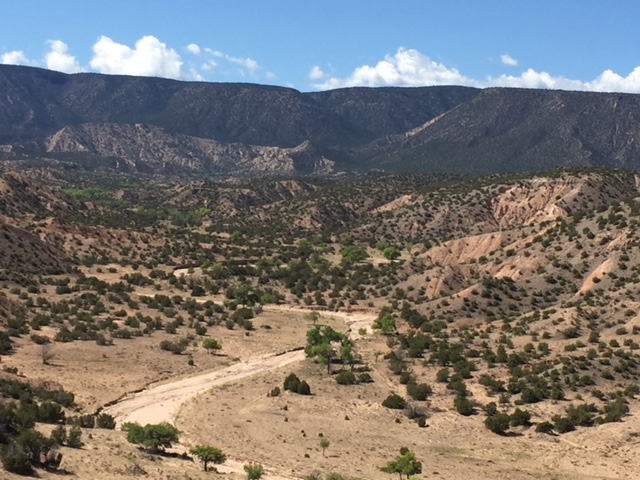
Sapawe is an ancestral Tewa Pueblo located outside of El Rito. Until this weekend I had never been to the ruin. I didn’t know, for example, that it was the largest ruin in New Mexico, and perhaps the entire Southwest or that during the period it was built and occupied (1300- 1500’s) that ten thousand people lived there. Estimates suggest that there were at least 1,800 ground rooms and twenty – three kivas. Walking around the huge compound is something I have yet to do. It was too hot for me to do more than take in the astonishing view or traverse a small part of the plateau, briefly. I did note that there were artifacts and planned to come back another time – soon.

Early yesterday morning I met with four other people to see the shrine that was located outside the pueblo. This was the place that secret ceremonies were held on behalf of all the people in the pueblo. On the surface all that could be seen was a large raised stone circle, but there was a sense of presencethere that felt both powerful and peaceful probably because few people knew about this shrine and the  natural power of place had not had a chance to dissipate. After having explored a couple of other Tewa ruins, I learned that it was very important to allow place to speak in its own time, and to allow that to happen I had to return again and again with an open heart, eyes that could see beyond the obvious, and an active inner ear … The land speaks to those that can listen.

Continue reading “The Grandfathers, part 1 by Sara Wright”
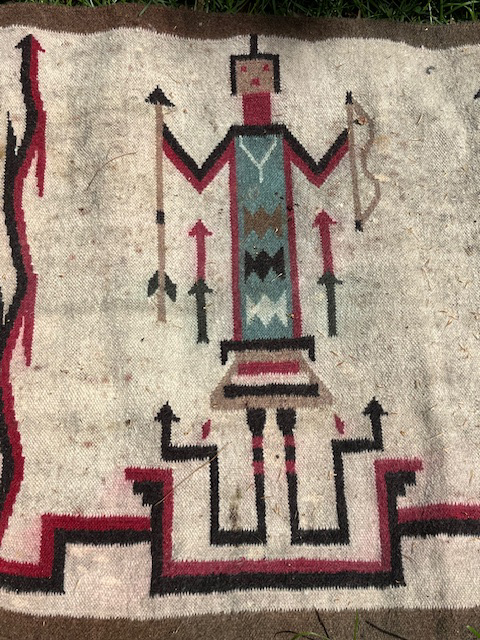
The Story of Changing Woman, part 1 by Sara Wright

Moderator’s comment: Sara wrote this in April, 2019. It has even more resonance today.

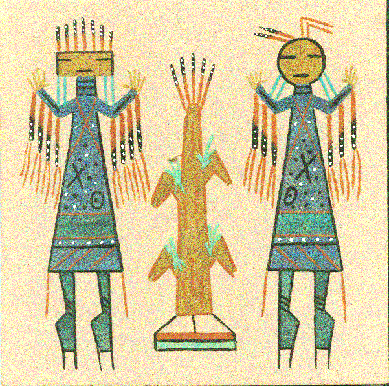
Changing Woman – who grows old and then young again. Navajo Sand Painting.

I want to begin by recounting the story of how Changing Woman came to be and why she was so important to Navajo mythology. In these dark and tumultuous times I think Changing Woman’s story has a deep resonance for all of humanity. We seem to have forgotten who we are and are in desperate need of guidance that will help shift our current paradigm.

The Navajo word Diné means the People (every Indigenous group defines its inhabitants by using the same word in their own language).

Continue reading “The Story of Changing Woman, part 1 by Sara Wright”

Elderberrying with the Yei by Sara Wright

Every year at the end of August I celebrate the Wild Harvest by gathering elderberries to make a medicinal tincture that I use all year long and share with close friends.

This gathering is a process that begins in the spring as I search for new bushes and then later blossoming elderberry flowers in old and new places. As the summer progresses, I continue to monitor the bushes searching for those with berries. Beginning in early August I am on alert for ripening. I am especially mindful because our weather is changing rapidly. If the trend of bad air, fog, and too many deluges continues unabated it’s probable that the times for harvesting berries may shift. In addition, many of the wild places that once supported elderberry bushes have been manicured to get rid of the wild plants by mowing them down, bulldozing the soil to remove all greenery, etc. The rape of wild nature has escalated with time. 

This year I have been especially fortunate because I found new clusters bursting out in places they weren’t before. I think the Elder – Berry Woman is helping me. Destroying these precious wild plants and their habitat means that a once common ancient Native plant remedy may be disappearing. Despite horticultural advertising our elderberry bushes do not do well in cultivation, if they survive at all.

Continue reading “Elderberrying with the Yei by Sara Wright”

Deep Time, Big Dream by Sara Wright

I am standing on top of a mountain looking over a landscape of unspeakable wild natural beauty that stretches as far as I can see. This is the ‘long view’ the dream -maker tells me. The trees are stretching out their lush green needles to the sky as if in prayer, and they are whole. The forests, clear waters, the animals, birds, insects, and All of Nature has been returned to a State of Grace.

An Old red skinned Indian Man appears. He is a Grandfather. He is on the mountain with me but also stands below (both and). He speaks to me.

 “Sit, listen, this is the Song of Life”.

 A finely crafted flowing red clay seat appears below (it flows like a wave) although it is situated a few inches above the earth. Almost hovering. I also see a drum made from deerskin and red clay on the ground. There is a four directional equilateral black cross on the skin of the drum. The cross is thick and around the cross an intricate design is etched/inked into its skin also highlighted in black.

Continue reading “Deep Time, Big Dream by Sara Wright”

The Feast of Santo Tomas by Sara Wright

This morning I went up to the village plaza in Abiquiu to watch the dancers parade around the church with their saint who is also honored at this village festival held every year at the end of November.

This is one of the two Native American festivals that is honored each year by the genizaros who are mixed Spanish and American Indian people who embrace and practice the Catholicism that was once forced upon them.

This eclectic community is made up of descendants of Native American slaves. Those captured in warfare were brought here, converted to Catholicism, taught Spanish and held in servitude by New Mexican families. The young women and female children endured the usual atrocities perpetuated on captive females including rape at the hands of their captors. Some New Mexican male genizaros gained their freedom by serving as soldiers to defend frontier villages like Abiquiu from Indian raids. By the late 1700s, genizaros comprised one-third of the population of New Mexico. Ultimately these non – tribal peoples were assimilated into New Mexican culture.

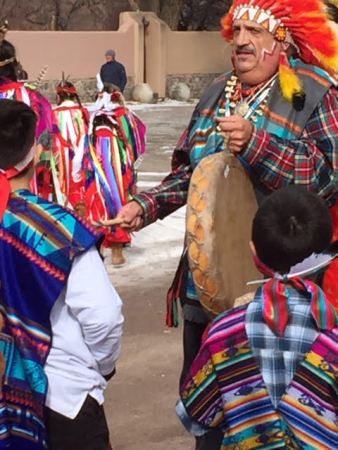
The dances are beautiful to witness with the smallest female children dressed in predominantly white regalia some wearing a rainbow of ribbons, the young girls were dressed in red and white and had red circles of war paint inscribed on their cheeks, some of the older women also wore red, many carried turkey or eagle feathers in their hands. Most wore face paint.

Continue reading “The Feast of Santo Tomas by Sara Wright”