Moving to Ursula: Dream Wisdom and the Sacred Feminine by Rabbi Jill Hammer, PhD

For the last seven years, I have been conducting research for my book Undertorah: An Earth-Based Kabbalah of Dreams, which is about to appear courtesy of Ayin Press.  On this writing journey, I’ve interviewed seventy dreamers, and have studied pre-modern dreams from texts of ancient Israel and ancient Sumer to dream accounts of women kabbalists and Chasidic masters.  I’ve also sat with my own dreams and their odd truths. Many of the dreams I’ve encountered express powerful visions of the feminine. I find these often odd and eerie visions particularly useful in expressing “the multiplicity of experiences of [the feminine]… rather than an imposed definition of those experiences…”[i]

Continue reading “Moving to Ursula: Dream Wisdom and the Sacred Feminine by Rabbi Jill Hammer, PhD”

Facing the Angel:  Samson’s Mother as a Model for Feminist Spiritual Practice by Jill Hammer

Dedicated to Kohenet Andrea Jacobson of blessed memory, a deep practitioner of priestess presence

I have always loved obscure biblical women.  My wife, who was educated in a yeshiva, marvels at the names and tales I mention to her; she’s never heard of them.  Telling their stories, for me, is a form of resistance.  They may be minor to the text, but to me they are main characters.  As a feminist midrashist, I love digging into a text to find out more, to discover a radical take, to imagine a first-person perspective.  As a contemporary spiritual teacher on the trail of the ancient priestesses, I find priestess role models in these hints of story.  As the Jewish holiday season ends and we return to finding the sacred in the mundane, I want to share about a character I love, who doesn’t even have a name, but who, to me, teaches about being present, and meeting the mystery wherever we go. 

“Manoah’s Sacrifice” by Rembrandt Harmensz. van Rijn 1641.( Source: Wikimedia Commons, public domain, PD-1923)

Judges 13 begins with a traditional biblical scene of annunciation.  The wife of Manoah does not have a child.  An angel appears to her to say that she will bear a son.  He must be a nazir or nazirite and will be a hero, delivering his people from their enemies. A nazir is a kind of self-appointed priest, who has taken a vow not to drink wine or cut one’s hair, and who, like the high priest of the Temple, is forbidden to be near dead human bodies.  Such a person’s hair is holy and, at the end of the nazirite service, will be offered on an altar.  Both men and women could be nazirites; indeed, the nazirite vow seems to be an avenue where women can become holy.  We can see there is patriarchal anxiety about this avenue to priestesshood; Numbers 30 is full of laws about how fathers and husbands can annul the vows of daughters and wives, which likely is partly concerned about women becoming nezirot (sing. nezirah) of their own volition.

Continue reading “Facing the Angel:  Samson’s Mother as a Model for Feminist Spiritual Practice by Jill Hammer”

Becoming the Mother: A Dream Journey to the Sacred Feminine by Jill Hammer

This essay is dedicated to the memory of Carol P. Christ, scholar of the Goddess, who has brought so much wisdom and liberation to our world, and whom I deeply admired. May her memory be a blessing.

The call of the Divine Mother has compelled me for most of my life. I have scoured kabbalistic works for visions of God/dess as Mother, Womb, Protectress, Home of Being. I’ve gone on treasure hunts through museums to find paintings of the Annunciation and statues of birthing goddesses. I’ve written poems to the Mother Goddess of my imagination. Experiencing Deity as creatrix and nurturer moves me. But when I had a daughter of my own, becoming the Mother in an immediate sense proved to be more difficult than revering Her from afar. I couldn’t fully internalize that I had stepped into the sacred role of parent, even after I became one. I know this is true because of my dreams.

Not long after my daughter was born more than a decade ago, I began to have disturbing dreams. In the first of these dreams, I dropped my infant daughter by mistake into water that had flooded the area around my home. She disappeared without a trace into the deep water. I begged for help finding her, but no one would help me. Soon I realized she must be dead. I woke up terrified and sobbing. In another dream, I realized no one was watching my daughter and she must have fallen into the nearby lake. In a third dream, a huge flood came into my house and carried her away.

Continue reading “Becoming the Mother: A Dream Journey to the Sacred Feminine by Jill Hammer”

Fragments of Sinai by Jill Hammer


Every year on Shavuot, the story of the giving of the Torah at Mount Sinai is read in synagogues around the world. It’s a dramatic story, with thunder and lightning and mysterious ram’s horns blasting, and Moses disappearing into a thick cloud.  It’s a powerful story.  It’s also a problematic story, for me.  As a feminist, ascribing divinity to an ancient text with a vision of women/gender that is very far from my own doesn’t work for me.  And yet, as a scholar and midrashist who often plays with the words of the biblical text, I do meet God/dess and my ancestors there.  I’m moved by the ancient legend that all Jewish souls, of every time and place, were present to receive Torah at Sinai.  How to express this layered and complex relationship with Torah?

The Kohenet Hebrew Priestess Institute has been holding Shabbat prayer online since the pandemic began, and we gathered on Shavuot morning to pray.  As a community committed to the liberation of all genders, I felt we couldn’t read the Torah portion the way it was—but I also felt we couldn’t not read it.  So I created an aliyah—a Torah reading—composed of fragments of the text.  Three of us read it together; I chanted the Hebrew, and Kohenet Ketzirah Lesser and Kohenet Harriette Wimms and I read the English.  I picked fragments of the text that spoke to me in some way.

Continue reading “Fragments of Sinai by Jill Hammer”

Reflections on Miriam’s Cup by Rabbi Jill Hammer


For many years, I’ve had a Miriam’s Cup on my Passover seder table, next to the Cup of Elijah. Our cup of Elijah is a kiddush cup belonging to my great-grandfather Joseph Frankel and inscribed with his name. Our cup of Miriam was created by a ceramic artist and bears the word “Miriam” at its base. The Cup of Elijah, filled with wine, is an old tradition—a cup on the seder table for the prophet Elijah, who according to legend visits every Passover seder. The cup of Miriam, filled with water, is a custom only a few decades old, honoring the prophetess Miriam, who watched over the infant Moses, danced in celebration at the crossing of the Sea, and who according to a famous ancient tale had a well of water that followed her through the wilderness.

According to scholar Annette Boeckler, the custom of the Cup of Miriam began at a Shabbat table in Boston in 1989, made its way to the post-Sabbath Havdalah ceremony, and eventually found its way to the seder table. The custom was intended to honor the prophetess Miriam as well as the contributions of women to the Exodus and to Jewish life. Many of the heroes early in the book of Exodus are women, yet their stories are not part of the seder. The Miriam’s Cup at the seder is a way to give the participants an opportunity to include those stories. Continue reading “Reflections on Miriam’s Cup by Rabbi Jill Hammer”

Was Sefer Yetzirah Written by a Woman? Jill Hammer


This year, I published a book called Return to the Place: The Magic, Meditation, and Mystery of Sefer Yetzirah (available from Ben Yehuda Press, benyehudapress.com).  Sefer Yetzirah, or the Book of Creation, is an ancient Jewish mystical work (written in approximately the sixth century CE, though scholars offer dates from as early as the 1st century CE to as late as the 9th century).  This brief, cryptic, poetic book describes the process by which God creates the universe.  God engraves letters, which are also the elements and fundamental forms of being, into the cosmos.  These engraved letters act like energetic channels between the Creator and the Creation, allowing creative intention to flow from the One to the Many.  The book instructs the mystical practitioner to develop awareness of this creative process and seek to embody it, thus allowing energy to flow back from the Many to the One.

This flowing between One and Many is called retzo vashov, running and returning—the constant ebb and flow between unity and multiplicity.  Sefer Yetzirah says of the elements that “God’s word in them is running and returning.”  This means that the divine intention moves within creation, and the elements shape themselves in response to this intention.  In Sefer Yetzirah, as in most Jewish texts, the Creator takes a male pronoun.  However, the elements—water, air, and fire, since the book has a three-element system rather than the more common four elements— all have female pronouns.  These three elements, often identified with the Hebrew letters Aleph, Mem, and Shin, are sometimes known within the text of the book as the three mothers.  And, God’s breath or spirit, the ruach elohim chayyim or breath of the living God, which gives rise to all the other elements, also take female pronouns.  Not only that, but Wisdom, the feminine entity who is the sum total of all the engraved pathways between God and the world, is also feminine.  We can say with certainty that the text gives the feminine unusual primacy, compared with other Jewish texts of the time.  We also don’t see in this text any of the misogyny that is common in ancient texts of this time period. Continue reading “Was Sefer Yetzirah Written by a Woman? Jill Hammer”

Hagar, the Divine Witness, and the New Year by Jill Hammer

The Torah reading for the first day of Rosh haShanah, the Jewish new year, is not, as one might expect, the creation of the world (Rosh haShanah was Friday night, Saturday and Sunday, 9/18-9/20).  Instead, the set reading is Genesis 21, the story of how Sarah, wife of Abraham, gives birth to Isaac—a joyous occasion indeed, given that she is ninety years old.  But then Sarah becomes anxious that her husband’s other wife, Hagar, also has a son, Ishmael, who could inherit from Abraham, and demands that Hagar and Ishmael be expelled from the household.  This year, reading this tale, I am seeing a story that shows how when we think about success, abundance, and consequences, we include some people in our consideration but not others. In this tale, the Divine includes the perspectives of the unwitnessed even when we do not.

In Genesis 16, it is Sarah (originally called Sarai) who first arranges a sexual relationship between Hagar, an Egyptian woman enslaved to her, and her husband Avraham, who has been called by God to create a new nation.  God has promised her husband Avraham a great posterity, but they do not have even one child.  Sarah gives Hagar to Avraham in order to produce an heir (no consent on Hagar’s part is recorded). When Hagar becomes pregnant, the text suggests that Sarah has become “light” or “diminished” in Hagar’s eyes.  In other words, Hagar no longer treats Sarah as her owner.  Sarah complains to Avraham, and Abraham gives Sarah permission to do whatever she wants with Hagar.  Sarah abuses Hagar, and Hagar runs away. An angel arrives while Hagar is sitting by a well, and directs Hagar to return, for she is to give birth to a child who will give rise to uncountable numbers of offspring.  During this encounter, Hagar gives God a name: El Ro’I, the God who sees me. Continue reading “Hagar, the Divine Witness, and the New Year by Jill Hammer”

Eve, Revisited by Jill Hammer

About six months ago I was hired to write a curriculum for a Jewish organization on biblical women in ancient and contemporary midrash.  Midrash—the ancient process of creative interpretation of sacred text that began two thousand years ago and continues to this day—has been one of my fields of expertise, and women in midrash is a particular specialty.  I knew the first lesson I wrote would be on Eve (Chava in Hebrew), the first woman of Genesis.  Yet as I began to write lessons, I started with Sarah and Hagar, then proceeded to Rebekah and Lot’s wife, Rachel and Leah, even Asnat (Joseph’s wife) and Naamah (Noah’s wife).  It became clear over the months that I was avoiding Eve.  Whenever I began to think about beginning “her” lesson, I grew anxious and immediately began to think of something else. Only when I had already written six of my ten lessons did I finally, reluctantly, begin to research ancient legends and modern feminist poems on the first foremother of the Bible.

Why was I avoiding Eve?  In part, because she seemed like such a huge topic.  Generations of Jews (and, of course, Christians) have had a great deal to say about Eve, her creation, the fruit of knowledge, the serpent, Eve’s relationship with Adam, and more.  How would I encapsulate it all?   And then there was Lilith, Eve’s alter ego, and all of the legends about her.  Choosing a handful of midrashim out of this vast corpus seemed impossible.  Plus, there was a whole literature about the relationship between Eve and ancient Near Eastern myth I wanted to allude to—Eve as a kind of human version of the Goddess with her Tree.  How to choose what to put in and what to leave out? Continue reading “Eve, Revisited by Jill Hammer”

Ruth the Priestess: Redemption and the Returning Grain by Jill Hammer

I spend a lot of time on Zoom these days and my current life in New York City is not tremendously familiar to me.  Home schooling, uncertainty about work, and concern for relatives are all part of my world right now. So I’ve been keeping myself sane, between the various kinds of curve balls thrown by social distancing, by walking in the park.  I now know when everything comes into season. I’ve watched the cherry blossoms bloom and the wisteria flower and the magnolia petals fall.  In this time, I’ve become more in tune with the piece of land I live on and its cycles.  And that helps me tune in to the mysteries of the Book of Ruth.

The Jewish holiday of Shavuot, first fruits festival and season of the giving of Torah, begins this Thursday night.  It is a custom that during this holiday, Jews read the story of the giving of the Ten Commandments on Mount Sinai.  And, there is also another story read: the book of Ruth.  The book of Ruth tells of a family who finds support and shelter at the time of the grain harvest, and Shavuot is a grain harvest festival.  The book of Ruth also describes the journey of Ruth to join the Israelite people, and so it is often understood as a conversion story.  The reason I love to read the Book of Ruth at this time is because I understand this story to have undercurrents out of Near Eastern myth—the joining of a priestess and a king, and the return from death to life.  While Ruth is usually seen as a devoted daughter-in-law, a feminist analysis might see her as the engine for redemption. Continue reading “Ruth the Priestess: Redemption and the Returning Grain by Jill Hammer”

A Jewish Amulet against Plague by Jill Hammer

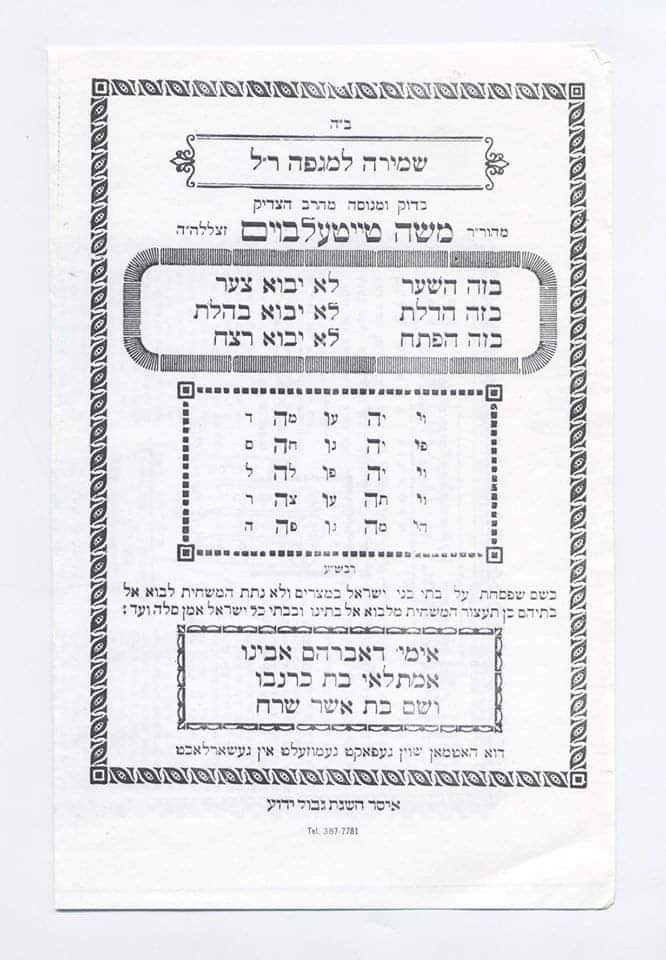
image of amulet originally by Rabbi Moshe Teitelbaum (1759-1841)
originally by Rabbi Moshe Teitelbaum (1759-1841)

 I begin with prayers and wishes for all who are suffering because of the COVID-19 epidemic: those who are ill, those who are mourning people who have died, those who face economic hardship, and all who are afraid.  May we find ways to support and comfort one another.

This 19th century printed amulet against cholera, which was widely disseminated through the Jewish community at the time, was written by Moshe Teitelbaum.  Part of it has become a common “house blessing” in Jewish homes Several friends, including Rabbi Jay Michaelson and Rabbi Amichai Lau-Lavie, posted the amulet on Facebook when the coronavirus epidemic began to take hold in the US.  I immediately recognized it because I had been to Paris with my family and gone to a wonderful amulet exhibit at the Museum of Jewish Art and History, and this amulet was prominently displayed.  In a time of 21st century plague, as we seek shelter, protection, and mutual care, the amulet seems newly and profoundly relevant. Continue reading “A Jewish Amulet against Plague by Jill Hammer”