Why Celebrating the 9th Anniversary of the Goddess Feminist Activist Spirituality Movement? (Part 2) by Helen Hye-Sook Hwang

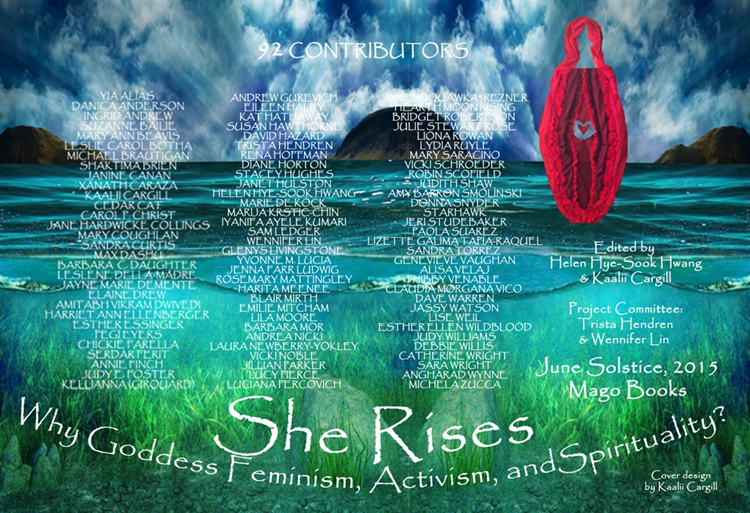
As I noted in Part 1, this year marks the 9th anniversary of the first volume of She Rises trilogy, a collective writing project, which was first published in 2015 by Mago Books. Entitled Why Goddess Feminism, Activism and Spirituality?, the 93 contributors trumpeted the onset of the Goddess Feminist Activist Spirituality. It was followed by the second volume​, How… Goddess Feminism, Activism, and Spirituality?, with 96 contributors, in the following year, and the third one, What… Goddess Feminism, Activism, and Spirituality?, in 2019.​ The 9th anniversary of the first volume provided a new momentum for all contributors of the trilogy to come together as a virtual group, which we named “She Rises…” This group allows the authors of all three volumes to gather together for the first time, while inviting newcomers from outside the She Rises trilogy.

Continue reading “Why Celebrating the 9th Anniversary of the Goddess Feminist Activist Spirituality Movement? (Part 2) by Helen Hye-Sook Hwang”

How we Began the Movement of Goddess Feminist Activist Spirituality in the 21st Century (Part 1) by Helen Hye-Sook Hwang

Mago is an East Asian/Korean word for the Cosmic Mother or the Creatrix. This piece is written as the first of a four-part essay. In this series I am surveying the past 9 years of The Mago Work (A collective effort to restore the consciousness of Mago, the Creatrix), which birthed the Movement of Goddess Feminist Activist Spirituality, while being shaped by the latter.

Continue reading “How we Began the Movement of Goddess Feminist Activist Spirituality in the 21st Century (Part 1) by Helen Hye-Sook Hwang”

The Mago Hedge School: Why Remember Mary Daly? By Helen Hye Sook Hwang

Prologue

By writing this, I do not intend to defend Mary Daly’s position in any dispute. A controversial figure, Mary Daly never let go of her fight with those whom she thought on the other side of her feminist war. Like anyone else in history, Mary Daly belonged to her time and culture, and I leave her unresolved issues up to her. What I write here is my fond memory of her, whose feminist thought left an indelible mark on my being as well as humanity as a whole. Daly’s contribution remains to be reassessed from the fresh eye of new generations. In the meantime, I begin to speak for my part. Without Mary Daly’s thought, I would not have been in this place where I stand right now. It has empowered me to actualize my dreams to the fullest as a wo/man who was born and raised in Korea but had come from the One Home in origin.

I first hear of the hedge school
“Have you heard of the hedge school, Hye Sook?” asked Mary. “No, I haven’t heard of it,” I answered. This conversation took place during the conference called the Feminist Hullaballoo held in Santa Fe, New Mexico in 2007. We met there and spent three days as chums. Mary was with another friend, Yvonne Johnson, so the three of us hung out together. It was a very special time for me – I felt as if I were wrapped up in the eye of the storm. (In fact, my life feels so.) At the conference, someone asked me how I came to be invited as a featured speaker. I was among such renowned feminist speakers as Sonia Johnson, Paula Gunn Allen, and Mary Daly herself. They felt like giants to me. I told her that Mary Daly invited me. Mary had asked me if I would like to go and speak at that conference. I did not have an inflated ego. I would not have been hurt if I were not chosen. But I said “Yes” without hesitation. At the time, it felt like another one of the many “outlandish” adventures that I had undertaken throughout my life. In retrospect, however, this was a very special “Yes” to the beginning of my life’s new phase.   Continue reading “The Mago Hedge School: Why Remember Mary Daly? By Helen Hye Sook Hwang”

A Cross-Cultural Feminist Alchemy: Studying Mago, Pan-East Asian Great Goddess, Using Mary Daly’s Radical Feminism as Springboard by Helen Hye-Sook Hwang

Feminist theology was self-transcending to me. I was unafraid of going beyond the boundary of Christianity and its God. 

Mago is the Great Goddess of East Asia and in particular Korea. Reconstructing Magoism, the cultural and historical context of East Asia that venerated Mago as the supreme divine, is both the means and the end. Magoism demonstrates the derivative nature of East Asian religions such as Daoism, Buddhism, and Confucianism while redefining East Asian Shamanism to be the religious expression of Magoism.

I encountered the topic of Mago during my doctoral studies. The topic of Mago fell out of nowhere at the time I was preparing for qualifying examinations. I had never heard the name, Mago. Only when I was able to collect a large amount of primary sources from Korea, China, and Japan, was I awakened to the cultural memory of Mago. I grew up craving the stories of Halmi (Grandmother/Great Mother), a common referral to Mago among Koreans. I had a childhood experience of being in the fairy land unfolded by my grandmother’s old stories. While “Mago” was unfamiliar to most Koreans, she was taken for granted in her many other names such as Samsin (the Triad Deity) and Nogo (Old Goddess) and place-names such as Nogo-san (Old Goddess Mountain) and Nogo-dang (Old Goddess Shrine). Continue reading “A Cross-Cultural Feminist Alchemy: Studying Mago, Pan-East Asian Great Goddess, Using Mary Daly’s Radical Feminism as Springboard by Helen Hye-Sook Hwang”