Two Poems: Crucifixion and Renewal by Sara Wright

(The Mark of the Bear is Upon Her)

CRUCIFIXION

Part I

She listens
to those
who intone
Betrayal
break hearts
open

love
pours golden
honey
healing
blood
soaked
wounds

truth
often
lies hidden
deep
beneath
kindly words

torment
tears holes
in fragile
skin

without
closure

Continue reading “Two Poems: Crucifixion and Renewal by Sara Wright”

The Story of Changing Woman, part 2 by Sara Wright

Part 1 was posted December 7th. You can read it here.

Commentary:

I love this story because it demonstrates the evolutionary and eternal nature of Woman; her intimate relationship to Nature, her ability to give birth, to mother, to let go, her ability to endure, her need for animals and plants as companions and her willingness to stand her ground until she is able to get what she needs. Changing Woman matures from a passive figure who is acted upon by the forces of Nature into a self-directed female power who knows what she wants, and one who finds peace in choosing relationships with animals, plants and humans on her own terms.

Initially, Changing Woman is impregnated by the wind – the power of the spirit moving across the land – and not through sexual intercourse. Spirit and the Body of the Earth are the two equally creative aspects involved in her birth. The same holds true for her children, who are male, but conceived and birthed in a similar manner without the need for male insemination (no room for Patriarchy to enter here), suggesting to me that all three are parts of one spiritual/bodily whole that cannot be separated. As creative principles (beyond gender stereotypes) they work together as a triad to rid the world of monsters, to make the Navajo world a safe place, and to secure the matrilineal line. According to Navajo mythology securing the matrilineal line is primarily how Changing Woman saves the world.

Continue reading “The Story of Changing Woman, part 2 by Sara Wright”

The Story of Changing Woman, part 1 by Sara Wright

Moderator’s comment: Sara wrote this in April, 2019. It has even more resonance today.

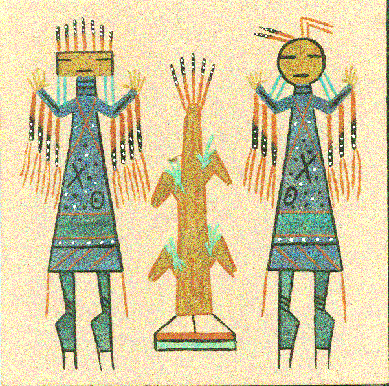
Changing Woman – who grows old and then young again. Navajo Sand Painting.

I want to begin by recounting the story of how Changing Woman came to be and why she was so important to Navajo mythology. In these dark and tumultuous times I think Changing Woman’s story has a deep resonance for all of humanity. We seem to have forgotten who we are and are in desperate need of guidance that will help shift our current paradigm.

The Navajo word Diné means the People (every Indigenous group defines its inhabitants by using the same word in their own language).

Continue reading “The Story of Changing Woman, part 1 by Sara Wright”

The Navajo Mountain: A Feminist Perspective Chant by Sarah Wright

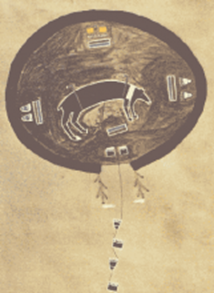
Mountain Chant image
Frighten Him On It – Sand painting used in the Mountain Chant, circa 1907″ by E.S. Curtis

Like the Navajo Night Chant celebrated at winter solstice the Navajo Mountain Chant is the last important winter ceremony, one that marks the shift in seasons and the return of the light. The Mountain Chant was once nine days in duration; today it has apparently been shortened to a four – day ceremony. It is celebrated in early February and each night different holy songs are sung.

The Mountain Chant is also a very complex healing series of ceremonies. Elaborate sand paintings are created and then destroyed after each healing. Disease may be diagnosed by either a woman or a man, but a Medicine man always leads the ceremonies. The intention is to cure a person of the disharmony that is creating the illness. The ceremonies are also enacted to pray to the holy people (Yei) for rain, and to receive assistance with the crops, and most importantly they are done to restore balance and harmony between the People and nature. Continue reading “The Navajo Mountain: A Feminist Perspective Chant by Sarah Wright”