
Legacy of Carol P. Christ: Tree-Hugging Is About Trees and So Much More Than Trees

This was originally posted March 11, 2019

Not too long ago I heard someone deride members of a seminar who were building labyrinths in the olive groves of Greece as “a bunch of tree-huggers.”  I bristled! I probably first heard of the Chipko tree-hugging movement which is led by women in the 1970s and 1980s. Because I love nature, I naturally assumed hugging trees is a good thing. Originally, I had no idea that the tree-hugging movement was about much more than saving trees from being felled in the interests of short-term profit.

I did not know that the deeper purpose of the movement is to save a way of life based on forest-culture that is being threatened by the imposition of western ideas and practices promoted by colonialism and its successor, the green revolution. Nor did I know that the traditional forest-culture of India is the provenance of women: more than 4000 years of observing and experimenting created a “women’s knowledge” passed down from mother to daughter.

Continue reading “Legacy of Carol P. Christ: Tree-Hugging Is About Trees and So Much More Than Trees”

Tree-Hugging Is About Trees and So Much More Than Trees by Carol P. Christ

Not too long ago I heard someone deride members of a seminar who were building labyrinths in the olive groves of Greece as “a bunch of tree-huggers.”  I bristled! I probably first heard of the Chipko tree-hugging movement which is led by women in the 1970s and 1980s. Because I love nature, I naturally assumed hugging trees is a good thing. Originally, I had no idea that the tree-hugging movement was about much more than saving trees from being felled in the interests of short-term profit.

I did not know that the deeper purpose of the movement is to save a way of life based on forest-culture that is being threatened by the imposition of western ideas and practices promoted by colonialism and its successor, the green revolution. Nor did I know that the traditional forest-culture of India is the provenance of women: more than 4000 years of observing and experimenting created a “women’s knowledge” passed down from mother to daughter. Continue reading “Tree-Hugging Is About Trees and So Much More Than Trees by Carol P. Christ”

And Then There Was Sita by Vibha Shetiya

VibaWe have been hearing a lot about Kali and Durga lately, manifestations of the great goddess (“Kali Ma,” by Jassy Watson, July 3; “What Would Durga Do?” by Barbara Ardinger, August 2). Nancy Vedder-Shults’ three-part series on Kali (August-October, 2014) too helped shed light on an often misunderstood deity. Both Kali and Durga personify the power or shakti within women, a force that can be empowering and terrifying at once. Kali represents uncontrolled female energy, whereas Durga is portrayed as one in control of her abundant power. These images, especially the one of Kali are double-edged; they can prove problematic for women insofar as – from the male perspective – they confirm the fact that women possess an alarming energy, especially a sexual one, which in turn justifies the need for men to subdue them.
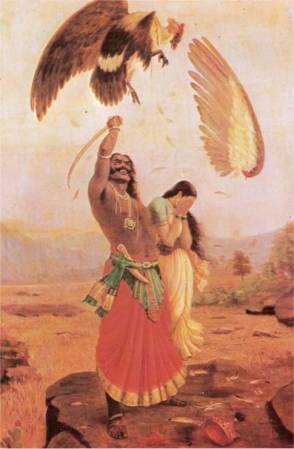
Sita's abduction by Ravana. Artist: Raja Ravi Verma
Sita’s abduction by Ravana. Artist: Raja Ravi Verma

Within this context, I would like to talk about Sita, who, one could argue, is the antithesis of the two. Sita is the gentle wife of Lord Rama, hero of the Ramayana, a two-thousand year old Sanskrit epic. In the Ramayana, Rama, the crown-prince of Ayodhya, is exiled to the forest for fourteen years. His loyal and faithful wife, the princess and goddess Sita, insists on accompanying him to the wilderness. There, the demon king, Ravana kidnaps her leading to a battle between Rama and Ravana. Almost a year and thousands of casualties later, Rama succeeds in slaying Ravana and reclaiming Sita.

But alas, Rama rejects his wife in the presence of the hundreds of onlookers, eagerly awaiting the reunion of the couple, on the grounds that her chastity was suspect; after all, says Rama, surely Ravana couldn’t have resisted her ravishing beauty? If she is to be worthy of Rama, Sita has to undergo a trial by fire to prove that she had indeed remained chaste throughout her captivity. Although she passes with flying colors, Rama eventually gives in to gossip and banishes her to the wilderness a few years later – while she is pregnant with his twins – where she is left to die (she, however, does not). Continue reading “And Then There Was Sita by Vibha Shetiya”