

This was originally posted on October 12, 2014
I still remember the first time I read Mary Daly’s Gyn/Ecology. It awoke something within me. Her use of language, the power of her writing and the ease with which she created new words taught me so much about the world around me and about the way the language, and subsequently its use in writing, shapes lives, choices, abilities and destinies. She also taught me about myself.
I was hooked, but not just on Mary Daly. Shortly after I finished her book, I moved onto other feminists writing about religion like Katie Cannon, Judith Plaskow, Alice Walker, Carol Christ, Rita Gross, Gloria Anzaldua, Audre Lorde, Adrienne Rich, Margaret Farley and Starhawk to name just a few. All of them, in fact every feminist I’ve ever read, has shown me the way in which words have power and how words speak truth to power. Ever since, I’ve wanted to be the kind of writer whose words carry a power that not only affects people but also inspires a more just, more equal, more compassionate and more humane world. In other words, I wanted to be a writer activist.
Continue reading “From the Archives: Writing: Changing the World and Ourselves. By Ivy Helman” I was asked by my sculpture teacher to make a monument. “A monument to what,” I asked? “Anything,” he answered. The only parameter seemed to be that the work was produced in wood. Having seen some interesting stone and marbleizing paints, I had the immediate idea to transform the wood into a marble-like appearance. Marble, for some reason, probably because it is the cemetery standard, seemed like the right medium for a monument to me.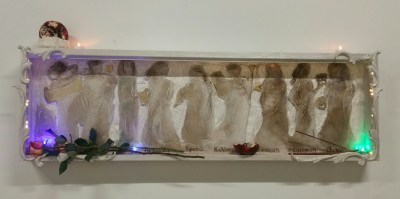
 Feminism and Religion