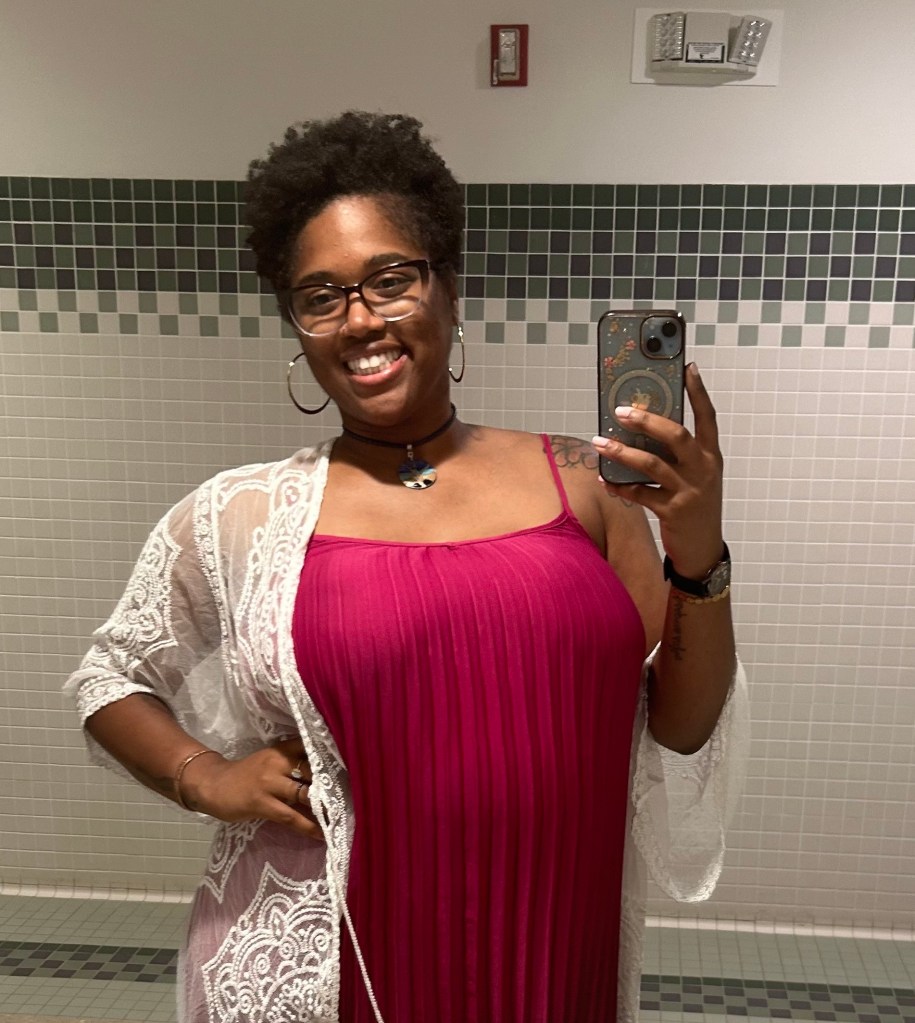
Mother Blues: Interfaith Somatic Reflections on Support Systems, Chronic Pain, Tension Relief, and Supporting Oneself by Chaz J

I have had a weird relationship with my stomach or core BEFORE birth. 

My back has been hurting since giving birth.

I’ve carried fragments of my birth story like heirlooms,
passed down in murmurs from my mother and family.
They say she went into labor at home,
a warm plate of food in her hands,
My aunt Akami recalls she refused to leave for the hospital
until every bite was finished.

I came into the world under sudden urgency—
an emergency C-section,
my first act a quiet rebellion:
I had soiled the waters before taking my first breath.

My mother remembers it in a haze,
“I was pregnant, went to sleep…
when I woke up, there was a baby in the corner.”

I do not know if every detail is true,
but the outline fits—
the origin of a loneliness that has followed me
like a shadow that never unhooks from the heel.

Continue reading “Mother Blues: Interfaith Somatic Reflections on Support Systems, Chronic Pain, Tension Relief, and Supporting Oneself by Chaz J”

Bake the Damn Cake: Owning Up to and Mitigating Our Traditions’ Trauma Histories by Chris Ash

Christy at the beach

“We have learned that trauma is not just an event
that took place sometime in the past;
it is also the imprint left by that experience
on mind, brain, and body.
This imprint has ongoing consequences
for how the human organism
manages to survive in the present.”
— Bessel A. van der Kolk, The Body Keeps the Score: Brain, Mind, and Body in the Healing of Trauma

While I’m not a trauma therapist, I work in a field in which I regularly support people who have experienced trauma. Sometimes I’m accompanying a recent survivor of assault at the emergency room for a rape kit, speaking warmly, offering compassion, providing distraction. Other times, I’m holding space over the phone while a fifty-something year old survivor tearfully discloses, for the first time in her life, the things done to her during childhood. Recent or old, those experiences shape us and our responses to them, even those that might not serve our health, are efforts to protect ourselves, to avoid pain, and to seek an elusive sense of safety.

“Trauma isn’t what happened to us.
Trauma is what happened inside us as a result of what happened to us.”
— Gabor Mate, in his presentation “Addressing the Long-Term Effects of Childhood Trauma”
during the Healing Trauma Summit

Our attempts to resolve trauma, to escape it, may be labeled dysfunctional and may not, ultimately, serve our highest good. They are, however, the actions of someone who wants to feel secure, who wants to feel loved.

My desire to understand trauma and trauma recovery serves my professional development as well as my personal journey, and learning more about the how trauma relates to the body has proven helpful in both of these areas of my life. I’m not a mental health clinician — I’m a crisis advocate and consent educator. But the process, as I understand it, is something like this: Continue reading “Bake the Damn Cake: Owning Up to and Mitigating Our Traditions’ Trauma Histories by Chris Ash”

Broken Mirrors, Broken Bodies, and Sophia Wisdom by Angela Yarber

angelaFreshly cleansed, I stood naked in front of a foggy full-length mirror. I had just taken my first hot, indoor shower in nearly two months. I’ve been volunteering in a National Forest all summer with my wife and toddler; it is stunningly beautiful. While there is a lake for bathing, we have no access to running water and there are certainly no mirrors hanging from the birch trees. Sure, I can catch a glimpse of myself in the rearview mirror of my car, but this was the first time I saw all of me—sun-kissed and mosquito-bitten—in a while. This may not seem like a big deal, and I didn’t think it would be, but the absence of mirrors has had a profoundly holy impact on me this summer.

As the dirt of two months swirled down the drain and I savored every drop of warm water pouring endlessly over my aching body, I thought about the mirror that awaited me. I thought about how it has been almost 15 years since I’ve intentionally starved myself or shoved my finger down my throat to induce calorie-purging vomiting. I thought about how I weigh thirty pounds more than I did during the nadir of my eating disorder. I thought about how much grace I’ve offered my body over these years. The grace to grow. The grace to age. The grace to gain. The grace to work hard. The grace to accept.

I thought about the tremendous privilege my body carries: the privilege of my whiteness, the privilege of being temporarily able-bodied, thin privilege. I thought about how my white body has never feared for her life when pulled over for a traffic violation. I thought about how my body has access to do whatever she wants—climb stairs into inaccessible buildings, or mountains to stunning vistas. I thought about how I can find clothing in my size in virtually any store, how no one offers me health advice when ordering at a restaurant, or diminishes my concerns at the doctor’s office based on my size. I thought about racism, ableism, and fatphobia. I thought about what it means to be a queer femme body. Continue reading “Broken Mirrors, Broken Bodies, and Sophia Wisdom by Angela Yarber”

Feeling it in Bones & Water: Practicing Somatic Spirituality

Kate BrunnerThere is a phrase I’ve heard here and there while living in Australia that I love for the sense that it evokes– “I can feel it in my water.” The usage is similar to the American phrase to “feel it in my bones.” It is that sense of knowing through the body that something is happening or about to happen. There are different explanations that posit to what “water” the phrase refers. I’ve been told it means urine in the bladder or it refers to the fact that the human body is truly mostly water. But, admittedly, my favorite explanation is that it points to the water of the womb. People of all shapes and sorts may use the phrase. But to date, I’ve only ever heard it from women, which gives some anecdotal credence to the womb theory. Any way you look at it, if you feel it in your water or your bones, you are connecting with the deep wisdom of the body.

I feel this somatic wisdom, this feeling of the bones & water, is something, as a group of modern Western cultures, we do not engage as often as we could. We have a tendency to see the body as a means to an end. It gets us from one place to another, yes. But it also seems so high maintenance some times. If only we didn’t have to sleep so much, or eat & drink at regular intervals, we could get more done. If only we didn’t get sick. If only we didn’t have to take time out of our busy lives to exercise & stay healthy. If only our bodies would get with the program, so our minds and spirits could achieve their lofty goals and be even more productive. For women, this is further compounded by layer after layer of patriarchal programming about what we should or should not do with said body. We have national debates in the public forum over and over again pertaining to this. We struggle in private with the intimate relationship between body & other parts of self. Continue reading “Feeling it in Bones & Water: Practicing Somatic Spirituality”