This was originally posted on Feb. 6, 2012 with updates added later.
I believe that we should we care about birds because it is right to do so. If we do not, we will contribute to extinction of species, and we will leave a diminished world to those who come after us. We must not give up hope that we can save the world for birds, for other wildlife, and for our children’s children.
On February 2, 2012, the International Day for Wetlands, the Greek government signed into law a Presidental Directive mandating protection of the small wetlands of the Greek islands. There is no assurance that this law will be enforced. There are still no measures in effect to protect most of the larger wetlands in Greece, even though this is required by the European law Natura 2000, which requires all of the countries in the European Union to protect bird and wildlife habitats.
When I became a birdwatcher, I could not have told you what a wetland is. Now I know that wetlands are fragile bodies of water shallow enough for wading birds from flamingoes to sandpipers to stand in “without getting their bottoms wet” while feeding on shrimp, small fish, frogs, and other watery treats. Wetlands often take the form of pools near the sea, but they also include the deltas at river mouths and seasonally flooded fields. In the twentieth century and today many wetlands were designated “swamps” and drained.
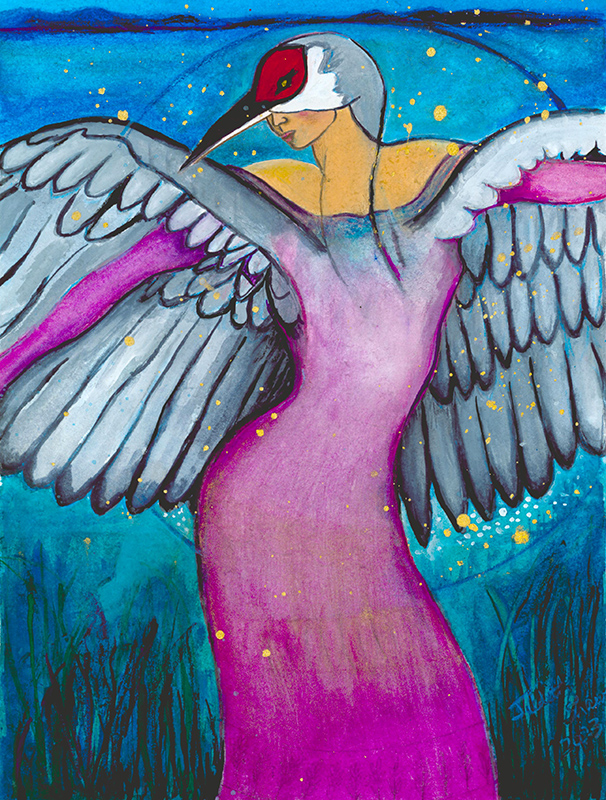
People think that goddesses only came into being long, long ago. People think goddesses are only found in ancient mythology. But people are wrong. I know because I am Aviana, the Wetlands Crane Goddess who helped create the Bosque del Apache Wildlife Reserve of New Mexico. I first manifest on Earth as an Otherworldly force in the early 1900s. It was the migrating birds and waterfowl, in particular sandhill cranes, who called me into being.
You see before Euro-Americans arrived in the land of the American Southwest, the Rio Grande was a mighty river which flooded every year bringing life and renewal to the land. These wetlands were a favorite wintering habitat of the Sandhill Cranes. They left their summer nesting grounds of Alaska, Canada and the northern United States and headed south for the winter. Every year in November hundreds of thousand of cranes arrived in New Mexico. Here they fed on grasses and small animals throughout the short winter days.
On February 20, 2018, the Greek government issued a Presidential Decree mandating the formation of government bodies to monitor and protect the more than four hundred bird and wildlife habitats in Greece designated as part of the European law Natura 2000. This decision came after decades of government inaction regarding the enforcement of the Natura law it accepted as part of its entrance into the European Union.
Whether the Presidential Decree will result in protection on the ground remains to be seen, but it is an important step in the right direction. The Presidential Decree was issued after years of negotiations initiated by the European Commission to compel the Greek government to comply with the law. A Complaint to the European Commission regarding failure to protect the Natura wetlands of Lesbos on which I was the first author formed part of the basis of these negotiations.
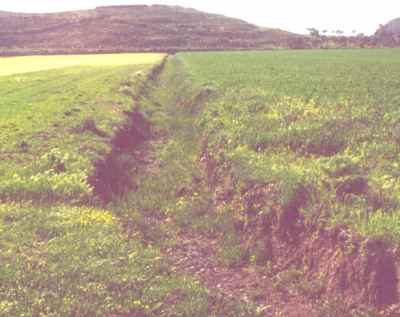
a ditch drains a wetland to produce agricultural land
Almost as soon as I became a birdwatcher in 1999, I began to notice the degradation of bird habitats by dumping, drainage, and building, especially in wetland areas. Wetlands are seasonal bodies of water created by winter rains that dry out in the summer heat. Generally, they are shallow, which means that they are a perfect stopping over place for migrating birds. The most common visitors to wetlands are wading birds that stand in shallow pools and puddles without immersing their bodies in the water. Lesbos, the island where I began to watch birds, has some of the most important wetlands in Europe, visited by birds migrating from Africa to Europe in the spring for rest and feeding. Because of this, Lesbos is also a destination for birdwatchers.
Wetlands are not only important for birds. In rainy periods they act as a sponge between rivers and the sea and dry land, absorbing water that otherwise could cause flooding. The devastating flood damage to New Orleans in recent years is the result of building on wetlands. Similar damage occurs regularly wherever wetlands are drained, including on the island of Lesbos.
In 2001, I wrote a petition that was signed by over 600 birdwatchers and others urging the Greek government to protect the wetlands of Lesbos. I presented it at an open meeting in May 2001 organized by the Mayor of Kalloni, Lesbos, Aris Eleftheriou, to explain the plan to protect the wetlands of Kalloni which had been funded by the European Union. Instead of being congratulated for his work and vision, the mayor was met by an angry mob. Many of the Natura wetlands are privately owned fields traditionally used for grazing sheep and goats. As local economies were transitioning to tourism, landowners did not want any restrictions placed on their ability to drain and build on their land.
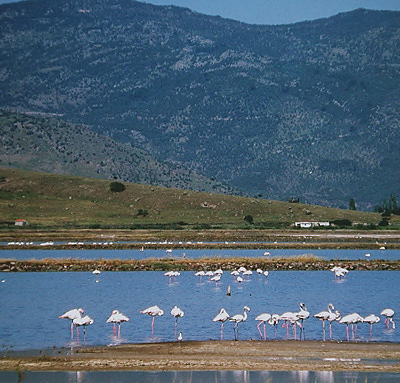
flamingos are now permanent residents of Lesbos
It was in this context that John Bowers, a longtime birdwatcher in Lesbos, an environmental economist, and the first to sign my petition, formed Friends of Green Lesbos, an international internet-based group dedicated to protecting the wetlands of Lesbos that soon counted over 800 members. I became its Vice President. In 2003, Friends of Green Lesbos, in co-operation with Idatinos, a local environmental group, drafted an internet letter and petition, that was automatically sent to the Greek government every time it was signed, asking the Greek government to fulfill its legal responsibility to protect the wetlands of Lesbos. The government responded that it was required to enforce the Natura law even though no specific Greek law had been passed specifying how this was to be done. A committee in the department of building and land development in Lesbos was created and charged with the responsibility of protecting the local wetlands.
We did not understand that this committee would not be monitoring the wetlands on a regular basis, but would only respond to complaints. This was clarified at a meeting organized by World Wildlife Fund in Athens in 2005. I was then put in touch with a new local environmental group, Nautilos en drasi that was also formed to save wetlands. Together with WWF, we began to draft complaints about the degradation of individual wetlands. These complaints, numbering well over fifty, were all decided in our favor. Fines were issued, but there was no mechanism to ensure compliance. Numerous meetings with the Governor of the island resulted in promises that were not kept. We finally realized that he was more interested in currying favor with landowners and developers than in enforcing the law.
In 2008 while lecturing at a conference in Ireland, I met a Green Party member of the European Parliament who encouraged me to write a complaint to the European Commission. After six months of intense effort, I completed a formal complaint of over 100 single-spaced pages, supported by two large files of documents, detailing the government’s failure to protect the wetlands under the Natura law. It was immediately approved by Friends of Green Lesbos and Nautilos en drasi, but it took over two years for World Wildlife Fund and Hellenic Ornithological Society to revise and sign it.
The complaint was submitted to the European Commission in September 2011. After several requests for additional documentation, the Commission found Greece in violation of the Natura law in Lesbos in October 2014. In August 2016 the Commission informed us that it had made our case part of horizontal negotiations with Greece regarding its failure to protect all of its Natura sites. The February 2018 Presidential Decree is the fruit of these negotiations. It is certain that the European Commission will continue to watch the situation in Greece to ensure that the government follows through with the monitoring and protection mandated by the new law.
This has been a long and tiring and often discouraging struggle of nearly two decades and it is still ongoing, but if the end result is the protection of all of the Natura sites in Greece, it will have been well worth it.
Others involved in Natura struggles in Lesbos besides John Bowers and myself include Eleni Galinou, Michael Bakas, Costas Zorbas, and Stellios Kraonakis, and in Athens, Foteini Vrettou, George Chassiotis, and Elias Tzirtzis of World Wildlife Fund Greece, and Malamo Korbeti of Hellenic Ornithological Society.
I believe that we should we care about birds because it is right to do so. If we do not, we will contribute to extinction of species, and we will leave a diminished world to those who come after us. We must not give up hope that we can save the world for birds, for other wildlife, and for our children’s children.
On February 2, 2012, the International Day for Wetlands, the Greek government signed into law a Presidental Directive mandating protection of the small wetlands of the Greek islands. There is no assurance that this law will be enforced. There are still no measures in effect to protect most of the larger wetlands in Greece, even though this is required by the European law Natura 2000, which requires all of the countries in the European Union to protect bird and wildlife habitats.
When I became a birdwatcher, I could not have told you what a wetland is. Now I know that wetlands are fragile bodies of water shallow enough for wading birds from flamingoes to sandpipers to stand in “without getting their bottoms wet” while feeding on shrimp, small fish, frogs, and other watery treats. Wetlands often take the form of pools near the sea, but they also include the deltas at river mouths and seasonally flooded fields. In the twentieth century and today many wetlands were designated “swamps” and drained. Continue reading “Why Should We Care About Birds? By Carol P. Christ”




 Feminism and Religion