OMÓS DO SINÉAD O’Connor by Rev. Nóirín Ní Riain

Sinéad contacted me for the first time in 1995 asking me if I would teach her some Gregorian Chant. I was living in Glenstal Abbey at the time and she came to my home to spend a few days with me.

I was working on a doctorate then on the Sound of God and we had great conversations in between moments of teaching and at meal times. She was an extraordinary student. Sing her a phrase and she had it immediately; sing to her an entire chant, no notes taken, but she could sing it straight back to you. She loved Gregorian chant and in the afternoons, we would steal into the church and try out the morning’s learnings. One evening in particular I shall never forget. We went up to Compline – Night Prayer at 8.35pm. Afterwards, one of the community, Br. Ciarán, came down to us and Sinéad asked him if she could sing the hymn which the community had just sung once the monks had left. She did and indeed it became her favourite encore at many concerts she gave at that time.

Continue reading “OMÓS DO SINÉAD O’Connor by Rev. Nóirín Ní Riain”

Curiosity by Beth Bartlett

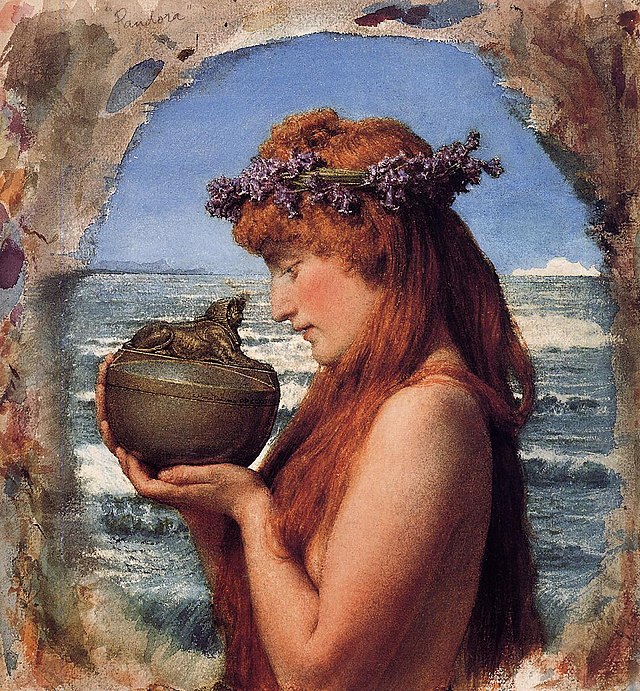
In my last post I mentioned the tale of Prometheus who stole fire from the gods.  Zeus’s punishment of eternal torture was not enough to avenge the offense.[i]  In addition, Zeus punished the entire human race by sending the first woman, Pandora.  Pandora is a woman of “all gifts,” one of which is the curiosity that drives Pandora to open the forbidden jar, unleashing evils and miseries into the world.  Woman as punishment, as the bringer of evil and misery — these themes have shaped the western view of women for millennia.

Continue reading “Curiosity by Beth Bartlett”

Image and Likeness by Dale Allen

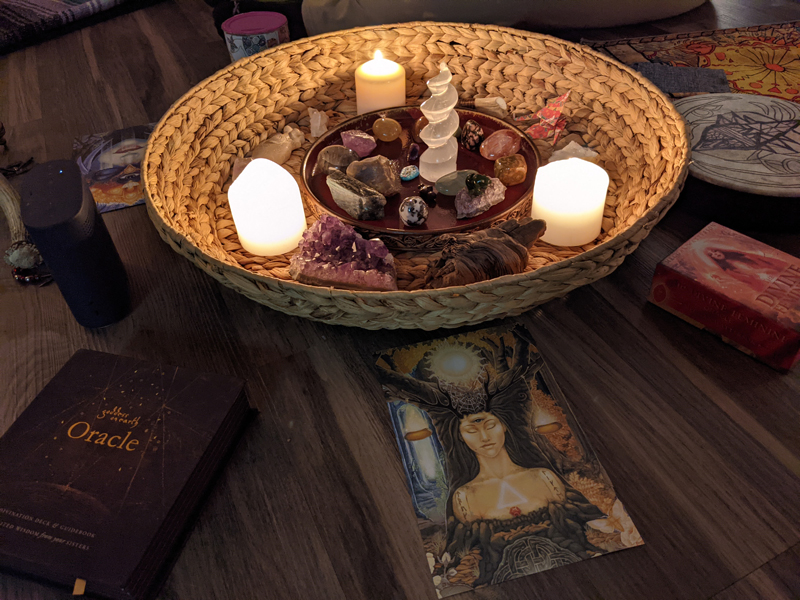
I attended a beautiful women’s circle to celebrate my dear friend Gloria’s birthday recently.  Each woman was invited to bring a sharing for Gloria – a poem, reflection, oracle card, song or dance – whatever felt right.  Each sharing that day was not only a gift to Gloria, but to each of us.

I had met Gloria during the period of my life when I had written a play titled, “Dancers of the Dawn,” with a cast of seven women of different ages, shapes, sizes and colors. The play featured original music, drummers, myth, history, dance, even comedy for a sumptuous experience of the sacred feminine emerging in modern women.  Gloria was a part of the women’s sacred circles that we co-created during that time – circles that continued for a decade and still retain heart-connections today. 

Continue reading “Image and Likeness by Dale Allen”

Abundant Life Is for Women, Too by Liz Cooledge Jenkins

I lived in East Palo Alto, CA, for two years in my mid-twenties. During the first year, a man was killed down the street from my apartment building, in the parking lot of the building where my friends lived. I walked through that parking lot often, as a shortcut back to my own place from wherever I could find street parking. I didn’t know the man, but I knew people who knew him. His death was both disturbing and tragic. The neighborhood mourned. My friends and I got together and wrote a prayer for our community. The murder changed my experience of living there.

Continue reading “Abundant Life Is for Women, Too by Liz Cooledge Jenkins”

Breaking the Silence by Sara Wright

 I believe that The Fourth of July is the most despicable cultural celebration Americans engage in. This year I met the weekend head on. On July 1st I publicly posted the following words knowing that locally, at least, there would be fallout:

Before the colonizers took over this land from Indigenous Peoples no one considered being “independent” because the People knew there was no such thing… Like it or not we all belong to the earth and are dependent upon this planet for our survival.

 What we really celebrate on the 4th of July is the Colonizers’ takeover of what was once a pristine continent ripe with lush forests, plants, wildlife, and peaceful people who had relationships with all their non-human relatives. These Native people also understood they belonged to the powers of each place they called ‘home’.

Continue reading “Breaking the Silence by Sara Wright”

The Importance of Finding a Local Sacred Circle or Event by Caryn MacGrandle

What not many know that the founder Caryn MacGrandle (aka Karen Lee Moon), who is a soul-sister to me, has devoted her life to the building, developing and promoting of this app, in service to the Rising Feminine … “ Jonita D’Souza, Rising Feminine

I came back this weekend from my land in North Carolina to two email messages about women finding divinely feminine events through the divine feminine app. I cannot even begin to tell you how happy this makes me. After nine years of nurturing, developing, daily work and pouring my personal funds into the app, it is truly working.

Continue reading “The Importance of Finding a Local Sacred Circle or Event by Caryn MacGrandle”

A Poem for Enheduanna by Nan Lundeen

Cuneiform Tablet from Nippur, Sumeria
(Modern Iraq) 2300 – 2100 BCE
Mary Harrsch from Springfield, Oregon, USA,
CC BY 2.0 <https://creativecommons.org/licenses/by/2.0&gt;,
via Wikimedia Commons

In beautiful synchronicity, I received an invitation to submit a poem to an anthology in the voice of a female-identified persona around the same time I first learned of Enheduanna. The first named author and poet was mentioned in my New Moon Womyn’s Circle. When I looked her up, I was flabbergasted. I am a poet, a feminist, and a long-time student of Women’s Spirituality, and yet the world’s first author—a high priestess who worshipped a female supreme deity, was unknown to me.

I learned that Enheduanna was a brilliant poet who wrote with majestic metaphors, who shared her emotions, and who grappled with concepts of the divine as a female supreme deity in and with nature, and with whom she experienced a personal relationship. She lived and wrote around 2300 B.C.E. Scholars say they do not have the specific dates of her birth and death, but they do know that she served as high priestess for 40 years at the city of Ur in what is now Iraq.

Continue reading “A Poem for Enheduanna by Nan Lundeen”

Hear Me! Redux by Winifred Nathan

She Said; He Said 
And How 
She won! He lost!

On May 9, 2023, in New York Supreme Court, “she said,” won. E. Jean Carroll was awarded a judgment of five million dollars in compensatory damages in her defamation and sexual abuse case against former President Donald Trump. YES, she won! He lost!  

How did this happen?

The starting point is looking to a New York state change in its law regarding sexual assault. The assault took place in early 1969. Like many women, Ms. Carroll didn’t seek immediate legal help. She waited until 2019 to file a suit. Her explanation: at her trial, she opined, “I was born in 1943. Women like me were taught and trained to keep our chins up and not to complain.”

In November 2019, E. Jean Carroll did bring her first lawsuit against Donald Trump, which grew from his remarks when she accused him of sexual abuse. The suit was, however, limited to defamation. (Applicable statutes of limitation precluded any potential criminal action for sexual assault.) The Justice Department appealed the case. 

Continue reading “Hear Me! Redux by Winifred Nathan”

Rhiannon by Diane Finkle Perazzo

This poem is dedicated with gratitude to my “Women in the Mabinogi” writing group…


Rhiannon comes to me in my dreams.
She ebbs and flows like the waxing and waning  
of the moon.

Steady hoofbeats, 
clop, clop, clop  
and then, in a rush of beating wings
she vanishes,
leaving a swirl of tiny white petals that spiral like stars.

Continue reading “Rhiannon by Diane Finkle Perazzo”

Woman’s Sacred Hand – and Handkerchief by Laura Shannon

Berber Hamsa. Photo: public domain.

In my recent post ‘Forty Days After Childbirth, Mary Returns to the World,’ I wrote that ‘the woman’s power to bless and protect, as well as to create, is shown in the symbol of her hand.’ We see expressions of this power in the Orthodox Christian icon of the Three-Handed Madonna, whose third hand is over her womb, and the Hamsa, the hand-shaped talisman common to Jewish, Christian, and Islamic traditions. Also known as the Hand of Fatima, Miriam, or Mary, the Hamsa often incorporates eye or vulva motifs, which also offer protection.

Hand, womb, and eye all signify female creative power, personified in the image of Goddess and revered in Neolithic Old Europe. This life-giving principle is expressed in many ways apart from childbearing: as Carol Christ affirms, early technologies of spinning, weaving, pottery, and agriculture, along with Neolithic religion, were most likely invented by women. 

Continue reading “Woman’s Sacred Hand – and Handkerchief by Laura Shannon”