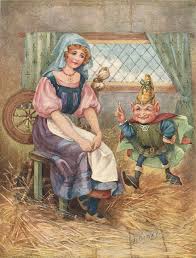
And so the little man smiled a smile that showed all his teeth and sat down at the wheel and—whirr, whirr, whirr—the whole roomful of straw was soon spun into the finest gold thread imaginable, twice as fine as the finest silk thread the merchants sold at the harvest festival.
As soon as the Queen arrived back at her palace the next day, her Nephew introduced his betrothed to her. The Queen was much older than Perdita thought she would be, and she was as wise as she was old. She took Perdita into her private chamber and asked her several questions. She learned more about Perdita than the girl realized, also about her mother and stepfather and young traveling scholars. Nevertheless, the Queen gave her royal blessing to the marriage, for she wanted her Nephew to be married to someone with a quick mind, good manners, and some ambition so the land would be well cared for after her death.
The wedding took place on the day following the summer solstice, and guests were invited from lands all around. Perdita’s mother and stepfather were invited, too, and they were both given new clothes to wear. The stepfather tried to have a private conversation with the Queen, but the major-domo led him into the map room and showed him some extremely dependable treasure maps.
After the wedding banquet of roast peacock and candied goldfish and artichoke hearts and rosewater dumplings, the Queen and Perdita’s mother walked together in the gardens and talked of many things. Pretty soon, after the stepfather had memorized several of the treasure maps and borrowed enough money to rent a ship and set off to claim his treasure, the mother was invited to move into the palace, where her healing and domestic arts would be appreciated.
A year and a day later, Perdita gave birth to a daughter who was the most beautiful baby in the whole land. The royal birth was celebrated with fireworks and parades and festivals and rituals in the temples that lasted three whole days without pause. Perdita’s mother was appointed chief nursemaid and immediately hired a wet nurse who had the creamiest milk in the whole land.
On the third night after the baby’s blessing and naming day, Perdita was alone in her chamber, brushing her long, curly hair, when she heard a noise behind her.
“Well then. I have come for the baby.”
“What?” Perdita pretended not to recognize the little man. “And just who are you? And what are you doing in my private chamber? Get out immediately or I shall call the guards.”
“You know who I am. You know why I’m here.”
“Yes, yes, I confess it. I do.” She allowed a tear to roll down her cheek. “Oh, but please don’t take my baby. I have never loved anyone before, and I love this baby more than anything I have ever possessed. Here—take my jewelry. All of it. Take my jeweled toys. Take the tapestries from the walls. Take my richly embroidered clothes. Take my royal robes. Take my golden coronet. Take these books I’ve read. Take anything you want, but please, Kind Sir, oh, please don’t take my daughter.”
“We made a bargain. I have spun the gold for you. No man can spin gold, but I can, and I spun for three nights. Because of my spinning, you are now the heiress of the throne of this land. You must keep your part of the bargain.”
“No, no!” Perdita cried, glad that the baby was in her mother’s watchful care. “I cannot give up my daughter! She is more precious to me than gold.” And Perdita began to cry, to really cry, and her crying was so heart-rending that the little man finally began to take pity on her.


 When the Spirit of the Cap upon which were embroidered the words I Am Always Very, Very Great told the Big Boss he needed consultants, the Boss called his posse together and ordered referrals. “I always get what I want very, very quickly,” he told the posse, which consisted of several of his wives and the goodfellas that ran the real estate where Ladies of the Night and their Good Friends gambled the nights away. “I make very, very good deals,” said the Big Boss. “Find me some very, very good advisors. If you don’t, you’re fired.” Continue reading “The Emperor’s New Clothes by Barbara Ardinger”
 What on earth, I hear you asking, got into that dish? Why did she run away? Well, let me tell you. It was at one of our last carnivals. It was an enchantment. That dish was our Princess, and she was under the enchantment. Actually, the whole Royal Family was enchanted. The warriors came galloping in from the steppes beyond the river, but first they sent a Prince. He told our Queen that they were coming to “protect” us, that they were bringing new gods to us. Bringing what they called new civilization and new ways, bringing us what they called “good news.” Well, our Queen and Her Consort were rightly skeptical about all these news, and they locked the Princess up in a safe tower. Kept her there for who knows how long while that handsome but rapacious Prince came and went and the warriors surrounded our lands. Back and forth, back and forth. It was them that declared the carnival and threw that enchantment on all our important people. The Prince lured her down out of the tower—he’d stolen the magic words that unlocked the door—and then he told her he was going to eat her up. She thought it was a joke. He dressed himself up as a big spoon and persuaded her to dress herself as a dish. And then, when the invasion got serious, she ran away with him. Maybe she thought she was saving herself.
  There has been so much hate on display in the world so far in the 21
 Let’s turn off the news for a little while. Let’s set aside our devices and all those pesky social media. Instead, let’s consider one of the best known (and, alas, probably most ignored) teachings of Jesus—the Sermon on the Mount as given in the Gospel of Matthew. I especially like the Beatitudes (verses 3-12):
 You all know my story, at least the popular version of it. I was an only daughter, the princess (so to speak) of the house until Mama died. Then Papa, who couldn’t seem to manage anything, much less a busy household, went out and got married again and brought Stepmother and her two ugly daughters into the house…and the princess was promptly reduced to servitude.
 You see that kid sitting
  (With apologies to Jean de La Fontaine for significant changes to his fable)
 “Not on your life,” muttered this grandmother, most of whose conversations with her many daughters and granddaughters consisted of instructions on how to properly clean their homes and hills and how to prepare and store food for the winter. “Life is serious business, it is, it is. We need to plan ahead.”
 Perdita
 Feminism and Religion