Exploring the F-word in religion at the intersection of scholarship, activism, and community.
Author: Judith Shaw
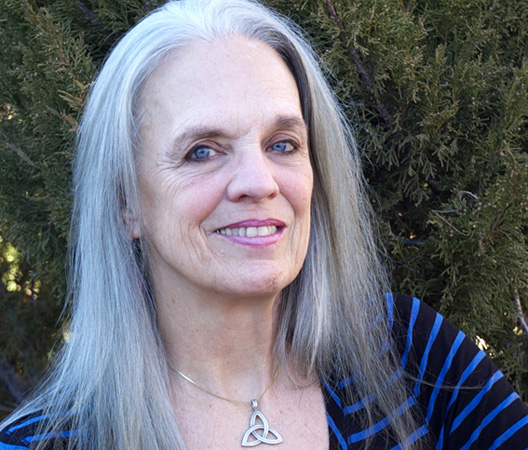
Judith Shaw, a graduate of the San Francisco Art Institute, has been interested in myth, culture and mystical studies all her life. Not long after graduating from SFAI, while living in Greece, Judith began exploring the Goddess in her art. She continues to be inspired by the Goddess in all of her manifestations, which of course includes the flora and fauna of our beautiful Earth.
Judith has exhibited her paintings in New York, San Francisco, Mytilene Greece, Athens Greece, New Orleans, Santa Fe NM, Taos NM, Albuquerque NM, Houston TX and Providence RI. She has published two oracle decks - Celtic Goddess Oracle and Animal Wisdom Oracle and is hard at work on an illustrated fairytale - Elena and the Reindeer Goddess.
At first glance the ancient belief that bees were birthed from dead bulls seems odd. But if we delve deeply into pre-historical artifacts we discover the mythopoetic roots of this idea.
Our Paleolithic ancestors lived immersed in nature within the cyclical nature of time. For them the moon, which revealed monthly, yearly and even longer cycles of time, became the symbol of the cycle of birth, death and regeneration.
Are cruelty, violence and greed written into the human DNA? Are we destined as a species to continually and for eternity create our world in a hierarchical manner where the privileged few receive almost all of the goods and services while the masses live in slavery of one form or another?
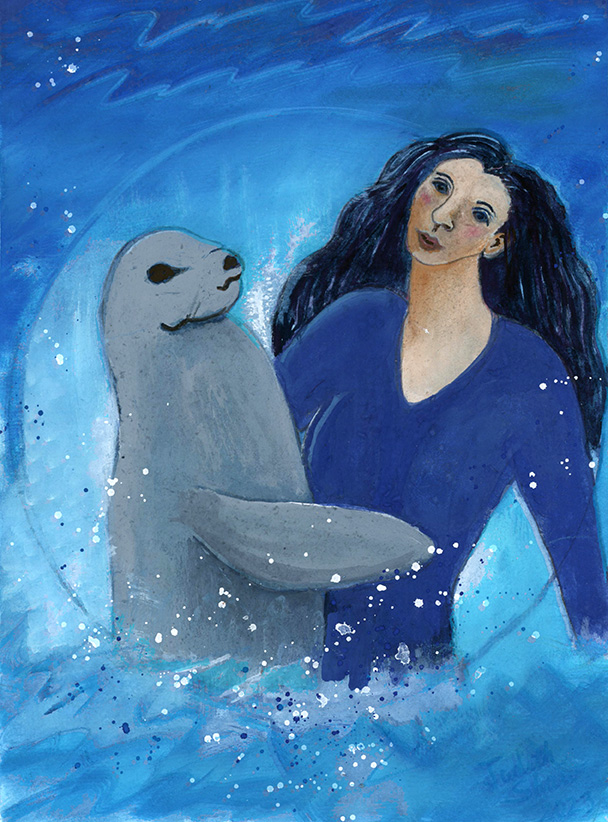
I’ve known of the existence of the Sabian symbols for a long time, but not much about the details or meanings – which is kind of surprising considering how much I love symbolism. Sabian symbols, which first emerged in 1925 from clairvoyant Elsie Wheeler are written symbolic meanings of each degree of the astrological zodiac. Recently I heard astrologer, Heather Ensworth, speaking about the new moon of March 21 at 1° Aries and the Sabian symbol attached to that lunation which is – “A woman rises out of the water, a seal rises and embraces her.”
Upon hearing that Sabian symbol recited, my inner eye exploded with an image to match the words and then buried itself deep in my heart. I fought the urge to paint it as I have other projects which need completion. But ultimately the woman and the seal would not leave me, so I began to visualize it resulting in this painting, which might or might not be finished.
But why did it strike me so deeply and what might it mean?
Night becomes day, winter becomes spring, children become adults who become elders who become ancestors – transformation is a theme that appears again and again in our myths, legends and natural world.
But transformation is not easy as it requires us to let go of the old, the comfortable, the familiar and make way for the new and unknown. We can look to myth and legend with their many instances of transformation for guidance through these difficult moments.
Now that my Animal Wisdom Oracle is out in the world I’m delving more deeply into the stories and legends associated with the animals I’ve learned about. Though many legends of animals are strongly associated with goddesses and gods, there are also many that focus solely on animals themselves. In both cases these stories help us understand our place in the world and teach about living in balance and harmony with all beings – a cornerstone of feminism and goddess spirituality.
As winter nears its end, I’d like to share my re-telling of a story with you about Crow. It comes from the storytelling tradition of the Lenni Lenape – a Native American tribe whose traditional territory spanned what is now eastern Pennsylvania, New Jersey, lower New York, and eastern Delaware. This is a different kind of crow from the one we know today. It goes like this….
Imbolc has come and gone. It appears that Punxsutawney Phil, the American version of animal weather prophets on that cross-quarter day, was correct. Winter cold continues. I’ll admit that I am getting pretty tired of the cold but it does help me to keep focused on the paintings for my winter fairytale – Elena and the Reindeer Goddess.
Though my work on this project will certainly continue into the spring and summer, this will be the last excerpt I post here at FAR. I know you will all be more interested in postings related to the growing times of spring and summer once the days are longer and warmer. This third excerpt picks up where my post from last month stopped. If you missed excerpts one and two you can check them out here and here.
Brigid, the Celtic Goddess of Healing, Poetry, and Smithcraft, begins her reign on Imbolic, February 2, the midpoint between winter solstice and spring equinox. On this day the ancient Celts held their Fire Festival in honor of Brigid and the growing light. In Scotland, as recently as the mid-twentieth century, houses were cleaned and the hearth fires rekindled on February 2, to welcome in Brigid. Remnants of this festival are found in America today on Groundhog Day.
Like the Cailleach, She existed in many places and was known by many names. The Irish called her Brighde; she was Bride in Scotland, Brigantia in Northern Britain, and Brigandu in France. Some called her Brid, Brig or Brighid. Later she was transformed by Christianity into Saint Bridget. Her older name was BREO SAIGHEAD. Her name has various interpretations, many relating to fire – “Power,” “Renown” “Fiery Arrow of Power ” “Bright Arrow”, “The Bright One”, “The Powerful One”, “The High One” and “The Exalted One”.
The past few years have been way too busy. Every winter I longed for quietness and solitude – for time and space to see and feel the strong bones of tree trunks and branches standing sharp against the sky and to gaze in awe into the fathomless winter night. And yet responsibilities and duties continued to yell at me for attention. The quiet gifted by Winter slipped away and soon I was on the treadmill of action offered by Spring and Summer once again.
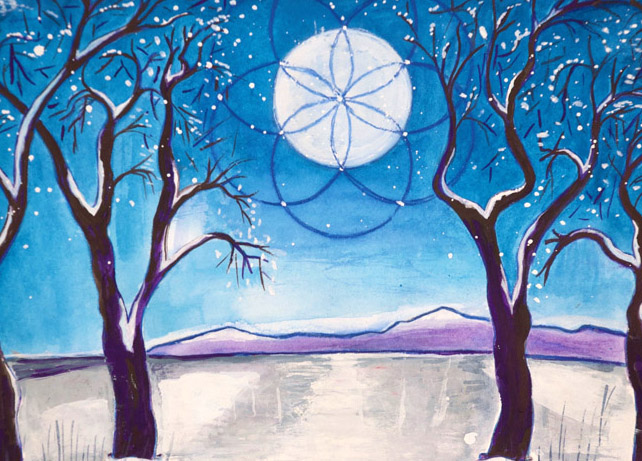
The mad pre-Christmas rush of activity has passed and we find ourselves again in the quiet, dark and cold of winter. Winter Solstice, the longest night and shortest day of the year in the Northern Hemisphere, occurred last week. With a gain of only a few seconds of daylight each day in the ten days after Winter Solstice, we can take advantage of the stillness offered to seek within ourselves for the seeds laying dormant, waiting to be recognized and nurtured into fruition and manifestation.
Bright Solstice Night by Judith Shaw
Having just finished all the pre-press and pre-order fulfillment of the first of the Animal Wisdom Oracle decks, now is the perfect time for me to work on seeds of my own – another project that has long been in the works. This project has gotten back burnered every spring for the past couple of years as I seem to need the dark of winter to complete the art. It’s a folk tale inspired by the ancient stories of the Reindeer Goddess. It’s a tale that honors the Sacred Feminine. The story is written and now I have the illustrations to complete. Here’s a little taste of what’s to come:
Elena and the Reindeer Goddess
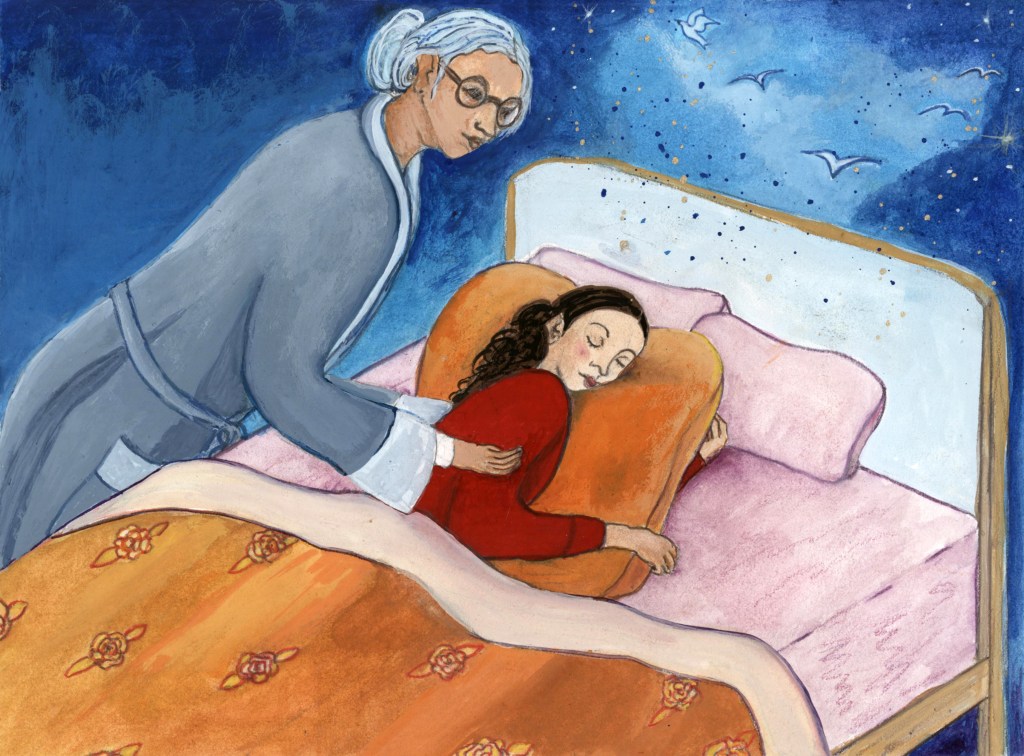
Just before dawn on a cold winter morning, Grandmother woke up with a smile on her wrinkled face and a feeling of hope in her heart. She had had a dream, one that had come from her ancestors, and from her own deep knowledge. It was a dream of prophecy.
“The Reindeer Goddess returns,” Grandmother whispered to herself.
She threw back her quilts and rose, shoving her cold feet into soft wool slippers, and hurried to wake her granddaughter, Elena.
She rushed into Elena’s cozy little room, then leaned over her and shook her gently, saying, “Elena, Elena, wake up. Quickly Elena, there’s no time to lose!”
Elena opened her eyes and yawned. “What’s wrong Grandmother? What’s happened?”
“It’s more about what will happen,” Grandmother said. “Come, let’s put on our coats and boots and while we walk I’ll explain everything. I need your pure heart, your quick wit, and your strength.”
Elena and Grandmother bundled up against the cold and stepped outside. They began to trudge through the snow lying thickly on the ground, past little puddles here and there, glinting hard as stone in the light from a million stars.
Grandmother gathered her coat more tightly around her as she began telling Elena the story, her breath puffing out like mist in front of her.
“Long, long ago in the northern lands of snow and ice – the Old World of our ancestors – the Reindeer Goddess was alive in the hearts of the people. It was she who took flight on the Winter Solstice bringing understanding of the power that lies in darkness and of the hope that spring would return.
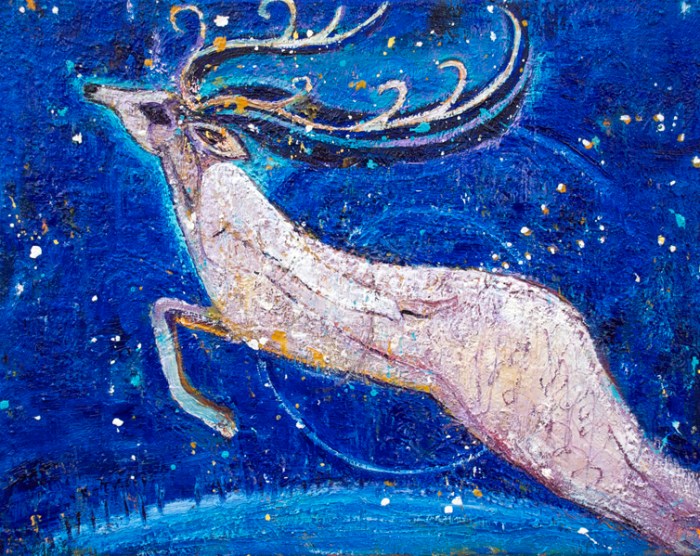
“Our people knew her as Reinna. Sometimes she was seen as a woman who flew through the skies in a chariot pulled by reindeer. At other times she was seen as a flying reindeer herself.
Flight of the Reindeer Goddess by Judith Shaw
Look for more excerpts over the winter months and discover how Elena helps the Reindeer Goddess accomplish her very important mission of love. The book should be ready for the printers by the end of summer – early fall 2024.
Reindeer are the only deer species in which the females grow antlers. And the females’ antlers are larger and stronger than those of male reindeer. So who was Santa Claus really and who were his flying reindeer?
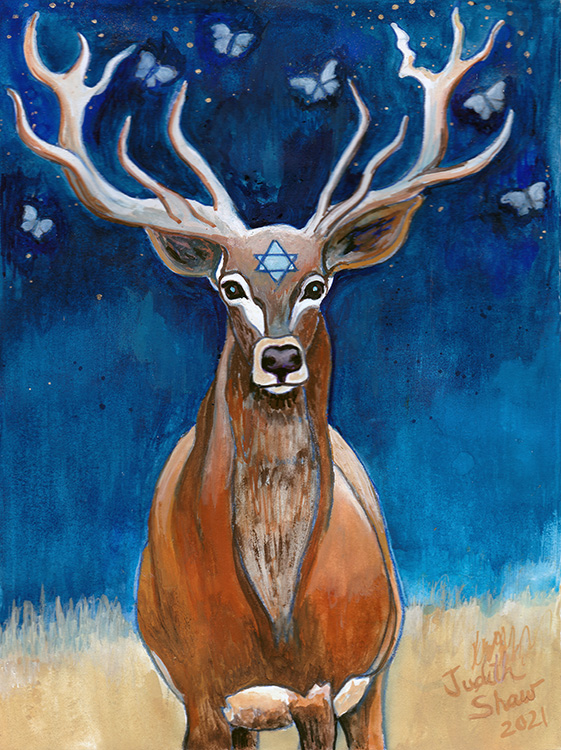
As our ancestors were well aware of the need for balance, Stag – the male red deer indigenous to the UK – is also celebrated at this time. Stag, who grows a massive rack, is symbolic of the masculine power of regeneration, a messenger from the spirit world and one who leads humans to spiritual enlightenment. Males are called bucks in other deer species.
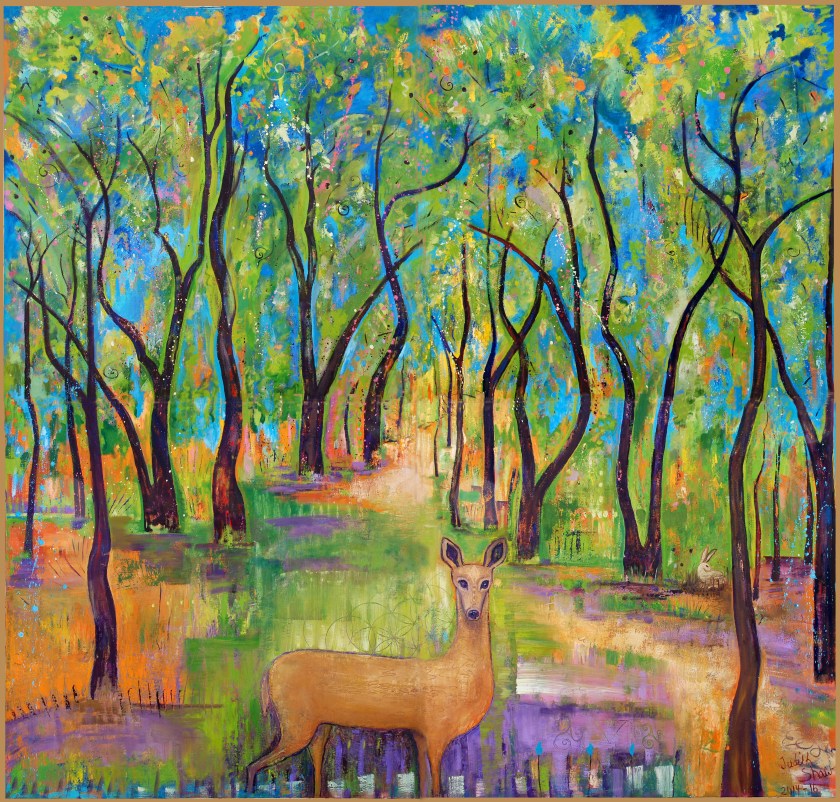
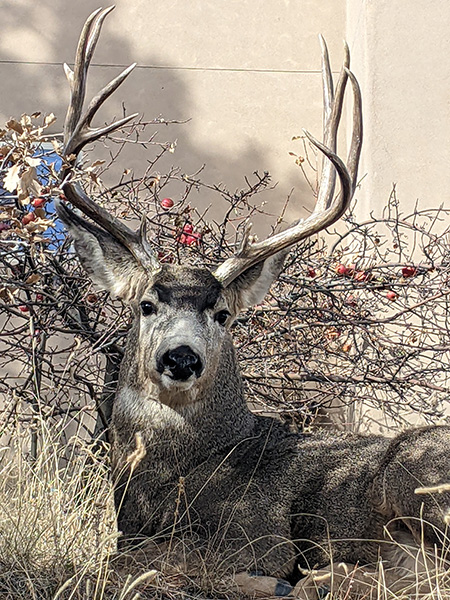
The racks found on bucks from other deer species during the fall rut are also impressive. I was lucky to see many mule deer during my Thanksgiving stay in the Jemez Mountains of New Mexico. Deer who wander into town are protected and thus not afraid of humans. This allowed me to get very close to this magnificent buck and capture his photo. He was not at all interested in looking at me so it took awhile to get this shot from just a few feet away.
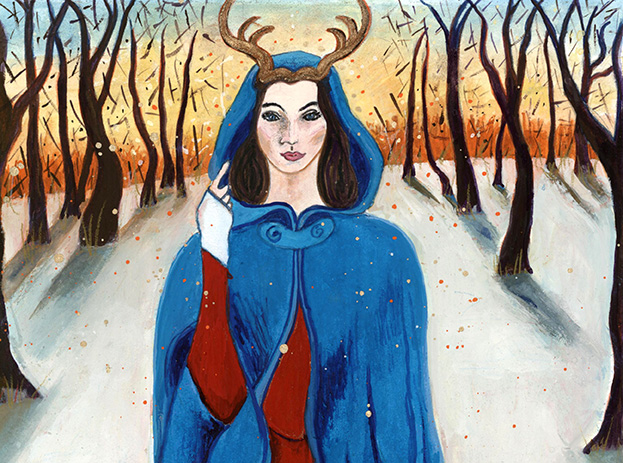
And finally I’ll share my painting of Stag with you all again.
May the Reindeer Goddess continue to nurture you with her love and gifts of abundance while Stag guides you to spiritual enlightenment.
Judith Shaw, a graduate of the San Francisco Art Institute, has been interested in myth, culture and mystical studies all her life. Not long after graduating from SFAI, while living in Greece, Judith began exploring the Goddess in her art. She continues to be inspired by the Goddess in all of her manifestations, which of course includes the flora and fauna of our beautiful Earth. Originally from New Orleans, Judith makes her home in New Mexico, The Land of Enchantment.
Judith’s illustrated fairytale: Elena and the Reindeer Goddess — A Magical Winter Solstice Mission — will be released by late January 2024. Sign up for Judith’s newsletter on her website for more info on the release.
Judith’s oracle decks are available on her website: Celtic Goddess Oracle — order your deck here. Animal Wisdom Oracle – order your deck here.
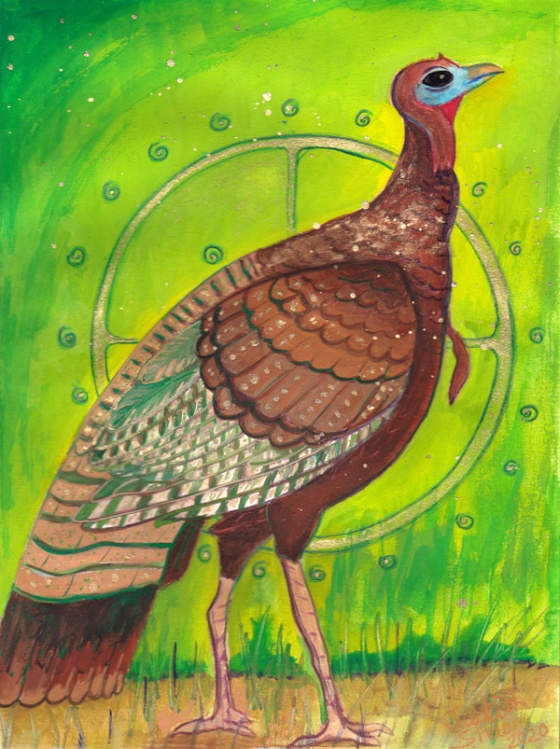
In the United States turkeys are equated with Thanksgiving. But there is so much more to Turkey – a gentle creature who forms strong attachments. Reputed to be dumb, Turkey is in fact quite intelligent and curious, with the ability to solve problems. Turkeys have an excellent understanding of the details of their location which makes them so successful at feeding themselves. They also love to play and to cluck along with music.
photo by Tony Castro
Turkeys, indigenous to North America, evolved over 20 million years ago and share a common ancestor with grouse, pheasants and other fowl. Two species of wild turkey exist today – the wild turkey of eastern and central North America of which there are 5 sub-species and the ocellated wild turkey of the Yucatan.
Yet why is turkey named turkey? Strangely enough it was a mistake. English colonial settlers thought turkeys were a type of guinea fowl which England imported from Turkey – thus the name. The Spanish word for turkey is guajolote which is derived from the Nahuatl (Aztec) name huexolotl.





 Feminism and Religion