Happiness Habits by Katey Zeh

derek-thomson-406050Finding joy has never been a priority for me in terms of how I structure my life. A long-term goal? Certainly, yes. My path to getting there, however, has been misguided. I’ve held the common belief that if I can achieve and succeed enough, joy–or at the very least, contentment–will find its way to me.

Sometimes I wonder if I was drawn initially to the field of faith-based advocacy because the nature of the work is to resist complacency. The successes are few and far between, and they are never sufficient for achieving the ultimate goal of justice for all. My proclivity to be dissatisfied with progress and to keep on pushing aligns well with the vision of many social justice movements.  

My permanent state of dissatisfaction, which was for some time a motivational force, seeped into how I felt about nearly everything. Whenever feelings of joy or happiness would arise, particularly around work, I often attributed them to a false sense of pride that had caused me to lose focus on the long game. In short, I didn’t believe I deserved to feel joy. Continue reading “Happiness Habits by Katey Zeh”

The Trouble  with “Wellness” by Katey Zeh

katie-smith-104748

During the holiday season we’re bombarded constantly with contradictory messages about how we ought to take care of our bodies this time of year. Over the early winter months there is a collective expectation and even glorification of indulging in all kinds of ways–eating, drinking, spending money, etc. But if we dare enjoy ourselves a bit, we’re then on the receiving end of the diet and fitness culture propaganda that capitalizes on our time of indulging by telling us we need to clean up our eating and get (back) to the gym–assuring us that 2018 will be the year when we finally achieve our “dream bodies.”

Oftentimes the coded language of “wellness,“ “clean eating,” and even “health” is rooted in the same problematic framework that toxic diet and fitness culture espouses: your best self is your thinnest self. Strict binary language used to describe food–processed foods high in fat or sugar are “bad” while fruits, vegetables, and whole grains are “good”–attributes moral weight to what we eat. Beneath this is the myth that our health outcomes and the way that our bodies look are completely within our control. If we simply commit to “healthy” habits, we can become “good” (thin). Continue reading “The Trouble  with “Wellness” by Katey Zeh”

Politicians Make Dangerous Theologians by Katey Zeh

ben-white-181034

Accounts and allegations of sexual harassment, assault, and abuse perpetrated by mostly straight white men in power have flooded the U.S. news cycle for months. Each new revelation confirms that sexual violence is an epidemic fueled by systems of unchecked power and authority, including patriarchy, white supremacy, and Christian supremacy.

After The Washington Post published the story of Leigh Corfman who recounted the sexual abuse she suffered as a teenager at the hands of Roy Moore, Alabama State Auditor Jim Zeigler came to his defense and argued that this would have no political impact since Moore “never had sexual intercourse with any of these girls.” Continue reading “Politicians Make Dangerous Theologians by Katey Zeh”

Restricting Access to Birth Control is Immoral by Katey Zeh

On a hot August day in 2012, I was taking my usual monthly trip to Walgreens to pick up my birth control prescription. As I pulled out my wallet to cover the co-pay, I was pleasantly surprised when the pharmacist informed me that I didn’t owe anything. It was the first month that the contraceptive mandate included in the Affordable Care Act required health insurance companies to provide contraceptives without a copay.

pills-1354782_1920

Over the years my birth control pills had cost me between $30-50 a month. It might not sound like much, but as a young professional working in the nonprofit sector, it was something I had to budget for carefully. I was also paying my own insurance premiums at the time. Throughout most of my twenties I worked as a contractor, which meant I didn’t qualify for employer-provided insurance, and with my limited budget, I had to settle for less-than-ideal coverage.

When I discovered that the cost of my birth control would be covered completely under my premiums, I wanted to show my appreciation to the Obama Administration. I quickly snapped a picture of my pharmacy receipt that showed my total as “$0.00” and posted in on Facebook with the simple phrase, “Birth control with no copay. Thanks Obamacare!”

tumblr_m8exo7olqp1rdr9obo1_1280

The next morning I woke up to find my image had gone somewhat viral after the Planned Parenthood and Barack Obama social media teams had shared it on their platforms. I had a lot of support, but as you might imagine, the backlash was hellacious. I was incredibly grateful that I’d been wise enough not to capture any of my personal information in the picture I’d taken. Here are a few examples of the messages I got.

“I don’t want to pay for you to have the power to sleep around.”

“It really disgusts me that MY tax dollars are paying for other people to have protected sex and abortions. That money could go into my college fund or help pay for a car or help pay for medication that I actually NEED, but nope. The government decided that my money is better used to pay for someone else to have protected sex. I really hope you all enjoy spending MY hard earned money.”

There’s absolutely nothing factually accurate about these two comments from trolls–I was in a committed relationship and paying for my birth control prescription through paying my insurance premiums–but they do capture some of the most common arguments made against women having the ability to make decisions about our bodies and lives.

  • Women who have sex and want to avoid pregnancy should be shamed.
  • We should not do anything to support a woman making a decision about her life and body.
  • Any social program that supports women’s reproductive decision is a burden on taxpayers.

The pervasiveness of these beliefs and the disdain for women’s autonomy among white conservative men is why the Trump administration has no qualms about its plans to rescind this policy that has helped over 55 million women over the last five years. What is the premise of this decision? Religious freedom.

There is nothing moral about restricting a person’s access to the tools and resources they need to plan their lives, care for their bodies, and dream about their futures.

In March of 2014 I stood outside the Supreme Court building to speak my truth in protest of the argument of “religious freedom” used (successfully, I hate to say) in the Hobby Lobby case. I spoke these words:

As a young woman, a family planning advocate, and a Christian, I stand in solidarity with millions of women in this country whose access to contraception is at stake today.  I do this not in spite of my faith, but because of my faith.

I stand upon the firm foundation of my Methodist faith that has declared health care as a right, and access to contraception a moral good that enables women and couples to make responsible, ethical decisions about the timing and spacing of their families. To permit an employer to restrict that access through financial hardship or other means would impose upon my religious freedom—and the religious freedom of millions of other like-minded people of faith.
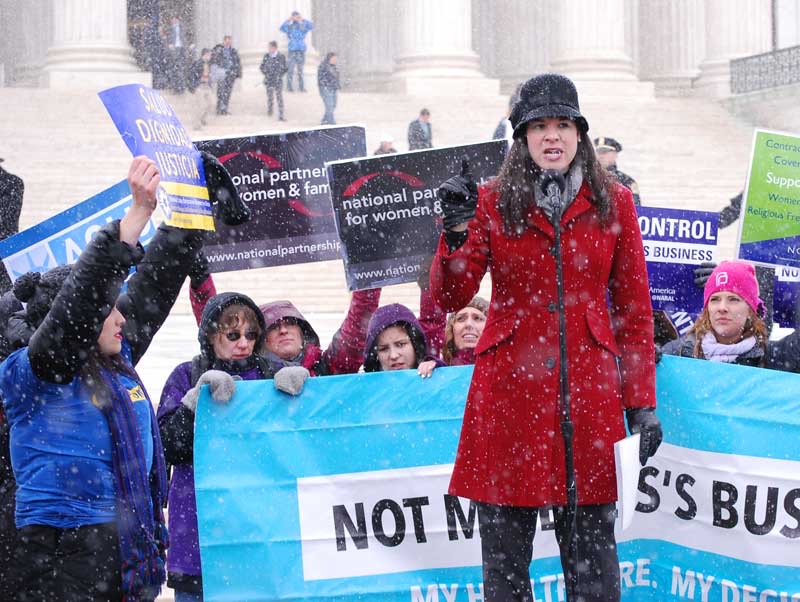
scotuszeh11.jpgWhat few people knew at the time was that when I gave that speech,  I was 10 weeks pregnant with my daughter who will turn three later this month. It was a planned pregnancy and a cause for joy in my life, even though physically I felt terrible. Looking back now I see how critical access to birth control was in creating the family I wanted. It allowed me to become a parent at the time that was right for me.

Isn’t that what all of us ought to be striving for?

 

RA82Katey Zeh, M.Div is a strategist, writer,  and speaker who inspires communities to create a more just, compassionate world.  She has written for outlets including Huffington Post, Sojourners, Religion Dispatches, Response magazinethe Good Mother Project, and the Journal for Feminist Studies in Religion. She is the co-host of Kindreds, a podcast for soul sisters. Her book Women Rise Up will be published by the FAR Press in March of 2018.  Find her on Twitter at @kateyzeh or on her website kateyzeh.com

Introducing the Kindreds Podcast by Katey Zeh

What do we mean when we call girls “bossy”?


How do we deconstruct the myth that women can’t get along?

What are the real costs of emotional labor?

Kindreds is a podcast for souls sisters. In each episode my co-host Ashley Peterson and I take on big questions connected to our faith and our feminism from our respective homes in Mississippi and North Carolina. From the question of “Should I have a kid?” to “What does it mean to make a feminist choice?” we explore issues of gender, culture, and the church.

My favorite part of every episode is when we lift up the incredible people doing the work of justice in the world as our “Kindreds of the Moment.” We’ve featured folks like Dr. Willie Parker, the people of the Faith Matters Network, and Eileen Matthews, creator of the #100DaysofFeministAds campaign. Continue reading “Introducing the Kindreds Podcast by Katey Zeh”

The Trouble with Boaz by Katey Zeh

The Trouble with Boaz (1)

I’ve always been troubled by the story of Boaz found in the Book of Ruth. While there are plenty of biblical narratives that horrify me–Hagar, Tamar, and other “texts of terror” as Phyllis Trible called them–the story of Boaz is uniquely problematic in how it has been interpreted and applied by some Christian traditions, particularly among evangelicals. What is so insidious about this biblical re-telling is how the relationship between Boaz, a wealthy landowner, and Ruth, a foreign widow, is idealized as some kind of romantic love story.

Ruth and Boaz social media meme

Waiting for your Boaz is a popular blogging platform among single white evangelical women who desire a husband. Their Facebook page alone has nearly 300,000 likes. For purchase on the main site is a book entitled 31 Days of Prayer for your Future Husband: Becoming a Wife Before the Wedding Day. The premise of Waiting for your Boaz is that if single women quit searching for a husband (i.e. dating) and pray for one instead, God will “write your love story” and like a matchmaker, will bring them one eventually.

While there are many troubling theological issues at play in this framework, for this particular piece I will focus on the cooption of the biblical narrative to uphold a worldview in which the fate of women is left to the whims of men and a male God.

In the biblical narrative Boaz is the distant relative of Naomi, Ruth’s mother-in-law.  When the women are widowed suddenly and thus left destitute, they return to Naomi’s homeland in Bethlehem. (Orpah, Naomi’s other daughter-in-law who is also a widow, remains in Moab.) With no other known male relatives available to help them, Boaz is the women’s only hope for sustenance. He permits Ruth to glean the leftover crops after his fields have been harvested and instructs the workers not to bother her while she gathers food. While I acknowledge that Boaz acts kindly–or at least neutrally–toward Ruth, we ought not forget the immense power dynamics at play: Boaz is a native, wealthy, land-owning man while Ruth is a foreign, widowed woman with no rights.

At no other point in the narrative is this difference in power more evident than when Naomi insists that Ruth put herself at even greater risk–again for their collective well-being–by offering herself sexually to a drunk Boaz in the hopes that doing so might result in their continued protection.

This is not a fairytale. This is a story of survival.

In the end Boaz does offer Ruth and thus Naomi his protection through marriage. For two widows with no rights whatsoever, this is the best possible outcome, but it comes at great cost: namely Ruth’s bodily safety and autonomy which are threatened not only by her being a foreign woman working in the field, but also by her own mother-in-law’s admonition that Ruth offer herself as sexual collateral.

Single women ought to be praying for this? I think not.

Ruth does not wait. She cannot wait. Like many women, both ancient and contemporary, she uses what little power she has to do what is necessary in order to stay alive at great risk to her personal safety. Instead of admiring Boaz and his benevolent paternalism, our focus ought to be on removing the restrictions and confronting the injustices that leave women like Ruth and Naomi in such desperate circumstances in the first place.

RA82Katey Zeh, M.Div is a strategist, writer,  and speaker who inspires communities to create a more just, compassionate world.  She has written for outlets including Huffington Post, Sojourners, Religion Dispatches, Response magazinethe Good Mother Project, the Journal for Feminist Studies in Religion, and the United Methodist News Service. She is the co-host of Kindreds, a podcast for soul sisters. Her book Women Rise Up will be published by the FAR Press in March of 2018.  Find her on Twitter at @kateyzeh or on her website kateyzeh.com

The Intersections of Faith and Reproductive Justice by Katey Zeh

The Intersections of Faith & Reproductive Justice

Last week I participated in a panel discussion hosted by the Center for American Progress (CAP) on the intersections of faith and reproductive justice. These conversations are critically important, particularly in these political times when threats to our bodily autonomy and right of conscience are sanctioned by our current administration, Congress, and many state legislatures.

The framing of these public discussions is always interesting and somewhat troubling to me. Often progressive spaces like these do recognize that many people of faith support reproductive health care, but with that understanding is the assumption that supporting the full spectrum of reproductive healthcare, including access to safe abortion care, necessitates some kind of moral reckoning for religious people.

Continue reading “The Intersections of Faith and Reproductive Justice by Katey Zeh”

Anti-Muslim Demonstrations Demand Our Response by Katey Zeh

kamesh-vedula-208292

On June 10th anti-Muslim demonstrations were held in 28 cities across the United States, including one a few miles down the road from me at the North Carolina Capitol grounds in Raleigh. Organized by ACT for America, identified by the Southern Poverty Law Center as the largest Anti-Muslim hate group in the country, these “anti-Sharia” gatherings were advertised with propagandist messaging like “If you stand for human rights, please join us to march against Sharia” and “Sharia is incompatible with our Constitution and our American values.”

It’s no coincidence that these anti-Muslim demonstrations were organized during LGBTQ Pride month, specifically the weekend before the one year mark of the massacre at the Pulse nightclub in Orlando that left forty-nine people dead and fifty-three others wounded, nearly all of whom were young members of the Latinx community. The shooter Omar Mateen had pledged allegiance to the Islamic State before opening fire at the gay club. Scott Pressler, one of the major organizers of the anti-Muslim gatherings, claims that the Orlando massacre was a wake-up call that led him to do two things: to come out as a gay man, and to join ACT for America “to fight for my community, my country.”

ACT for America operates under the guise of human rights and women’s liberation to justify its anti-Muslim, white Supremacist agenda. The organization’s founder, Brigitte Gabriel, cited acts of violence against women including female genital mutilation and honor killings as the basis of organizing these anti-sharia demonstrations. She criticized U.S. feminists, claiming (falsely) that they have we have been silent on these issues. In an interview Scott Pressler also tried to appeal to feminists in joining his anti-Muslim crusade when he said, “ We [the LGBTQ community] are under attack simply because of our sexuality. Just like women, just for being born a female you are already under attack, and I think that’s demonstrative of how extreme radical Islam really is.”

Continue reading “Anti-Muslim Demonstrations Demand Our Response by Katey Zeh”

Finding Peace in the Wait by Katey Zeh

In Flux Katey ZehHave you ever tried to download a number of large files to your computer at the same time? If you’ve purchased a TV series through iTunes or received high-resolution pictures from an important event that you couldn’t wait to view, you can probably identify with this scenario.

You sit impatiently as the progress bar barely creeps toward completion—one painful percentage point by painful percentage point. Maybe you get up from your chair, spend a few minutes doing something to take your mind off of the files, and return a bit later only to find that not a single file is complete yet. Argh! If you can manage somehow to sit long enough to watch this mind-numbing process, one file eventually finishes. Hurrah! Then another. And another. Soon enough the progress accelerates as fewer files remain in the queue and eventually the download is complete. The waiting is over.

Lately my life has been feeling like a collection of slow simultaneous computer downloads. My “files” include a book, a podcast, a new professional website, a training, and a number of consulting ventures. Although I’m disciplined enough to work on each of them at least semi-regularly, each effort gets a much smaller portion of my attention than if I were to focus on a single project. Even if I were able to shift my energies to completing only one of these at a time, all of them are collaborative endeavors involving other people. In the end a lot of the progress is beyond my control.

Over the last several months I’ve wasted a lot of energy feeling annoyed with this overall lack of progress in my life. Some of these projects have been going on for years at this point, those pesky “to do” items that I can never cross off my list. I can’t count how many times I’ve expressed to others, “I just want one of these to be done!” Like painfully watching the slowly downloading files, I’ve been sitting anxiously with an inner sense of dread: this process will never, ever be over.

Sometimes I find it somewhat amusing if not entirely useful to entertain briefly the worst-case scenario brought to the surface by my anxiety du jour. What will happen if every single one of these efforts fails? If my book is never published, how will I feel? If my new website is never launched, what will that mean for my life?

I keep coming back to this hard reality: I’ve got big stakes in a future that I have no control over. As long as I believe my self-worth lies in what is beyond my ability to shape, I am destined for a lifetime of suffering.

My go-to coping strategy in these situations is to make myself busy and do a bunch of stuff to make me feel like I’m holding everything together. This time I’m trying something different.

With the guidance and encouragement of wise women in my life, I have been attempting to shift my perspective on this period of anticipation and waiting. Rather than spin my wheels trying to find another strategy to try or project to start, I am beginning to experiment with doing less. Releasing expectations. Holding with curiosity and gentle attention the anxiety and fear of not measuring up to my perfectionistic standards. Instead of doing something to distract myself from them, I’m holding them in my heart with love—or at least tolerance.

Inhale. Breathe in compassion. Exhale. Breathe out love.

My perfectionism runs deep, but the Spirit of love runs deeper.

RA82Katey Zeh, M.Div is a strategist, writer,  and educator who inspires communities to create a more just, compassionate world.  She has written for outlets including Huffington Post, Sojourners, Religion Dispatches, Response magazine, the Good Mother Project, the Journal for Feminist Studies in Religion, and the United Methodist News Service. Her book Women Rise Up will be published by the FAR Press in March of 2018.  Find her on Twitter at @kateyzeh or on her website kateyzeh.com

When a Methodist Turns Baptist by Katey Zeh

simon-launay-236262

Nearly a year ago, almost to the day, I entered the sanctuary of an historic church in downtown Raleigh for the first time. Visiting a new faith community is nearly always at least a slightly uncomfortable social experience. In my case I’d grown quite accustomed to feeling like an outsider in these spaces as a significant portion of my work included traveling to congregations around the country. This particular Sunday, however, had me a more on edge than usual.

The church, as it turns out, was Baptist. I was Methodist. Sitting down in a Baptist Church for worship felt something akin to rooting for a rival sports team. It was simply not done.

I recall on several occasion the pastor of my hometown Methodist church, a soft-spoken and generally mild mannered man, would poke fun at Baptist preachers from the pulpit. If a worship service ran long as it often did on the Sundays we celebrated communion, my mother and I would half-jokingly lament that our favorite lunch spot would be filled with Baptists by the time we got there. One could argue it was all in good fun like any hometown rivalry. But even well-meaning jokes, if they are repeated enough, have a poisoning effect over time.

As I fidgeted in the pew that first Sunday waiting for the service to begin, a woman sporting black cat-eye glasses and fiery red lipstick leaned across the pew to greet my husband and me. “Is this your first time at Pullen?” she asked. I nodded my head and confessed quietly that I was struggling a bit with being in a Baptist church. “I’m Methodist,” I whispered to her. Without skipping a beat, she responded with a hint of a smile, “Well honey, I’m Jewish.”

Needless to say this Baptist Church was unlike the ones we’d joked about in my small town Georgia church. Pullen Memorial Baptist Church has been on the forefront of social justice movement for decades, much to the chagrin of certain other Baptist-identifying bodies. From affirming women and the LGBTQ community to standing against racism and Islamophobia, Pullen is committed to the work of dismantling oppressive systems.

Prior to my first Sunday at Pullen I’d tried desperately to find community in several local Methodist churches, but I could not in good conscience align myself with their theological values. Pullen, on the other hand, affirmed my spiritual sensibilities and challenged me to examine them critically. In the end I had to make a decision: what was more important to me, the ministry of the congregation or its label (and the stereotypes that came with it)? As you might guess, the choice was easy.

Last month my husband and I along with our two-year-old daughter stood before the congregation and pledged our commitment as official members of Pullen Memorial Baptist Church. Some have asked me if leaving the Methodist faith was terribly painful for me. In truth this decision felt very little like a departure at all; rather it felt grounded in the deep joy and affirmation of having found a community to make my spiritual home. No change is without some sense of loss, but what I mostly feel is an overwhelming sense of joy.

Joining a Baptist congregation has opened my heart to the possibility of unexpected becoming. We are never as sure of things as we might like to believe. I’m grateful for that.

RA82Katey Zeh, M.Div is a strategist, writer,  and educator who inspires communities to create a more just, compassionate world.  She has written for outlets including Huffington Post, Sojourners, Religion Dispatches, Response magazine, the Good Mother Project, the Journal for Feminist Studies in Religion, and the United Methodist News Service. Her book Women Rise Up will be published by the FAR Press in March of 2018.  Find her on Twitter at @kateyzeh or on her website kateyzeh.com