Ritual Dances for Greek Easter by Laura Shannon

In a previous post on FAR I wrote about some of the Easter customs in Greece in which pre-Christian and Christian practices intertwine, and I would like to pick up this thread again here.
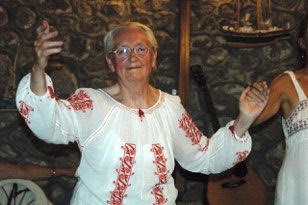
Today is ‘Bright Saturday’, the Saturday after Greek Easter (one week after Western Easter in 2019). This week is known as ‘Bright Week’, and is the joyful culmination of the Orthodox calendar cycle which began with carnival back in February. During Bright Week, people come together in celebration and feasting. Fasting is not permitted, a welcome relief after the seven weeks of Lent.

While Carnival and Twelfth Night customs are mainly performed by men, spring rituals and dances are almost exclusively in the hands of the women. Many of the dance songs are sung a cappella by the women themselves, typically in unison, emphasising group unity and solidarity. Continue reading “Ritual Dances for Greek Easter by Laura Shannon”

Generosity and Community: the Alternative Worldview of Women’s Ritual Dances, Part 2 by Laura Shannon

Dr. France LeJeune Milchberg taking her turn to lead the dance line, Lesvos 2007. Photo: Sheryl Ackerman

Starhawk describes the work of her Reclaiming collective as the creation of ‘spaces of refuge from a harsh and often hostile world, safe places where people can heal and regenerate, renew our energies and learn new skills.’[i] These words also apply to the women’s traditional dances. One participant on my courses expresses it thus: ‘In the circle no-one is left out, no-one is ignored, all are held and included, all have their place, all are connected.’[ii]

Crucially, women’s ritual dances empower everyone to develop leadership skills. Every woman must know how to lead the line at the appropriate time, and she must also know how to pass on the responsibility afterwards. Continue reading “Generosity and Community: the Alternative Worldview of Women’s Ritual Dances, Part 2 by Laura Shannon”

Generosity and Community: the Alternative Worldview of Women’s Ritual Dance, Part 1 by Laura Shannon

My life’s work with traditional women’s circle dances of Eastern Europe and the Near East has been a natural interweaving of feminism, activism and Goddess spirituality. In more than thirty years of experience, my students and I have gained valuable insight into their potential as tools for healing and transformation.

These simple and ancient dances connect us with women’s ritual practices from the past which are rooted in a Goddess-reverent paradigm honouring the earth, the body and the female face of the divine. In the present day, the practice of mindfully dancing traditional circle dances which embody this worldview can help us imagine and create a more equitable society in the future.

Continue reading “Generosity and Community: the Alternative Worldview of Women’s Ritual Dance, Part 1 by Laura Shannon”

Women’s Ritual Dances and the Nine Touchstones of Goddess Spirituality – Part Four by Laura Shannon

In Rebirth of the Goddess, Carol P Christ offered Nine Touchstones of Goddess Spirituality as an alternative to the Ten Commandments. The Nine Touchstones are intended to inform all our relationships, whether personal, communal, social, or political.[1] In this four-part blog (here are parts 1-3 Part 1, Part 2, Part 3) I am exploring ways in which these Nine Touchstones are inherently embodied in traditional women’s ritual dances of the Balkans, which has been my spiritual practice for over thirty years.

Carol’s Fourth Touchstone is: ‘Speak the truth about conflict, pain, and suffering.’ Many women’s dance songs which allow the women to speak and sing their grief and pain. When we bring that pain into the healing container of the circle, sharing simple steps, Dancers in the circle simultaneously give and receive support for their own and others’ sorrow. Ultimately, the sense of community  and solidarity in the circle transforms our grief so that the burden becomes manageable. Many historical songs, too, tell stories of women being abducted or abused, and how they fought back or got away – or not – so that they are remembered and honoured by future generations.

Continue reading “Women’s Ritual Dances and the Nine Touchstones of Goddess Spirituality – Part Four by Laura Shannon”

Women’s Ritual Dances and the Nine Touchstones of Goddess Spirituality-Part Three by Laura Shannon

Women’s apron from Pentalofos, Greek Thrace

In Rebirth of the Goddess, Carol P Christ offered Nine Touchstones of Goddess Spirituality as an alternative to the Ten Commandments. The Nine Touchstones are intended to inform all our relationships, whether personal, communal, social, or political.[1] In this series of blogs I am exploring ways in which these Nine Touchstones are embodied in the traditional women’s ritual dances of the Balkans, which I have studied as a spiritual practice for more than thirty years.

Carol P Christ’s Second Touchstone is: ‘Walk in love and beauty.’ As she says, ‘love and beauty are the great gifts of bounteous earth’.[2] Dancing women of the Balkans walk in love and beauty each time they put on their festive dress to dance together in the courtyard or the village square. Their ceremonial costumes are created from the bounty of the earth – just a couple of generations ago, this was literally the case, as the women tended the sheep, prepared and spun the wool, wove, sewed, embroidered and ornamented their garments with the work of their own hands. Even now, the cloth they buy is purchased with money they have earned from working and harvesting the land.

Continue reading “Women’s Ritual Dances and the Nine Touchstones of Goddess Spirituality-Part Three by Laura Shannon”

Women’s Ritual Dances and the Nine Touchstones of Goddess Spirituality-Part Two by Laura Shannon

In the first part of this article, I looked at how Carol P Christ’s Nine Touchstones of Goddess Spirituality from Rebirth of the Goddess are related to traditional women’s ritual dances of the Balkans. After more than thirty years of researching and teaching these dances and the way that they pass on information in encoded symbolic ways, I have come to see them as an educational system, a women’s mystery school.[1] The main message which the dances convey is an ethic of community, partnership, mutual support, and other life-enhancing values aligned with the Nine Touchstones, which can be directly experienced in the dance.

We know from the research of Marija Gimbutas that these values were central to the Old European civilizations which honoured the Goddess, while Yosef Garfinkel and Elizabeth Wayland Barber show that circle dances have their roots in these same early Neolithic cultures of Eastern Europe and the Near East. This leads me to suggest that Balkan women’s circle dances surviving today may have their origin in early egalitarian matriarchal cultures of Neolithic Europe. The Nine Touchstones of Goddess Spirituality provide an perfect template through which to explore the ethics of women’s ritual dances.

Continue reading “Women’s Ritual Dances and the Nine Touchstones of Goddess Spirituality-Part Two by Laura Shannon”

Women’s Ritual Dances and the Nine Touchstones of Goddess Spirituality-Part One by by Laura Shannon

In Rebirth of the Goddess, feminist theologian Carol P Christ offered a list of ‘Nine Touchstones of Goddess Spirituality’.[1] She revisited the Nine Touchstones in an interview with Karen Tate on Voices of the Sacred Feminine titled ‘Gratitude and Sharing: Principles of Goddess Spirituality‘, and in an inspiring series of blogs on this site recently exploring each touchstone in depth.

In her incisive analysis of the ethics of Goddess religion, Christ argues that Goddess spirituality can offer the ‘ethical guidance that we need to combat the forces of evil in our world’, and that this ethic is not imposed from a set of rational principles nor from a transcendent God known through the prophetic traditions of the Bible, as suggested by Rosemary Radford Ruether.[2] Rather, the ethics of Goddess spirituality are discerned through intuition and reflection on the world of which human beings are a part.[3]

Continue reading “Women’s Ritual Dances and the Nine Touchstones of Goddess Spirituality-Part One by by Laura Shannon”

The Cosmic Dance (Part Two) by Laura Shannon

Part One of this post looked at connections between the cosmic dance and the Goddess Hera. To read it, click here.
Pythagoras was the first to call the universe by the Greek term kósmos, referring to the order, beauty and tranquility which are inherent in natural and universal geometric form and proportion. He described the cosmos as a single living being in which all things are related, including music, beauty, movement, and justice – much as the world was understood in the Neolithic Goddess cultures of Old Europe, of which more later.

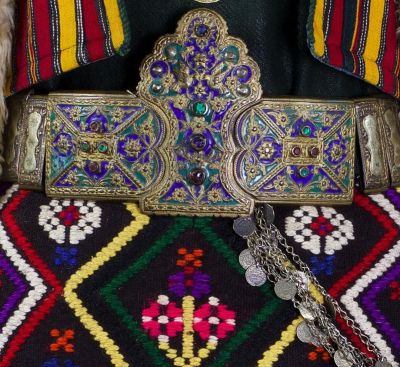
The word kósmos (κόσμος) gives us the word kósmima (κόσμημα), jewellery – silver and gold like the moon and sun, with glinting gems like the stars and planets – as well as the word kosmitiká (κοσμητικά), cosmetics. These adornments were used by priestesses in classical Greece, not to emphasise their individual beauty, but rather to identify them in their public role as instruments of cosmic beauty, harmony, and order. This is the same role which dancers take on today when they don traditional costume to dance on ritual occasions such as Epiphany or Easter. Continue reading “The Cosmic Dance (Part Two) by Laura Shannon”

The Cosmic Dance and the Goddess Hera (Part One) by Laura Shannon

Summer is here, and even with the terrible troubles going on in our world, I hope that some of us are managing to take time out and enjoy pleasant evenings outside under the stars. Gazing up at the heavens, we see the same starscape our ancestors saw, thousands of years ago.

In the worldwide Sacred Circle Dance network of which I am part, many dances have been created or choreographed which work with the energies of the sun and the moon. The power these heavenly bodies have in the human world is obvious, but many people do not realise the importance which the stars and planets also had to ceremonial practice in the ancient world. The architecture of Greek temples in antiquity was oriented to the rising of specific constellations and other astronomical phenomena, which also alerted people in far-off locations that the time was drawing near for celebrations or ceremonies in particular places. Continue reading “The Cosmic Dance and the Goddess Hera (Part One) by Laura Shannon”

My Many Grandmothers by Laura Shannon

Carol P. Christ has described spending meaningful time with her grandmother as a child and the unconditional love she received from her mother and grandmothers: ‘my relationships with my mother and grandmothers were full of love. This makes it easy for me to imagine the loving arms of Goddess embracing the world.’ She talks about this in her new book with Judith Plaskow, Goddess and God in the World: Conversations in Embodied Theology.

I have always loved to hear these kinds of stories from Carol and other friends, since I lost my own grandmothers before I felt I really knew them. My mother’s mother passed away when I was a young child. My father’s mother lived until I was in my twenties, but Alzheimer’s stripped her of her ability to recognise her family many years before her physical death. How I wish I had known them as an adult and had been able to talk to them, even once, woman to woman. And how I wish I had received the advice, support and unconditional love which Carol describes, and which I have seen other grandmothers offer their grandchildren. This absence has left an aching heart, a raw wound, for my entire adult life.

Continue reading “My Many Grandmothers by Laura Shannon”