This short paper was part of a series of assessment pieces for university where we had to imagine ourselves as people living in a number of ancient cultures. It addresses a very direct question: “Imagine you are in Ancient Greece sometime during the 5th century BCE and a family member is preparing to be initiated into the Mystery Rites at Eleusis. You have come to support them and join in the festival. Briefly describe your experience?”
It is the month of Boedromion (Late September/Early October) and the sixth day of the Eleusinian festivities held annually in the great city of Athens. I travelled some distance to take part in the nine-day festival held in honour of the ‘Greater Mysteries’ for which my niece prepared as an initiate. The city is alive with women, men and children from near and far. Many have come to take part and fulfil the countless functionary roles associated with the festival, along with the great crowd of initiates who have spent the past three days fasting and ritually preparing. Continue reading “Demeter – Mother of Creative Potential”
The end of my Ph.D. program is in sight. Originally, in 2004, I came to Boston University School of Theology (BU STH) from Los Angeles for a two-year masters program. Along the way I switched to a three-year masters program, after which I ended up staying for the Ph.D. Now, eleven years later, the end is actually in sight.
Last week I successfully defended my dissertation, “A Feminist Analysis of the Emerging Church: Toward Radical Participation in the Organic, Relational, and Inclusive Body of Christ.” Two days ago I had the last class section that I will ever teach as TA (teaching assistant) – next time I teach I will be doing so as a professor of religious studies at Cal State Northridge. Finally, because I am one of the students who will be graduating this year, I was invited to participate in the last chapel service of the year and be a speaker for the “This I Believe” service – themed after the NPR series by the same name. Yesterday, I was one of six students who were given three minutes each to share what we believe – which, let me tell you, is not a small task! Continue reading “What “I Believe” and Found Worth Sharing by Xochitl Alvizo”
Life – a precious gift I so often take for granted. Events of recent weeks have turned that blatant disregard into profound gratitude.
I began keeping bees about three years ago. My first two years were unsuccessful. But last year, bees I obtained from my bee mentor, Mike, were strong and vibrant. They provided me with my first honey harvest, wintered well, and come spring were out and about pollinating the neighborhood.
For many years I been told of the beautiful Hymn of Kassiani, sung only on Easter Tuesday night, but I had never heard it until this week. For many this song is the high point of Easter week.
Kassiani, also known as St. Kassia, was a Greek woman born into a wealthy family in Constantinople (now Istanbul) about 805 to 810 AD. According to three historians of the time, she was intelligent and beautiful and selected as a potential bride for the Emperor Theophilos. The chroniclers state that the Theophilos approached her and said: “Through woman, the worst,” referring to the sin of Eve. Clever Kassiani responded, “Through woman, the best,” referring to the birth of the Savior through Mary.
Apparently unable to accept being put in his place by a woman, Theophilos chose another bride. Kassiani founded a monastery in Constantinople becoming its first abbess. She was an outspoken theological advocate of icons during the iconoclastic crisis (for which she was flogged). One of only two women to publish under her own name during the Byzantine Middle Ages, Kassiani wrote both poetry and hymns. Up to 50 of her hymns are known today, with 23 of them being part of the Greek Orthodox liturgy. Continue reading “Kassiani: Placing a Woman at the Center of the Easter Drama by Carol P. Christ”
Sophia was the first Holy Women Icon with a folk feminist twist I ever painted. A church gallery was hosting a Lenten triptych exhibition with the theme of “The Many Faces of Jesus.” I knew immediately that the face of Jesus I wanted to portray was Sophia wisdom. Sophia is the Greek feminine word for wisdom in the New Testament. Her characteristics are similar to the Hebrew hokhma, but expand in early Christian theology as she is understood as a divine attribute, or part of the trinity. In these ways, sophia is portrayed as a hypostasis of God’s wisdom, or a part of God’s substance. Accordingly, early Trinitarian formulas reference God the father, Jesus the son, and Sophia the spirit. A female spirit was undeniably an early part of the trinity.
It is worth noting that such an early understanding of the trinity, and of an unequivocally feminine spirit, was once normative. The Spirit was understood as and spoken of as a “she.” April DeConick highlights the difficulty of such an understanding today: “[W]hat must be realized is that Judaism and Christianity are the products of centuries of religious developments. So what might have been considered ‘orthodox’ at an early time, a few centuries later might be considered ‘heretical’ because the tradition and practices had drastically changed by then (April DeConick, Holy Misogyny, 7).” What was once orthodox—a female sophia spirit—has slowly, yet intentionally been overshadowed by patriarchal understandings of the trinity and the spirit. Continue reading “Painting Sophia by Angela Yarber”
In 2014 I wrote about the passing of my dear Pop and the painting that burst forth when I was told very clearly that Pachamama had come to accompany him on his return. It is with a very heavy heart that I now write with news of the recent passing of my dear Nanna. The anchors of our family now both gone. When I was told of her passing, I envisioned her being carried by angels; at peace and free of pain.
The last time I saw her she told me the spirits had been visiting. “I’m not scared,” she declared. This was not surprising for Nan always had a close relationship with spirit. I remember her telling me of a ghostly experience she had many years ago. It was very late one night and someone had come knocking at the door. Out of bed she got and answered it only to be greeted by her brother who had died many years before. He asked her to come with him and she told him it wasn’t time yet. Nan swore it wasn’t a dream. It had really happened. This is just one of many otherworldly encounters she told me about over the years.
Much of my childhood and early adulthood was spent at Nanna’s house so there are plenty of fond and funny memories of her. Her obsession with ghost and horror stories stands out as one of them. When we were children, she would get my sister and me to stay up late with her and watch all kinds of mystery murder shows. I remember watching The Hounds of Baskerville with her and being scared witless. The bonus however was getting to cuddle up in bed with her for the night.
Reading was one of her greatest passions, and she read everything from Shakespeare to Stephen King. I believe it was Nanna who inspired my love of history and over the years we swapped and shared numerous historical books. Her knowledge of Old Britain was astounding, and I remember many a discussion over the fate of Mary Queen of Scots – Nanna was always a bit anti-English, and we often wondered how history may have unfolded if Mary hadn’t been de-throned and exiled. In fact the last book she sent for me to read was another about her.
Stargazing was another one of her loves and is something she will be dearly remembered for. Many evenings were spent out on the deck looking to the night sky. Nan knew where all the constellations and zodiac signs were and she rarely missed an astronomical event. Whenever I have looked to the stars I have thought of Nanna, but now when I look to them, she is one of them. Shining down on us brighter than ever.
I dedicated my latest painting to Nanna. For me, painting is how I can process my thoughts and feelings and is also a way to find clarity and understanding on matters such as the nature of life and death. From the moment I made the first marks on the canvas I kept hearing “your ancestors are behind you.” I knew I was being guided by them and tried my hardest to connect in with Nanna’s spirit to see and feel who guided her home. Nanna had strong ancestral ties so it was only fitting to feel them so strongly here. The two younger women standing in front are the gatekeepers, standing at the threshold to the other side. The woman in the centre came with the message that Nanna is at peace – she is peace. She is pictured smelling the roses that were one of Nanna’s favourite flowers to grow. The firebird symbolizes transformation and the flight of her spirit that is seen to the left leaving, heading back to the cosmos from whence she came.
“Suddenly all my ancestors are behind me. Be still they say. Watch & listen. You are the result of the love of thousands.” She is at Peace, by Jassy Watson
Death is surreal and it still hasn’t quite sunk in that I will never see her again. Nanna was a strong and caring woman who loved her family deeply. Her legacy is one of love, and while the circle feels broken in the sense that she is no longer physically here, it remains unbroken for her spirit lives on forever in our hearts.
I am the daughter of Ramona Cherise Lane, the granddaughter of Ailsa Aileen Rollings and the great granddaughter of Ruth Harrison. I come from a long line of beautiful, strong and capable women stretching back to the dawn of humankind. I honor them and give thanks for all that they have taught and shown me.
Nanna taught me about my ancestors.
She taught me about the importance of storytelling.
She taught me about mystery and history.
She taught me to love books.
She showed me how to crochet and knit.
She showed me how to play cards.
She showed me spirit.
In life and death Nanna has taught me of unconditional love and acceptance.
“Death leaves a heartache no one can heal, love leaves a memory no one can steal”
(Irish Headstone)
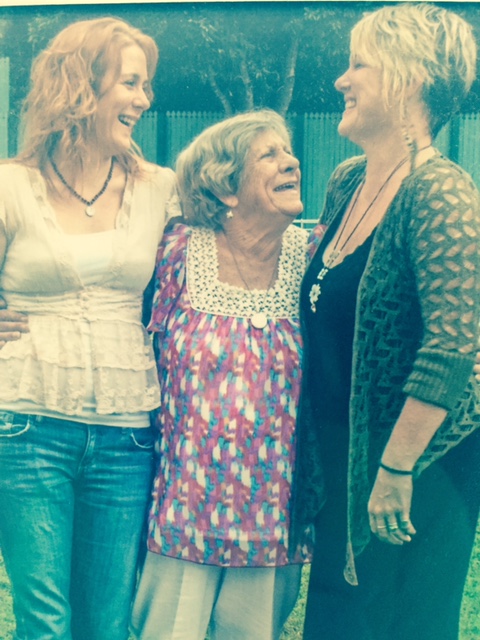
My sister Carissa, Nanna (Ailsa) and me
Jassy Watson, who lives on the sub-tropical coast of Queensland Australia, is a Mother of four, passionate organic gardener, Intuitive/Visionary & Community Artist, Teacher, Intentional Creativity Coach and a student of Ancient History and Religion at Macquarie University, Sydney. She is the Creatress of Goddesses Garden, Studio & Gallery; a school for the Sacred Creative Arts. Jassy teaches regular painting workshops in person, nationally and internationally, and online based around themes that explore myth, history, earth connection and the Goddess. Regular creative events and presentations are also held that have included visits from international scholars, artists and musicians. Visit http://www.goddessesgardenandstudio.com to read more about her and the work she creates.
Reading the story of the Levite’s pîlegeš – found in the Hebrew Bible, Judges 19:1-20:7 – is unlike any other scholastic endeavor I have undertaken.1 The narrative is of a woman who leaves her husband’s house, only to be retrieved by her husband, gang raped on her way to his home, and dismembered upon arrival. This intense violence then escalates to the abduction and rape of more than 400 virgins and the death of many more (Judges 20-21).
The first time I encountered this narrative was while reading Phyllis Trible’s Texts of Terror as an undergrad student. While at the time I did not fully understand the textual nuances Trible points out, I did understand this story was sacred in a way I could not articulate. It was not until years later that I realized I was not truly listening to the story because I had not read it from the pîlegeš’ perspective and was yet to be affected by the horror of it.
An explanation is needed when one calls a story of violence sacred. To clarify, it is the telling of the story that makes it sacred, not the violence. In much of the world today, violence done to women is taboo.2 Not only are the violent acts ignored, but the victim and her retelling of the acts are also often ignored. Perhaps this is because our society is biased towards the perpetrator. Perhaps it is because our faith communities have self-identified as loving and to acknowledge violence is to acknowledge failure. But perhaps it is mostly because violence is hard to process, especially when the violent act is committed against a loved one, and we prefer not to struggle with the presence of violence all around us. Continue reading “Painting Women from Judges – Part 3: The Sacred Account of the Levite’s Pîlegeš by Melinda Bielas”
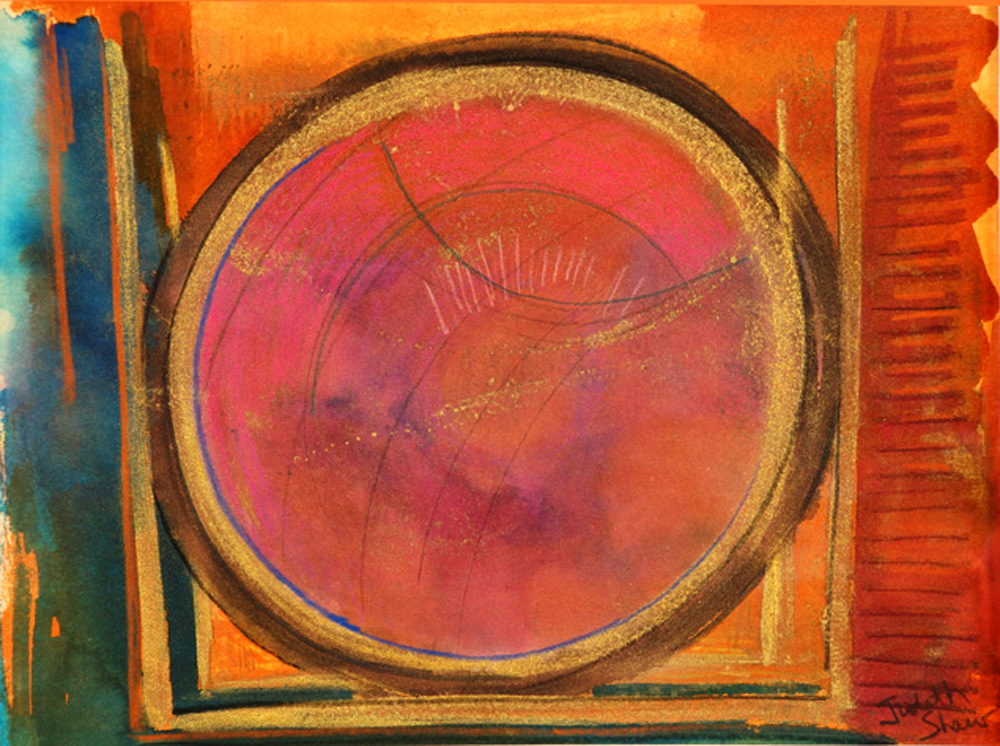
Dawn Mandala, ink and watercolor on paper, by Judith Shaw
Can geometry open our hearts and minds to spirit? Throughout time people around the world have thought so. Mandalas and Sacred Geometry symbols are found in many cultures both ancient and modern.
Mandala is a Sanskrit word which means “sacred circle.” In Buddhism, Hinduism and other ancient wisdom traditions of the East, the mandala has been used as a tool to facilitate contemplation and meditation. Through the process of studying and/or creating a mandala one can reach one’s center, one’s connection to Source. The circle, the first closed shape of Sacred Geometry, thus becomes a doorway to Oneness.
Traditional Hindu mandalas follow a strict form. Every mandala is created following the precise design of that form. One sees a further development of other Sacred Geometries within these traditional forms. First there is the squaring of the circle also known as “The Marriage of Heaven and Earth”, with the circle representing Heaven and the square representing Earth.
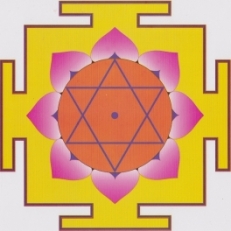
In the Hindu tradition, each design within this “Marriage of Heaven and Earth” is called a yantra mandala and functions as a symbol which reveals cosmic truths. Thus yantra mandalas become sacred geometric symbols of a particular Hindu deity.
One of the most famous yantra mandalas is the Shri Yantra, a symbol of Tripurasundari, a supreme Hindu Tantric Goddess. It depicts a series of precisely interlocking triangles, half pointing downward and half pointing upward. It forms a state of perfect balance and harmony and represents the union of the female and male principles. Also known as the Yantra of Creation or the Cosmic Yantra it is the most honored of all the Hindu yantras. The Shri Yantra becomes a door which can lead to the experience of Oneness.
Another goddess whose divine truths are revealed through the mandala is Lakshmi, Hindu Goddess of fortune, light, luck, and beauty. Meditating on the Lakshmi Yantra encourages spiritual progress and helps to overcome internal blocks.
Christianity has also used the mandala to represent Divine Oneness and to teach the wisdom of its tradition. The magnificent rose windows of the Gothic cathedrals are luminous examples of western mandalas. Complex sacred geometries were used in the architectural designs of the buildings themselves and of the rose windows.
The rose windows are a western representation of our human aspiration towards wholeness and balance. The rose windows operate on various levels; spiritual, emotional and intellectual. The instructional aspect of the rose windows is clearly seen by the subject matter – biblical stories, lives of the saints, astrological calendars, and morality stories to name a few.
In much the same way that the Hindu yantras symbolize the aspects of a particular deity, the rose windows typically show Christ or the Virgin or some other combination in the central rosette of the window. The gates at the cardinal points of the yantras depict the many paths available to reach the divine. In a similar fashion, the saints shown in the petals of a rose window can be seen as paths to Christ.
More than likely, mandalas were reintroduced into western thought through the Carl Jung’s pioneering work on the unconscious. Jung wrote: “I sketched every morning in a notebook a small circular drawing,…which seemed to correspond to my inner situation at the time….Only gradually did I discover what the mandala really is:…the Self, the wholeness of the personality, which if all goes well is harmonious.”
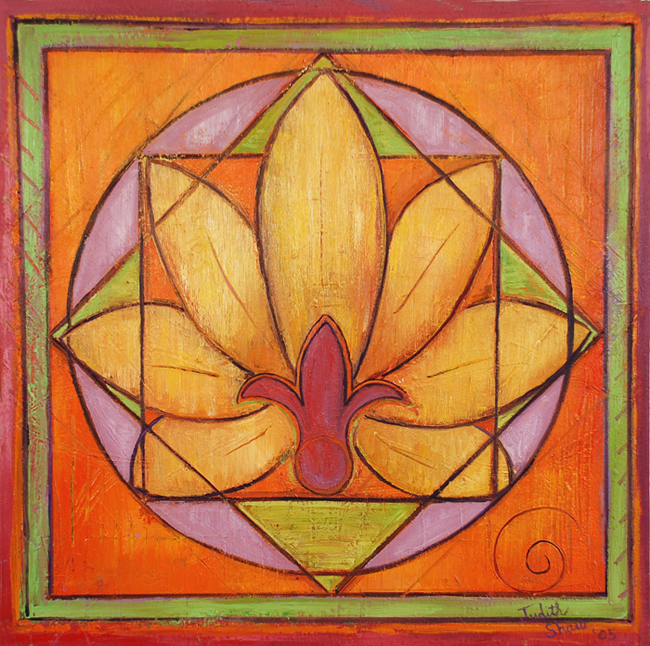
Lotus Mandala 1, oil on canvas, by Judith Shaw
Continuing in this tradition, artists and spiritual practitioners today have been exploring a more free-form style of the mandala. Within the basic foundation of the “squaring of the circle”, the artist then creates a personal, spontaneous design based on the concepts of balance, wholeness and oneness.
A quick google search reveals a multitude of mandala workshops being offered all around the world. Exploration of the mandala through these workshops offers a connection to your true self, an experience of sacred love, an opportunity to improve your life with intention, a deepening of your connection to nature, healing of emotional, mental, or physical pain, and a chance to be truly in the moment.
The mandala is a form that I have used in my own art since before I discovered the existence of Sacred Geometry. Even when not directly exploring the mandala, I find that often I want to draw a circle around the main image in my painting – seeking that experience of wholeness in the process of painting.
In future posts I will explore other elements of Sacred Geometry, all of which grow out of the mandala, the sacred circle.
Judith’s deck of Celtic Goddess Oracle Cards is available now. You can order your deck on Judith’s website. Experience the wisdom of the Celtic Goddesses!
Judith Shaw, a graduate of the San Francisco Art Institute, has been interested in myth, culture and mystical studies all her life. Not long after graduating from SFAI, while living in Greece, Judith began exploring the Goddess in her artwork. She continues to be inspired by the Divine Feminine in all of Her manifestations. Originally from New Orleans, Judith now makes her home in New Mexico where she paints and teaches part-time. She is currently hard at work on a deck of Goddess cards. Her work, which expresses her belief in the interconnectedness of all life, can be seen on her website.
The story of the woman from Timnah, Samson’s first wife – found in the Hebrew Bible, Judges 14:1-15:6 – is often interpreted as yet another wickedly seductive woman who distracts and confuses the heroic judge, preventing him from enacting the deity’s will. I remember the first time I questioned this interpretation: I was an undergraduate student teaching a youth bible study.I asked the high school students in the room what they thought about the Timnah woman and how we might understand the story differently if we read it from her perspective. Neither the students nor I had any idea how to answer these questions because we did not know how to see Samson as anything but a hero.
In her groundbreaking work, Trauma and Recovery, Judith Herman points out that it is impossible for bystanders to remain morally neutral in cases of traumatic events. However, especially in cases of violence against women, our society is biased towards the perpetrator, requiring the victims to not only explain their painful experiences but also to refute the silence, denial, and rationalization of the perpetrators. In addition, the victim asks much more from bystanders than does the perpetrator. Whereas victims ask for action, engagement, and remembrance, the perpetrator requires that the bystander do nothing. Herman’s work is significant in this context because our societal norms affect how we understand narratives and determine which morals we take from the biblical text.
While it is a prevalent view in the academy and church, I think the interpretation of Samson as the victim in this narrative is wrong. This becomes clearer when one assesses Samson’s actions when women are absent and considers the text from the woman’s perspective. Some of Samson’s actions in Judges 14 that do not occur when the Timnah woman is around to “lure” him from his divine path include: walking through vineyards, touching unclean carcasses, and participating in non-Israelite cultural traditions (i.e. drinking parties). As a Nazirite, Samson was not supposed to interact with impure things like wine, grapes, and dead bodies (Num. 6:1-21). It is odd that someone who should not be eating grapes would be walking through a vineyard (Judg. 14:5); that someone who was supposed to stay away from dead bodies would scoop honey from a carcass (Judg.14:9); and that someone who is supposed to refrain from intoxicants would participate in a drinking party (Judg. 14:10). It is clear that Samson was not an upright judge, and that loose women were not the primary cause of his unrighteous behavior.Continue reading “Painting Women from Judges – Part 2: The Woman from Timnah Reframed by Melinda Bielas”
Deborah is one of the few women in scripture depicted as a strong leader who does not need the help of a man. The start to Deborah’s story appears bland, a mere introduction to a narrative that will later become juicy, surprising, and even a bit gory. Judges chapter four merely introduces us to a woman named Deborah, a judge over Israel. Judges is a book that records a time when Israel was without a king, so judges had to arbitrate justice, command, lead, and settle disputes. The book of Judges involves a constant downward spiral in which the people of Israel experience God’s grace; they forget God and do evil; they get into trouble and cry out for help; a judge arrives to help; the people get better; the judge dies and the people repeat the cycle.
When Deborah appears on the scene, the people have gotten themselves into trouble. We, as readers, know that because she is a judge, she will deliver them. But it’s easy to pass over Deborah’s uniqueness in reading her seemingly boring introduction. As in most texts, when we take time, we realize there is much more than meets the eye. Continue reading “Painting Deborah by Angela Yarber”