Earlier this week, social media was all abuzz about the Pope’s investigation into restoring women to the diaconate. In the complete transcript of the Pope’s comments, the traditional notion of women’s maternal role in the church is mentioned in relation to the Church. Certainly this is nothing new. Here the Pope describes important “maternal” work such as working with the marginalized, catechesis, and caring for the sick – once again, nothing new.
However, in the next sentence, a very subtle shift is seen when it comes to normative gender roles:
…. there are men who do the same [work as consecrated women], and it is good…..and this is important.
What does this mean – a change in language? a laying of groundwork? or nothing at all?
It is no secret that cultural constructs of women as maternal and how a mother is defined as or even does has radically changed in today’s society; but, the Church continues to remain steadfast in normative roles between the priesthood and the “motherhood” of the Church (and therefore “motherhood” in general).
Reading the recently released papal letter “The Joy of Love,” I was surprised to see that it opens a “new” discussion of marriage and the family with a very old patriarchal trope from Psalm 128:
Blessed is every one who fears the Lord,
who walks in his ways!
You shall eat the fruit of the labour of your hands;
you shall be happy, and it shall go well with you.
Your wife will be like a fruitful vine
within your house . . . (see ch. 1, pp. 7-8)
Notwithstanding the “inclusive language” translating the male generic in Hebrew as “one,” there is no way around the fact that this psalm is addressed by a male God to men. It compares women to property owned and tended by men. Nor does it provide any opening to consider the blessings of same sex marriage. Continue reading “The Pope Punts and Catholics Vote with Their Feet by Carol P. Christ”
Last week I watched Spotlight, the film about the Boston Globe‘s exposure of priests’ sexual abuse of children, and then I watched it again. There are many reasons for my fascination with this film. I almost always root for the underdog, and in this story the underdog wins. Moreover as a former Catholic (for a period of time) and as part-Irish, I relish an inside glimpse of the machinations of the all-male Church hierarchy and the all-male Irish power structure that supported it in Boston.
A theology of complementarity, referred to by Pope Francis as an “anthropological fact,” has had a strong influence on American politics. According to the Vatican teaching, women and men have distinct but complementary roles, meaning that women’s value is found in the home as wife and mother and men are responsible for providing for the family. Such a teaching is highly problematic in that it demeans women’s value and places women on the underside of dualism.
As a woman with an ongoing struggle with infertility, I find it troubling that my church sees my value as less because my womb is barren. Likewise, do women have less value if they choose a career over motherhood? What if they choose not to marry? There are also clear implications for single parents, LGBTQ parents, and so on. In addition, societal norms make clear that women’s work in the home is not valued as the work of men in society. Likewise, it is damaging to men in that it refuses to acknowledge the critical role men play in the household, in the lives of their children, and their responsibilities to be partners and co-parents.
The idea of complementarity upheld by Pope Francis greatly contributes to economic injustice for women. The Vatican’s refusal to value women’s roles outside the home influences US social policy on women’s issues. The continued struggle to close the pay gap, implement paid parental leave, and create viable options for childcare and early childhood education are directly connected to complementarity. If women are supposed to remain in the home and be wives and mothers, then there is no need to address any of these issues. How can we possibly have women in leadership roles if they are supposed to be at home cooking dinner and caring for children? And so, when women do pursue careers the social attitude is that women do not belong. Such an idea is even more problematic for women of color who suffer a lower pay rate – $.64 on the dollar for African American women and $.54 for Latina women. Furthermore, many have have been forced to work outside of the home as a result of economic and racial injustice. In this secular nation, Christian values dominate our political debates and perpetuate the idea that women are subordinate to men. And to be frank, these are community issues that impact men as well as women; yet they have been deemed women’s issues as a result of the manifestation of theological teachings.
As republicans focus on defunding Planned Parenthood, ending marriage equality, protecting religious freedom, and claiming issues like parental leave are not federal issues, women continue to be relegated to second class status. In a time of turmoil and multiple threats to the progression of our nation, there is greater concern for regulating women’s bodies than guns.
Pope Francis has been praised for his commitment to the poor; yet he has been unable to make the connection between poverty and the women’s issues that exist as a result of complementarity. Likewise, the Church’s stance on reproductive justice continues to perpetuate the very issues that the pope seeks to address. As Sr. Joan Chittister points out:
I do not believe that just because you’re opposed to abortion, that that makes you pro-life. In fact, I think in many cases, your morality is deeply lacking if all you want is a child born but not a child fed, not a child educated, not a child housed. And why would I think that you don’t? Because you don’t want any tax money to go there. That’s not pro-life. That’s pro-birth. We need a much broader conversation on what the morality of pro-life is.
No doubt, his lack of relationships with women is a major contributing factor to his ignorance when it comes to such issues – by the way, which could be easily fixed by embracing women’s ordination. And so, as Pope Francis has become an international figure deemed a savior to the people, these disconnects fuel ongoing US political debates that keep women in a marginalized position and continue a cycle of poverty and oppression.
Pope Francis has called for a “Year of Mercy” in which he has stated that if a woman confesses having an abortion, she will be forgiven. Many have praised the pope for taking such a step towards healing; yet, I can’t help but think, “how judgmental and irresponsible.” Without knowing a woman’s circumstance, her decision making process, her doctor’s concerns, etc., why should one be told to repent? To deny women the right to reproductive justice is to deny women the ability to make decisions about their physical, emotional, and financial health – and we see this play out in the US as a result of the influence of complementarity in our political system. So, in this “Year of Mercy,” I wonder will the Vatican confess its sins against women, LGBTQ persons, and others it has marginalized?
Portions of this article are excerpts from If Jesus Ran for President coming from the Far Press in Spring, 2016.
Gina Messina-Dysert, Ph.D. is Assistant Professor of Religion and Gender Studies at Ursuline College and Co-founder of Feminism and Religion. She writes for The Huffington Post, has authored multiple publications and is the co-editor of the highly acclaimed Faithfully Feminist: Jewish, Christian, and Muslim Feminists on Why We Stay. Messina-Dysert is a widely sought after speaker and has presented across the US at universities, organizations, conferences and on national platforms including appearances on MSNBC, Tavis Smiley, NPR and the TEDx stage. She has also spoken at the Commission on the Status of Women at the United Nations to discuss matters impacting the lives women around the world. Messina-Dysert is active in movements to end violence against women and explores opportunities for spiritual healing. Connect with her on Twitter @FemTheologian, Facebook, and her websiteginamessinadysert.com.
She appeared on a hill on December 9, 1531. She spoke to Juan Diego in his native tongue of Nahuatl; the language of the Aztecas. She asked for a church to be built at that very site in honor of her, the Virgin Mary. Juan Diego took the request to the local priest, but his story was not believed. On December 12, following further instructions from La Virgen, Juan Diego was able to find and pick roses not native to Mexico. He rolled them up in his tilma and returned to the priest. When he unrolled his tilma to present the roses, there on the tilma was the image of La Virgen de Guadalupe; she was as dark as the natives themselves.
Natives across Mexico and throughout the Americas endured the brutal realities of conquest, and experienced the relegation to second class citizens during the colonial period in Mexico. In particular, native women experienced oppression two-fold. This is evident in the fact that native men had privileges and opportunities within the public sphere of society which were denied to women, such as holding particular types of public service positions.
So how is it that millions of natives across the continent converted to Catholicism, the religion used by their oppressors to justify the horrors and atrocities inflicted upon them? The appearance of La Virgen to Juan Diego. She is seen as the blending of the Indigenous and European cultures. A Huffington Post article, Everything You Need to Know About La Virgen de Guadalupe, explains, “Her image has been used throughout Mexican history, not only as a religious icon but also as a sign of patriotism.” Indeed, she has appeared as a symbol even in the most pivotal of moments, such as the fight for Mexican independence and the Mexican Revolution. The authors of the study The Evolving Genre of ‘Our Lady of Guadalupe’: A Feminist Analysis, also note that she has become “. . .the ideal model for womanhood and motherhood.” Continue reading “La Virgen de Guadalupe: New Feminist Portrayals by Jose Duran”
Last week I was finally able to see “Spotlight“, the recent movie depicting the true story of the Pulitzer Prize-winning Boston Globe investigation into the priest pedophilia abuses. What makes “Spotlight” so compelling is the shared burden of culpability by those outside the organized Catholic Church. While hunting down the priestly offenders, including Cardinal Bernard Law, “Spotlight” also takes calculated aim at those official offices and individuals that turned a blind eye from the sexual abuse of children. In his NCR review, film critic Steven D. Greydanuspraises the film for its ability to include such collaborators as “Lawyers, law enforcement, family members and friends, and pointedly and repeatedly, the fourth estate itself—the press and specifically the Globe – are all implicated.” Which is to say, the sin of silence through a misguided sense of protection of the institution is as damaging as the act itself.
In the Globe’s investigative work, ateam of four reporters begins the difficult work of interviewing survivors of sexual abuse. What moved me deeply was the recurrentsyllogism expressed by each in their retelling of the abuse at the hands of their parish priest. In the first statement of a syllogism, the major premise is the articulating of the moral principle. Step two, the minor premise, is the particular act to be judged. Step three is the logical conclusion inferred between the major and minor statements. With regard to the Catholic Church’s doctrine of the priesthood and views expressed by survivors, the syllogism looks like this:
Step 1:“By ordination one is enabled to act as a representative of Christ, Head of the Church in his triple office of priest, prophet, and king” (Catechism of the Catholic Church, # 1581)
Step 2: All priest (as males) reflect Jesus Christ in word and deed.
Step 3: When a priest abuses children it is as if Jesus Christ is also the abuser.
For those survivors interviewed by the Globe, their early religious teaching of the priest as Jesus made Jesus as God a participant in the abuse. Cries of anger over the abuse at the hands of priest who stood in the place of God turned to lament at the losing of ones faith and belief in a benevolent God. Continue reading ““Spotlight” and the Recovery of a Lost Faith by Cynthia Garrity-Bond”
“Is that your wife or your girlfriend?” These words were addressed to my husband a few weeks back as I walked up to a podium, where I was to sit on a panel and give my views on the relationship between the Church and Generation X. The event was a well-attended and well-funded initiative by a well-known organization, celebrating its multi-decade long history of supporting progressive action and vision for the future the Roman Catholic Church. After accolades, awards, and a stirring keynote, I and two others were to address in cross-generational perspective, the needs of changing populations of Catholics.
It was a slightly uncomfortable event for me because I was not sure who my audience was, but I was pretty certain early on in the night that everyone in the room had more or less acquiesced to the same set of ideas, framed in the same ways, and represented by the same heroic champions of women’s ecclesial vocations and same-sex unions. I knew basically what this group was about, but I had not prepared remarks specifically aimed at women’s ordination or homosexuality. I focused on the issues of authority, ambiguity, and ambivalence as historical-situational markers for Gen X (that is, to the extent that I felt that I could say anything collectively about or for Gen X at all), and as a result I was not sure that my words, perhaps misaligned, would really add too much to the evening.
As it turned out, it did not matter what I had prepared to say because I didn’t have a chance to say it. The accolades, awards, and stirring keynote went way too long, and the panel had fewer than fifteen minutes total, including Q & A, to address the perspectives of representatives of three different generations on the status of the Roman Catholic Church. Ah, the best laid plans, right…
So, it felt a little like a bust, but at least at first I thought it was still a nice enough night. The location was a bit of a drive from my house, but it happened that my mom was visiting AND my husband was free. This meant that my mom could watch the kids and William could drive with me – a rare thing for my speaking and even rarer on a random, unplanned weekday. As we were getting ready for bed, as I often do, I asked William to tell me a joke. He hesitated for a moment, and then this exchanged followed: Continue reading ““Is that your wife or your girlfriend?” by Natalie Weaver”
In my class yesterday (a survey of Christian thought and practices), I was lecturing about monastic life in the Middle Ages. Among other points, I mentioned that medieval religious orders provided settings where women could be educated and assume leadership roles (primarily among other women), thinking of Hildegard of Bingen (1098-1179) who was the Abbess of a monastic community in Rupertsberg. Other women medieval writers who developed influential writings, like Mechtild of Magdeburg (ca. 1210-1282) and Catherine of Siena (1347-80), belonged to tertiaries or third orders, which were monastic community for laypersons. This part of the lesson emphasized that monastic reforms around the 12th century opened religious orders more extensively to women and laity.
Still speaking of medieval reforms, I displayed a picture of Francis of Assisi on the screen at the front of the room. I mentioned that Francis was concerned about the poor and the animals and that he has inspired some contemporary Christians, including the current pope who took Francis as his name. We talked about how both St. Francis and Pope Francis are seen as reformers.
Because earlier in my lesson I’d made a point of speaking of women’s experience, when I spoke about the Pope’s name as a possible sign of renewal or reform, Gina Messina-Dysert’s question “What about the women?” came to mind. In her recent post, she responded to the Pope’s exclusion of many issues that concern women in his address to the US Catholic Bishops. Like Gina, I applaud many of the Pope’s reforms but I am confused about how rarely he is criticized for maintaining the long-held Catholic view that disallows women to be ordained as priests.
Let me provide an example: During the Pope’s visit to the US, one of my students described Pope Francis as “very liberal.” When I interjected that he has not supported the ordination of women, the student laughed and said the pope would be accused of heresy for supporting that! While that may be true, my more immediate concern was that in a classroom of students who are mostly supportive of women in ministry, the Catholic restrictions on the priesthood were seen as a part of the tradition not worth challenging. Why is it that preserving male leadership is excused as a part of the tradition while preserving exclusive marriage practices is something to be challenged? They are interrelated.
As we know from blogs and social media sites, many people who support LGBTQ rights were upset over news stories about the Pope meeting with Kim Davis, the county clerk who was jailed for refusing to issue marriage licenses to same-sex couples. Certainly such a meeting is disturbing to same-sex marriage advocates. But is it surprising? At least one womanist ethicist I know, Eboni Marshall Turman, pointed out in a Facebook discussion that the church has long since been public in its support of male privilege and heteronormativity. My intent is not to single out Catholicism for sexist practices. When recently asked about women’s ordination and leadership in Baptist churches in my own town of Waco Texas, I had to admit that even though ordination of women is permissible and practiced in many of the churches, the number of churches that have called women to the position of senior pastor is shockingly few.
My point is this: When we find teachings in particular religious traditions that justify the exclusion of one group, we should expect to find justifications for excluding other groups, too. In the same discussion I referenced above, Eboni Marshall Turman said, ”Oppressions are compounded and intersectional. If they come for me, it is just a matter of time before they come for you. This is basic theological ethics.”
The experiences of varied groups are not the same; our oppressions and marginalizations also differ. But practices of exclusion are constructed on the same logic that values some persons (the in-group) more than others (the outsiders). Therefore, feminists have a responsibility to advance the well-being and interests of other groups (besides women) who are being marginalized.
Another reason for this advocacy is that many women are included in other marginalized groups. To ignore the intersectionality of oppression is to deny its pervasiveness and the realities of women’s lives. This is why feminists of color are often critical of white feminism. (The recent debate over the photo shoot for the movie Suffragette is a new instance of a persistent critique of white or mainstream feminism. See Rebecca Carroll’s piece on “Suffragette’s Publicity Campaign and the Politics of Erasure”).
To counter the limitations of our own experiences and be consistent in our pursuit of equality, feminists should intentionally cultivate practices of solidarity and coalition-building in our work. I, like everyone else, am often unable to see the inconsistencies in my own practices and teachings without others’ experiences to expand my view. This is one reason I value this Feminism and Religion community. Thank you for the wisdom and practices you offer from your own religious traditions and your own experiences of marginalization. You make me a better feminist through your writings and comments.
Perhaps working together, we can bring about religious reforms that our descendants will recognize in the centuries to come.
Elise M. Edwards, PhD is a Lecturer in Christian Ethics at Baylor University and a graduate of Claremont Graduate University. She is also a registered architect in the State of Florida. Her interdisciplinary work examines issues of civic engagement and how beliefs and commitments are expressed publicly. As a black feminist, she primarily focuses on cultural expressions by, for, and about women and marginalized communities. Follow her on twitter, google+ or academia.edu.
Pope Francis offered many words of wisdom and discussed key issues in his address to US Bishops in Washington DC. He acknowledged the sex abuse scandal as a crime and called for bishops to be healers. He asked that bishops move beyond their own perspectives and be open to dialogue. And his personal call to act as pastors to immigrants in the US is one that we should all adhere to. However, I must ask, what about the women?
Noticeably absent from Pope Francis’ address are the many issues that are directly connected poverty and keep women suppressed in the Catholic Church. While he has addressed particular women’s issues on certain occasions, the pope’s comments have been brief and not followed with action. In addition, they do not honor the ongoing struggles women endure as a result of institutional violence that stems from Vatican teaching.
Frances Xavier Cabriniwas an Italiannun, who founded the Missionary Sisters of the Sacred Heart, serving the Italian immigrant population in Chicago. Despite the lack of support by bishops and clergy alike, her groundbreaking outreach to the poor and marginalized, earned her the privilege of being the first naturalized citizen of the United States to be canonized by the Roman Catholic Church.
More contemporary Chicago feminist prophets include Tina Fey, Jennifer Hudson and Chaka Kahn. And, I would be remiss not to invoke the names of the Holy Trinity of contemporary Chicago women saints….Hillary Clinton, Michele Obama and Oprah Winfrey.
So, now we focus on Francis, who I call my Holy Conundrum.
His words are, indeed, impressive….listen to what he says…..
The best wines come from every person who risks everything on love.
Things have a price and can be for sale, but people have a dignity which is priceless.
Let the church always be a place of mercy and hope where everyone is welcomed, loved and forgiven.
It is vital that government leaders and financial leaders take heed and broaden their horizons working to make sure that all citizens have dignified work, education and healthcare.
Finally,
Let us not be afraid to say it: we want change, real change, structural change. We want change in our lives, in our neighborhoods, in our everyday reality. We want a change which can affect the entire world, since global interdependence calls for global answers to local problems. The globalization of hope, a hope which springs up from peoples and takes root among the poor, must replace the globalization of exclusion and indifference!
Makes one wonder….
Does Francis truly intend to inspire the church to become the open window of John XXIII, letting in the fresh air of the Spirit or does he represent an institutional dose of air freshener; hoping we would smell the roses rather than the stench of a clerical system which, at best isolates women and at worst, renders them invisible? Continue reading “Francis: My Holy Conundrum by Linda Pinto”


 Earlier this week, social media was all abuzz about the Pope’s investigation into restoring women to the diaconate. In the complete transcript of the Pope’s comments, the traditional notion of women’s maternal role in the church is mentioned in relation to the Church. Certainly this is nothing new. Here the Pope describes important “maternal” work such as working with the marginalized, catechesis, and caring for the sick – once again, nothing new.
 ntly released papal letter
 Last week I watched
  A theology of complementarity, referred to by Pope Francis as an “anthropological fact,” has had a strong influence on American politics. According to the Vatican teaching, women and men have distinct but complementary roles, meaning that women’s value is found in the home as wife and mother and men are responsible for providing for the family. Such a teaching is highly problematic in that it demeans women’s value and places women on the underside of dualism.
 Portions of this article are excerpts from
  She appeared on a hill on December 9, 1531. She spoke to Juan Diego in his native tongue of Nahuatl; the language of the Aztecas. She asked for a church to be built at that very site in honor of her, the Virgin Mary. Juan Diego took the request to the local priest, but his story was not believed. On December 12, following further instructions from La Virgen, Juan Diego was able to find and pick roses not native to Mexico. He rolled them up in his tilma and returned to the priest. When he unrolled his tilma to present the roses, there on the tilma was the image of La Virgen de Guadalupe; she was as dark as the natives themselves.
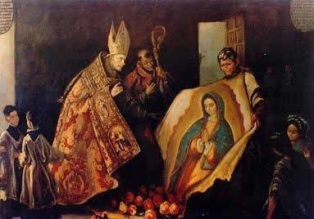 La Virgen de Guadalupe
 Last week I was finally able to see “
 “Is that your wife or your girlfriend?” These words were addressed to my husband a few weeks back as I walked up to a podium, where I was to sit on a panel and give my views on the relationship between the Church and Generation X. The event was a well-attended and well-funded initiative by a well-known organization, celebrating its multi-decade long history of supporting progressive action and vision for the future the Roman Catholic Church. After accolades, awards, and a stirring keynote, I and two others were to address in cross-generational perspective, the needs of changing populations of Catholics.


 Feminism and Religion