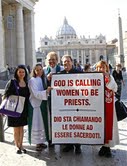
Pink Smoke, Call to Disobedience, and a Holy Shake-Up: Is it Time to Convene the Third Vatican Council? By Michele Stopera Freyhauf

This past August I wrote about the canonical warning that Fr. Roy received and the issue surrounding the exercise of conscience over church teaching.  For a more detailed explanation of the warning and the background regarding the ordination of women, please see my prior article.

October 17th (this past Tuesday), Fr. Roy Bourgeois, Erin Saiz Hanna (Executive Director of Women’s Ordination Council), Therese Koturbash (Coordinator of Canada’s Catholic Network for Women’s Equality), Nicole Sotelo (Call to Action), Miriam Duignan (Womenpriests), and about 14 other representativesof various other Catholic organizations from around the world went to the Vatican to

present a petition containing 15,000 signatures supporting full and equal participation of women as deacons, priests, and bishops in a renewed church. The group was not permitted in St. Peter’s Square because of their signs; they did not have the proper permit.  Access was also denied to the Women who wore albs/stole because their dress was considered a form of protest.  “We love our family, the Catholic Church,” stated Miriam Duignan of Women-Priests.  “We feel obliged in conscience to make our carefully considered reasons known.  In doing so, we fulfill our canon law duty to speak out, as our present Pope has encouraged us to do.”  Koturbash states “even though canon law invites our Church leaders to hear from the faithful, our leaders are silent when we try to engage.” Continue reading “Pink Smoke, Call to Disobedience, and a Holy Shake-Up: Is it Time to Convene the Third Vatican Council? By Michele Stopera Freyhauf”

Rosemary Radford Ruether’s Women and Redemption: A Theological History By Gina Messina-Dysert


Women and Redemption : A Theological History. 2nd ed. By Rosemary Radford Ruether.Minneapolis: Fortress Press. 2011.

Women and Redemption: A Theological History

Having been critically impacted by the work of Rosemary Radford Ruether, I was anxious for the release of the second edition of her crucial book, Women and Redemption: A Theological HistoryRedesigned with illustrative material, research questions, and suggested reading for further research, as well as the addition of a new chapter exploring recent developments in feminist theology, this text does not disappoint.

With this newest edition, Ruether acknowledges the ongoing journey in the field of feminist theology and emerging issues faced by women in religion and society. Examining the Christian claim of an inclusive and universal redemption in Christ, she traces paradigm shifts in understandings of gender over the last two millennia.  Ruether offers an historical exploration of women and redemption in the first five chapters followed by a global survey of contemporary feminist theologies in the final four chapters, which includes a concluding section that gives attention to “Fourth World” feminisms and post-colonialism in an effort to “bring this volume up to date” (xvii). Continue reading “Rosemary Radford Ruether’s Women and Redemption: A Theological History By Gina Messina-Dysert”

Anita Caspery, IHM: Prophetic Icon of Renewal By Cynthia Garrity-Bond

this we were, this is how we tried to love,

and these are the forces they had ranged against us,

and these are the forces we had ranged within us,

within us and against us, against us and within us.

Adrienne Rich

Last week a colleague of mine forwarded the sad news that Anita Caspary, IHM, had died at the rich age of 95. This was the same day (October 5) that Steve Jobs passed away from his battle with pancreatic cancer.  The tension between the two figures was not lost on me.  The death of Jobs, an icon of ingenuity and leadership, wonderful husband and father, is mourned throughout the world.  The life and legacy of Anita Caspary will be remembered and mourned as well, but by comparison, on a much smaller scale. That’s unfortunate, because the life and legacy of Caspary as an instrument for change in the lives of Catholic women in general, and Women Religious in particular is what legends are made of.

As an IHM sister, Caspary was teacher, poet, author, and president of Immaculate Heart College (1958-1963), but is best known in her role as Mother General Sister Humiliata (1963-1973) of the IHM’s.  In Witness to Integrity, Caspary dramatically chronicles the painful struggles and controversies between the IHM sisters and Cardinal Archbishop of Los Angeles, James Francis McIntyre, in which 600 IHM Los Angeles nuns were released from their canonical vows in 1970.  Released because of their self-determination in remaining at the center of their religious fidelity and thought by putting into practice The Second Vatican Council’s  Decree on Up-to-Date Renewal of Religious life, or Perfectae Caritatis Addressed to priest and religious, this decree sanctioned the exodus from the middle ages for the sisters by insisting they join the modern world in both dress and discernment of vocation that best utilized each sister’s talents.  In an exert put forth from the 1967 Decrees of the Ninth Chapter, the IHM community clarify their position for renewal: Continue reading “Anita Caspery, IHM: Prophetic Icon of Renewal By Cynthia Garrity-Bond”

Room at the Table: The “Problem” of Men By Lara Helfer

This post is written in conjunction with the Feminist Ethics Course Dialogue project sponsored by Claremont School of Theology in the Claremont Lincoln University Consortium,  Claremont Graduate University, and directed by Grace Yia-Hei Kao.

Lara Helfer is a 3rd year MDiv Student at Claremont School of Theology. She is humbled and excited by the intelligence, passion, and commitment of her classmates and professors, and looks forward their feedback and challenges to her very first blog post. 

As an out lesbian for more than 25 years, I have always struggled with the separatist movements associated with radical feminism. For me, affiliating as a ‘woman loving woman’ means just that, I love women. But wait – I love men too!  Whom I partner with – and yes, as a lesbian my partner is a woman – is but one aspect of me. Being a lesbian is not all of who I am, by far. I can’t, and do not wish to, imagine my life without men as an integral part of it. Continue reading “Room at the Table: The “Problem” of Men By Lara Helfer”

What Does It Mean to Say that All White Feminists Are Racist? (Questions Posed to White Women/Myself about Our Part in the Dialogue with Women of Color) By Carol P. Christ

Carol P. Christ, a founding mother in the study of Women and Religion and Feminist Theo/a/logy, has been active in anti-racist, anti-poverty, anti-war, feminist, pro-gay and lesbian, anti-nuclear, and environmental causes (in that order) for many years.  All of these issues have informed her teaching, her scholarship, and her politics.

The recent posting of Mary Daly’s letter to Audre Lorde on the Feminism and Religion blog is a correction of a piece of feminist history that is important in its own right and because of the way Lorde’s letter has shaped feminist discourse and politics up to the present day.  Knowledge of the existence of Daly’s letter and the facts surrounding Lorde’s distortion of history has been in the public domain since the 2004 publication of Alexis DeVeaux’s Warrior Poet, but when I searched the internet for a copy of “Mary Daly’s letter to Audre Lorde” a few days ago, what came up was Lorde’s letter to Daly — not Daly’s letter to Lorde.

I often hear younger feminists say that “all white feminists” of the older generations “were racist.”  Sometimes Mary Daly is mentioned.  Setting the record straight about Mary Daly is one step in retelling the history of feminism in a more complex way.  Continue reading “What Does It Mean to Say that All White Feminists Are Racist? (Questions Posed to White Women/Myself about Our Part in the Dialogue with Women of Color) By Carol P. Christ”

Mary Daly’s Letter to Audre Lorde

Note: This is an old conversation, in so many ways (including, historical). The more important elements of this exchange is the content, experience, and work that Audre Lorde was communicating in the writing of her original letter to Mary Daly. It is the plea we continue to hear today from those whose voices are systematically marginalized, brutalized, and erased. To that point, this post fails to take heed, and reflects the personal relationship many had to Daly, and not to Lorde, and is therefore another example of the wrongheaded emphasis so many of us continue to fall into. We must and will do better. And the post remains here as another negative example and a case study, the lesson of which is a call to renew one’s commitments to be willing to hear, see, and feel the cries of those bearing the brunt of injustice, and respond in justice-making actions. Here is Audre Lorde’s letter, which, as Ellen in the comments below rightly states, is a “deep, heart-felt, informed, impassioned, desperately empathic response,” written of her great beneficence. Spend time with Lorde’s powerful words:  https://www.historyisaweapon.com/defcon1/lordeopenlettertomarydaly.html.
– Xochitl, 2/22/23  

In May of 1979, Audre Lorde shared her critique of Gyn/Ecology with Mary Daly via a letter.  Lorde claimed she had received no response from Daly and subsequently published her assessment of Daly’s work as an open letter, first in This Bridge Called My Back in 1981 and then in Sister Outsider in 1984. Lorde had commented on this issue over the years and in 1982 claimed in an interview that if she had received a response from Daly, she would not have published her critique as an open letter. Lorde’s letter was widely republished and has been used as a paradigmatic teaching tool for the study of “white feminist racism” in Women’s Studies courses.

However, in 2003 as Alexis De Veaux was completing research for her forthcoming biography about Lorde, Warrior Poet, she  found Daly’s letter of response in Lorde’s papers.  On the letter Daly’s last name was written in the bottom corner in Lorde’s handwriting.  On June 9, 2003 De Veaux contacted Daly explaining her discovery and asked permission to quote from Daly’s letter that was dated September 22, 1979.  DeVeaux wrote about the existence of the letter and what must have been an unsatisfactory encounter between the two women at a conference in late September 1979; she also speculated on the reasons Lorde chose not to disclose receiving the letter.

In Amazon Grace Daly tells her version of the story and explains that it was gratifying that De Veaux thought it was crucial to publish the letter and correct the widespread misbelief that Daly had not responded to Lorde (26).  Shortly after Daly received a copy of her letter from DeVeaux, she called friends and colleagues asking them to help make this information more widely known.  Carol P. Christ gave me access to the copy of Mary’s letter she received at that time.  Because parts of the letter itself may be difficult to read, I am also posting a transcription.

September 22, 1979

Dear Audre,

First, I want to thank you for sending me The Black Unicorn.  I have read all of the poems, some of them several times.  Many of them moved me very deeply – others seemed farther from my own experience.  You have helped me to be aware of different dimensions of existence, and I thank you for this.  

My long delay in responding to your letter by no means indicated that I have not been thinking about it – quite the contrary.  I did think that by putting it aside for awhile I would get a better perspective than at first reaction.  I wrote you a note to that effect which didn’t get mailed since I didn’t have your address.  Then there was a hope of trying to get to Vermont in August, but the summer was overwhelmingly eventful.

Clearly there is no simple response possible to the matters you raise in your letter.  I wrote Gyn/Ecology out of the insights and materials most accessible to me at the time.  When I dealt with myth I used commonly available sources to find what were the controlling symbols behind judeo-christian myth in order to trace a direct line to the myths which legitimate the technological horror show.  But of course to point out this restriction in the first passage is not really to answer your letter.  You have made your point very strongly and you most definitely do have a point.  I could speculate on how Gyn/Ecology would have been affected had we corresponded about this before the manuscript went to press, but it doesn’t seem creativity-conducing to look backward.  There is only now and the hope of breaking the barriers between us – of constantly expanding the vision.

I wonder if you will have any time available when I come to New York for the Simone de Beauvoir conference?  Since I have a lot to do here, I had thought of just flying down Friday morning and returning that night.  Are you free Friday afternoon or evening?  Or will you be in Boston any time soon?  I called and left a message on your machine.  My number is …. Hope to see you and talk with you soon.

[Handwritten] I hope you are feeling well, Audre.  May the strength of all the Goddesses be with you – Mary

Click the link below to view a copy of the actual letter from Daly.

Mary Daly’s letter to Audre Lorde

Also see:

Mary Daly speaking about discovering that she responded to Audre Lorde in writing and that Audre Lorde kept the letter and deposited it at Spellman College

Mary Daly’s recollection of the events in Amazon Grace, p. 22-26

Warrior Poet, p. 233-238, 246-248, 251-253

Adrienne Sere’s In remembrance of Mary Daly: Lessons for the Movement

Carol P. Christ’s response to the publication of Daly’s letter on this blog: What Does It Mean to Say that All White Feminists Are Racist? (Questions Posed to White Women/Myself about Our Part in the Dialogue with Women of Color)

(This blog was revised on October 8, 2011)

Taking my body back from… the pill? A call for more of “her stories” about contraception By Sara Frykenberg

I recently made what felt like a very big decision in my life to stop taking the birth control pill… not to try to get pregnant mind you, though some of those I told incorrectly read this as the subtext of my decision. I stopped taking the birth control pill because I didn’t like what it was doing to my body.   So, I am taking my body back… but from the pill? Really?  Didn’t it, in some ways, give me a kind of freedom?  Didn’t it do what it promised and help me to feel that I was being responsible in my sex life (since I don’t want kids right now)?  Yes, I suppose it did; and I very much believe that access to contraception is a very important feminist and religious issue.  … But after a three year on and off relationship and six years steady with pills, all with different side effects, all with different demands on my metabolism and libido, I began to feel a stranger to my nether regions and so I have decided to stop. Continue reading “Taking my body back from… the pill? A call for more of “her stories” about contraception By Sara Frykenberg”

The Misbegotten Male: Male Sex-Selection & Female Abortion By Cynthia Garrity Bond

I turned away and, despite myself, the tears came, tears
Of weakness and disappointment; for what woman
wants a girl for her first-born?  They took the child from
me.  Kali said: “Never mind.  There will be many later
On.  You have plenty of time”
To our modern sensibility, the ancient Greeks understanding of procreation is as far reaching as say Nordstrom’s may be to any dollar store.  To the Greeks, men’s testicles had a particular function or job to fulfill: the left one produced girls with the right one producing boys.  For Aristotle, if you were willing to “man-up” and take the pain, tie off your left testicle during intercourse in order to insure the birth of a son.  In this formula, if something were to go wrong, even though you followed the correct game plan and a girl was born instead of the hope for son, something obviously went wrong at conception, thus the term “The Misbegotten Male,”i.e. a daughter, as the misbegotten.   Continue reading “The Misbegotten Male: Male Sex-Selection & Female Abortion By Cynthia Garrity Bond”

Infantilizing Women, Sexualizing Girls By Grace Yia-Hei Kao

Continue reading “Infantilizing Women, Sexualizing Girls By Grace Yia-Hei Kao”

Idealistic, Cynical, and Pragmatic Mormon Feminists: Who Stays, Who Goes

One of my Mormon feminist friends once made an observation to me about feminists who were able to stay and even thrive within the Mormon Church, versus the ones who left or were forced to leave. She saw that the more pragmatic and cynical feminists seemed to be able to remain practicing, whereas the idealistic feminists were the ones who didn’t stay.

I thought this was an intriguing framework: the idealistic ones who can’t endure the dissonance between what they know in their heart is right/just and what the Church teaches about gender eventually leave the Church, whereas the pragmatic or cynical ones who see patriarchy as inescapably infusing almost all institutions (universities, corporations, etc.) or who decide to weigh the pros and cons and stay for various reasons including community, family, heritage, and root belief in core Mormon teachings tend to be able to make Mormonism work for them.

This gave me pause. Where do I fall in this framework? Continue reading “Idealistic, Cynical, and Pragmatic Mormon Feminists: Who Stays, Who Goes”